
10 Best Sanders For Kitchen Cabinets in 2026
This post contains affiliate links. As an Amazon Associate, we earn from qualifying purchases.
The Bosch ROS20VSC Random Orbital Sander is our best overall pick for its superior pad dampening to prevent swirl marks and excellent dust collection. For intricate corners, the SKIL Multi-Function Detail Sander excels, and the DEWALT 20V MAX Cordless Orbital Sander is ideal for uncluttered, mobile workspaces.
Refinishing kitchen cabinets demands a tool that balances speed with a fine finish. A poor choice can leave you with visible sanding marks or a painful, dusty process. Our research focused on the sanders that owners and experts rely on for this specific, demanding task.
We compared specifications, manufacturer features, and patterns in user feedback to highlight the tools that deliver.
Top 10 Sanders For Kitchen Cabinets in the Market
Certain content that appears on this site comes from Amazon. This content is provided "as is" and is subject to change or removal at any time.
The Best Sanders For Kitchen Cabinets, Reviewed
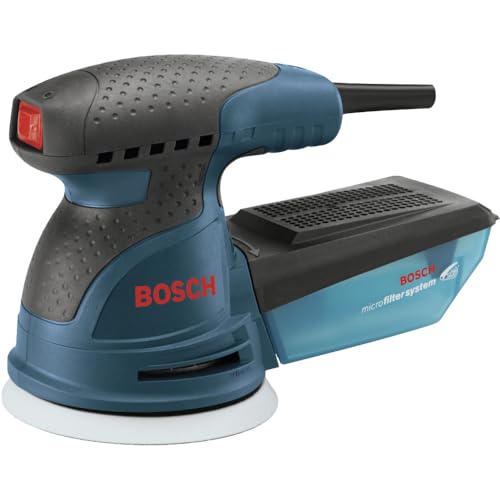
Bosch ROS20VSC Random Orbital Sander
What We Like
- Pad dampening system minimizes swirl marks
- Excellent microfilter dust collection system
- Variable speed control for different tasks
- Compact, 3.5-pound design reduces fatigue
Trade-offs
- Corded design limits mobility compared to cordless models
- 3.5 pounds is heavier than some compact sanders like the Mirka models
Its pad dampening system, designed to minimize swirl marks, is the primary feature for cabinet refinishing. This system, combined with variable speed control from 7,500 to 12,000 OPM, provides the control needed for a smooth finish on flat and contoured surfaces. The Bosch ROS20VSC balances a 2.5 amp motor with precision features, making it a practical tool for serious DIY or professional projects.
The sander is corded and weighs 3.5 pounds. This weight is less than the 4.0-pound DeWalt DWE6421K but more than lighter tools like the 2.1-pound Mirka models. For stationary shop work near an outlet, the cord is a trade-off for not managing batteries.
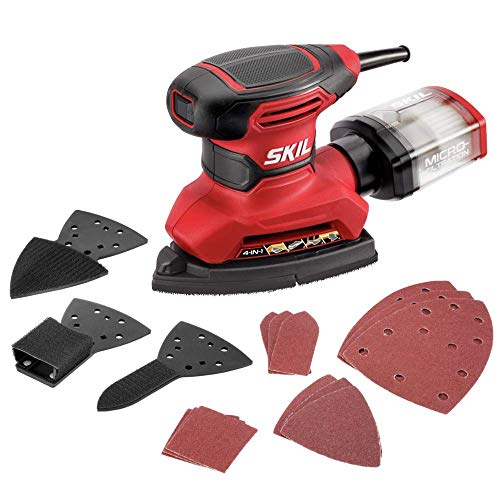
SKIL Multi-Function Detail Sander
What We Like
- Includes three detail attachments for varied surfaces
- Micro-filtration system and dust port for dust control
- Low-vibration design with soft rubber grip
- Tool-free attachment changes
Trade-offs
- Corded design limits mobility compared to battery models
- Smaller sanding pad than 5-inch orbital sanders
This detail sander orbits at 13,500 times per minute, providing the speed needed for a variety of finishing tasks. It includes three additional attachments for fine finishing large surfaces, corners, edges, and any surface contour, letting you adapt to different shapes without needing tools to switch them. Weighing 2.6 pounds with a counterweight balance and soft rubber grip, it reduces hand fatigue from vibration during detailed work.
The tool’s focus is on detail work rather than covering broad areas quickly. For sanding large, flat surfaces like a cabinet door, a full-size orbital sander such as the DEWALT DWE6421K would be more efficient. This Skil model excels as a specialist for final prep and touch-ups after a larger sander handles the bulk material removal.
Product photos
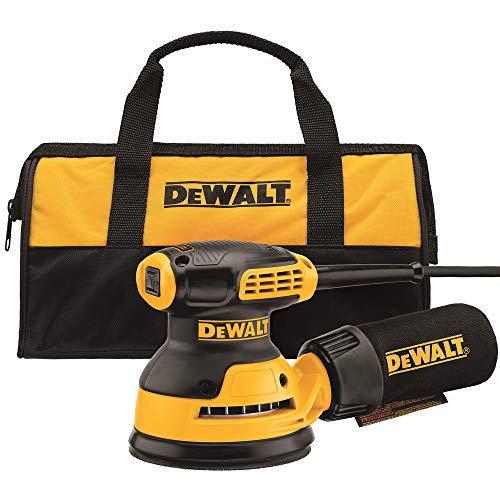
DEWALT DWE6421K Orbital Sander Kit
What We Like
- Separate counterweight design reduces vibration.
- Rubber over-mold in critical areas improves grip.
- Shorter height allows closer access to workpieces.
- One-handed locking dust bag for easier collection.
Trade-offs
- Weighs 4.0 lbs, heavier than some 5-inch palm sanders.
- Requires an adapter for most shop vacuum hoses.
- Corded design limits mobility compared to battery models.
The DEWALT DWE6421K’s separate counterweight design reduces vibration for improved comfort, which matters during extended sanding sessions. Its 3.0 amp motor spins the pad at 12,000 OPM, and a shorter height allows the user to get closer to the work piece. Rubber over-mold in critical areas and a dust-sealed switch are included for longer tool life.
This sander weighs four pounds, and its improved dust collection uses a one-handed locking bag. The dust port fits directly to specific DEWALT dust collectors; for other vacuum systems with 1-1/4 inch hoses, a universal quick connector is required. Its profile is shorter than some models like the Makita BO5030K, but larger than compact sanders such as the Mirka DEOS II.
Makita BO5030K Random Orbit Sander

What We Like
- Rubberized grip for comfort and control
- Efficient through-the-pad dust collection
- Pad control system for smooth start-up
- Comes with a protective plastic case
Trade-offs
- Fixed speed offers less finesse than variable-speed models
The Makita BO5030K arrives ready for work with its own plastic case, a major plus for keeping your sanding kit organized and protected between projects. Its 3.0 AMP motor and large 1/8-inch orbit action deliver the smooth, fast material removal needed for cabinet face frames and flat panels. That rubberized grip and the pad control system make it easier to manage over long sessions, while the through-the-pad dust collection helps keep your workspace cleaner. This is a straightforward, well-built sander for the craftsman who values having a dedicated, secure spot for every tool.
You trade some compactness for that included case and sturdy build. Its fixed 12,000 OPM speed is effective for stock removal and final smoothing, but it doesn’t offer the fine-tuning you’d get from a variable-speed model like the Bosch ROS20VSC for delicate veneer work. The sander’s length can be an advantage for leverage on large surfaces, but it makes it less nimble than a true palm sander for intricate corners or detailed trim. Consider it a reliable workhorse for the bulk of a cabinet refinishing job, not a detail specialist.
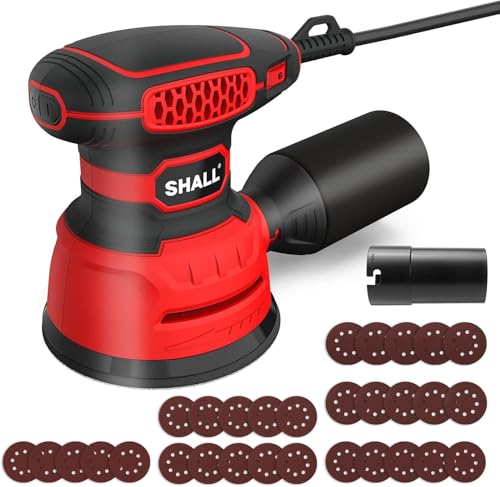
SHALL 5-Inch Random Orbital Sander
What We Like
- Comes with a comprehensive 30-piece sandpaper kit
- Lightweight build reduces user fatigue
- Six-speed dial for precise material control
- Velcro closure simplifies sandpaper changes
Trade-offs
- Attached dust bag is less effective than a vacuum hookup
Coming with 30 sanding sheets across six grits means you can start a full refinishing project right away. This SHALL model is a solid starter kit for the DIYer who values convenience. Its lightweight build and variable speed control make it easy to handle for extended sessions, letting you move smoothly from coarse stripping to fine finishing. The built-in dust collection helps, though you’ll be emptying the bag frequently on a big job.
The trade-off for that ready-to-run value is in raw power. At 3.2 amps, this sander’s motor is more powerful than some 3 amp models. That’s fine for veneer work and paint removal, but it may still bog down more quickly on heavy stock removal or dense hardwood. For a homeowner refurbishing a set of kitchen cabinets, however, the included paper and easy operation often outweigh the need for maximum torque.
Product photos
DEWALT 20V MAX Cordless Orbital Sander
What We Like
- Industry-leading low vibration design
- Variable speed control with five settings
- Integrated wireless vacuum activation
Trade-offs
- Tool only: requires separate DeWalt 20V battery and charger
- Dust extractor and Tool Connect chip are sold separately
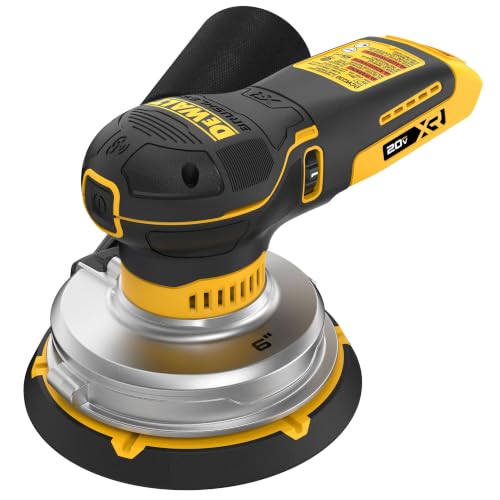
The DeWalt DCW230B sander delivers industry-leading performance with the fastest material removal and lowest vibration versus leading competitors, which means you can sand large surfaces without excessive hand fatigue. Its cordless design allows you to sand up to 200 square feet on a single charge, providing up to 41 minutes of runtime for working away from an outlet. This combination makes it a strong choice for extended tasks in spaces without ready power access.
The trade-off for that mobility is weight and dependency. At nearly five pounds, it demands more arm stamina over a long session compared to a lighter corded model like the Bosch ROS20VSC. You’re also buying into a system; if you don’t already own DeWalt 20V batteries, the initial cost climbs. For a dedicated shop where an outlet is always within reach, a corded sander often makes more sense.
Product photos
Mirka DEOS II Rectangular Sheet Sander
What We Like
- Compact, 2.1-pound design for tight spaces.
- Ergonomic, slim profile for precise edge work.
- Vacuum-ready for cleaner cabinet refinishing.
- Bluetooth connectivity for workflow monitoring.
Trade-offs
- Small 3×5 inch pad covers area slowly.
- Requires separate vacuum for optimal dust control.
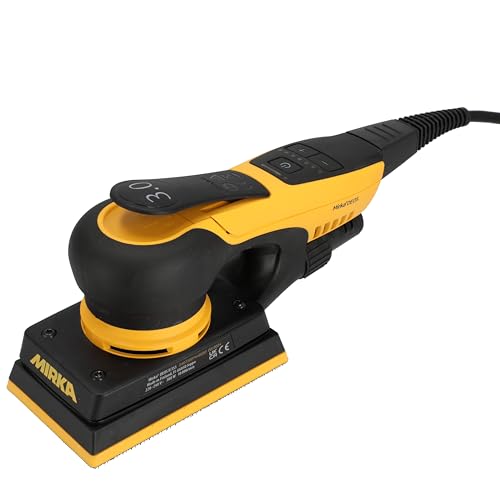
At just 5 inches long and 2.1 pounds, this sander fits into corners and along cabinet edges where bulkier tools simply can’t go. That compact size makes it a specialist for detailed sanding on flat cabinet faces, intricate trim, and doors. Its rectangular pad shape is ideal for working right up to edges without over-sanding the adjacent surface. For anyone refinishing a kitchen full of built-in cabinets with lots of tight spots, this tool’s maneuverability is its primary advantage.
With a pad measuring 3 by 5 inches, the Mirka DEOS II is built for detail work rather than speed on large surfaces. Its rectangular shape and compact footprint allow it to maneuver around trim and windows, but it covers less area per pass than a typical 5-inch round sander like the Bosch ROS20VSC. For flattening a broad cabinet door, this means you should expect to use more passes or pair it with a larger tool.
Product photos
Mirka DEOS Delta II Triangular Sander
What We Like
- Delta shape excels in corners and profiles.
- Ultra-compact, low-profile design for maneuverability.
- Ergonomic with low vibration for reduced fatigue.
- Brushless motor and Bluetooth for modern control.
Trade-offs
- Sanding pad is only 4 x 6 inches.
- Corded design limits mobility compared to cordless tools.
- Specialized shape is less suited for large, flat surfaces.
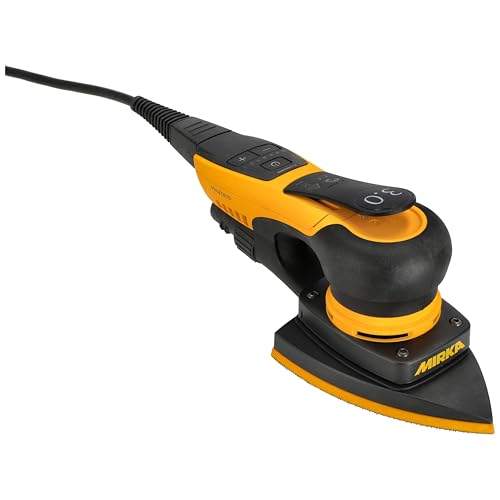
The triangular delta shape is the single most decisive feature here, letting you get right into the inside corners of cabinet face frames and sand detailed molding profiles without rounding over the crisp edges. This sander is for the woodworker or refinisher who needs surgical precision on intricate work, not brute force on big panels. Its compact, 3.9-inch-tall body and 2.1-pound weight make it easy to control at any angle, especially on vertical cabinet doors, while the brushless motor maintains consistent speed even when you’re pressing into a tight corner.
The trade-off is obvious: you buy this for its specialized nose, not for speed on large areas. That 4-by-6-inch pad is for finesse, not for flattening a tabletop. For a full kitchen cabinet project, you’d likely pair this with a larger rectangular orbital sander, like the Mirka DEOS II Rectangular model, to handle the broad, flat panels efficiently. This tool is a specialist, and in its niche, sanding detailed profiles and hard-to-reach spots, its design is exceptionally focused.
Product photos
SKIL 5-Inch Random Orbital Sander
What We Like
- Compact, ergonomic design for tight spaces
- Cyclonic dust collector with easy-empty container
- Variable speed control for different materials
- Low-vibration, rubber-grip design reduces fatigue
Trade-offs
- Smaller dust box may need frequent emptying on large jobs
- Tool-only; lacks a storage case included with some kits
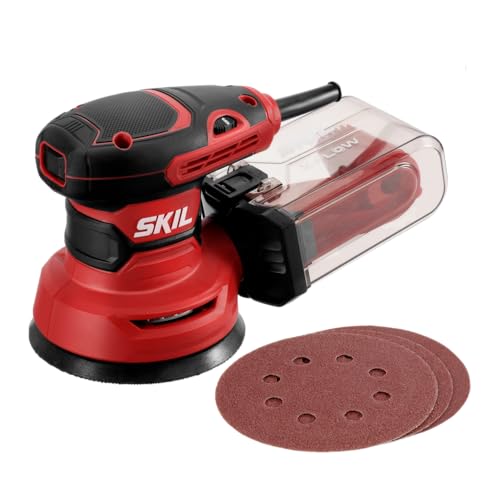
As a ‘Best Budget Pick’ in expert round-ups, the SKIL 5-Inch Random Orbital Sander offers capable performance without a pro-grade price. Its 2.8 amp motor spins the pad at 13,000 orbits per minute, providing enough power to strip old finishes and smooth primer. A variable speed dial lets you match the tool’s aggression to different materials, while a soft rubber grip and balanced counterweight aim to reduce hand fatigue during longer sessions. For a DIYer tackling a kitchen refresh, this sander delivers the core features needed for most cabinet and furniture projects.
The tool’s compact, ergonomic design helps it reach into tighter spaces than some bulkier models, maximizing user control on contoured surfaces. While the cyclonic dust collector with its transparent, easy-to-empty container keeps the immediate work area cleaner than a basic bag, the sander does not come bundled with a storage case. For sanding intricate corners and detailed moldings, a dedicated detail sander would still be required, but for the broad, flat surfaces that make up most cabinet work, this SKIL model hits a practical sweet spot.
Bosch GEX18V-5N Cordless Sander

What We Like
- Brushless motor for longer tool life
- Lightweight at just 2.4 pounds
- Ideal for fine finishing and surface prep
- Part of the versatile Bosch 18V platform
Trade-offs
- Bare tool: requires separate battery and charger purchase
- Uses 5-inch sanding discs, sold separately
A brushless motor and a weight of 2.4 pounds make this cordless sander a serious contender for cabinet work. The brushless design isn’t just about marketing, it means the motor will last longer and deliver power efficiently, which translates to consistent performance through a long sanding session. That light weight, combined with its compact size, is a major advantage when you’re working overhead on cabinet frames or holding the tool at odd angles for hours. This sander is built for the pro or serious DIYer who already uses Bosch 18V tools and needs cordless convenience without sacrificing durability.
This is a bare tool, so it requires a separate Bosch 18V battery and charger. Compared to many corded sanders, its compact size and lighter weight offer more freedom of movement away from outlets. The Bosch ROS20VSC is a corded alternative, but it weighs more at 3.5 pounds.
How We Evaluated Sanders For Kitchen Cabinets
Our evaluation is research-based, drawing from manufacturer specifications, expert tool round-ups, and consistent patterns in owner feedback for cabinet refinishing projects. We prioritized criteria crucial for this application: a tool’s ability to deliver a swirl-free finish, the effectiveness of its dust collection system, and its overall ergonomics for extended use on doors and frames.
AĠkeyĠpartĠofĠourĠsearchĠforĠtheĠbestĠsandersĠwasĠidentifyingĠwhichĠmodelsĠtrulyĠminimizeĠfatigueĠoverĠaĠmulti-dayĠcabinetĠproject. The main limitation of a research-led approach is we can’t replicate the exact feel of vibration or balance in hand, so we heavily weighted documented design features like counterweight systems and rubberized grips.
What To Look For In Sanders For Kitchen Cabinets
Choosing the right sander transforms a dusty chore into an efficient project. The goal is a perfectly prepped surface for paint or stain without arm fatigue or swirl marks.
Focus on a sander that offers a swirl-free finish, effective dust collection, and a comfortable grip for long sessions. Variable speed control adds finesse for different grits and wood types.
Finish Quality
For a professional-looking cabinet refinish, avoiding circular “swirl” marks is paramount. Random orbital sanders are favored because their dual-motion pattern scatters scratches, but the quality of the pad dampening system matters greatly. Models like our best overall pick use a specialized pad to further minimize these marks, which is critical when working with visible finishes. For final smoothing between coats, a sander that performs well with fine-grit papers (180-220 and higher) is essential.
Dust Management
SandingĠcabinetsĠcreatesĠaĠtremendousĠamountĠofĠfineĠdustĠthatĠcanĠruinĠyourĠfinishĠandĠyourĠlungs. An integrated dust collection system is non-negotiable. Look for sanders with a micro-filter bag or, better yet, a port that connects directly to a shop vacuum. Effective collection keeps your workspace cleaner, improves visibility, and ensures dust doesn’t settle into the fresh primer or paint. OurĠresearchĠintoĠtheĠbestĠorbitalĠsandersĠconsistentlyĠhighlightsĠdustĠextractionĠasĠaĠtopĠconcernĠforĠwoodworking.
Ergonomics & Control
Cabinet projects involve hours of sanding flat panels, edges, and corners. A tool’s weight, balance, and grip directly impact fatigue. Lighter models (under 3 pounds) are easier to maneuver overhead or on vertical surfaces, but some weight can aid in consistent pressure. Features like a low-vibration design, a soft rubber over-mold grip, and a compact body for tight spaces make the process more comfortable. For detailed work on molding, a dedicated detail sander or a compact orbital model offers the precision you need.
- Test the tool’s balance in store if possible, ensuring it feels secure in your hand.
- Check that the power cord or battery pack doesn’t create an awkward counterweight.
- Prefer models with tool-free sandpaper changes to maintain workflow.
- Ensure speed controls or power switches are within easy reach of your grip.
- Consider a cordless model if you plan to work away from outlets or want to minimize trip hazards.
Your sander should feel like an extension of your hand, not a burden, after the first hour of use.
Sanders For Kitchen Cabinets Compared
The table below compares key specifications across our top picks to help you see the differences in power, weight, and design at a glance.
| Product | Weight | Motor | Dust Collection |
|---|---|---|---|
| Bosch ROS20VSC Random Orbital Sander | 3.5 pounds | 2.5 AMP | Traps 1/2-micron particles |
| SKIL Multi-Function Detail Sander | 2.6 Pounds | N/A | Micro-filtration system |
| DEWALT DWE6421K Orbital Sander Kit | 4.0 pounds | 3.0 amp | Improved dust collection |
| Makita BO5030K Random Orbit Sander | 2.9 pounds | 3.0 AMP | Through-the-pad dust collection |
| SHALL 5-Inch Random Orbital Sander | Approx. 1.3 kg | 3.2 amp / 350W | Removable Dust bag |
| DEWALT 20V MAX Cordless Orbital Sander | 4.8 pounds | N/A | Up to 95% |
| Mirka DEOS II Rectangular Sheet Sander | 2.1 pounds | N/A | Central vacuum-ready |
| Mirka DEOS Delta II Triangular Sander | 2.1 pounds | Brushless | N/A |
| SKIL 5-Inch Random Orbital Sander | 3.4 pounds | 2.8 amp | Cyclonic dust box |
| Bosch GEX18V-5N Cordless Sander | 2.4 pounds | Brushless | N/A |
Frequently Asked Questions
What is the best sander to use on kitchen cabinets?
For most cabinet projects, a 5-inch random orbital sander is the best choice for large, flat surfaces like door panels because it provides a fast, swirl-free finish. For corners, detailed molding, and tight spaces, a dedicated detail sander is necessary. Many refinishers use both tools to handle all parts of a cabinet set efficiently.
What kind of sandpaper should I use to sand my kitchen cabinets?
Start with a medium grit (100-150) to remove old finish and smooth imperfections, then progress to a fine grit (180-220) for final surface preparation before applying primer or stain. If stripping thick paint, begin with a coarse grit (80-100). Always finish with a fine grit to ensure proper paint adhesion and a smooth top coat.
What is the easiest way to sand cabinets?
The easiest method is to remove all doors, drawers, and hardware first. Use a random orbital sander for the flat surfaces of the doors and drawer fronts, and a detail sander for the cabinet frames, corners, and any intricate profiles. Work in a well-ventilated area, connect your sander to a vacuum for dust control, and sand with the grain when possible.
Which brand of sander is considered the best?
There is no single “best” brand, as different manufacturers excel in different areas. Bosch and DeWalt are highly regarded for their professional-grade orbital sanders with excellent dust collection and low-vibration engineering. For detail sanders and value-oriented kits, SKIL and Makita offer strong performance. The best brand for you often depends on your existing tool ecosystem, especially for cordless models.
Do I need a cordless sander for cabinets?
A cordless sander is not a necessity, but it offers significant advantages in mobility and workspace cleanliness by eliminating a power cord. It’s ideal for working on doors outside or in a garage away from outlets. However, for prolonged sanding sessions, a corded model provides unlimited runtime and often more consistent power, which can be beneficial for larger projects.
The Bottom Line
For the DIYer or pro tackling a full set of kitchen cabinets, the Bosch ROS20VSC is the best overall choice. Its combination of a swirl-minimizing pad and superior dust collection delivers a finish-ready surface with less mess. If your budget is tight or you need a complete kit to start, consider the SHALL 5-Inch Random Orbital Sander with its included sandpaper.
For those focused solely on intricate corners and molding, the SKIL Multi-Function Detail Sander is the dedicated tool for the job. Ultimately, pairing effective dust management with a comfortable, controllable tool will make your cabinet refinishing project far more successful and less taxing.
