
10 Best Saw Blades To Cut Aluminum in 2026
This post contains affiliate links. As an Amazon Associate, we earn from qualifying purchases.
The best saw blade for cutting aluminum is the Oshlun SBNF-120120 TCG Saw Blade for its 120-tooth design that delivers a professional-grade finish. For a premium choice on thin stock, consider the Freud LU90M010 Non-Ferrous Metal Blade. The Diablo Thick Aluminum Saw Blade is a good option for a circular saw.
Cutting aluminum requires a specialized blade to prevent clogging, dangerous kickback, and a ruined workpiece. A standard wood blade will fail. This guide is based on research into specifications, manufacturer data, and patterns in owner feedback. We’ll help you match a blade to your saw and material thickness.
Top 10 Saw Blades For Cutting Aluminum in the Market
Certain content that appears on this site comes from Amazon. This content is provided "as is" and is subject to change or removal at any time.
The Best Saw Blades For Cutting Aluminum, Reviewed
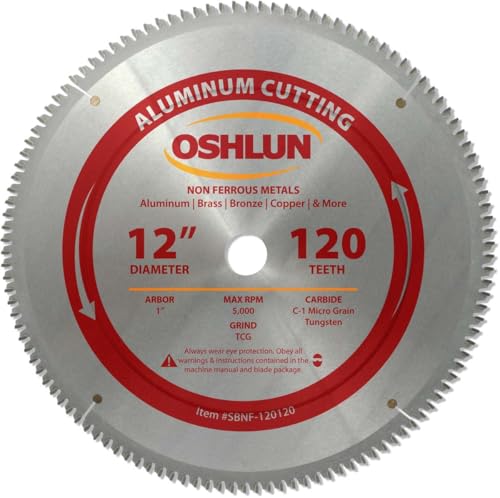
Oshlun SBNF-120120 TCG Saw Blade
What We Like
- 120-tooth TCG design for fine cuts in aluminum
- Negative hook angle for safe, controlled feeding
- Professional grade C-1 carbide for durability
Trade-offs
- At 3.0 pounds, it is heavier than most 10-inch blades
- Requires a saw with a 1-inch arbor, not the common 5/8-inch
- 12-inch diameter limits use to larger stationary saws
This 12-inch blade with 120 triple-chip grind teeth is designed for cutting aluminum and non-ferrous metals. Its negative hook angle is a feature common on blades for these materials. This combination of size and tooth geometry is intended for use on a cabinet or sliding miter saw where finish quality is a priority.
The trade-off is its heft and specialized arbor. At three pounds, it demands a powerful, stable saw to spin it smoothly, and that 1-inch arbor won’t fit every machine. For jobs on a standard 10-inch miter saw, the Freud LU90M010 offers a similar TCG design in a more common size. But when your saw can handle it, the Oshlun’s capacity and cut quality are in a class of their own.
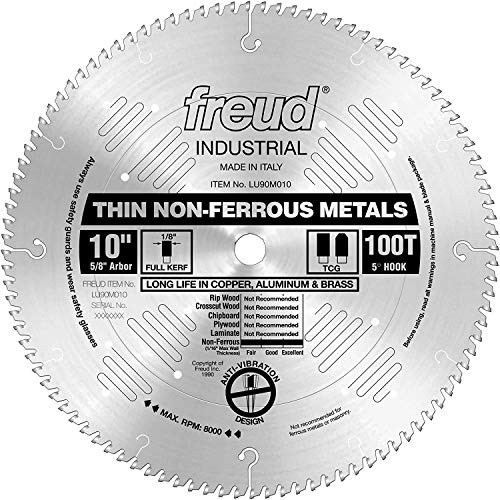
Freud LU90M010 Non-Ferrous Metal Blade
What We Like
- Negative hook angle for burr-free cuts
- TiCo carbide for long tooth life
- Silver I.C.E. coating resists corrosion
- Fits miter, table, and radial arm saws
Trade-offs
- Specifically for thin stock up to 1/16 inch
- 100-tooth design is for fine cuts, not speed
A -5-degree hook angle pulls the blade away from the work, minimizing grab and material distortion in soft metals like aluminum and brass for burr-free cuts. This Freud blade is designed for thin non-ferrous metals with a wall thickness up to 1/16″, delivering a clean finish that often requires no further sanding. Its TiCo Hi-Density Carbide and Silver I.C.E. coating are formulated for durability in these materials.
That specialization is its main trade-off. It’s designed for sheet and thin-wall material, so it’s not the blade for chopping thick aluminum extrusions. For that kind of heavy-duty work, you’d look to a blade like the Diablo Thick Aluminum Saw Blade. But for fine trim, detailed fabrication, or any task where a ragged edge ruins the piece, this Freud’s controlled aggression is exactly what you need in a premium blade.
Product photos
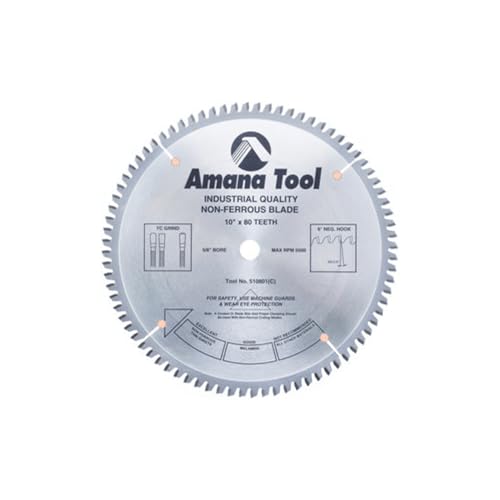
Amana Tool Carbide Tipped Aluminum Blade
What We Like
- Negative 6-degree hook angle for clean cuts.
- 80-tooth TCG grind for smooth aluminum finish.
- Carbide-tipped teeth for durable cutting edge.
- 10-inch size fits common miter and table saws.
Trade-offs
- The 80-tooth count is lower than some ultra-fine blades.
A -6° hook angle pulls the blade away from the material to reduce grabbing and kickback. That controlled feed, paired with 80 TCG teeth, supports precise miter and bevel cuts in materials like aluminum and brass. This combination prioritizes safety and a clean finish during detailed cutting work.
The blade’s design emphasizes control over aggressive feed. Compared to a more aggressive 56-tooth blade, its 80-tooth configuration and negative hook are geared for a different cutting action. Review data suggests it is engineered for applications where a smooth, controlled cut is the primary goal.
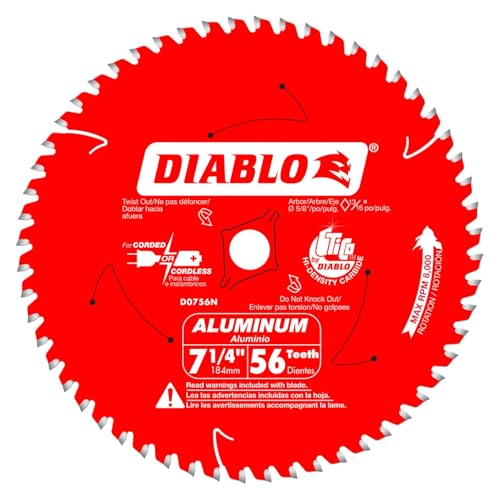
Diablo Thick Aluminum Saw Blade
What We Like
- Tri-Metal brazing for superior impact resistance.
- Laser-cut stabilizer vents reduce noise and vibration.
- Non-stick coating protects against heat and corrosion.
- TCG geometry delivers clean, burr-free cuts.
Trade-offs
- 7-1/4" diameter limits cut depth vs. 10" or 12" blades.
- Designed for thick aluminum, not optimized for very thin stock.
A 7-1/4-inch diameter suits standard circular saws, fitting the tool many already own for on-site work. Its TiCo carbide and Tri-Metal brazing are engineered for extreme cutting longevity and impact resistance, which means it can handle the harsh, grabby nature of thick aluminum without quickly dulling. The Perma-SHIELD Non-Stick Coating offers protection against heat and gumming, preventing aluminum from welding to the blade to maintain consistent performance. This blade is designed for projects like flooring, remodeling, and demolition where materials such as aluminum, copper, and plastics need cutting.
You trade some cut capacity and a hyper-fine finish for extreme portability and durability in a common size. The laser-cut vents are a subtle but critical feature, damping vibration so the lightweight circular saw doesn’t chatter its way off your line. For thicker plate or larger structural pieces, the Oshlun SBNF-120120 with its 12-inch diameter will give you a deeper cut in a single pass, but you’ll need a stationary saw to run it. This Diablo blade turns your handheld circular saw into a surprisingly capable metal cutter, letting you tackle a fabrication job right where the material lies.
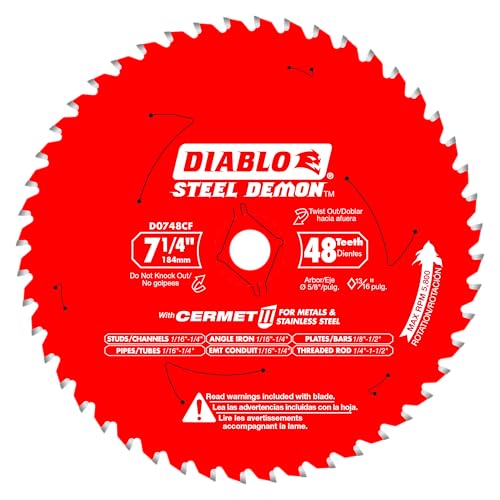
Diablo Steel Demon Cermet II Blade
What We Like
- Cermet II teeth provide superior wear resistance
- Triple Chip Cutting minimizes sparks for safety
- Laser Cut Stabilizer Vents reduce noise and vibration
- Optimized design minimizes metal wandering for accuracy
Trade-offs
- 7-1/4 inch diameter limits depth of cut versus 10 or 12-inch blades
- 48-tooth count may not produce the finest finish on very thin aluminum
- Blade is designed for circular saws, not large stationary miter saws
Up to 50X cooler cuts versus a grinding disc mean this blade helps prevent the permanent discoloration that excessive heat causes in steel. Its Cermet II teeth and Laser Cut Stabilizer Vents manage thermal buildup, allowing for repeated cuts without warping the material. That feature, combined with a design that minimizes sparks, addresses key concerns for metal cutting where temperature control and safety are priorities.
The trade-off for that cool, fast performance is the blade’s 7-1/4 inch size. It’s ideal for sheet stock and standard extrusions, but you won’t be slicing through thick aluminum billet. For deeper cuts on a stationary saw, you’d look to a larger diameter option like the Oshlun SBNF-120120. This Diablo blade excels in its intended role: turning a standard circular saw into a highly efficient, cooler-cutting machine for aluminum, dramatically outlasting and outperforming abrasive discs in the process.
Product photos
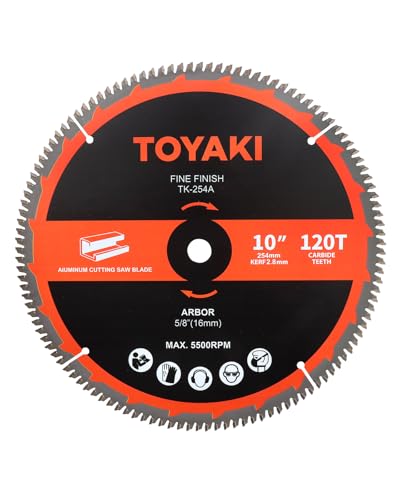
TOYAKI Ultra-Fine Finish Saw Blade
What We Like
- High 120-tooth count for fine finish
- Standard 5/8-inch arbor for wide compatibility
- Constructed with high-grade carbide for durability
- Balanced design for accurate, stable cutting
Trade-offs
- 10-inch diameter limits cut depth versus 12-inch blades
- Fine 120-tooth grind may cut slower in thick stock
A 120-tooth TCG grind is designed for an ultra-fine finish on non-ferrous metals, which suits projects where a clean cut straight from the saw is the primary goal. This fine finish working capability is noted for maintaining consistent cutting quality. It’s a logical choice for detailed shop projects or fabrication where the appearance of the cut edge is critical.
The 10-inch diameter is a common size, providing a standard cutting capacity. It cannot match the cut depth of a larger 12-inch blade like the Oshlun SBNF-120120 on thicker stock. This TOYAKI blade excels in its specific niche, prioritizing a smooth final surface above all else.
Product photos
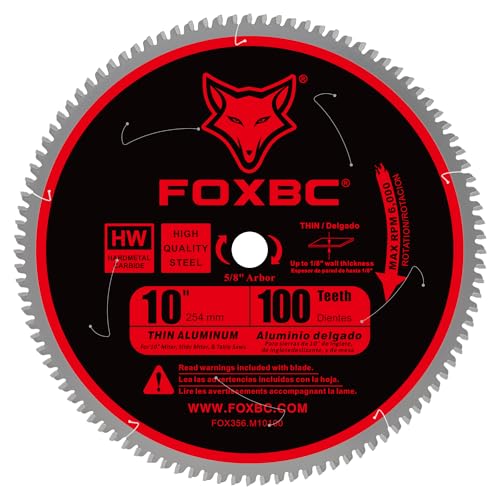
FOXBC 100-Tooth Aluminum Saw Blade
What We Like
- Explicitly rated for thin, medium, and thick aluminum
- Laser-cut stabilizer vents reduce vibration
- High-density tungsten carbide for long life
- Triple Chip Grind geometry for clean, burr-free cuts
Trade-offs
- Weighs 1.8 pounds, heavier than some 10-inch competitors
- 5/8-inch arbor not compatible with all 10-inch saws
- Designed for non-ferrous metals only, not steel or wood
This blade’s explicit rating for thin, medium, and thick aluminum makes it a uniquely versatile single-blade solution. The 100-tooth TCG geometry is the key, providing enough teeth for a fine finish on sheet metal while the tooth design and carbide have the strength to power through thicker extrusions. It’s the right pick when your shop needs to handle everything from flashing to structural channel without swapping blades. The laser-cut stabilizer vents are a thoughtful touch, trapping noise and vibration so you can focus on a straight line.
You do pay for that versatility in heft. At 1.8 pounds, it’s a solid chunk of steel, which demands a well-tuned saw with a strong motor to spin it smoothly without bogging down. For a dedicated shop cutting only thick aluminum bar stock, a more aggressive 56-tooth blade might be faster. But for the majority of fabricators and installers facing mixed material thicknesses, the FOXBC blade covers the entire range capably from a single arbor.
Product photos
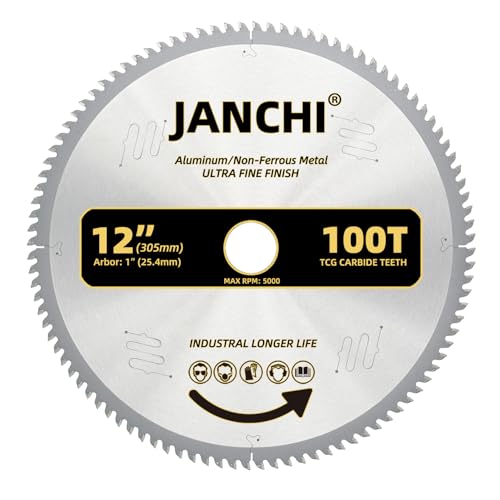
Janchi Ultra Fine Finish Saw Blade
What We Like
- Upgraded TCG grind for smooth cuts.
- Laser-cut slots reduce vibration and heat.
- Tungsten carbide teeth for durability.
- Heavy 3.1-pound construction for stability.
Trade-offs
- Heavier than the 3.0-pound Oshlun blade.
- Requires a 12-inch saw, not a compact tool.
The 100-tooth, upgraded TCG grind is the key here, engineered specifically for an ultra-fine finish on thin aluminum and plastic. This blade is built for the user who values a clean, burr-minimized cut right off the saw, aiming to reduce secondary finishing work. Its heavy-duty C-4 tungsten carbide teeth and substantial 3.1-pound frame suggest it’s made for consistent, demanding use in a workshop setting, where its laser-cut stabilizer vents will help manage noise and keep the cut true.
That solid construction comes with a trade-off in heft, making it a blade for a stationary miter or table saw, not a handheld circular. Compared to the Oshlun SBNF-120120, which is a direct competitor in size and purpose, the Janchi is slightly heavier, which can aid in dampening vibration but also indicates a different balance in its build. For projects involving delicate, thin non-ferrous materials where finish quality is paramount, this blade’s specifications are purpose-driven.
TOMAX 7-1/4-Inch Aluminum Saw Blade

What We Like
- Electrophoretic coating fights rust and corrosion
- Construction-grade carbide teeth for longer life
- Standard 5/8-inch arbor fits many common circular saws
- Backed by a limited lifetime warranty
Trade-offs
- Smaller 7-1/4-inch diameter limits cut depth on thick stock
The Electrophoretic Coating on this TOMAX blade is its standout feature, providing a serious defense against the oxidation that plagues metal-cutting blades. This makes it a smart, durable choice for anyone working in a humid garage or coastal environment where rust is a constant battle. The 60-tooth TCG grind and construction-grade carbide are built for the abrasiveness of materials like aluminum and brass, promising a solid service life for general fabrication and cutting tasks on a standard 7-1/4-inch circular saw.
That 7-1/4-inch size is both its main appeal and its primary limitation. It’s the perfect match for a handheld circular saw, offering excellent maneuverability for sheet goods and trim. For deeper cuts or a finer finish on delicate material, however, you’ll hit its limits. A blade like the TOYAKI Ultra-Fine Finish Saw Blade, with its 120 teeth on a 10-inch plate, is engineered specifically for that smoother, cleaner cut on a miter or table saw. The TOMAX is the workhorse for the job site or shop where corrosion resistance and durability in common sizes are the priority.
Product photos
Benchmark Abrasives TCT Circular Saw Blade

What We Like
- Engineered for cutting multiple non-ferrous and non-metal materials
- 60-tooth geometry for clean, square cuts in sheet panels and trim
- Wide compatibility with major brand low-RPM dry cut saws
- Exceeds ANSI and EU manufacturing standards
Trade-offs
- 6.5-inch diameter limits depth of cut versus larger blades
- Not designed for cutting ferrous metals like steel
A 6.5-inch diameter with 60 teeth makes this blade a versatile choice for the fabricator who needs to switch between materials like aluminum, PVC, and fiberglass without stopping to swap blades. It’s built for clean cuts in sheet goods and profiles, and its broad compatibility with common dry-cut saw platforms means it can slot right into an existing workshop setup. This is the blade you grab when the job calls for precision across a mix of non-metallic and soft metal stock.
This 6.5-inch blade is engineered for non-ferrous and non-metal materials like aluminum, brass, and PVC, so it’s a versatile choice for mixed-material fabrication. Its balanced tooth geometry and 60-tooth design support smooth engagement for clean cuts in sheet panels and trim work. The blade fits common 5-3/8-inch circular and miter saws from brands like DeWalt and Makita, making it a practical accessory for shop and jobsite use.
Product photos
How We Evaluated Saw Blades For Cutting Aluminum
Our evaluation began with a review of manufacturer specifications and technical documentation to understand each blade’s intended use, geometry, and material composition. We then analyzed expert round-ups and aggregated patterns in owner feedback to see how these blades perform in real workshops. The core criteria were tooth geometry and hook angle for safe, controlled cutting; carbide quality and construction for durability; and blade diameter and arbor size for compatibility with common saws.
Since this is a research-based guide, we cannot report on long-term wear or compare cut quality side-by-side in a controlled shop environment.
What To Look For In Saw Blades For Cutting Aluminum
Choosing the right blade transforms a difficult, hazardous job into a smooth operation. The wrong blade can overheat, clog with sticky aluminum chips, or grab the material violently.
Look for a negative hook angle and a Triple Chip Grind (TCG) tooth geometry to prevent grabbing and produce clean cuts. Carbide-tipped teeth are essential for durability. Finally, ensure the blade’s diameter and arbor hole fit your specific saw.
Tooth Geometry And Hook Angle
This is the most critical factor for safety and cut quality. Aluminum is soft and sticky, so a standard positive hook angle, common on wood blades, will aggressively pull the material, causing dangerous kickback. You need a blade with a negative or zero hook angle. This design pushes the workpiece down into the table for controlled feeding. The tooth shape should be a Triple Chip Grind (TCG), which alternates a raker tooth with a trapezoidal tooth to shear material cleanly and minimize burrs without clogging.
Blade Material And Construction
The teeth must be carbide-tipped. Carbide is vastly more wear-resistant than steel when cutting abrasive non-ferrous metals. Look for mentions of C-1 or other professional-grade carbide formulations. The blade body should be laser-cut with expansion slots or stabilizer vents to reduce vibration and heat warp, which is crucial for accuracy. Some blades feature a non-stick or corrosion-resistant coating, which is beneficial for longevity, especially in humid environments or when using cutting fluid.
Compatibility And Application
Blade diameter determines your maximum cutting depth. A 7-1/4-inch blade fits most circular saws but can’t handle thick plate, while a 12-inch blade needs a large stationary saw. The arbor hole size must match your saw’s shaft, common sizes are 5/8-inch and 1-inch. Don’t assume all 10-inch blades have a 5/8-inch arbor. Finally, match the tooth count to your desired finish and material thickness. A 48-tooth blade cuts faster in thick stock, while an 80 or 100-tooth blade yields a finer finish on sheet metal and extrusions.
.
- Confirm your saw’s arbor size before buying.
- Use cutting fluid or a lubricant like WD-40 to reduce heat and improve finish.
- Always wear safety glasses and secure your workpiece firmly.
- Ensure your saw’s RPM rating is compatible with the blade’s maximum speed.
- Start with a test cut on scrap material to dial in your feed rate.
The single most important rule: never use a standard wood-cutting blade on aluminum.
Saw Blades For Cutting Aluminum Compared
The table below compares the key specifications of all ten blades to help you see the differences at a glance.
| Product | Diameter | Tooth Count | Arbor Size |
|---|---|---|---|
| Oshlun SBNF-120120 TCG Saw Blade | 12 inches | 120 teeth | 1 inch |
| Freud LU90M010 Non-Ferrous Metal Blade | 10 inches | 100 teeth | 5/8 inches |
| Amana Tool Carbide Tipped Aluminum Blade | 10 inches | 80 | 5/8 inch |
| Diablo Thick Aluminum Saw Blade | 7-1/4" | 56 Teeth | N/A |
| Diablo Steel Demon Cermet II Blade | 7-1/4 inches | 48 TCG teeth | N/A |
| TOYAKI Ultra-Fine Finish Saw Blade | 10 inches | 120 teeth | 5/8 inch (16mm) |
| FOXBC 100-Tooth Aluminum Saw Blade | 10 inches | 100 teeth | 5/8 inches |
| Janchi Ultra Fine Finish Saw Blade | 12 inches | 100 teeth | 1 inch |
| TOMAX 7-1/4-Inch Aluminum Saw Blade | 7-1/4 inches | 60 TCG | 5/8-inch DMK |
| Benchmark Abrasives TCT Circular Saw Blade | 6.5 inches | 60 teeth | N/A |
Frequently Asked Questions
What type of saw blade is best for cutting aluminum?
A carbide-tipped blade with a negative hook angle and a Triple Chip Grind (TCG) tooth geometry is best. This combination prevents the blade from grabbing the soft, sticky aluminum, which reduces kickback risk and produces a cleaner, burr-free cut. TheseĠareĠspecializedĠbladesĠforĠcuttingĠaluminum,ĠnotĠgeneral-purposeĠwoodĠblades.
What is the best type of blade for cutting aluminum?
For stationary tools like miter or table saws, a 10-inch or 12-inch blade with 80 to 120 teeth provides excellent control and finish. ForĠportableĠmetalĠcutting,ĠaĠ7-1/4-inchĠcircularĠsawĠbladeĠwithĠaĠnon-stickĠcoatingĠisĠidealĠforĠon-siteĠwork. The blade type should match your saw and material thickness.
How many teeth on a saw blade to cut aluminum?
It depends on material thickness and desired finish. For faster cuts in thick aluminum bar or plate, a 48 to 60-tooth blade works well. For a smooth finish on thin sheet metal, extrusions, or trim, choose a blade with 80 to 120 teeth. Higher tooth counts produce finer finishes but cut more slowly.
Can you cut aluminum with a regular skill saw blade?
You should not. A standard wood-cutting blade has a positive hook angle that will aggressively grab the aluminum, likely causing a violent kickback. Its teeth are also not designed for metal and will dull instantly or clog with sticky aluminum chips, ruining the blade and the workpiece.
What other saws can I use to cut aluminum?
While circular, miter, and table saws are common, you can also use a reciprocating saw with the correct blade. ForĠthatĠjob,Ġyou’dĠneedĠspecializedĠreciprocatingĠsawĠbladesĠdesignedĠforĠnon-ferrousĠmetals. TheĠprinciplesĠofĠcontrolledĠfeedĠandĠproperĠbladeĠmaterialĠselectionĠstillĠapply.
The Bottom Line
For shop professionals and serious DIYers with a large-format saw, the Oshlun SBNF-120120 TCG Saw Blade is the best overall choice, delivering an exceptionally fine finish on aluminum extrusions and plate. If you’re on a budget or using a standard circular saw, look to the Diablo Thick Aluminum Saw Blade or the TOMAX 7-1/4-Inch Aluminum Saw Blade for reliable performance. No matter your pick, prioritize a blade with a negative hook angle, it’s the non-negotiable feature for safe, controlled cutting of aluminum.
