
8 Best Saws For Cutting Laminate Flooring in 2026
This post contains affiliate links. As an Amazon Associate, we earn from qualifying purchases.
For a versatile, dust-free tool that handles most modern flooring projects, our top choice is the Cutterex 13″ Laminate Vinyl Floor Cutter. For those working in occupied homes, the Marshalltown Ultra-Lite LVP Flooring Cutter is the best for dust-free operation, while the Roberts 10-63 13″ Flooring Cutter excels at clean guillotine cuts.
Choosing the wrong saw can lead to a messy workspace, chipped edges, and a frustrating install. The right tool makes clean, precise cuts quietly, turning a tedious job into a smooth process. Our research compares eight leading cutter models based on their specifications, manufacturer guidelines, and patterns in installer feedback to help you match a tool to your specific project and priorities.
Top 8 Saws For Cutting Laminate Flooring in the Market
Certain content that appears on this site comes from Amazon. This content is provided "as is" and is subject to change or removal at any time.
The Best Saws For Cutting Laminate Flooring, Reviewed
Cutterex 13" Laminate Vinyl Floor Cutter

What We Like
- Cuts a vast range of laminate and vinyl materials
- Integrated ruler and angle markings for precise work
- Dust-free, quiet operation ideal for indoor use
- Long-lasting HSS blade rated for over 20,000 cuts
Trade-offs
- Cannot cut porcelain tile or solid wood flooring
- Requires a specific two-step technique for clean cuts on some materials
- Stone-plastic composite floors may crack without proper cutting experience
The ability to cut a 13-inch wide plank in a single, dust-free step makes this cutter a standout for efficiency on major flooring jobs. It handles nearly every modern vinyl and laminate type you’ll encounter, from LVP to SPC, and its pre-set angles let you tackle transitions and corners without guesswork. For the serious DIYer or installer facing a large area, the clean operation and long blade life translate directly to a faster, less messy project from start to finish.
The manufacturer specifies it should not be used on porcelain tile or solid wood floors. To get a clean cut and avoid jagged edges, the guidance is to make the final cut in at least two steps. For materials containing stone powder, which can crack, this two-step method and additional cutting strength are recommended.
Product photos
Marshalltown Ultra-Lite LVP Flooring Cutter
What We Like
- Dust-free and quiet manual operation
- Lightweight for a portable, single-hand carry
- Precise repeatable angle cuts for joints
- Honing stone included for blade maintenance
Trade-offs
- 15.6 lb weight is heavier than some competitors like the Norske model
- 3/8 inch max cut for engineered wood limits some thick planks
- No integrated telescoping support plate for long planks
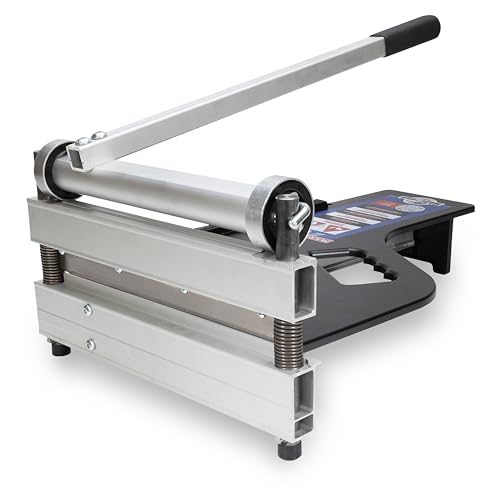
The Marshalltown cutter’s clean, quiet operation is its defining feature. It provides a true dust-free and electricity-free cutting experience, which is a major advantage for indoor renovations in occupied homes. The 13-inch width capacity handles most modern plank sizes, and the ability to lock in precise 45-degree cuts is a genuine time-saver for creating clean joints. This tool is built for the installer who prioritizes a clean jobsite and needs a reliable, portable shear for vinyl and standard laminate.
You do trade off some versatility for that clean operation. Its 3/8-inch limit on engineered wood means it won’t handle every thick product, and at over 15 pounds, it’s not the absolute lightest in the category. For strictly straight cuts on very long planks, a model like the Vevor with its telescoping support might be more ergonomic. But if your primary concern is avoiding the fine dust cloud of a power saw, this Marshalltown is a purpose-built solution.
Roberts 10-63 13" Flooring Cutter

What We Like
- Guillotine mechanism for clean, splinter-free cuts
- Long handle provides significant mechanical advantage
- Built-in miter gauge for precise angled cuts
- Cuts multiple flooring types including laminate and vinyl plank
Trade-offs
- Weighs 14.6 pounds, making it less portable for upstairs work
- Requires separate purchase of replacement blades (model 10-463)
- Large 30.4-inch length demands ample storage and workspace
With a guillotine-style cutter for material up to 13 inches wide and half an inch thick, this tool can snap through a full plank of laminate or vinyl in one controlled motion. The long handle design provides extra leverage, turning a tough cut into an easier press for consistent results. It is built for cutting vinyl plank, vinyl tile, laminate, and engineered wood flooring.
The trade-off is in its size and weight. At 30.4 inches long and 14.6 pounds, it’s a substantial tool designed for a stable work area. For a more compact option, the Marshalltown Ultra-Lite model is listed at 24.2 inches in length. On a stable project setup, however, the Roberts’ long handle and integrated table miter gauge become practical advantages.
Vevor 12" Laminate Flooring Cutter

What We Like
- Labor-saving aluminum-alloy lever for easier cuts
- Sharp, detachable D2 blade for clean, chip-reduced edges
- Versatile angle options for straight, miter, and corner cuts
- Telescoping support plate adds stability during operation
Trade-offs
- Requires manual blade sharpening with included honing stone
Its upgraded aluminum-alloy lever requires less force than traditional designs, so operators can make smoother cuts with less strain. By adjusting the bearing position, users find an ideal pivot point for easier cutting action. This Vevor cutter handles materials like laminate, LVP, and engineered wood up to 16mm thick, covering most common modern flooring.
That labor-saving design comes with a physical trade-off: at 30.2 pounds, this is a substantial piece of shop equipment. The 12-inch cutting capacity is one inch less than several 13-inch rivals, though it fits standard plank widths. For comparison, the Marshalltown model weighs 15.6 pounds.
Norske Tools 13" Laminate Flooring Cutter
What We Like
- Cuts a wide variety of tough materials cleanly
- Heavy duty fixed aluminum fence aids precision
- Built-in angled miter settings for complex cuts
- Sturdy construction reduces flex during cuts
Trade-offs
- Its 25-inch length demands more storage space than compact models
- Lacks the telescoping support plate found on the Vevor cutter
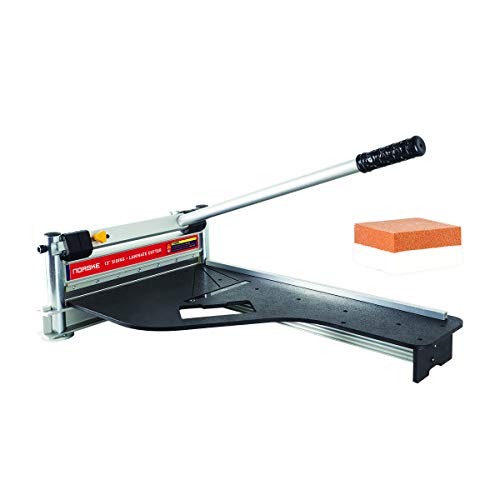
A 13-inch cutting capacity paired with the ability to handle fiber cement board and vinyl siding makes this cutter a standout for installers tackling mixed-material projects. It’s built from high-quality steel and aluminum to withstand the abrasion of engineered wood and cement siding without splintering. The heavy-duty fixed fence and built-in miter settings deliver the repeatable accuracy needed for clean finishes on everything from a laminate floor to a home’s exterior.
Weighing 13 pounds and measuring 25 inches long, the Norske cutter is built for stationary floor work rather than portable overhead tasks. Its steel and aluminum construction provides the heft needed for clean cuts in materials up to 19/32 inch thick, including fiber cement board. For projects where minimizing tool weight is the priority, the 15.6-pound Marshalltown Ultra-Lite model offers a lighter alternative.
Roberts PrecisionCuts Pro Multi-Floor Cutter
What We Like
- Built-in light for precision in low light
- Resharpenable tungsten blade for long life
- Guide bar for straight 90-degree cuts
- Ruler with two measurement systems
Trade-offs
- 9-inch capacity is narrower than many 13-inch cutters
- Battery for the work light is not included
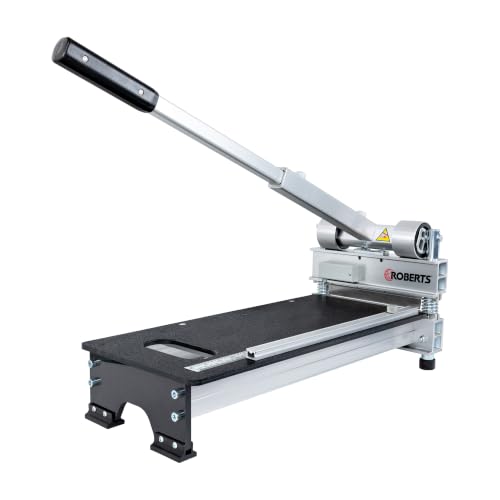
With a 9-inch cutting width and a movable guide bar for straight 90° cuts, the Roberts PrecisionCuts Pro provides a focused work area for precise cuts on materials like laminate, vinyl, and engineered wood. Its built-in ruler with both inch and millimeter scales eliminates measurement conversions during a job. The resharpenable tungsten blade is designed for long-term use across its listed materials.
The trade-off for that precision is a smaller cutting capacity compared to full-size models like the Roberts 10-63 13″ Flooring Cutter. You won’t be slicing through wider planks as efficiently. Consider this your specialist tool for finish work, and pair it with a larger cutter for the main field if you have a big, open floor to cover.
Product photos
Mantistol Pro Heavy Duty Laminate Floor Cutter
What We Like
- Extruded aluminum base for strength and stability
- Telescopic handle provides extra leverage for thick cuts
- Safety lockout cam to immobilize cutter when not in use
Trade-offs
- Manual operation demands proper technique to avoid blade damage
- Specific cutting procedure required to prevent blade breakage
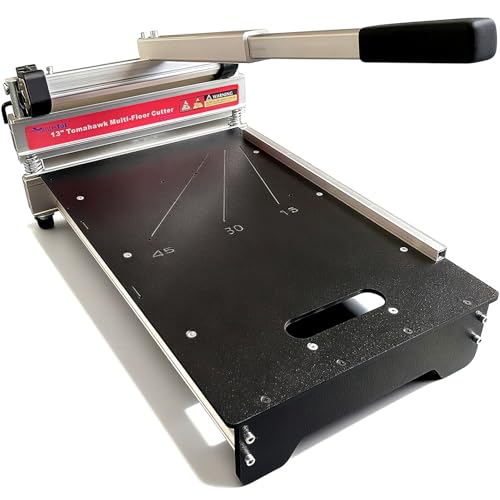
A 13-inch blade can make full-width cuts through material up to 17mm thick, which includes dense bamboo flooring. This capacity is paired with an extruded aluminum base and a solid plastic work surface, creating a stable platform for handling tougher materials. The tool’s marketing targets professional flooring installers, and its construction is described as aircraft-grade aluminum.
Proper technique is required, as the instructions warn that failing to press the flooring down before cutting can lead to a broken blade. Its 15.4-inch width offers a broad work area, though this makes it wider than the 15.2-inch Marshalltown Ultra-Lite model. For jobs involving a variety of thick, hard materials listed in its description, the cutter’s design accommodates that need.
Product photos
NAACOO 13" Heavy Laminate Cutter
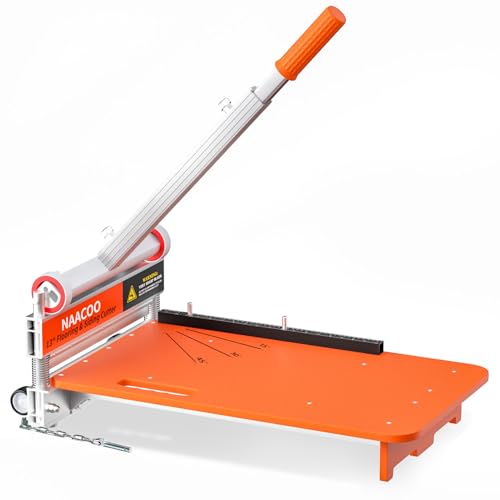
What We Like
- Rubber wheels for effortless movement
- Single-step angle and length alignment
- Integrated chain brake bar for safety
- Detachable, replaceable Wolfram steel blade
Trade-offs
- 13 mm thickness limit excludes some flooring
- Cannot cut porcelain tile per manufacturer
The NAACOO cutter’s standout feature is its set of rubber wheels, which completely changes the game on a job site. You can roll this tool from one end of the room to the other without straining your back, a simple but major advantage when you’re laying a whole floor. That mobility, paired with its one-step alignment system for setting both angle and length, makes it a logical choice for installers tackling large, open areas where speed and reducing physical fatigue are priorities. It’s built from sturdy aluminum alloy and HDPE, promising to hold up through repeated use without the noise or dust of a power saw.
Its 13 mm maximum cutting thickness covers most laminate and vinyl plank, though it falls short of competitors like the Mantistol Pro which cuts 17 mm material. The design includes a chain brake bar to lock the mechanism and a blade cover, features that prioritize safety during transport and storage. For the laminate, vinyl, and solid wood it’s designed for, the rolling wheels and single-step angle alignment define its practical utility.
Product photos
How We Evaluated Saws For Cutting Laminate Flooring
Our evaluation is based on a review of product specifications, manufacturer documentation, and flooring expert round-ups. We also considered consistent patterns in owner feedback, though we did not physically test these tools. The key criteria were cutting capacity, which determines the thickness and material types you can work with. We also focused on cut quality, looking at mechanisms that produce clean, chip-free edges, and usability factors like portability, integrated guides, and the physical effort required.
A research-based approach like this effectively compares published specs and common user experiences, but it cannot replicate the feel of a tool in your hands or predict its performance in every unique on-site condition.
What To Look For In Saws For Cutting Laminate Flooring
The right flooring cutter balances material compatibility, cutting action, and job-site practicality. Your project’s specific needs will determine which features are most important.
Look for a cutter that matches your flooring’s thickness and material, offers a clean cutting action to prevent chips, and fits your work area in terms of size, weight, and dust output.
Material & Thickness Capacity
First, verify the cutter’s maximum thickness rating, often listed in millimeters. A 13mm limit is common for standard vinyl plank and laminate, but thicker engineered hardwood or bamboo may require a heavy-duty model like the Mantistol Pro. Equally important is material compatibility.
Most dedicated cutters handle laminate, LVP, and vinyl flooring, but many cannot cut porcelain tile or solid wood. If you work with multiple materials, a versatile option like the Norske Tools cutter is worth considering. Check the manufacturer’s specifications to ensure your chosen tool can manage your specific flooring type.
Cutting Action & Quality
The cutting mechanism directly impacts edge quality and effort. A manual guillotine-style cutter, like the Roberts 10-63, uses a long handle for leverage to produce a clean, splinter-free snap. Other models use a lever system, like the labor-saving design on the Vevor cutter, to reduce the force needed.
For the cleanest cuts, look for features like a sharp, high-quality blade (often tungsten or HSS steel) and integrated guides. A built-in ruler, miter gauge, or fence, as seen on the Cutterex and Norske Tools models, aids in making precise repeatable cuts, which is crucial for tight joints and professional-looking results.
Portability & Workspace Fit
Consider where you’ll use the tool. For multi-story jobs or work in tight spaces, a lightweight, compact design is key. The 15.6-pound Marshalltown cutter is lighter than many, but still requires carrying.
For large, open areas, a cutter with wheels, like the NAACOO model, offers excellent mobility. Also, assess the tool’s footprint. A long cutter, such as the 30.4-inch Roberts model, needs ample stable workspace and storage.
A telescoping support plate, like on the Vevor, adds stability for long planks but increases the tool’s overall size. Finally, manual cutters produce no dust and very little noise, making them ideal for finished rooms, unlike power saws which require dust management.
- Check the tool’s weight if you need to carry it upstairs frequently.
- Measure your available storage space against the cutter’s folded or assembled length.
- Consider if a built-in light, like on the Roberts PrecisionCuts Pro, would help in dimly lit areas.
- Ensure the cutting base provides enough stability for the plank lengths you’re working with.
- Look for integrated safety features, like a chain brake bar or lockout cam, for secure transport and storage.
Choose the most portable tool that still meets your capacity and cut-quality needs for your specific work environment.
Saws For Cutting Laminate Flooring Compared
The following table provides a quick side-by-side comparison of the key specifications and features for all eight saws reviewed.
| Product | Max Cut Width | Max Cut Thickness | Cutting Angles |
|---|---|---|---|
| Cutterex 13" Laminate Vinyl Floor Cutter | 13" (330mm) | 5/8" (15.80mm) | 0°, 15°, 22.5°, 30°, 45° |
| Marshalltown Ultra-Lite LVP Flooring Cutter | 13 inches | 15/32 inch (12 mm) | 45° and 90° |
| Roberts 10-63 13" Flooring Cutter | 13 inches | 1/2 inch (12mm) | 0º to 45º |
| Vevor 12" Laminate Flooring Cutter | 12 inch / 304.8 mm | 16 mm | straight, miter, inside corner, and width cuts |
| Norske Tools 13" Laminate Flooring Cutter | 13 inches | 19/32 inches | N/A |
| Roberts PrecisionCuts Pro Multi-Floor Cutter | 9 inches | N/A | straight 90° cuts |
| Mantistol Pro Heavy Duty Laminate Floor Cutter | 13" wide | 17mm thick | 15°, 30°, 45°, 90°cuts |
| NAACOO 13" Heavy Laminate Cutter | 13 inches | 13 mm | 0°, 15°, 30°, 45° |
Frequently Asked Questions
What saw is best to cut laminate flooring?
For most DIYers and pros installing modern laminate, vinyl plank, or engineered wood, a dedicated manual flooring cutter like the Cutterex 13″ model is an excellent choice. It provides clean, dust-free cuts and is designed specifically for the material. For more intricate cuts around obstacles, a jigsaw with a fine-tooth blade is often the best tool, as detailed in our guide on jigsaw blades for laminate.
How can I cut laminate flooring without it chipping?
To minimize chipping, use a sharp blade designed for laminate or fine finishing cuts. With a manual cutter, ensure you follow the manufacturer’s specific technique, often a two-step score-and-snap process. When using a power saw like a circular saw, cutting with the finished side of the plank facing down can significantly reduce top-side chipping, a technique covered in our circular saw guide.
What blade is best for cutting laminate flooring?
A carbide-tipped blade with a high tooth count, designed for fine cuts, is recommended. These blades are made to slice through the abrasive layers of laminate cleanly. For manual cutters, a hardened steel or tungsten blade is standard. Selecting the right blade is important for cut quality and blade life.
What is the easiest way to cut laminate flooring?
The easiest method for straight cuts is a dedicated manual flooring cutter. It requires no power, creates no dust, and with a proper technique, makes quick, clean snaps. For its simplicity and cleanliness, it’s hard to beat for the majority of cuts in a standard installation, which is why our guide focuses on these tools.
Can I use a circular saw to cut laminate flooring?
Yes, a circular saw is a versatile option, especially for long rip cuts or when you already own one. To get clean results, use a fine-tooth blade and employ proper technique, such as supporting the plank fully and cutting with the good side down. For best results, equip it with one of the best blades for laminate flooring.
The Bottom Line
The Cutterex 13″ Laminate Vinyl Floor Cutter is our best overall pick. It cleanly cuts a wide range of modern materials while operating quietly and dust-free, which makes it ideal for most DIY and professional flooring projects. For installers on a strict budget or those needing extreme portability, the Marshalltown Ultra-Lite offers excellent value. Professionals dealing with very thick materials should look to the heavy-duty capacity of the Mantistol Pro. Ultimately, matching the tool’s stated material and thickness capacity to your specific flooring is the single most important step for a successful, frustration-free installation.
