
10 Best Scroll Saws For Woodworking in 2026
This post contains affiliate links. As an Amazon Associate, we earn from qualifying purchases.
The DEWALT DW788 Variable-Speed Scroll Saw is a top choice overall, offering a 20-inch capacity and precise speed control for large, intricate work. For a professional-grade shop tool, the JET JWSS-22B is a strong option, while the Delta 40-694 is noted for quick blade changes.
Choosing the right scroll saw means matching its capabilities to your specific woodworking projects and shop space. A saw that’s perfect for a permanent workshop might be overkill for a portable setup. We researched specifications, manufacturer features, and patterns in owner feedback to build this list of ten top models, helping you find the ideal balance of throat capacity, vibration control, and convenience features.
Top 10 Scroll Saws For Woodworking in the Market
Certain content that appears on this site comes from Amazon. This content is provided "as is" and is subject to change or removal at any time.
The Best Scroll Saws For Woodworking, Reviewed
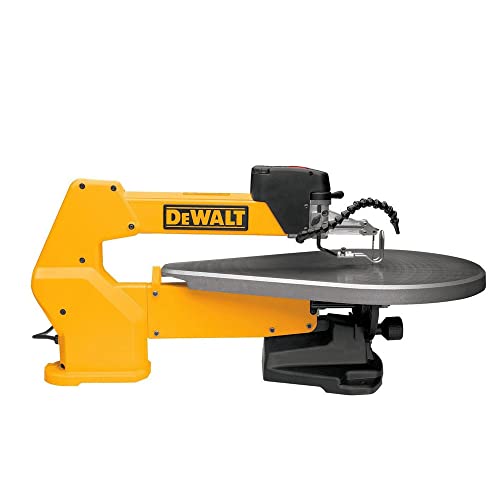
DEWALT DW788 Variable-Speed Scroll Saw
What We Like
- 20-inch blade capacity for larger workpieces
- Variable-speed trigger for precise control
- 20-inch steel blade for larger projects
Trade-offs
- At 66.1 pounds, it requires a dedicated bench
- Small 11.6-inch table limits support for wide stock
With its 20-inch steel blade, this scroll saw can handle large fretwork and complex intarsia projects that smaller 16-inch models cannot. The variable-speed trigger gives you direct fingertip control over the cutting speed, which is essential for delicate materials and intricate designs. In one expert round-up, it was selected as the overall favorite.
At 66.1 pounds, this saw is significantly heavier than many competitors, like the 24.7-pound SKIL model, requiring a dedicated bench or stand in your workshop. Its substantial weight means it is not designed for easy portability or storage after each use.
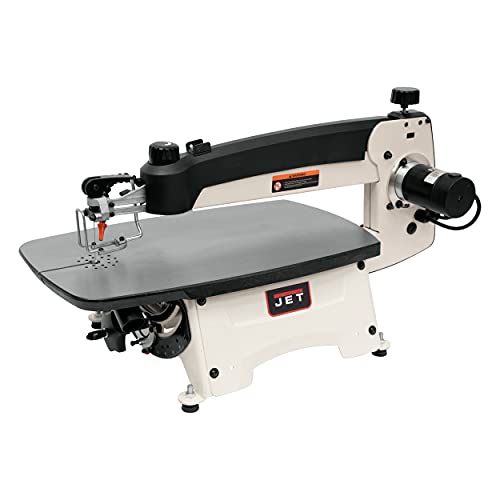
JET JWSS-22B Scroll Saw
What We Like
- Large, vibration-dampening cast iron table
- Hands-free operation with included foot switch
- Upper blade clamps and tensions in one action
- Arm tilts 45° each way with a flat table
Trade-offs
- At 68.2 lb, it's a substantial, permanent shop tool
- No built-in work light mentioned in specifications
- Larger footprint than models like the DeWalt DW788
The 22-inch throat depth and massive cast iron table are the foundation of this saw’s professional-grade performance. That solid work surface soaks up vibration for cleaner, more precise cuts in thicker stock, while the foot switch gives you complete control over the motor without taking your hands off the workpiece. This is built for the serious scroller who demands accuracy and reduced fatigue during long, intricate projects. The clever blade storage and 2-in-1 upper blade changer are thoughtful touches that streamline the workflow.
You pay for that stability with heft and footprint. It’s a dedicated machine, better suited to a permanent stand than a crowded bench. Compared to a more compact option like the Delta 40-694, the JET demands more space but delivers a noticeably steadier platform. If your shop has the room and your projects require that level of precision, the trade-off is a clear one.
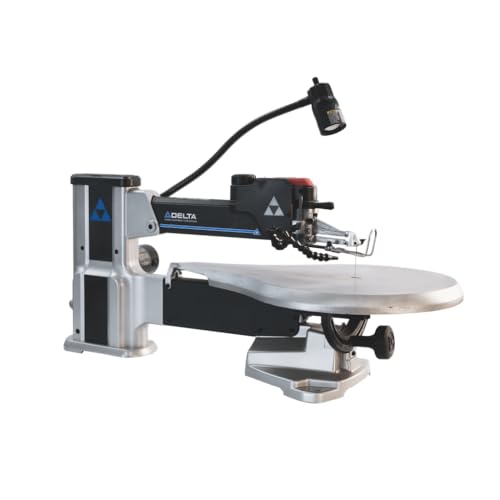
Delta 40-694 Variable-Speed Scroll Saw
What We Like
- Upper arm lifts and locks for easy blade access.
- Tool-free blade tensioning with a single lever.
- Large, cast-iron table for stable material support.
- All primary controls are located up front.
Trade-offs
- Weighs 70 lbs, making it a substantial bench-top fixture.
- Maximum cut at a 45° bevel is limited to 1-5/8 inches.
The single most important feature here is the upper arm that lifts and locks in place. This design completely clears the work area, so you can swap blades or thread them through interior cuts without fumbling in a tight space. For anyone doing intricate fretwork or projects requiring frequent blade changes, this mechanical simplicity is a major time-saver. The large cast-iron table and upfront controls further support focused, precise work.
Weighing 70 pounds, this scroll saw stays put on your workbench during detailed cuts. Its 20-inch throat capacity handles most common scrollwork patterns. The upper arm lifts and locks for easy blade changes, and controls like the variable speed dial and blade-tensioning lever are mounted up front for convenient access during a project.
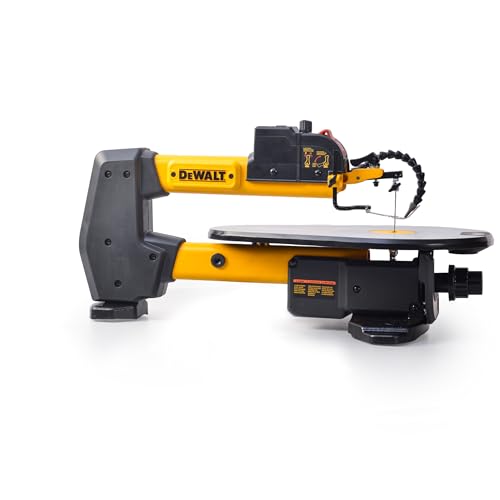
DeWalt 18-Inch Scroll Saw
What We Like
- Large 18-inch throat for bigger projects
- Stable die-cast aluminum table reduces vibration
- Convenient front-facing bevel scale for angles
- Oversized front controls for easy adjustments
Trade-offs
- At 34.2 lb, it's a substantial bench-top tool
- 1.6 Amp motor is less powerful than some 20-inch models
An 18-inch throat depth gives you the room to tackle larger panels and more ambitious scrollwork projects that smaller saws simply can’t handle. This DeWalt model is built for the hobbyist or craftsman who regularly works beyond typical 16-inch limits and needs a solid, vibration-resistant work surface. The die-cast aluminum table and upfront bevel scale make setting up precise angled cuts straightforward, which is crucial for detailed joinery and decorative pieces.
You trade some maximum throat depth and stroke speed compared to pro-grade 20-inch and 22-inch saws, like the JET JWSS-22B. Research and owner feedback point to it as a reliable, capable machine for those whose projects demand more space but don’t require the absolute largest capacity on the market.
Product photos
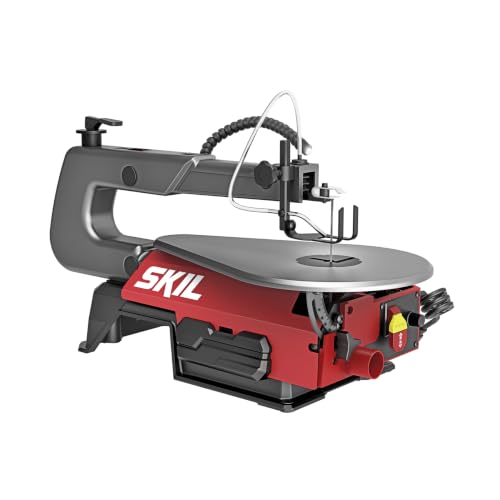
SKIL SS9503-00 Scroll Saw
What We Like
- Integrated LED worklight improves visibility
- Keyless blade change for fast, tool-free swaps
- Tilting work table enables precise angled cuts
- On-tool blade storage for easy access
Trade-offs
- Arm-driven dust removal provides only marginal airflow
- 16-inch throat limits interior cuts on wider stock
A 24.7-pound benchtop saw with keyless blade changes and a tilting table makes this a compact, user-friendly option for hobbyists setting up a modest workshop. The integrated LED light is a genuine help for seeing fine scrollwork lines, and the variable speed control lets you match the stroke rate to different materials. It’s a straightforward machine that gets you cutting with minimal fuss, which is exactly what you want from a value-focused tool.
The integrated dust removal system is driven by the saw’s arm movement, a common design where reviewers report the airflow is only marginal. It helps keep the cut line somewhat clearer, but you will still be brushing away sawdust during detailed work. This SKIL model weighs 24.7 pounds, making it far more portable than the 66.1-pound DEWALT DW788, which suits smaller workshops where the saw may need to be moved or stored.
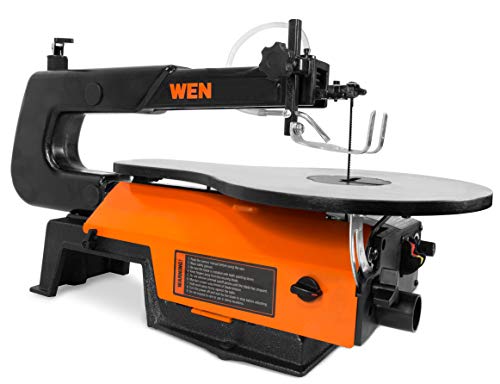
WEN 3922 Variable-Speed Scroll Saw
What We Like
- Side panel opens for easy blade access
- Tool-free blade changes with thumb screw
- Variable speed from 550 to 1600 strokes per minute
- Includes air pump and dust port
Trade-offs
- 2-inch maximum cut thickness limits thicker stock
- Cast iron base adds weight for a 16-inch saw
A 16-inch throat depth allows for cutting large workpieces, while the table tilts up to 45 degrees for angled cuts. The saw weighs 24.9 pounds, which makes it easier to move around a workshop than heavier models. Its side panel flips open for blade changes, a design aimed at simplifying a common task.
It cuts wood up to 2 inches thick, a capacity suited for many common projects. The cast iron base contributes to stability during operation. With a variable speed range from 550 to 1600 strokes per minute, users can adjust for different materials and cut types.
JET JWSS-18B Variable-Speed Scroll Saw

What We Like
- Large, thick steel table limits vibration
- Exclusive 2-in-1 upper blade change mechanism
- Variable speed from 400 to 1,550 strokes per minute
- Removable dust port collects at the source
Trade-offs
- At 54 lb, it's heavier than many 16-inch models
- Left tilt limited to 30 degrees unless dust port is removed
A 1/4-inch thick, large steel table is the foundation of this saw’s exceptional stability. That mass, combined with a solid 54-pound frame, soaks up vibration so your blade stays on the line even during intricate cuts. For a woodworker tackling delicate fretwork or dense hardwoods, that controlled performance is the difference between a smooth finish and a jagged edge. This saw is built for precision where steady hands matter most.
That stability comes with a physical footprint. You’ll want a dedicated stand or a sturdy bench, as this isn’t a tool you’ll casually move around the shop. Compared to a more portable option like the WEN 3922, the JET is a shop anchor. It trades some maneuverability for a work surface that feels planted, making it a focused choice for detailed projects where vibration is the enemy.
Product photos
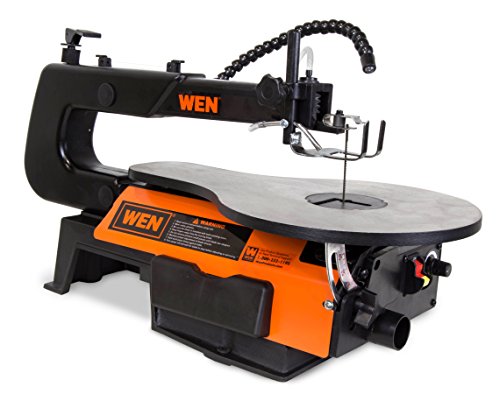
WEN 3921 Scroll Saw
What We Like
- Unique 90-degree blade orientation for infinite ripping
- Tool-free blade changes with thumb screw adapter
- Built-in work light and dust port
- Cast iron base for stability
Trade-offs
- 2-inch max cut thickness limits very thick stock
The ability to mount a blade at a 90-degree angle is this saw’s defining feature. It transforms a standard scroll saw into a machine capable of infinite ripping, letting you slice long boards lengthwise as you would on a band saw. For a woodworker needing to resaw thin stock or create long, intricate edge profiles, this design opens up unique possibilities. The 16-inch throat and variable speed from 400 to 1600 strokes per minute provide solid core functionality for detailed scrollwork, while the tool-free blade changes and onboard storage keep the workflow smooth.
Its unique design accepts blades in two directions for infinite ripping capacity, a major advantage for long cuts. Weighing 25.5 pounds, it is lighter than many models, like the 68.2-pound JET JWSS-22B, which can aid in moving it around a workshop. However, the lighter weight may affect stability compared to heavier saws during operation.
Product photos
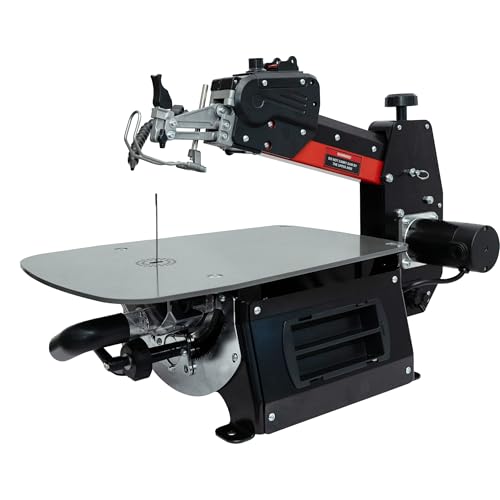
BUCKTOOL 16-Inch Scroll Saw
What We Like
- Innovative rotating arm for precise bevel cuts
- Quick tool-less blade change system
- Large worktable and up-front controls
- Includes two pinless blades for versatility
Trade-offs
- Relatively compact at 5-inch cube dimensions for a primary workshop saw
- Arm-pivot design is a departure from traditional table-tilt systems
The BUCKTOOL’s rotating saw arm, which pivots 30 degrees left and 45 degrees right, fundamentally changes how you approach angled scroll work. Instead of tilting the entire table and risking workpiece shift, the arm moves, guaranteeing alignment for complex bevels and compound cuts. This design, paired with a solid 16-inch throat and variable speed up to 1550 RPM, makes it a standout for the detail-oriented craftsperson who regularly needs precision beyond straight vertical cuts. The tool-less blade clamps and top-down insertion further streamline the workflow from setup to intricate inside cutouts.
The BUCKTOOL’s rotating arm, which pivots for angled cuts, is a key design choice. This arm-pivot system allows for precise bevels without moving the workpiece, which reviewers report aids in alignment. Some users who prefer the traditional, heavier mass of a full cabinet saw for vibration damping, like the Delta 40-694, might find the arm-pivot design a different approach.
Product photos
Bosch MS20-01 Scroll Saw

What We Like
- Extremely portable at just 9.1 pounds
- Detaches for handheld coping work
- Auto-tensioning for quick blade changes
- Variable-speed control for material versatility
Trade-offs
- The 4.8-inch height limits thick stock capacity
- Missing guide levers shown on packaging
Weighing just over nine pounds, this saw is built for mobility, not a permanent workshop bench. Its fast-clamp base lets you secure it to any stable surface, and the whole unit can be detached for use as a handheld coping saw. That makes it a brilliant solution for the carpenter who needs to bring the tool to an installed piece of trim or for the hobbyist with very limited shop space. The variable-speed control and dust port add to its utility as a genuine, compact workhorse.
You trade a dedicated, solid table for that portability. The work area is necessarily smaller and lower to the mounting surface compared to a full-size model like the JET JWSS-22B. This isn’t the saw for intricate, large-scale fretwork projects that benefit from a massive, tilting table. It is, however, a uniquely adaptable cutting tool that solves problems a standard scroll saw simply cannot reach.
Product photos
How We Evaluated Scroll Saws For Woodworking
Our evaluation is based on a thorough review of manufacturer specifications, expert round-up articles, and consistent patterns in owner feedback. We focused on criteria that directly impact scroll saw performance in a woodworking context: throat capacity for project size, blade-change mechanisms for workflow efficiency, and vibration control for intricate detail work. We also considered the practical realities of shop use, like overall footprint and dedicated features such as work lights or dust ports.
This research-based approach allows us to compare features and reported performance across many models. However, it cannot replicate the hands-on feel of a tool or predict long-term durability for every individual user. Our aim is to provide a clear, researched comparison to inform your purchase, serving as a solid guide to buying a scroll saw.
What To Look For In Scroll Saws For Woodworking
The right scroll saw unlocks detailed fretwork, intarsia, and precise curves. Your choice hinges on your typical project size, your tolerance for setup time, and the stability of your workspace.
Key factors include throat capacity, which is the distance from the blade to the rear frame and determines your maximum workpiece width. Tool-free blade change systems improve efficiency during projects. Features like variable speed control and vibration-dampening construction also matter, as they help produce clean cuts in different materials.
Throat Capacity
Throat capacity, measured in inches from the blade to the back of the saw’s arm, dictates the maximum width of material you can cut. A common range for hobbyists is 16 to (https://toolsframe.com/best-scroll-saws-for-beginners/), while 18-inch and 20-inch models accommodate larger panels for signs or furniture components. Consider your most frequent project dimensions; a larger throat offers more flexibility but often comes with a larger, heavier tool footprint.
Blade Change & Tensioning
Frequent blade changes are part of scroll saw work, especially with intricate patterns. Mechanisms that lift the upper arm or open a side panel provide clear access to the blade clamps. Tool-free systems, using levers or knobs instead of hex keys, significantly speed up the process. Similarly, easy tensioning adjustments, often via a single lever, help maintain optimal blade tightness for accurate cuts, a crucial part of learning how to use a scroll saw effectively.
Vibration Control & Features
Excessive vibration can blur cut lines and fatigue the user. Look for saws with heavy, cast-iron bases or tables designed to dampen movement. Other features enhance the experience. A variable-speed motor, typically ranging from 400 to 1,800 strokes per minute, lets you match speed to material hardness. An integrated LED worklight illuminates the cut line, and a dust port helps keep the work area clean. For those deciding between tool types, understanding the scroll saw vs band saw comparison is useful, as each excels at different kinds of cuts.
- Secure the saw to a sturdy bench or stand to minimize operational vibration.
- Test the blade change system’s accessibility before purchase, if possible.
- Ensure the table’s tilt mechanism (if present) locks securely at common angles like 15°, 30°, and 45°.
A stable, well-lit workspace is just as critical as the saw itself for achieving precise scroll work.
Scroll Saws For Woodworking Compared
The comparison table below outlines the key specifications and features of our top picks at a glance, helping you weigh factors like throat capacity, weight, and special functions side-by-side.
| Product | Throat Depth | Variable Speed Range | Table Size | Weight |
|---|---|---|---|---|
| DEWALT DW788 Variable-Speed Scroll Saw | 20 in | Variable-Speed Trigger | L 11.6 in, W 7.7 in | 66.1 pounds |
| JET JWSS-22B Scroll Saw | 22 inches | 400-1,550 SPM | 12-7/8" x 23" | 68.2 pounds |
| Delta 40-694 Variable-Speed Scroll Saw | 20 In. | 400-1,750 SPM | 16 in. x 24 in. | 70 lbs |
| DeWalt 18-Inch Scroll Saw | 18 inches | 500-1500 SPM | N/A | 34.2 Pounds |
| SKIL SS9503-00 Scroll Saw | 16 in. | Electronic variable | 16 in. x 10 in. | 24.7 pounds |
| WEN 3922 Variable-Speed Scroll Saw | 16 inches | 550-1600 SPM | 16 x 10 inches | 24.9 pounds |
| JET JWSS-18B Variable-Speed Scroll Saw | 18-Inch | 400-1,550 SPM | 11-5/8" x 21" | 54.0 lb |
| WEN 3921 Scroll Saw | 16 inches | 400-1600 strokes/min | 16 x 11 inches | 25.5 pounds |
| BUCKTOOL 16-Inch Scroll Saw | 16 inches | 360-1550 RPM | 19-11/16" x 13-3/8" | N/A |
| Bosch MS20-01 Scroll Saw | N/A | Variable-speed control | N/A | 9.1 Pounds |
Frequently Asked Questions
Which scroll saw is considered the best quality?
Quality in a scroll saw is often associated with solid construction, smooth operation, and precision. Models like the JET JWSS-22B and DEWALT DW788 are frequently noted for their professional-grade build, which includes large, vibration-dampening cast iron tables and reliable variable-speed motors. The most suitable model depends on matching that construction to your specific shop needs and project scale.
Is Harbor Freight scroll saw good?
Our research did not cover specific Harbor Freight models. Generally, budget-friendly saws can be suitable entry points for beginners or for very light, occasional use. For consistent performance in detailed woodworking, however, reviews and owner feedback often suggest investing in a saw from a brand specializing in power tools. In those models, features like tool-free blade changes and effective vibration control are more consistently implemented.
What type of wood is best for cutting with a scroll saw?
Softwoods with straight, fine grain like basswood, poplar, and pine are excellent for beginners and intricate work because they cut cleanly with less blade wear. Thin plywood (1/4 inch or less) with a smooth veneer is also a popular choice for many scroll saw projects. As skills advance, hardwoods like cherry or walnut can be used, typically requiring slower blade speeds and sharper blades.
What is better than a scroll saw?
No single tool is universally “better”; it depends on the cut. For resawing thick lumber or making long, straight cuts, a band saw is more efficient. For rough cuts and breaking down sheet goods, a jigsaw or circular saw is faster. The scroll saw’s unique advantage is making extremely tight, intricate interior cuts and complex curves in thinner stock, which is why it’s considered an essential tool for detailed woodworking.
Can a scroll saw cut metal?
While some scroll saws can be fitted with special abrasive blades designed for thin, soft metals like aluminum, they are primarily woodworking tools. Cutting metal requires significantly slower speeds than most wood scroll saws provide, and it generates heat that can damage the saw’s components. For metal cutting, a dedicated metal-cutting band saw or a jeweler’s saw is a more appropriate and safer choice.
The Bottom Line
The DEWALT DW788 Variable-Speed Scroll Saw is our best overall pick for woodworkers who need a full-featured, precise saw for large projects in a fixed workshop. Its 20-inch capacity and solid build support detailed work on sizable panels.
If you’re on a tight budget, the WEN 3922 offers core variable-speed functionality, or for extreme portability, consider the Bosch MS20-01. For those who frequently swap blades for intricate patterns, the Delta 40-694’s tool-free system is a major time-saver.
Ultimately, matching the saw’s throat capacity and stability to your most common project size is the single most important step. A well-chosen scroll saw becomes a gateway to detailed craftsmanship, from simple ornaments to complex intarsia.
