
10 Best Small Circular Saws in 2026
This post contains affiliate links. As an Amazon Associate, we earn from qualifying purchases.
The Milwaukee M12 Fuel 5-3/8 Inch Circular Saw is our best overall small circular saw for its brushless power in a remarkably compact 7-inch body. The Makita Sub-Compact 6-1/2 Inch is our top pick for a blade-right design, while the Fanttik O11 Pro 3-3/8 Inch Mini Circular Saw wins for pocket-sized portability. For many tasks, a smaller, lighter saw is easier to control and maneuver than a full-sized 7-1/4-inch model. This guide is based on researching specifications, expert evaluations, and patterns in owner feedback to help you find the right compact saw for your projects.
Top 10 Small Circular Saws in the Market
Certain content that appears on this site comes from Amazon. This content is provided "as is" and is subject to change or removal at any time.
The Best Small Circular Saws, Reviewed
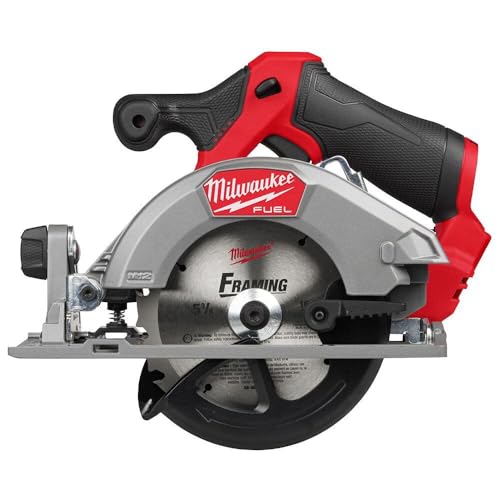
Milwaukee M12 Fuel 5-3/8 Inch Circular Saw
What We Like
- Compact 7-inch length for tight spaces
- Brushless motor provides power and torque
- Intelligent battery system for optimized performance
- Complete kit includes battery and charger
Trade-offs
- Smaller 5-3/8-inch blade limits cut depth
- Cannot cut at preset bevel angles
- Heavier than the 4.0-pound Makita sub-compact
A 7-inch overall length makes this Milwaukee the most compact saw here, letting you easily reach spots a full-size saw can’t. Its brushless motor and intelligent battery system deliver reliable power for a tool this small. For anyone needing a truly portable saw for finish work, panel cuts, or tight remodeling jobs, it’s the one that gets the call. This combination of compact design and cordless convenience is why it consistently ranks at the top of expert comparisons.
This saw’s smaller 5-3/8-inch blade means it can’t reach the same cutting depth as a standard 6-1/2-inch model, so you’ll need to plan your cuts for thinner materials. For its intended role as a supremely portable and capable compact cutter, the Milwaukee M12 Fuel is the benchmark. It’s the saw you grab when the job is too awkward for anything bigger.
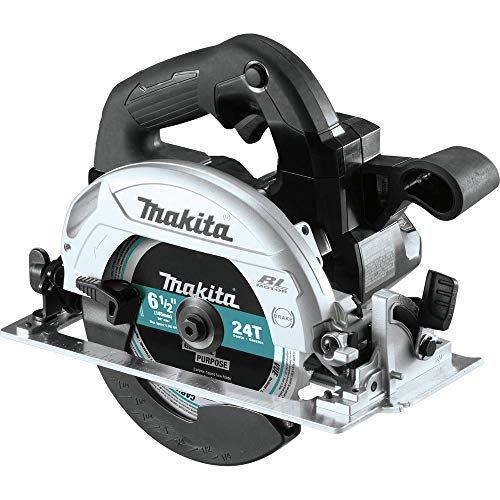
Makita XSH04ZB Sub-Compact 6-1/2 Inch Circular Saw
What We Like
- Compact blade-right design for easy line of sight
- Brushless motor runs cooler for longer life
- Includes dust extraction attachment
Trade-offs
- Tool only: requires separate battery and charger purchase
- At 13.5 inches long, it's larger than some ultra-compact rivals
- Blade-right design may feel less familiar to worm-drive users
Weighing just over six pounds with a battery, this saw balances power with a truly manageable heft. Its blade-right configuration puts the motor housing out of your line of sight, letting you focus on the cut line without craning your neck. That combination makes it a natural fit for anyone who needs to make precise, controlled cuts in framing lumber or sheet goods but wants to avoid wrestling a full-size saw.
While called sub-compact, this saw is longer than some mini models like the Milwaukee M12 Fuel, meaning it won’t fit into the most confined spaces. It is built for substantive cutting, not light craft work. The 2-1/4 inch depth of cut at 90 degrees provides capacity for many common materials, but the tool requires an investment in Makita’s 18V LXT battery system to operate, as none are included.
DeWalt 20V MAX 6-1/2 Inch Brushless Circular Saw

What We Like
- Bright LED improves cut line visibility
- Tool-free bevel lever for quick adjustments
- Electric brake for added safety
- Built-in rafter hook for jobsite storage
Trade-offs
- Tool only: requires separate DeWalt 20V battery purchase
- Shoe friction can be higher than some other brands
The DeWalt DCS565B is a 20V MAX brushless circular saw with a 6-1/2 inch blade, designed for cordless convenience on the jobsite. Its brushless motor provides efficient cutting performance in a variety of materials. Features like the built-in rafter hook allow for convenient storage, and compatibility with a dust chute helps minimize dust when connected to an extractor.
This saw offers a compact and lightweight design for high maneuverability. A tool-free bevel lever allows for quick adjustments from 0 to 50 degrees, and an electric brake adds safety by stopping the blade after the trigger is released. An integrated LED increases visibility for more accurate cuts.
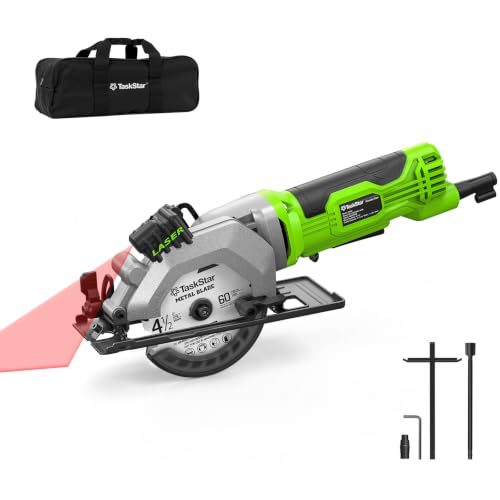
TaskStar Mini Circular Saw with Laser Guide
What We Like
- Laser guide and rip fence for straighter cuts
- Three blades for wood, metal, tile, and plastic
- Compact size and auxiliary handle for easy control
- Double safety switch reduces accidental starts
Trade-offs
- Corded design limits mobility away from outlets
- Maximum cut depth is less than 6-1/2 inch models
- Dust collection requires a separate vacuum hose
A 4.8-amp motor spinning at 4000 RPM gives this mini saw enough muscle for most household cutting tasks without the bulk of a full-size tool. The TaskStar is built for the DIYer who values a complete kit right out of the box, bundling a laser guide, rip fence, and three different blades to handle materials from plywood to tile. It’s a straightforward, capable corded option that delivers core features without complexity, perfect for someone setting up a first workshop or tackling frequent weekend projects.
This compact circular saw delivers a maximum cut depth of 1-11/16 inches at 90 degrees, so it can’t slice through a standard 2×4 in one pass. That design makes it a specialist for sheet goods, trim, and paneling rather than heavy framing. For a homeowner focused on shelving, flooring, or craft builds, however, its guided accuracy and included blade variety cover a wide range of common DIY jobs.
Product photos
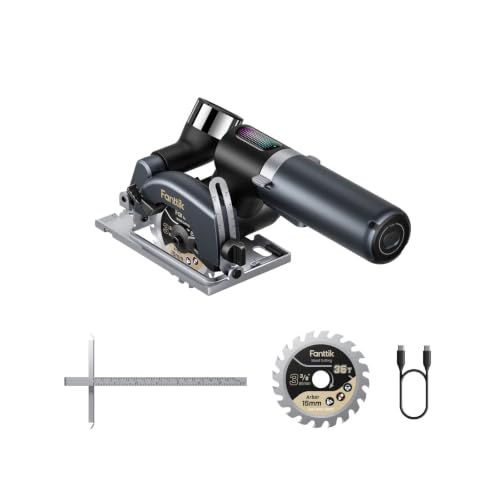
Fanttik O11 Pro 3-3/8 Inch Mini Circular Saw
What We Like
- Ultra-compact 10.75" length for tight spaces
- Smart digital display with low-battery alert
- Complete kit includes rip guide and dust ports
- Brushless motor for longer runtime and power
Trade-offs
- 1" maximum cut depth limits material thickness
- Dust port requires manual clearing without a vacuum
Weighing only 2.31 pounds and just 10.75 inches long, this saw prioritizes maneuverability over raw cutting capacity. Its compact size and one-handed design let you slip into cabinetry corners or handle trim work where a full-sized saw would be clumsy. Type-C fast-charging eliminates the need for bulky battery packs and docks, and the included rip guide helps maintain straight cuts even in confined spaces. It’s a natural fit for detail-oriented DIYers or crafters who need precision in tight quarters more than the ability to slice through thick lumber.
The trade-off for that pocket-sized form is cutting depth, limited to one inch at 90 degrees. This rules out cutting through a standard 2×4 in a single pass. For framing or decking, you would need a larger tool. A heavier option such as the Milwaukee M12 Fuel, for example, has a larger overall footprint. The Fanttik excels in its niche, providing cordless saw power in a package that genuinely disappears into a tool bag until you need it for precise cuts on thinner stock.
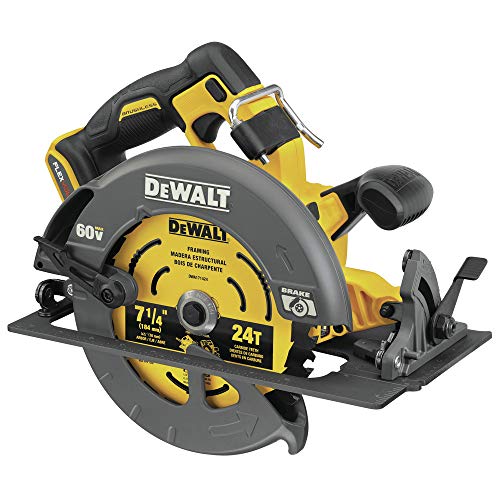
DeWalt FLEXVOLT 60V MAX 7-1/4 Inch Circular Saw
What We Like
- Electric brake for immediate blade stop
- Integrated LED light for cut line visibility
- Rafter hook for quick jobsite storage
- Substantial power from 60V brushless motor
Trade-offs
- Tool only: requires separate battery and charger purchase
- Heavier than most compact saws at 8.2 pounds
- Shoe coating creates more friction than some competitors
A 7-1/4-inch blade and over two and a half inches of cutting depth let this saw handle framing lumber and sheet goods like a corded model, but without the cord. It’s built for pros or serious DIYers who need that full-sized capacity in a cordless platform and are already invested in DeWalt’s battery system. The integrated LED and rafter hook are thoughtful jobsite touches, and the electric brake adds a layer of safety when you’re moving quickly between cuts.
Research indicates the saw’s heft and shoe friction require some muscle memory to manage smoothly on long rips. It’s a trade-off for that big-saw performance in a relatively compact body. If you prioritize lightweight maneuverability for overhead work or detailed cuts, the Makita Sub-Compact 6-1/2 Inch model is nearly half the weight. But if your priority is maximum cordless cutting muscle from a trusted brand, this DeWalt delivers.
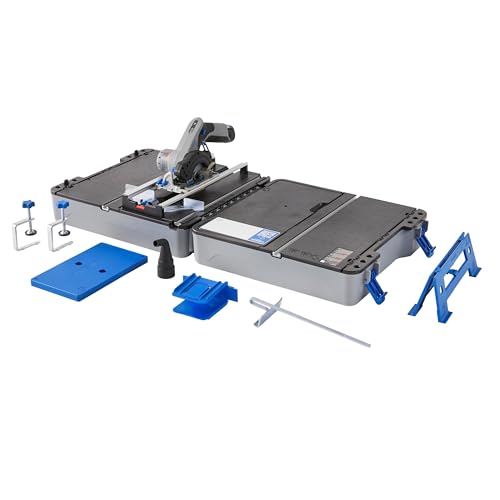
Dremel Blueprint Portable Saw Station
What We Like
- Integrated fold-out workstation for miter and bevel cuts
- Includes alignment laser for precise cut visualization
- Comes with comprehensive kit of guides and clamps
- Folds compactly for storage in tight spaces
Trade-offs
- 1-inch maximum cut depth limits material thickness
- Designed for trim and craft work, not heavy framing
- Small 3-3/8 inch blade versus standard 6-1/2 inch saws
A one-inch maximum cut depth means this tool is designed for lighter tasks like trim, vinyl flooring, and thin boards, not heavy framing. The bundle pairs a compact cordless circular saw with a fold-out workstation, creating a legitimate portable workshop for those with limited space. According to expert round-ups, it’s built with crafting and hobby projects in mind, where its all-in-one convenience and small footprint are major assets.
The trade-off is capacity. You won’t be breaking down sheets of plywood or cutting through a 2×4 in one pass. For those heavier tasks, a more powerful option such as the Milwaukee M12 Fuel 5-3/8 Inch Circular Saw offers more cutting muscle while still being relatively compact. The Dremel station excels as a space-saving system for precision small-scale work, not as a primary saw for construction.
Product photos
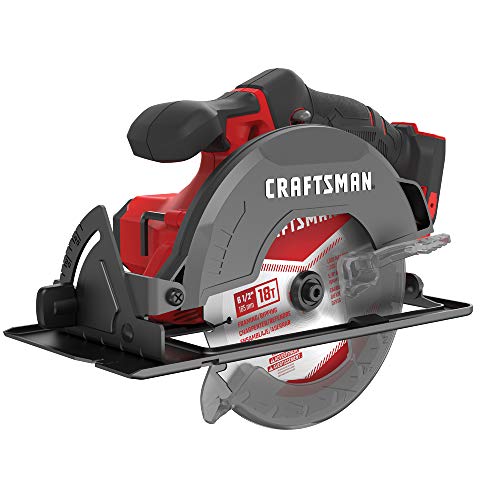
CRAFTSMAN V20 6-1/2 Inch Cordless Circular Saw
What We Like
- Compact, lightweight design reduces fatigue
- Tool-free bevel shoe pivots to 50 degrees
- Part of the extensive V20 cordless system
- Metal shoe for added durability
Trade-offs
- Tool only: requires separate V20 battery and charger purchase
- At 5.3 lb, heavier than Makita's 4.0 lb sub-compact
- Depth of cut limited to 2x material
That capacity, paired with a tool-free shoe that swings to 50 degrees for angled cuts, makes it a practical, full-featured cordless saw for general construction and DIY. The contoured, overmolded handle and 5.3-pound weight help keep it manageable during a day of deck building or shed assembly. This makes it a sensible choice for someone needing reliable cordless performance without a premium price tag.
This is a bare tool, so a V20 battery and charger must be purchased separately. It is part of the Craftsman V20 cordless system, which offers a range of compatible tools. Compared to the Milwaukee M12 Fuel 5-3/8 inch saw, the Craftsman has a larger blade diameter.
Product photos
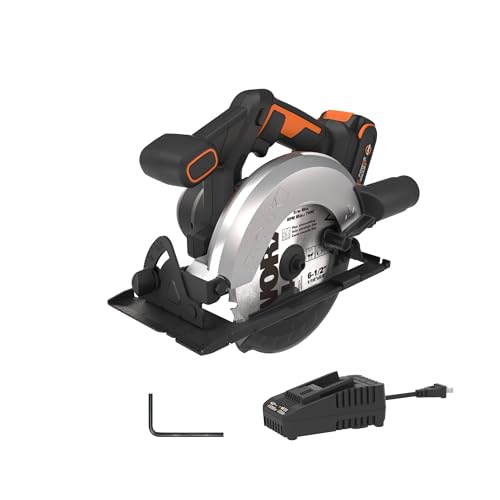
WORX WX526L 6-1/2 Inch Cordless Circular Saw
What We Like
- PowerShare battery system works across 20V, 40V, and 80V WORX tools
- Brushless motor for efficient cuts through 2x lumber
- Compact, dual-handle design for balanced, comfortable control
- Built-in LED light illuminates the cut line
Trade-offs
- At 6.4 lbs, heavier than the Makita XSH04ZB (4.0 lbs)
- Maximum cut depth of 2-3/16" is shallower than larger 7-1/4" saws
The PowerShare battery system is the standout feature, letting you use the same 20V packs across the entire WORX lineup. That makes this saw a logical choice if you’re already invested in their cordless ecosystem or plan to be. It’s a capable 6-1/2″ saw with a brushless motor that handles 2x lumber without complaint, and the dual-handle design makes it feel steady and controlled in your hands.
You do pay a small weight penalty for that versatility, it’s over two pounds heavier than the featherweight Makita sub-compact. It’s a trade-off, but one that makes sense if you value a unified battery system over absolute minimal heft. For cutting dimensional lumber on a deck frame or a shed project, it has the depth and bevel capacity to get the job done without dragging a cord behind you.
Product photos
Milwaukee M18 6-1/2 Inch Cordless Circular Saw
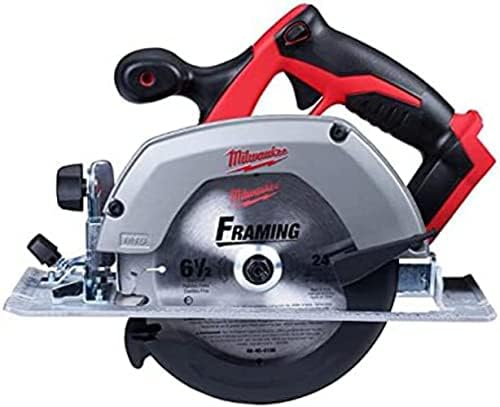
What We Like
- Magnesium upper and lower guards for durability
- 3,500 RPM motor for quick cuts in tough materials
- Aircraft aluminum shoe for precise rip cuts
- Soft-grip handle for comfortable, controlled use
Trade-offs
- Tool only: battery and charger sold separately
- At 7.3 lb, it's heavier than some 6-1/2-inch rivals
A 3,500 RPM motor means this saw won’t bog down in LVL headers or dense framing lumber, making it a reliable partner for serious job site work. The magnesium guards and aluminum shoe aren’t just marketing, they build a tool that can take a beating and still deliver accurate cuts. For a pro or a dedicated DIYer who demands durability and power in a cordless platform, this Milwaukee is a solid, no-nonsense choice.
You pay for that toughness with some extra heft; at 7.3 pounds, it’s noticeably weightier than a model like the Makita Sub-Compact. The tool-only nature also means you need to factor in the cost of a Milwaukee M18 battery if you’re not already invested in that system. It’s a trade-off: you get a saw built to last, but it’s best suited for users who need that ruggedness more than they need the absolute lightest option.
How We Evaluated Small Circular Saws
We compiled data from manufacturer specifications and professional tool reviews to compare performance claims across dozens of models. Our evaluation focused on portability, cutting capacity, motor power, and included features because these factors determine a small saw’s real-world utility in tight spaces. We cross-referenced this with common praises and complaints in owner feedback to identify consistent strengths and trade-offs. A research-based approach cannot replicate years of jobsite durability testing, but it effectively highlights the performance and design differences that matter most.
What To Look For In Small Circular Saws
Choosing a compact saw involves balancing power with portability. The right tool depends on the material you cut most and where you need to use it.
Prioritize blade size for cut depth, motor type for power and runtime, and weight for control. Cordless models offer freedom, while corded ones provide unlimited runtime. Consider if you need features like a dust port or LED light.
Blade Size and Cutting Capacity
Blade diameter directly determines maximum cut depth. A 6-1/2-inch blade can typically cut through standard lumber at 90 degrees, while a 5-3/8-inch or 4-1/2-inch blade is limited to a shallower depth. Smaller blades, like the 3-3/8-inch on the Fanttik, excel in ultra-tight spaces but are best for plywood, trim, and craft materials. Bevel capacity is also crucial; many compact saws tilt to 45 or 50 degrees for angled cuts, but some ultra-mini models lack this function entirely.
Power Source and Motor
Choose between corded unlimited runtime and cordless jobsite mobility. For battery-powered mini circular saws, brushless motors are more efficient, run cooler, and extend battery life compared to brushed motors. Voltage indicates potential power; a 12V system is fine for light-duty work, while 18V/20V platforms handle framing. Remember, a “tool-only” saw requires a separate battery and charger investment, so factor in your existing cordless ecosystem.
Weight, Balance, and Features
A lighter saw reduces fatigue, especially for overhead or one-handed use. Balance affects control; blade-right designs offer a clearer line of sight for right-handed users. Useful features include an LED light to illuminate the cut line, an electric brake for safety, and a dust port to connect a vacuum. For consistent results, look for a tool-free depth and bevel adjustment lever.
- Check the shoe (base plate) material; magnesium or aircraft aluminum is durable and glides smoothly.
- Ensure the handle design provides a secure, comfortable grip for your hand size.
- Verify if a rip fence or laser guide is included for making straight cuts.
- Consider the guard design for easy plunge cuts and visibility.
The most important factor is matching the saw’s physical size and cut depth to your most common project materials.
Small Circular Saws Compared
The following table compares key specifications for all our top picks to help you see the differences at a glance.
| Product | Blade Diameter | Power Source | Weight |
|---|---|---|---|
| Milwaukee M12 Fuel 5-3/8 Inch Circular Saw | 5-3/8 Inch | M12 Cordless (battery/charger included) | 5.8 Pounds |
| Makita XSH04ZB Sub-Compact 6-1/2 Inch Circular Saw | 6-1/2 inch | 18V LXT Lithium-Ion (tool only) | 4.0 Pounds |
| DeWalt 20V MAX 6-1/2 Inch Brushless Circular Saw | 6-1/2 inches | 20V MAX (tool only) | 6.3 pounds |
| TaskStar Mini Circular Saw with Laser Guide | 4-1/2 inch | 4.8A corded | N/A |
| Fanttik O11 Pro 3-3/8 Inch Mini Circular Saw | 3-3/8 Inch | USB Type-C (battery included) | 2.31 lb |
| DeWalt FLEXVOLT 60V MAX 7-1/4 Inch Circular Saw | 7-1/4-inch | 60V MAX FLEXVOLT (tool only) | 8.2 pounds |
| Dremel Blueprint Portable Saw Station | 3-3/8 inches | 12V Rechargeable Battery | N/A |
| CRAFTSMAN V20 6-1/2 Inch Cordless Circular Saw | 6-1/2 inch | V20 (bare tool only) | 5.3 pounds |
| WORX WX526L 6-1/2 Inch Cordless Circular Saw | 6-1/2 Inch | 20V (PowerShare) | 6.4 lbs |
| Milwaukee M18 6-1/2 Inch Cordless Circular Saw | 6-1/2 inches | M18 (bare tool) | 7.3 pounds |
Frequently Asked Questions
What is the top-rated mini circular saw?
Our top-rated model for extreme portability is the Fanttik O11 Pro 3-3/8 Inch mini circular saw. It stands out for its smart digital display, included rip guide, and ultra-compact 10.75-inch length, making it ideal for detailed work and tight spaces where larger blades cannot fit.
What is the best circular saw for the money?
The best value depends on your needs. The TaskStar Mini Circular Saw offers excellent value as a budget corded kit, including a laser guide and multiple blades. For cordless value within an existing system, the CRAFTSMAN V20 6-1/2 Inch saw provides capable performance at a mid-range price point.
What is the best budget mini circular saw?
The TaskStar Mini Circular Saw with Laser Guide is our best budget pick. It’s a capable corded tool that comes complete with accessories for cutting various materials, making it a great starter saw for DIYers who don’t want to invest in a battery platform.
Can a small circular saw cut a 2×4?
Yes, but only models with a large enough blade. A 6-1/2-inch blade can typically cut through a standard 2×4 in a single pass at 90 degrees. Smaller blades, like 5-3/8-inch or 4-1/2-inch, may require two passes or cannot cut through the full width.
What’s the difference between blade-left and blade-right saws?
The terms describe which side of the tool the blade is on relative to the motor. Blade-right saws place the blade on the right, offering a clearer line of sight for right-handed users over the cut line. Blade-left designs are common on worm-drive saws and can feel more natural for some users, but can obscure the line.
The Bottom Line
The Milwaukee M12 Fuel 5-3/8 Inch Circular Saw is our best overall pick for its potent brushless motor packed into the shortest body, ideal for carpenters and DIYers working in confined spaces. For budget-focused shoppers, the TaskStar corded kit delivers guided versatility, while those needing maximum portability should choose the pocket-sized Fanttik O11 Pro.
Regardless of your pick, honestly assess the maximum material thickness you need to cut. Choosing a saw with insufficient depth capacity is the most common mistake, so let your project requirements, not just the tool’s size, guide your final decision.
