
10 Best Small Milling Machines in 2026
This post contains affiliate links. As an Amazon Associate, we earn from qualifying purchases.
The best small milling machine for most users is the Proxxon Micro Mill MF 70, which wins for its stable cast iron base and precise, play-free slides ideal for desktop projects. For those needing a larger work area, the MechMaxx VM25LD Benchtop Mill earns our Best Large Table Mill award. The WEN 33013 offers excellent R8 spindle compatibility in a compact frame.
Choosing the right machine involves balancing your shop’s physical space with the size and materials of your typical workpieces. We researched specifications, expert insights, and owner feedback to bring you this focused list of ten capable machines, helping you match a mill to your workshop’s real constraints.
Top 10 Small Milling Machines in the Market
Certain content that appears on this site comes from Amazon. This content is provided "as is" and is subject to change or removal at any time.
The Best Small Milling Machines, Reviewed
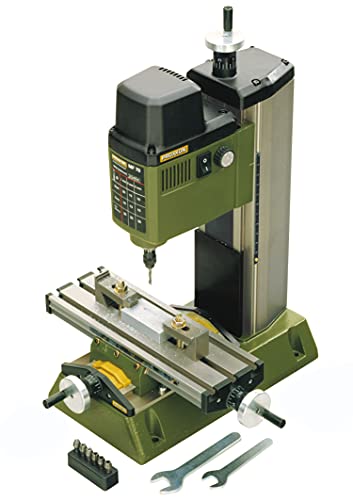
Proxxon Micro Mill MF 70
What We Like
- Compact size ideal for desktop use
- Play-free adjustable slides on all axes
- Stable cast iron base reduces vibration
- Includes steel collet set and clamp blocks
Trade-offs
- Fixed headstock is not positionable
- Smaller capacity than benchtop mills like the MechMaxx VM25LD
The Proxxon Micro Mill MF 70 weighs 17.6 pounds, which makes it easy to move and store in a small workshop. Its cast iron base and treated aluminum column and table are described as providing stability for milling. The feature list notes it is designed for lab, optician, jewelry, electronic, and model building projects. Research from an owner indicates it is considered a great desktop mill for small work, but that its head is not positionable.
Compared to the 37-inch long MechMaxx VM25LD, the Proxxon’s 11-inch width is significantly more compact. The owner feedback mentions outgrowing the Proxxon due to its fixed head, which cannot be angled for different operations. The Amazon feature bullets state the mill is for small projects like jewelry and model building, suggesting its intended scale of work.
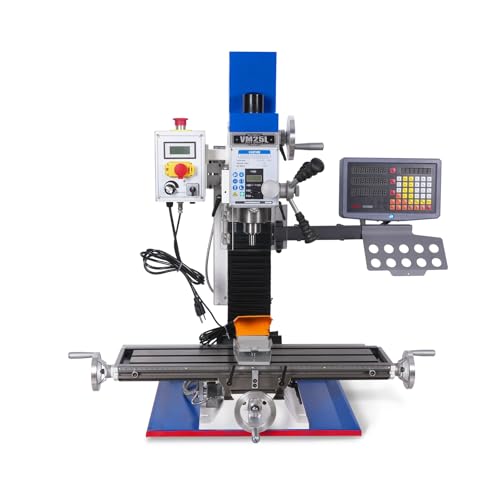
MechMaxx VM25LD Benchtop Mill
What We Like
- Large 7"x27-1/2" table for bigger work
- R8 spindle for wide accessory compatibility
- Powerful 1.5 HP brushless motor
- Precision ground ways for smooth movement
Trade-offs
- No stand included for its considerable footprint.
That 27-1/2 inch long table is the headline here. It lets you fixture larger plates or handle multiple smaller parts in a single setup, which is a serious upgrade over most mini mills. Combined with the 1.5 HP brushless motor and R8 spindle, this machine suits a serious home machinist who needs to tackle more ambitious projects in metal or tough composites. The ±90° head tilt and variable speed give you the control to execute those jobs precisely.
You pay for that capacity in shop space. It’s over three feet wide, so you’ll need a dedicated, sturdy bench. For someone whose projects are consistently smaller, the WEN 33013 offers a more compact R8 spindle machine. But if your work regularly bumps against the limits of a tiny table, the MechMaxx VM25LD’s real estate is its defining advantage.
Product photos
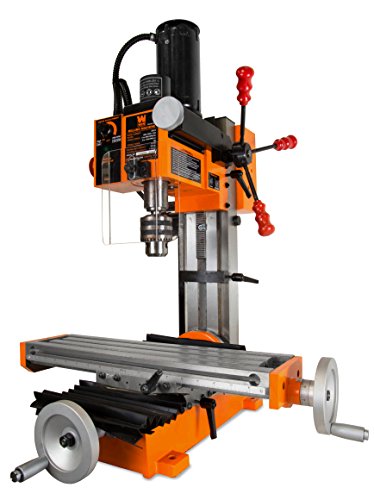
WEN 33013 Benchtop Milling Machine
What We Like
- R8 spindle taper for common tooling compatibility
- Variable speed from 100 to 2500 RPM for diverse materials
- 45-degree head bevel allows for angled milling operations
- Compact cast iron construction for stability in a small footprint
Trade-offs
- Y-axis travel of 5-1/8 inches limits work width
- At 130.1 pounds, it requires a sturdy, dedicated bench
An R8 spindle taper in a package with an 8-1/2 by 15 inch footprint makes this a serious contender for the home machinist. It offers professional tooling compatibility without needing a full-size mill that takes up a garage corner. The 45-degree head bevel and wide speed range mean you can tackle everything from steel to plastic without swapping machines. It’s built for the advanced DIYer or small shop that needs precise metalwork capability in a truly compact cast iron frame.
You trade overall capacity for that compact size, particularly in the Y-axis travel. The work envelope is sufficient for many precision parts and fixtures, but you’ll be making more setups for wider pieces. For someone needing more rigid mass and a larger table for bigger projects, the heavier Yokoma Benchtop Milling Machine is a logical step up, though it demands significantly more space.
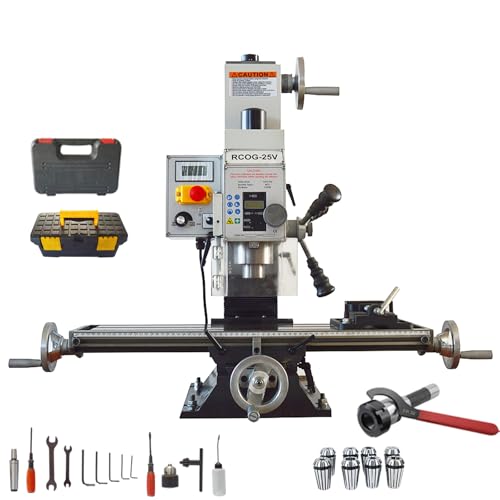
Yokoma Benchtop Milling Machine
What We Like
- Micro-feed handle with auto-return for depth control
- 90° tilting head for angled cuts without repositioning
- All-metal construction with brass gears for rigidity
- Dual LCD screens for real-time speed and depth monitoring
Trade-offs
- At 297 pounds, it requires a very sturdy, permanent bench.
- Its 37-inch length demands significant workshop floor space.
- Lacks the X-axis power feed of its larger Yokoma sibling.
Its micro-feed handle with auto-return enables fine manual adjustment of drilling and milling depths, a feature that supports accurate depth control. The machine’s solid all-metal body and brass gears are built for rigidity and stability. This construction aims to provide a durable platform for repeated milling and drilling tasks on materials like metal, wood, and plastic.
You pay for that capability with a substantial footprint and heft. This isn’t a machine you’ll tuck under a bench, as it’s built to be a workshop centerpiece. For users who need that precision but work in tighter spaces, the much smaller Proxxon Micro Mill MF 70 represents the extreme end of the compact trade-off. It sacrifices table size and power for a truly miniature form factor.
Product photos
HayWHNKN Mini Mill Drill Machine

What We Like
- Tilting spindle head with ±90° range
- 600W brushless motor for variable speed control
Trade-offs
- At 195 pounds, it requires a sturdy, permanent benchtop.
The tilting head and included MT2 collet set add to its versatility right out of the box, making it a capable all-in-one package for a home workshop. It’s a solid fit for a DIYer who needs more capacity than a micro mill but doesn’t have the space or need for an industrial-sized machine.
The trade-off for that capability is a 195-pound footprint that demands a dedicated, sturdy stand. While the MT2 spindle is common, it lacks the tooling rigidity of the R8 spindle found on heavier machines like the WEN 33013. For a user planning frequent, heavy milling in steel, that difference in spindle standard could be a limiting factor down the line.
Product photos
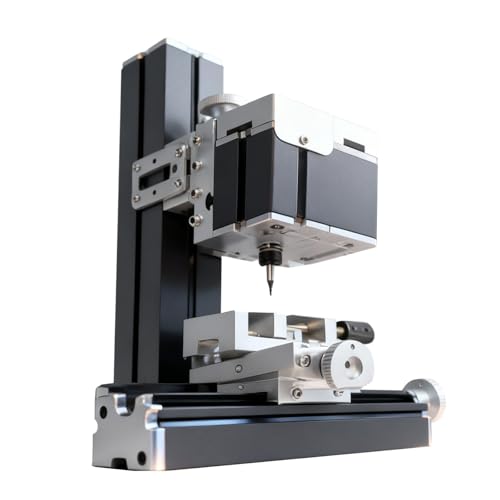
AcmeFlare Mini Milling Machine
What We Like
- Electroplated all-metal body for long-term rigidity
- 0.02mm precision on all three axes
- Triple anti-vibration design for superior finish
- Comes with scaled vise and safety adapter
Trade-offs
- 60W motor limits material removal rate on harder metals
The 0.02mm precision scaled handwheels on every axis are the core of this machine, letting you dial in cuts to a degree that’s rare at this scale. That makes the AcmeFlare ideal for the meticulous hobbyist or prototype builder working with small, intricate parts in metal, plastic, or wood where the final surface finish is critical. Its electroplated metal construction and triple anti-vibration design directly support that goal, fighting chatter to keep those fine details crisp. This is a tool for precision first and foremost.
The 60-watt motor prioritizes precision over raw material removal, so it’s better suited for fine detailing on smaller pieces than for hogging out steel. While it handles complex contours in metals, wood, and plastics, its power is less than heavier benchtop mills like the 1.5HP MechMaxx VM25LD, which occupies a larger footprint in the shop.
Product photos
INTBUYING RCOG-16V Mini Mill

What We Like
- 90-degree head tilt for angled milling and drilling
- Includes a set of R8-ER32 chucks for toolholding
- Fine 0.01mm micro-feed for precise depth control
Trade-offs
- At 215 pounds, it requires a very sturdy bench
- Scale is metric-only, which may frustrate some users
- Lacks the larger work envelope of full-size benchtop mills
That, combined with the 90-degree tilting head, makes the INTBUYING RCOG-16V a highly adaptable centerpiece for a small shop. Its 600W brushless motor provides enough torque for stainless steel and other metals, while the included R8-ER32 chucks mean you can start milling right out of the crate. This machine suits a hobbyist or DIYer who needs more capability than a micro mill but doesn’t have the floor space for a full-sized benchtop unit.
The trade-off for that capable table is mass. At 215 pounds, this isn’t a tool you’ll move around your shop easily; it demands a permanent, rock-solid stand. While its micro-feed system allows for fine adjustments, be aware that all scales are metric. If you primarily work in inches, that’s an extra mental conversion on every operation. For someone needing a truly miniature footprint above all else, the Proxxon Micro Mill MF 70 is dramatically smaller and lighter, but you sacrifice a tremendous amount of work area and power.
Product photos
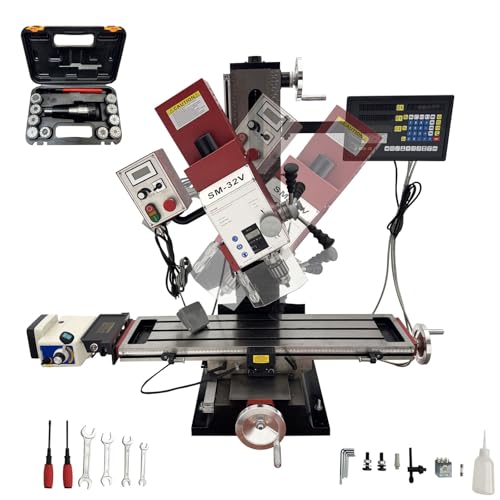
Yokoma X-Axis Power Feed Mill
What We Like
- X-axis power feed reduces manual effort.
- Large 33-inch cast iron worktable.
- High-precision 3-axis digital grating ruler.
- ±90° tilting head with 360° spindle rotation.
Trade-offs
- Weighs 523 pounds, requiring a permanent, sturdy bench.
- Footprint of 50 by 28 inches demands significant shop space.
This, combined with a substantial 33-inch worktable and a 1500W brushless motor, makes this Yokoma mill a serious contender for a small shop tackling repetitive metal or plastic work. It’s built for the user who values consistent feed rates and has outgrown purely manual machines.
Compared to a more compact option like the WEN 33013, the Yokoma demands a dedicated workshop space. For the right user, however, the power feed and large table transform it from a drilling tool into a true production-ready milling center for small batches.
Product photos
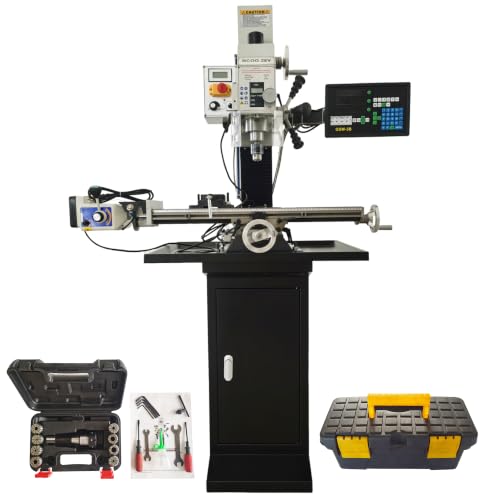
EQCOTWEA DRO Milling Machine
What We Like
- Precision 3-axis digital readout system
- Powerful 1.7HP brushless motor for tough materials
- Versatile 360° tilting and ±90° tilting head
- X-axis power feed reduces operator fatigue
Trade-offs
- At 390 pounds, it requires a very sturdy, permanent bench
- Its 63-inch height demands significant vertical clearance
A three-axis digital readout eliminates guesswork for precise metalworking, making this mill a standout for anyone tired of manual measurements. The 1.7HP brushless motor delivers reliable torque for drilling and face milling, while the R8 spindle ensures broad tooling compatibility. This combination suits a serious hobbyist or garage shop ready to step up from basic manual mills, where repeatable accuracy on complex parts is the primary goal.
Weighing 390 pounds and standing over five feet tall, this milling machine requires a dedicated, solid stand and a permanent spot in the workshop. Its substantial size is the trade-off for its capability, making it unsuitable for frequent moving. For small-scale projects in tight spaces, a tool like the 17.6-pound Proxxon Micro Mill MF 70 occupies the opposite extreme, though with less power and a smaller work area.
Product photos
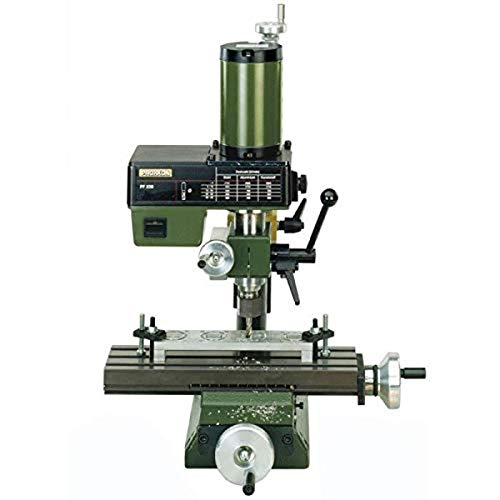
Proxxon FF 230 Micro Mill
What We Like
- German engineering and manufacturing.
- Compact 39.4 lb weight for easy benchtop placement.
- Integrated hand wheel for precise height and feed control.
Trade-offs
- Fixed head is not positionable for angled work.
- Smaller work envelope than a mid-size benchtop mill.
Weighing just 39.4 pounds, the Proxxon FF 230 is a true desktop machine that you can easily move around a workshop. Its German build quality and the hand wheel that doubles for height and fine feed adjustments deliver precise control for small-scale projects. This mill suits a hobbyist or model maker who needs a dedicated, accurate station for detailed metal or plastic work on a limited bench space. It’s a solid foundation for learning precision milling.
This German-made micro mill has a fixed head, which limits it to straightforward vertical milling operations. Research mentions indicate that a user who outgrew their Proxxon Micro Mill cited the lack of a positionable head as a reason for upgrading. That makes the FF 230 a specialist tool for small, precise work rather than a flexible solution for complex angled setups.
How We Evaluated Small Milling Machines
Our evaluation is based on manufacturer specifications, documentation, and patterns in expert round-ups and owner discussions. We focused on criteria critical for smaller shops. Physical footprint and weight determine if a machine fits your space and bench. Spindle type and work envelope dictate what you can make. Rigidity features like construction material and column design directly affect cut quality. This research-led approach identifies capable machines, but it cannot replicate the hands-on feel of operating a mill in your own workshop over time.
What To Look For In Small Milling Machines
Selecting a small mill means making smart compromises. Your shop’s size, your project materials, and your need for precision all guide the choice between a micro desktop unit and a heavier benchtop model.
Prioritize rigidity and work envelope. A cast iron base dampens vibration for better finishes, while table travel (X, Y, Z axes) defines your maximum workpiece size. Spindle taper, like R8, determines your tooling options.
Workspace & Machine Footprint
A machine’s weight and dimensions are non-negotiable for a small shop. True compact benchtop milling machines for home use can weigh under 40 pounds for easy placement, while more capable benchtop units often exceed 200 pounds, demanding a dedicated, sturdy bench. Measure not just the machine’s footprint, but also the clearance needed for the cranks and any head tilt. A machine that fits on your bench but leaves no room to work is useless.
Spindle & Work Capacity
The spindle’s taper, commonly R8 or MT3, defines your accessory compatibility, with R8 offering the widest range of affordable tooling. The worktable’s travel in the X (left-right) and Y (in-out) axes sets your maximum workpiece size. For example, a mill with 5 inches of Y-axis travel cannot mill a 6-inch-wide block. Consider future needs; a slightly larger capacity than your current projects require provides valuable flexibility.
Rigidity & Precision Controls
Rigidity is the foundation of accurate milling. Look for all-metal, preferably cast iron, construction and a square column design, which resists flex better than a round column. Features like micro-feed handwheels or digital readouts (DROs) aid in making precise, repeatable cuts. Understanding the pros and cons of a benchtop mill is key; a lighter machine saves space but may chatter on harder metals, limiting your material choices.
- Check the column design: square columns generally maintain alignment better than round ones after tramming.
- Verify the included tooling. Some mills come with a basic collet set, while others may require a separate purchase.
- Consider the motor power in context. A 60W motor suits delicate work in soft metals, but stalling on steel requires more horsepower.
- Assess speed control. Variable speed dials are more convenient than changing belts for different materials.
- Review the warranty and support availability for the brand, as parts and service matter for long-term ownership.
The most capable small mill is the heaviest and most rigid one your space and bench can safely support.
Small Milling Machines Compared
The table below compares key specifications to help you see the differences at a glance.
| Product | Spindle Speed Range | Head Tilt | Weight |
|---|---|---|---|
| Proxxon Micro Mill MF 70 | N/A | Fixed headstock | 17.6 pounds |
| MechMaxx VM25LD Benchtop Mill | 0-2500 RPM | ±90° | N/A |
| WEN 33013 Benchtop Milling Machine | 100-2500 RPM | ±45 degrees | 130.1 pounds |
| Yokoma Benchtop Milling Machine | 50-2250 RPM | ±90° | 297.0 pounds |
| HayWHNKN Mini Mill Drill Machine | 50-2250 rpm | ±90° | 195.0 pounds |
| AcmeFlare Mini Milling Machine | 20000rpm | N/A | N/A |
| INTBUYING RCOG-16V Mini Mill | 50-2250 RPM variable | Up to 90° left/right | 215.0 Pounds |
| Yokoma X-Axis Power Feed Mill | 50-2250 RPM | ±90° | 523.0 pounds |
| EQCOTWEA DRO Milling Machine | 20-2250 RPM | ±90° | 390 pounds |
| Proxxon FF 230 Micro Mill | N/A | N/A | 39.4 pounds |
Frequently Asked Questions
What is the best small milling machine for home use?
For general home use, the Proxxon Micro Mill MF 70 is an excellent starting point due to its compact size and stable design for precise small projects. If you regularly work with larger metal stock, a benchtop mill with an R8 spindle and a longer table, like the MechMaxx VM25LD, is a better long-term investment despite needing more space.
Which mini milling machine is the best for beginners?
Beginners should prioritize ease of use and safety. A mill with clear, precise controls like the Proxxon FF 230 or the AcmeFlare Mini Milling Machine allows for learning fundamentals on small-scale projects without overwhelming complexity. Avoid machines that require extensive modification or assembly to function correctly.
Can a small milling machine handle steel?
Yes, but performance depends on the machine’s rigidity and motor power. Heavier benchtop milling machines with 1HP or more, like the WEN 33013, can mill steel with appropriate feeds and speeds using small-diameter end mills. Very lightweight desktop mills are better suited for brass, aluminum, and plastics.
What is the difference between a mill and a drill press?
A milling machine moves the workpiece precisely under a stationary, side-load-resistant spindle to cut slots, faces, and contours. A drill press is designed only for vertical drilling operations; its spindle bearings are not built to handle the lateral forces of milling, which can quickly damage the tool. For milling operations, a dedicated mill is required.
Should I consider a lathe mill combo?
A lathe mill combo can be a space-saving solution for shops needing both turning and milling capabilities. However, these combination machines often involve compromises in rigidity, capacity, or convenience compared to dedicated single-function tools. They are best for light, intermittent use on smaller projects where shop footprint is the primary constraint.
The Bottom Line
For precise, small-scale work on a desktop, the Proxxon Micro Mill MF 70 is the best overall choice, offering remarkable stability in a compact package. If your budget is tight, consider the HayWHNKN Mini Mill Drill Machine for basic versatility, and for production-style jobs, look to the Yokoma X-Axis Power Feed Mill for its automated feed. Ultimately, the single most important factor is matching the machine’s rigidity and work envelope to the largest and hardest material you plan to cut, ensuring it can handle your projects without frustration.
