
10 Best Table Saw Blades For Plywood in 2026
This post contains affiliate links. As an Amazon Associate, we earn from qualifying purchases.
Our best overall plywood blade is the Freud Ultimate Plywood & Melamine Blade for its Hi-ATB teeth that virtually eliminate splintering. For pristine veneers, the Forrest Ply Veneer Saw Blade excels, while owners of portable saws should consider the Freud Thin Kerf Ultimate Plywood Blade.
Cutting plywood cleanly demands a specialized blade to prevent tear-out on the delicate face veneers. A general-purpose blade often leaves a ragged edge that requires extra sanding. We researched specifications, manufacturer data, expert round-ups, and patterns in owner feedback to select these ten blades, helping you match a blade to your specific saw and project needs.
Top 10 Table Saw Blades For Plywood in the Market
Certain content that appears on this site comes from Amazon. This content is provided "as is" and is subject to change or removal at any time.
The Best Table Saw Blades For Plywood, Reviewed
Freud Ultimate Plywood & Melamine Blade

What We Like
- Hi-ATB tooth design for splinter-free cuts
- Laser-cut anti-vibration slots reduce chatter
- Perma-Shield coating reduces drag and corrosion
- Premium TiCo carbide blend for durability
Trade-offs
- 2-degree hook angle is less aggressive for fast ripping
The Freud LU80R010 uses an 80-tooth Hi-ATB grind to produce splinter-free cuts in plywood and melamine, which means you get a clean edge straight from the saw. Its laser-cut anti-vibration slots reduce movement during the cut, leading to a crisp finish on expensive sheet goods. This design prioritizes a flawless surface over raw cutting speed.
That performance comes with some heft. At 2.0 pounds, it’s a solid blade that works best on a stable, powerful table saw. The .126-inch kerf is standard, so it will remove slightly more material than a thin-kerf option like the Freud LU79R010, which can be a consideration for underpowered saws. While it excels at crosscuts and sheet goods, that low 2-degree hook angle makes it less suited for fast, deep rip cuts in hardwoods compared to a dedicated ripping blade.
Product photos
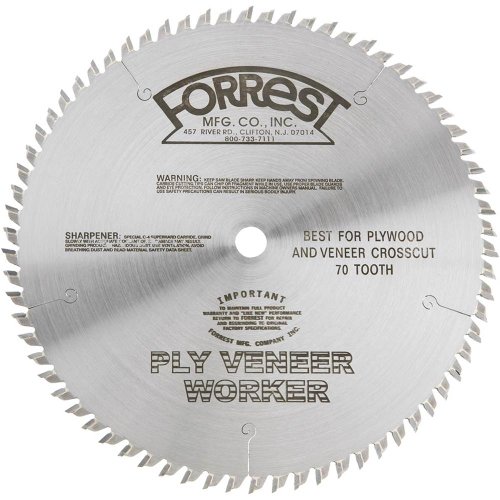
Forrest Ply Veneer Saw Blade
What We Like
- Engineered specifically for veneered plywood
- 70-tooth design for fine finish cuts
- Sold on Amazon
Trade-offs
- Heavier than the 1.7 lb Freud thin kerf blade
- A specialized blade, not a general-purpose combo
Engineered specifically for veneered plywood, this 70-tooth blade delivers a clean, tear-out-free surface on expensive sheet goods. It’s the blade you choose when the face veneer matters more than cutting speed. The design suits woodworkers who keep dedicated blades for specific tasks and value a flawless finish for cabinetry and furniture. One experienced user reports relying on Forrest blades for crosscutting and ripping on table and miter saws as a long-term choice.
The trade-off is its specialization. You wouldn’t leave this in your saw for ripping thick hardwoods or breaking down rough lumber. For those tasks, you’d switch to a dedicated rip or combination blade, like the Forrest Woodworker 2 mentioned by long-time users. Compared to a more general-purpose plywood blade like the Freud Ultimate, this one is honed for a singular, high-end purpose. It’s a premium tool for a specific, critical job in a well-equipped shop.
Product photos
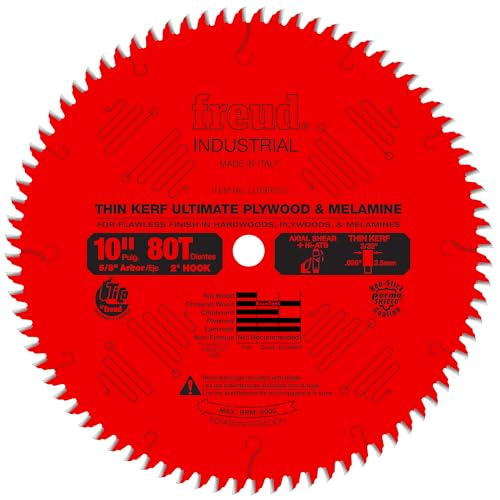
Freud Thin Kerf Ultimate Plywood Blade
What We Like
- Thin kerf design reduces load on saw motors
- Hi-ATB geometry minimizes tear-out on veneers
- Laser-cut anti-vibration slots for smoother cuts
- Perma-Shield coating reduces friction and pitch buildup
Trade-offs
- At 1.7 lb, it's lighter and potentially less rigid than the 2.0 lb Freud LU80R010
- Designed for finish cuts, not heavy ripping or construction lumber
The thin kerf design removes less material, placing less strain on a saw’s motor. This Freud blade features 80 Hi-ATB teeth and a Perma-Shield coating engineered for finish carpentry and cabinetmaking. Together, these elements deliver the chip-free, polished edges required for veneered plywood and melamine.
The trade-off for that easy cutting is inherent blade stability. A thinner plate can flex under side pressure or in very thick, dense stock. For a workshop with a powerful cabinet saw, the standard kerf Freud LU80R010 provides a more rigid platform for the same premium cut quality. But if your saw struggles, this blade’s design turns a limitation into capability, letting you achieve finish-grade results you otherwise couldn’t.
Product photos
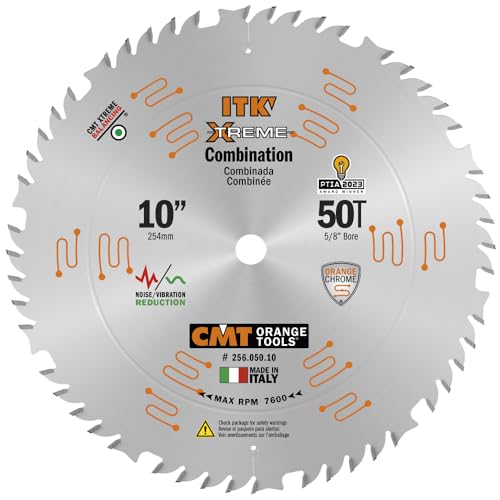
CMT ORANGE TOOLS 256.050.10 Table Saw Blade
What We Like
- Combination tooth geometry for rip and crosscuts
- Designed specifically for cutting plywood
- Moderate kerf balances power and waste
Trade-offs
- Thicker kerf requires more power than thin-kerf blades
- Kerf width of 0.102 inches is thicker than some thin-kerf blades.
CMT labels this as a combination blade, which means it’s designed to handle both rip and crosscut tasks without being swapped out. According to the manufacturer, it’s made for soft and hardwood, as well as plywood, suggesting a broad range of intended materials. This makes it a candidate for users who frequently switch between different types of wood in a single session.
That jack-of-all-trades design is also its limitation. For purely sheet goods, a blade like the Freud LU80R010 with its higher tooth count and specialized grind will produce a finer finish with less tear-out. This CMT combination blade asks you to accept a good, but not perfect, cut on veneered plywood in exchange for not needing a second blade for your 2x4s. It’s the pragmatic choice when your project list mixes sheet materials with solid wood.
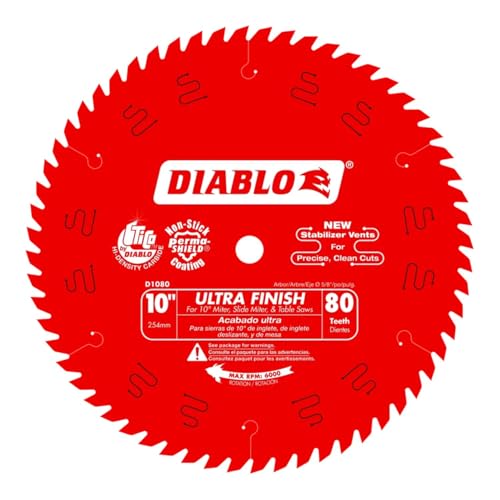
Diablo 80-Tooth ATB Saw Blade
What We Like
- 80-tooth ATB design for ultra-smooth cuts
- Premium carbide material for long-lasting sharpness
- Reduced vibration design for stability and control
- Compact, lightweight build for easy handling
Trade-offs
- At 0.812 kg, it's heavier than the 1.0 lb CMT K20010 contractor blade
- Universal 10-inch design is not specialized for plywood veneer
Its 80-tooth ATB design provides ultra-smooth, accurate cuts on wood and composite materials, which is ideal for fine woodworking and trim projects. This Diablo blade suits woodworkers seeking a polished finish from the saw to minimize sanding on hardwoods and veneered plywood. Universal compatibility lets it fit most 10-inch miter saws, table saws, and chop saws, so you can move it between tools in your shop.
You gain versatility but trade some specialization. While it handles plywood, products like the Freud Ultimate Plywood & Melamine Blade are engineered specifically for that material. The Diablo’s reduced vibration design ensures stability and smoother cuts for general fine-finish work, making it a pragmatic, all-around choice for craftsmen working with a variety of materials.
Product photos
DEWALT 80-Tooth Fine Finish Blade
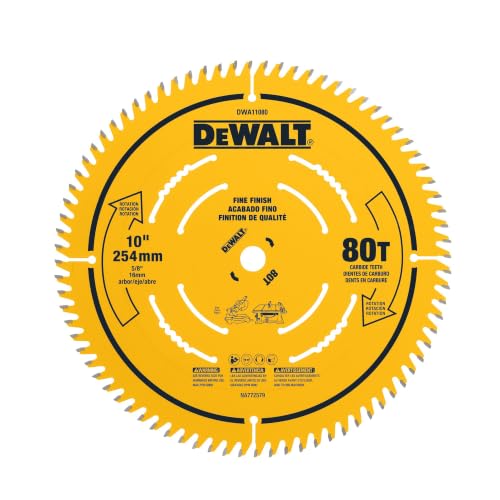
What We Like
- Patented slot design for low vibration
- Ultra sharp carbide for clean cuts
- Optimized tooth geometry for accuracy
- Designed for improved finish quality
Trade-offs
- Larger package at 13.4 inches long
- Heavier than the CMT K20010 blade
The patented body slot design is the key feature here, directly addressing the chatter and vibration that can ruin a plywood cut. This blade is built for the woodworker who values a smooth, clean finish and needs their saw to run quietly and steadily. The 80-tooth ultra-sharp carbide geometry is engineered for that purpose, making it a solid choice for fine cabinetry and finish work where tear-out is the enemy.
You trade some material efficiency for that stability, as its standard kerf is wider than a dedicated thin-kerf blade like the Freud LU79R010. That means it removes more wood per pass, which can be a consideration for high-volume projects. For general shop use where finish quality and a steady cut are the priority, however, its design delivers exactly what it promises.
CMT ORANGE TOOLS K20010 Table Saw Blade
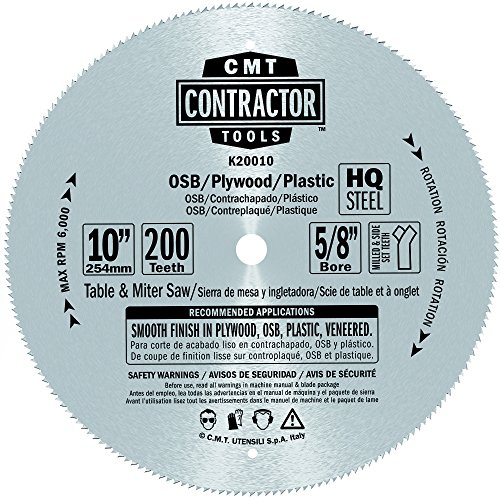
What We Like
- 200 teeth for exceptionally fine crosscuts
- Thin-kerf design reduces waste and cuts faster
- 5-degree hook angle minimizes tear-out on plywood
- Construction carbide provides longer blade life
Trade-offs
- Ultra-high tooth count reduces speed in thick rips
- 0.095-inch kerf is less stable in underpowered saws
Two hundred teeth deliver a glass-smooth surface on crosscuts, which is the whole point for finishing veneered plywood or plastic laminates. That high count, paired with a 5-degree hook angle, is engineered to score the veneer fibers cleanly before the main cut, virtually eliminating chipping. This blade is for the woodworker who values a ready-to-finish edge straight off the saw, saving hours of sanding on cabinets and furniture. It’s built for table and miter saws where precision is non-negotiable.
Achieving that finish involves a compromise on cut speed and required power. All those teeth create more friction, so feed rates slow down, especially in dense material. The thin 0.095-inch kerf saves material but can deflect if you force it or use it on a saw with a weak motor. For general shop work that includes ripping, a blade like the CMT 256.050.10 combination blade offers more versatility, but it won’t match this one’s crosscut finish on sheet goods.
Product photos
Forrest Duraline HI-AT Saw Blade
What We Like
- Heavy steel plate for maximum stability
- Negative face hook adds rigidity
- Hand-straightened for minimal run-out
- Designed specifically for melamine and plywood
Trade-offs
- 4.0-pound weight demands a well-tuned saw
A 100-tooth count and a heavy, hand-straightened plate are built for one thing: flawless cuts in veneered sheet goods. This blade is engineered to eliminate tear-out and chatter, which is why it’s a go-to for shops that can’t afford a spoiled panel. It suits the woodworker whose table saw is a central, precision instrument, not a weekend novelty. The feedback from long-term owners confirms that once you mount a Forrest blade, you stop worrying about cut quality and just focus on the build.
Weighing four pounds, this blade’s heavier steel plate maintains stability for clean cuts in melamine and plywood, but it demands a saw with a strong motor and precise arbor. One experienced woodworker reports using a Forrest Woodworker 2 combo blade for about 80% of work, reserving the Duraline HI-AT specifically for veneered plywood.
Product photos
FOXBC 90-Tooth Polished Finish Blade
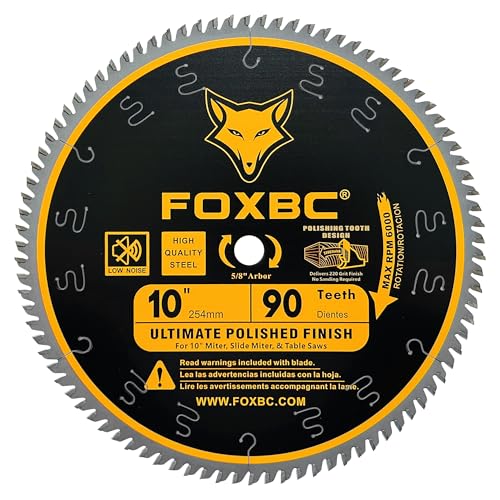
What We Like
- Double Side Grind for ultimate polished finish
- Axial Shear-face grind for clean shearing
- Ultra thin kerf reduces amp draw and waste
- Proprietary foxcarbide for durability and wear-resistance
Trade-offs
- At 1.6 pounds, it is lighter than premium blades like the Forrest Duraline
- 0.087" kerf is thinner than many, increasing potential for deflection in thick hardwood.
The 90-tooth double side grind geometry delivers a cut finish as smooth as 220-grit sandpaper right off the saw. That makes this blade a specialist for the woodworker who needs a polished surface on veneered plywood or fine molding without extra sanding steps. Its Axial Shear-face grind design and ultra-thin 0.087-inch kerf work together to shear cleanly through material with less strain on your saw motor. This smart design keeps cuts effortless and minimizes tear-out on delicate veneers.
Its double-side grind geometry produces a polished finish equal to at least 220-grit sandpaper, which means show surfaces often need no extra sanding. Achieving that fine finish can mean a slower cut speed and more potential for deflection in thicker, harder materials compared to blades with fewer teeth. For a pure plywood specialist, the Freud Ultimate Plywood & Melamine Blade offers a slightly thicker, more rigid plate. If your primary goal is eliminating post-cut sanding, however, this blade’s polished result is its defining characteristic.
Product photos
FOXBC Thin Kerf 60-Tooth Crosscut Blade

What We Like
- Thin 0.087-inch kerf reduces waste and power demand.
- ATB tooth design promotes a fine finish on plywood.
- High-density tungsten carbide ensures long blade life.
- Compatible with most major 10-inch miter and table saws.
Trade-offs
- Fewer teeth than specialized plywood blades like the 80-tooth Freud.
- General crosscut design, not optimized solely for sheet goods.
The 0.087-inch thin kerf design means less material is removed with each pass, which wastes less plywood and, according to the manufacturer, creates less vibration and noise. This blade is built for the woodworker who needs a versatile crosscutter that handles plywood cleanly alongside other hardwoods and softwoods. Its 60-tooth ATB grind is intended for fine finish crosscutting across the listed materials like oak, pine, and melamine.
You trade some ultimate polish for that versatility. For picture-perfect veneer surfaces, a dedicated plywood blade like the Freud Ultimate Plywood with its higher tooth count is designed for that specific task. The FOXBC is a pragmatic choice, listed as ideal for crosscutting oak, pine, melamine, plywood, and moulding on a single blade. It is positioned as a reliable, do-more blade for the shop.
Product photos
How We Evaluated Table Saw Blades For Plywood
Our evaluation is based on a thorough review of product specifications, manufacturer documentation, and expert recommendations from woodworking publications. We prioritized criteria that directly impact plywood cutting performance: tooth geometry for minimizing tear-out, kerf width for power demand and waste, and blade construction for stability and longevity.
We also examined patterns in long-term owner feedback regarding sharpness retention and real-world results on veneered sheet goods. An evaluation based on user reviews and specifications cannot replicate a controlled shop environment, but it helps identify the blades consistently praised for clean cuts and reliable performance.
What To Look For In Table Saw Blades For Plywood
Choosing the right blade transforms plywood from a splinter-prone material into a joy to work with. The goal is a clean, sand-ready cut on both sides of the sheet, especially critical for visible edges and veneered panels.
Look for a blade with a high alternate top bevel (Hi-ATB) tooth design and 60 to 80 teeth for a 10-inch diameter. A thin kerf reduces strain on lower-powered saws, while a full kerf offers maximum stability for cabinet saws. A near-zero or negative hook angle helps prevent tear-out on the bottom face.
Tooth Design and Count
The tooth geometry is the most critical factor for a clean plywood cut. A High Alternate Top Bevel (Hi-ATB) design is the consensus choice for sheet goods; the steep, alternating bevels create a shearing cut that slices through the cross-grain layers cleanly. For a 10-inch blade, a tooth count between 60 and 80 is ideal, providing enough scoring action for a fine finish without overly slowing the feed rate.
Blades like the CMT ORANGE TOOLS K20010 push this further with 200 teeth for an ultra-fine crosscut, but they are specialized tools not suited for general ripping.
Kerf and Hook Angle
Kerf width, the thickness of the cut the blade makes, affects both your saw’s power and your material yield. A thin kerf (often around 0.087″ to 0.095″) removes less material, reducing load on the motor of a portable or contractor saw. The trade-off is slightly less plate rigidity, which can lead to deflection in very thick hardwoods.
A full kerf is heavier and more stable, best suited for high-horsepower cabinet saws. The hook angle, or the forward lean of the tooth, should be low for plywood. A near-zero or negative hook angle presents the tooth to the wood more gently, reducing the chance of it grabbing and tearing out the bottom veneer as it exits the cut.
Blade Construction and Coating
A high-quality steel plate with precise laser-cut expansion slots minimizes vibration and “chatter,” which can mar a cut’s surface. Premium carbide tips, often a blend like TiCo (titanium and cobalt), resist heat and wear for longer life between sharpenings. Many blades also feature non-stick coatings, such as Freud’s Perma-Shield, which reduce friction, pitch buildup, and corrosion. While a heavier blade like the Forrest Duraline HI-AT indicates a thick, stable plate, it requires a well-tuned, powerful saw to run effectively.
- Check your saw’s arbor size (5/8-inch is standard for 10-inch blades).
- Ensure the blade is compatible with your saw’s maximum RPM rating.
- Consider the availability of professional sharpening services for the blade’s specific tooth grind.
- For the cleanest bottom face, always use a zero-clearance throat plate.
- Support the plywood sheet fully on both sides of the cut to prevent bending and tear-out.
The single best upgrade for clean plywood cuts is pairing a dedicated Hi-ATB blade with a zero-clearance insert.
Table Saw Blades For Plywood Compared
The following table compares the key specifications and best-use cases for all ten blades in our lineup.
| Product | Diameter | Teeth | Kerf |
|---|---|---|---|
| Freud Ultimate Plywood & Melamine Blade | 10 inches | 80 | .126" |
| Forrest Ply Veneer Saw Blade | 10 inch | 70 teeth | N/A |
| Freud Thin Kerf Ultimate Plywood Blade | 10 inches | 80 teeth | Thin Kerf |
| CMT ORANGE TOOLS 256.050.10 Table Saw Blade | 10 inches | N/A | 0.102 inch |
| Diablo 80-Tooth ATB Saw Blade | 10 inches | 80 teeth | N/A |
| DEWALT 80-Tooth Fine Finish Blade | 10 inch | 80 teeth | N/A |
| CMT ORANGE TOOLS K20010 Table Saw Blade | N/A | 200 | 0.095 inches |
| Forrest Duraline HI-AT Saw Blade | N/A | 100 | .125-Inch Kerf |
| FOXBC 90-Tooth Polished Finish Blade | 10 inches | 90 teeth | 0.087 inches |
| FOXBC Thin Kerf 60-Tooth Crosscut Blade | N/A | 60 teeth | 0.087 inches |
Frequently Asked Questions
What is the best table saw blade for cutting plywood?
The best blade for most woodworkers is a dedicated plywood blade with a High Alternate Top Bevel (Hi-ATB) tooth design and 60 to 80 teeth. Our top pick, the Freud Ultimate Plywood & Melamine Blade, uses this geometry along with laser-cut slots to minimize vibration, producing consistently splinter-free cuts in veneered sheet goods and melamine.
What type of blade is best for cutting plywood?
A blade specifically engineered for plywood, often labeled as a “plywood,” “finish,” or “crosscut” blade, is best. These blades feature a Hi-ATB tooth grind and a higher tooth count than a general-purpose blade. This design shears the wood fibers cleanly, preventing tear-out on the fragile face veneers that a standard combination blade might damage.
How many teeth blade for cutting plywood?
For a 10-inch table saw blade, aim for 60 to 80 teeth for optimal plywood cutting. This range provides a fine finish without sacrificing too much cutting speed. Some specialized blades, like the CMT K20010 with 200 teeth, are designed for ultra-fine crosscuts on veneers but are less versatile for other tasks.
What is a good 10″ table saw blade for plywood?
A good 10-inch plywood blade balances clean cuts with practical utility. The Freud Ultimate Plywood & Melamine Blade is an excellent all-around choice. For those needing one blade to handle plywood and solid lumber, the CMT ORANGE TOOLS 256.050.10 combination blade is a strong performer, while the Freud Thin Kerf version is ideal for lower-powered saws.
Can I use a general-purpose blade to cut plywood?
You can, but the results are often inferior. A standard 40-tooth combination blade is designed for a mix of ripping and crosscutting solid wood, not for the cross-grain layers of plywood. It is more likely to cause tear-out and splintering on the bottom face of the sheet, requiring significant sanding or even ruining a piece of expensive veneered plywood.
The Bottom Line
For woodworkers who regularly cut plywood and melamine, the Freud Ultimate Plywood & Melamine Blade is the best overall investment, delivering reliably clean, splinter-free cuts. If your budget is tight or your projects are mixed, the CMT ORANGE TOOLS 256.050.10 combination blade offers solid performance across plywood and solid lumber.
For those with lower-powered contractor or jobsite saws, the Freud Thin Kerf Ultimate Plywood Blade reduces motor strain without sacrificing finish quality. Ultimately, matching the blade’s tooth geometry and kerf to your specific saw and project needs is the surest path to perfect plywood cuts.
