
10 Best Table Saws For Home Use in 2026
This post contains affiliate links. As an Amazon Associate, we earn from qualifying purchases.
The best table saw for home use is the DEWALT DWE7491RS Jobsite Table Saw for its stable, accurate cuts and rolling portability. Our other top picks include the SawStop CTS-120A60 for unparalleled safety and the SKIL TS6307-00 for excellent value with a stand included. Choosing the right saw for a home shop means balancing power with footprint and accuracy with budget.
Selecting a table saw for your garage or workshop means navigating space constraints, budget, and your project ambitions. The wrong choice can leave you with a tool that’s frustrating to use or impossible to store. We researched top models to find the best options for various home woodworking needs.
This guide is based on specifications, expert round-ups, and patterns in owner feedback. You’ll find a ranked list of our picks, a detailed comparison table, and practical advice on what to look for.
Top 10 Table Saws For Home Use in the Market
Certain content that appears on this site comes from Amazon. This content is provided "as is" and is subject to change or removal at any time.
The Best Table Saws For Home Use, Reviewed
DEWALT DWE7491RS Jobsite Table Saw

What We Like
- Rack & pinion fence for fast, accurate adjustments
- Rolling stand for easy setup and transport
- Large 32-1/2 inch rip capacity for wide materials
- Comprehensive onboard storage for all accessories
Trade-offs
- Weighs 110 pounds, making the saw heavy to lift
- Lacks a dedicated power cord wrap
A 32-1/2 inch rip capacity means you can handle large sheet goods and wide shelving boards without a second thought. That rack and pinion fence system makes those adjustments smooth and repeatable, which is critical for accurate cabinetry and trim work. This saw is built for the serious DIYer or contractor who needs a portable saw that doesn’t feel flimsy. The sturdy rolling stand gets it off the ground quickly, and the onboard storage keeps the wrenches and push stick right where you need them.
The trade-off for that stability and capacity is heft. At 110 pounds, you’ll feel it when you lift the main unit, though the molded grips help. The stand sets up fast, but you do have to lift the saw to wheel it around once it’s folded. Compared to something more compact like the DEWALT DWE7485WS, this is a fuller-featured, more capable saw for larger projects, but it sacrifices some pure portability. It’s a saw designed to be moved to a job, not carried up a flight of stairs every day.
SawStop CTS-120A60 Compact Table Saw

What We Like
- Patented flesh-detection safety system stops blade on contact
- Heavy-duty construction provides stability for smooth cuts
- Rack & pinion fence is easy to adjust and stays square
- Quick tilt and micro-adjust for precise bevel angles
Trade-offs
- At 79 pounds, it's heavier than many portable benchtop saws
- Smaller rip capacity than full-size contractor or jobsite saws
The SawStop’s flesh-detection system is the single most decisive feature for any home workshop, transforming the inherent risk of table saw use. It triggers in milliseconds, dropping the blade and likely leaving only a small nick. This makes it the clear choice for anyone who values long-term safety for themselves or family members in a shared space. The saw itself is built with a heavy-duty, stable frame and a rack-and-pinion fence that stays reliably square, so your work stays accurate.
SawStop’s patented flesh-detection system is the decisive feature, designed to stop the blade instantly upon contact with skin to prevent serious injury. This safety technology comes built into the CTS-120A60, a compact saw with a heavy-duty, 79-pound construction that provides stability for smooth cuts on a job site. Its rack and pinion fence is easy to adjust and includes built-in shelves to support various workpiece sizes.
SKIL TS6307-00 Jobsite Table Saw
What We Like
- Rack-and-pinion fence for parallel, accurate cuts
- Integrated folding stand for portability and storage
- Micro-adjustable blade for parallel alignment
- Dust port elbow for easier cleanup
Trade-offs
- 4×4 max cut capacity restricts very large stock
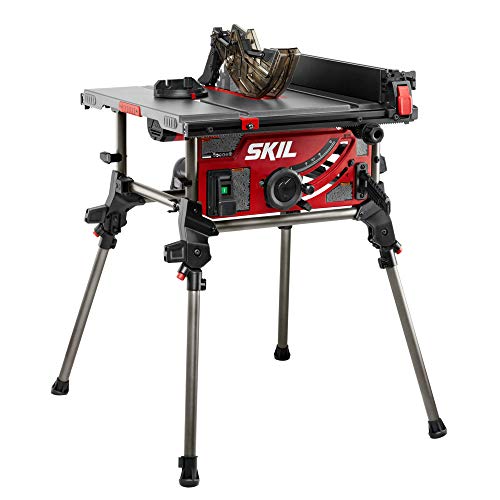
The integrated folding stand is the key here, transforming this 10-inch saw from a benchtop tool into a stable, ready-to-work station you can fold up and stash in a corner. For the home woodworker tackling decks, sheds, or furniture, that built-in stand paired with its rack-and-pinion fence delivers a core of job-site convenience and accuracy at a home-shop price. It’s a straightforward package that gets you making rip cuts, bevels, and crosscuts without fussing with a custom stand.
Weighing 51.1 pounds, this saw has a noticeable heft during transport. Its maximum cut capacity is limited to 4×4 lumber. When compared to the 66.0-pound DEWALT DWE7485WS, the SKIL model is the lighter of the two jobsite saws.
BOSCH GTS15-10 Portable Jobsite Table Saw
What We Like
- Soft-start circuitry prevents tripping breakers
- Electronic speed regulation maintains power under load
- Integrated wheeled stand makes moving and setup simple
- Quick-stop blade brake enhances safety and productivity
Trade-offs
- Weighs 103 pounds, making it heavy for frequent solo lifting
- ClampZone areas are limited to light-duty secondary work
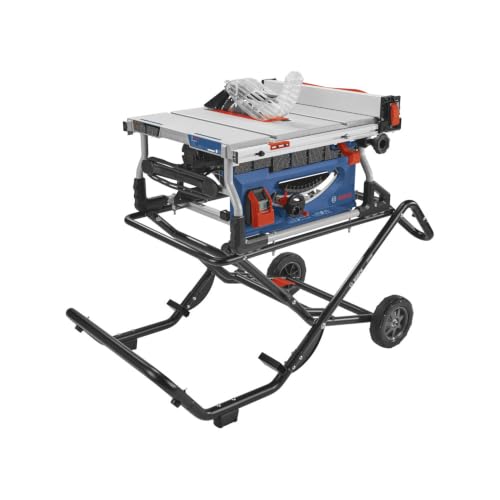
The included Gravity-Rise Wheeled Stand allows for single-action setup and takedown, making the 103-pound saw genuinely mobile around a jobsite. Adjustments to its fence are simple, using color-coded pins and a matching scale for the hand dial. A 15-amp motor runs at 3,800 rpm with electronically regulated speed to help maintain it under load.
Bosch’s soft-start is a thoughtful touch for older home workshops, and the blade brake adds a layer of safety. For a user who needs maximum portability in a lighter package, the SKIL TS6307-00 is less than half the weight, though you give up the Bosch’s refined fence system and stand convenience.
DEWALT DWE7485WS Compact Table Saw

What We Like
- 24.5-inch rip capacity handles full sheet goods
- Rack and pinion fence ensures fast, accurate adjustments
- Compact footprint eases transport and workshop storage
- Integrated stand sets up quickly and provides a stable base
Trade-offs
- At 66 pounds, it's heavy to lift without wheels
- No integrated cord wrap for tidier storage
A 24.5-inch rip capacity lets you slice a 4×8 sheet of plywood down the middle, which is a key feature for breaking down large panels in a home workshop. Its compact size is built for easy transportation and storage, suiting users who need panel-cutting capability without a permanent cabinet saw. The rack and pinion telescoping fence rails make fence adjustments fast, smooth, and accurate for consistent cuts.
You trade some convenience for that compact form. The stand is sturdy but lacks wheels, so you’ll be hefting all 66 pounds when you need to move it, though contoured grips molded into the table edges make lifting easier. For dedicated sheet good work in a confined space, this setup is hard to beat. The motor has a blade brake for safety and a power-loss reset to prevent accidental re-starts, which are thoughtful touches for regular use.
MarvTool 10-Inch Portable Table Saw

What We Like
- Very portable at just 28.3 pounds
- Powerful 15-amp motor for hardwoods and sheet goods
- Transparent blade guard for safety and visibility
- Includes dust port for vacuum connection
Trade-offs
- Shallow 2.1-inch cut depth at a 45-degree bevel
- No integrated stand or rolling base included
At 28.3 pounds, the MarvTool 10-Inch Portable Table Saw is light enough to carry from a garage to a driveway without strain. Its 15 amp motor delivers a blade speed around 4600 RPM, which provides the power for cutting hardwoods, plywood, and similar materials in a home shop. This saw suits a DIYer who needs that cutting power but must store the tool in a compact space after each use. The transparent blade guard and dust port are designed for user safety and to help manage debris in a workshop.
This saw’s 3.4-inch depth of cut at 90 degrees will handle standard lumber, but the capacity drops significantly when beveling. You trade some capacity and refinement for that portability. For a contractor needing a saw that sets up instantly on a job site, the DEWALT DWE7491RS with its folding stand is a more rugged choice. The MarvTool makes its case on a workbench or sawhorse, where its light weight and core power are most appreciated.
Product photos
Billowvolve Precision Mini Table Saw

What We Like
- Extremely portable at under 4 pounds
- Compact design fits on a desktop
- Precise rail and scale for accurate cuts
- Quiet, energy-efficient operation
Trade-offs
- Weighs only 3.7 pounds, limiting material stability
- No motor RPM or blade size specified
Weighing just 3.7 pounds, this saw is in a different class than any other tool here. It’s built for the craftsperson who needs precision cuts on miniature projects, think model making, intricate wood crafts, or cutting small pieces of plastic and circuit boards. Its aluminum alloy body and compact 18-inch footprint mean it lives on a workbench, not in a garage bay, and its low-noise motor won’t disturb a household. This is the definition of a specialty tool for detailed, lightweight materials.
Weighing just 3.7 pounds, the Billowvolve Precision Mini Table Saw is designed for easy transport and use in tight spaces where a full-size saw won’t fit. Its cutting applications are listed as circuit boards, plastic, PVC, wood, and acrylic, indicating a focus on thin, pliable materials rather than dimensional lumber. For projects requiring the breakdown of plywood or pine boards, a heavier portable model like the 66-pound DEWALT DWE7485WS would be a more suitable tool. This mini saw occupies a specific niche where its compact size is the primary advantage.
Product photos
EVOLUTION R8MTS Convertible Miter/Table Saw

What We Like
- Converts between miter saw and table saw.
- Cuts wood, plastic, and metal with one blade.
- Compact, 28.6 lb design for easy transport.
- Integrated blade guard and riving knife for safety.
Trade-offs
- Rip capacity is limited to 1-1/2 inches.
- Smaller 8-1/4 inch blade limits cut depth.
- Cast aluminum table is smaller than dedicated saws.
Combining a miter saw and table saw in one 28.6-pound tool saves significant space, a major advantage for tight workshops or job sites. Switching between modes uses simple locking pins, allowing a single tool to perform both crosscuts and rip cuts. Its included TCT blade cuts wood, plastic, and mild steel without needing a change, which simplifies projects involving different materials.
The trade-off for that compact versatility is in capacity. That 1-1/2 inch rip fence won’t handle sheet goods or wide boards, making it unsuitable for cabinetry. The 8-1/4 inch blade also limits cut depth compared to standard 10-inch table saws. For dedicated, larger woodworking, a tool like the DEWALT DWE7491RS with its 32-1/2 inch rip capacity is the clear choice. But if your projects are small-scale and your bench space is smaller, this 2-in-1 design covers remarkable ground.
Product photos
BOSCH GTS18V-08N Cordless Table Saw

What We Like
- True cordless mobility with 18V battery platform
- Rack-and-pinion fence for quick, accurate adjustments
- Integrated storage for fence, gauge, and safety gear
- Powerful brushless motor matches corded performance
Trade-offs
- 53.6 lb weight demands consideration for frequent transport
- 8-1/4 inch blade limits depth compared to 10-inch saws
A 25-inch rip capacity lets you handle sheet goods and wide boards without compromise, even though it runs on a cordless battery. This Bosch saw delivers professional power away from an outlet, useful for framing a shed or installing flooring. Its fence system uses a rack-and-pinion design that locks down precisely, so you spend less time adjusting and more time making straight cuts. The tool provides the core utility of a corded jobsite saw but without the cord.
With an 8-1/4 inch blade, this saw won’t plow through thick material like a 10-inch model, making it less suited for heavy timber work. You trade some cutting depth for that cordless freedom. Compared to a corded workhorse like the DEWALT DWE7491RS, you’re choosing ultimate portability over maximum capacity and continuous runtime. For trim, decking, and general construction, the Bosch’s performance is liberating, but you must factor in the cost of the high-power battery system it needs to run.
Product photos
SawStop JSS-120A60 Jobsite Saw PRO
What We Like
- Class-leading table depth enhances control for large cuts.
- Patented safety system prevents serious injury.
- Compact stowed size simplifies transport and storage.
- One-turn elevation system allows fast blade adjustments.
Trade-offs
- At 113 lb, it is the heaviest jobsite saw in the guide.
- Stowed length of 26.5 inches requires significant vehicle space.
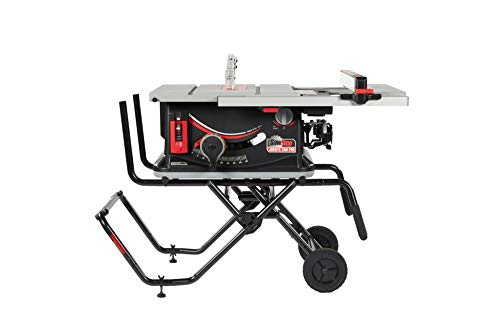
With a 24 5/8-inch table depth, this saw provides a class-leading work surface that enhances accuracy and control during large cuts, making it easier to handle sheet goods and long boards. It includes SawStop’s patented flesh-detection safety system, which detects contact with skin and stops the blade in under 5 milliseconds to prevent serious injury. For the serious home woodworker tackling cabinetry or furniture, this combination of a large table and integrated safety technology defines its position in the market.
That capability and safety come with a real-world trade-off in bulk and weight. At 113 pounds on its cart, this is a substantial machine to maneuver, even with its wheels. While its stowed profile is compact for its capacity, it’s still a larger package to load than something like the DEWALT DWE7485WS. You’re trading ultimate portability for a vastly more capable cutting platform and unparalleled safety. For the user who needs that large-table performance and values injury prevention above all, the compromise is an easy one to make.
Product photos
How We Evaluated Table Saws
Our selection is based on manufacturer specifications, expert reviews from professional woodworking publications, and consistent themes found in owner feedback. This method allows for an evaluation of performance, features, and long-term reliability.
The primary criteria were cutting capacity, fence system quality, portability, and safety features. For home use, a precise and easy-to-adjust fence is critical for repeatable cuts, while a stable base is essential for accurate results. We also prioritized models that offer a good balance of power and footprint for typical garage workshops.
Our research-led evaluation has limits; it can’t replicate the feel of a saw’s controls over hundreds of hours. We focused on documented performance, verified features, and widely reported user experiences to make our recommendations.
What To Look For In Table Saws
Choosing a table saw involves matching its core specifications to your most frequent projects and available workshop space. Portability, cutting depth, and fence precision are the most important factors.
Look for a powerful 15-amp motor, a fence that locks securely and stays parallel to the blade, and a stand that provides stability without sacrificing easy storage. Your choice should be guided by the size of material you most often cut and where you’ll store the saw.
Motor Power and Blade Size
A 15-amp motor is standard for most home table saws and provides enough power for hardwoods and sheet goods. A 10-inch blade is the most common size, offering a good balance of cutting depth and blade availability, but some compact saws use an 8-1/4 inch blade. For general woodworking, a 10-inch saw can typically cut over 3 inches deep at 90 degrees, which is sufficient for most dimensional lumber. A higher horsepower rating, often found in premium cabinet saws, helps maintain speed under load when ripping thick stock.
Rip Capacity and Fence System
Rip capacity determines the width of material you can cut between the blade and the fence. For breaking down 4×8 plywood sheets, you need at least 24 to 32 inches of capacity. The fence system is arguably the most critical component for accuracy. A rack-and-pinion fence, found on many top-rated jobsite saws, allows for fast, parallel adjustments and reliable locking. A poorly designed fence that deflects or doesn’t stay square will ruin your workpieces and compromise safety. For hobby woodworking, a solid, accurate fence is more important than maximum horsepower.
Portability and Stand Design
Consider how you’ll move and store the saw. A benchtop model is light and portable but requires a separate, stable surface. A jobsite saw with a folding, wheeled stand offers the best combination of stability and transport.
Weight is a key factor; a saw over 100 pounds is stable but difficult for one person to lift into a vehicle. Integrated stands with gravity-rise mechanisms or simple folding legs greatly enhance a saw’s utility in a home shop where space is at a premium.
Learning how to use a table saw safely begins with having it on a solid, level base.
–
Assess the maximum cut depth at 45 degrees for beveled cuts on thick material.
–
Check for onboard storage for the fence, miter gauge, push sticks, and blade guard.
–
Look for a standard dust port diameter (usually 2-1/2 inches) to connect a shop vacuum.
–
Verify that the saw includes a riving knife to prevent kickback.
–
Consider if you need a zero-clearance throat plate or dado insert as an accessory.
A good rule of thumb: Your saw’s rip capacity should exceed the width of your most common project panels by several inches.
Table Saws For Home Use Compared
The comparison table below outlines the key specifications and features of our top picks to help you see the differences at a glance.
| Product | Motor | Weight | Blade Size |
|---|---|---|---|
| DEWALT DWE7491RS Jobsite Table Saw | 15 Amp, 4800 RPM | 110.0 Pounds | 10 Inch |
| SawStop CTS-120A60 Compact Table Saw | 15A, 120V, 60Hz | 79.0 Pounds | N/A |
| SKIL TS6307-00 Jobsite Table Saw | 15 Amp | 51.1 Pounds | 10 Inch |
| BOSCH GTS15-10 Portable Jobsite Table Saw | 15 Amp | 103.0 pounds | 10 Inch |
| DEWALT DWE7485WS Compact Table Saw | N/A | 66.0 pounds | 8-1/4 inch |
| MarvTool 10-Inch Portable Table Saw | 15 amp | 28.3 pounds | 10 inch |
| Billowvolve Precision Mini Table Saw | N/A | 3.7 pounds | N/A |
| EVOLUTION R8MTS Convertible Miter/Table Saw | 12 Amp | 28.6 pounds | 8-1/4 inches |
| BOSCH GTS18V-08N Cordless Table Saw | N/A | 53.6 pounds | 8-1/4 inches |
| SawStop JSS-120A60 Jobsite Saw PRO | 1 1/2 HP, 120V, 60Hz | 113 pounds | N/A |
Frequently Asked Questions
What is the best table saw for home use?
For most serious home woodworkers, the best overall table saw is the DEWALT DWE7491RS. It combines a highly accurate rack-and-pinion fence, a large rip capacity for sheet goods, and a rolling stand for easy setup and storage, making it a versatile and capable tool for a home workshop.
What is the best table saw for value for money?
The SKIL TS6307-00 offers the best value with a stand included. It provides a stable, accurate cutting platform with a rack-and-pinion fence system at a very affordable price point, making it ideal for DIYers and weekend woodworkers who need solid performance without a premium investment.
Is Dewalt or Milwaukee table saw better?
Our research for home use favors Dewalt in this category, specifically for its excellent fence systems and integrated stands on models like the DWE7491RS. While Milwaukee makes capable tools, the available models and features in the portable jobsite category currently make Dewalt a stronger contender for most home workshops.
Are Harbor Freight table saws any good?
Harbor Freight sells budget table saws that can handle light-duty tasks, but they typically lack the precise fence systems, motor power, and long-term durability found in our recommended picks. For frequent or precise woodworking, investing in a proven brand from our list is generally a wiser choice.
Should I get a cordless table saw?
A cordless table saw, like the BOSCH GTS18V-08N, is an excellent choice if you often work away from a power outlet or on outdoor projects. Their performance now rivals corded saws for many tasks, but be prepared for the trade-off of a higher initial cost for batteries and potentially shallower cut capacity compared to 10-inch corded models.
The Bottom Line
The DEWALT DWE7491RS is our best overall pick for the serious home woodworker who needs a saw that delivers accurate, stable cuts on large materials and can be easily rolled into a corner. Its rack-and-pinion fence and comprehensive stand make it a reliable centerpiece for a home workshop.
If your top priority is preventing injury, choose the SawStop CTS-120A60. For those on a tight budget, the SKIL TS6307-00 provides remarkable value with its included stand. Always match the saw’s rip capacity and portability to your most common projects and your available storage space.
