
Composite vs Aluminum Air Impact Wrench: Key Differences
This post contains affiliate links. As an Amazon Associate, we earn from qualifying purchases.
A composite air impact wrench uses a lightweight polymer body, while an aluminum model uses a metal housing. The choice isn’t about raw power, both can deliver over 1,400 ft-lbs, but about matching the tool’s material to your work environment, budget, and tolerance for weight versus long-term repairability. For daily professional shop use with a focus on durability and serviceability, aluminum often wins. For reducing arm fatigue in overhead work or cold-weather comfort, composite is the better buy.
That torque figure isn’t a guess. It’s a specific, measurable output defined by how long you run the tool under pressure. Two manufacturers can claim “700 ft-lbs” and mean completely different things based on their testing methods. The real difference between a composite vs aluminum air impact wrench starts there, in the fine print of the spec sheet, not the color of the housing.
What follows is a breakdown of the specs that matter in a composite vs aluminum air impact wrench, the long-term realities each material faces in a shop, and a straightforward guide to picking the one that won’t let you down on the third stubborn lug nut of the day.
Key Takeaways
- Match the air supply hose size to the tool’s inlet. Running a 1-inch wrench on a hose smaller than the recommended size can significantly slash output.
- Composite bodies are typically lighter than comparable aluminum models, which makes overhead work much easier.
- The warranty gap is real: Powermate offers 2 years, SATA offers 3 months. Read the fine print as a signal of expected lifespan.
- Working torque and maximum torque are not the same, and sources disagree on how they are measured. SATA defines working torque as output accumulated over 5 seconds; other brands like JET and Lematec list similar metrics but may not specify the same testing duration, making direct comparisons misleading.
- For heavy, daily industrial use where repairability is key, aluminum’s serviceable metal housing is the safer long-term bet.
The Torque Spec Trap: How Manufacturers Measure Power
You can’t compare impact wrenches by the biggest number on the box. Two tools both rated for 700 ft-lbs might perform wildly differently on the same seized bolt. The reason lives in the manufacturer’s testing methodology, a detail most spec sheets bury.
SATA provides the clearest, most rigorous definition in their Dr. Composite series manual. They state:
Working torque refers to the accumulated torque actually output by the tool running forward for 5 seconds under working pressure. Maximum reversing torque refers to the torque actually accumulated when the tool reverses for 15 seconds under operating air pressure.
This turns a vague “power” claim into a reproducible, timed test. A SATA tool’s rating tells you what it can sustain, not just a theoretical peak it hits for a split second. Other brands are less transparent. The JET 400247 sheet lists “Max. Torque” and “Working Torque” but doesn’t define the duration for the max rating. Lematec lists “Max Nut-Busting Torque” without a timed context, leaving you to wonder if it’s a peak or a sustained value.
This discrepancy makes a head-to-head spec table essential when evaluating a composite vs aluminum air impact wrench. The numbers below are pulled directly from official manufacturer sources. OEM websites and PDF spec sheets, not marketing copy.
| Model & Material | Max. Torque (Reverse) | Working Torque (Forward) | Free Speed (RPM) | Key Spec Note |
|---|---|---|---|---|
| JET 400247 (Composite) | 700 ft-lb | 550 ft-lb (listed as PSI, likely a typo) | 8,500 | Spec sheet lists separate “Max” and “Working” torque. |
| Ingersoll Rand 2100G (Composite) | 550 ft-lb | Not specified | 9,500 | ISO 15744 sound level measured at 84.9 dB(A). |
| Powermate Px Pro (Composite) | 600 ft-lb | Not specified | 8,000 | Requires 8.0 CFM at 90 PSI. |
| SATA 02136 (Composite) | 1050 N·m (~774 ft-lb) | 800 N·m (~590 ft-lb) | Not specified | Torque defined over 5-second (working) and 15-second (max) tests. |
The lesson is in the rightmost column. A higher “max” number doesn’t guarantee more usable power if the tool can’t hold it. When you’re comparing, check the specifications for the working torque or the testing standard. If it’s not there, treat the big headline number with suspicion.
Weight, Grip, and the All-Day Comfort Factor
The weight difference isn’t subtle. Pick up a 1/2-inch aluminum impact wrench, then a composite one. Your shoulder will notice the difference by lunchtime.
The numbers from the fact sheet are concrete. That’s nearly a pound heavier, which translates directly into arm fatigue during repetitive tasks like tire rotations or suspension work.
Common mistake: Choosing a tool based on torque alone for overhead work. A lighter composite gun saves your rotator cuff on the tenth strut bolt of the day, even if its spec sheet torque is marginally lower.
But weight is only half the ergonomic story. The grip is the other.
A composite housing doesn’t transmit cold like metal. On a winter morning in an unheated shop, an aluminum tool is painfully cold to the touch for the first few minutes. Composite stays closer to ambient temperature. It also has a different surface texture, often a softer, rubberized overmold, that provides more friction when your hands are greasy. Aluminum grips are typically knurled or checkered bare metal, which can feel slick.
The trade-off is in the hand-feel of power. Aluminum has a dense, solid vibration that some mechanics interpret as “toughness.” Composite can feel slightly hollow or muted. That’s not a lack of strength; it’s the material damping vibration before it reaches your hand, which is a feature, not a bug. Lower numbers mean less fatigue.
Durability and Repairability: The Long Shop View

Drop a steel socket on the concrete floor. It rings, maybe dents, but you pick it up and use it. Drop a plastic trim clip. It shatters. This basic analogy frames the durability debate, but the reality for impact wrenches is more nuanced.
Aluminum bodies can dent. If you drop a gun from a ladder onto a shop floor, the aluminum housing might deform around the motor case. This can look ugly, but it rarely stops the tool from working. The metal absorbs the impact by bending. A composite body, made from high-strength, fiber-reinforced polymer, is designed not to dent but to flex and return to shape. However, if the impact stress exceeds its flexural strength, it can crack. A crack in a composite shell is often a death sentence for the tool’s structural integrity, while a dented aluminum shell is just a cosmetic flaw.
The real divider is what happens inside the shell when it’s time for service.
Aluminum housings are typically assemblies of cast or machined parts screwed together. You can unbolt the end cap, the trigger valve, the motor cylinder. Every major component is accessible for replacement. This design philosophy assumes the tool will be rebuilt. Composite bodies often use a clamshell design where two polymer halves are fused or heavily bonded around the internal mechanism. Getting inside requires breaking seals or cutting plastic tabs. The goal here isn’t repair; it’s sealed-unit longevity.
This is why warranty length becomes a telling data point. That’s a massive difference in manufacturer confidence. It doesn’t mean the SATA tool is bad, it might be aimed at a different, perhaps more cost-sensitive market, but it clearly signals a different expectation of product life and support.
For a professional whose livelihood depends on a reliable tool, the ability to buy a $30 rebuild kit and service the gun on a Saturday morning is a tangible advantage; see our picks for the best air impact wrenches to find durable models. It turns a potential $300 replacement into a $30 repair. The composite tool’s path is usually warranty replacement or outright disposal.
Air and Oil: The System Behind the Tool
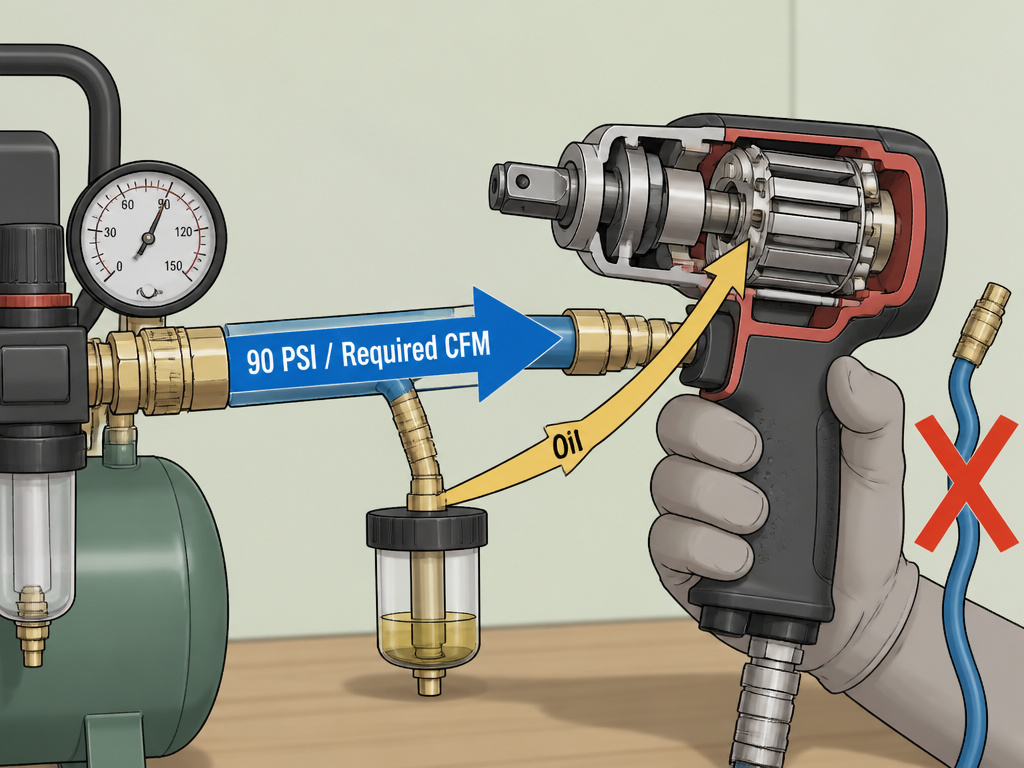
An impact wrench is only as good as the air system feeding it. This is the great equalizer between materials. A starved tool, whether composite or aluminum, is a useless tool.
The required air supply is measured in CFM (Cubic Feet per Minute) at a specific pressure, usually 90 PSI. If your compressor can’t deliver that continuous flow, the tool will stall, and you’ll blame the gun instead of the air supply.
Where this goes sideways: Connecting a high-demand tool with a restrictive hose. The JET 400424 1-inch composite wrench explicitly warns that using a hose smaller than 1/2-inch internal diameter will prevent it from reaching full output torque. The air can’t get through fast enough.
The other essential requirement is lubrication. All pneumatic tools, regardless of housing material, have steel vanes, rotors, and seals inside that will die a dry, squealing death without oil. The rule isn’t “when you remember.” It’s a scheduled ritual.
Skipping this turns your expensive impact wrench into a paperweight within months. An inline oiler automates this, but you must check it has oil.
Aluminum tools are no different. The need for oil is a function of the pneumatic motor, not the housing material. The difference is that a gummed-up, unoiled aluminum tool might be salvageable with a tear-down and soak. A seized composite tool often isn’t worth the repair attempt.
The Real-World Decision: A Flowchart
You have the specs. You know the trade-offs. How do you choose? Forget “it depends.” Now we can make a decision.
Start with your use case. Are you a DIYer changing tires twice a year, or a shop technician running the gun eight hours a day?
For the professional mechanic or industrial technician: Lean aluminum. The decision hinges on repairability and the expectation of decades of service. The aluminum housing is a known quantity, it dents, it’s cold, it’s heavier, but you can rebuild it. Brands like Ingersoll Rand (for their professional-grade metal tools) are built for this life. The Airpro SA22153 is a classic example of this breed. The upfront cost might be higher, but the total cost of ownership over ten years is lower.
For the dedicated home garage warrior or technician doing lots of overhead work: Composite is a strong contender. The weight savings are real. The vibration damping matters after the fiftieth bolt. Just go in with eyes open: you’re trading some long-term serviceability for daily comfort. Buy from a brand with a solid warranty, like Powermate’s 2-year coverage, and pair it with a meticulous oiling routine.
For ultra-heavy-duty industrial applications (think mining, heavy truck, shipbuilding): This is where drive size and pure torque matter more than body material. The Puncham PH-601 (aluminum) and the JET 400424 (composite) both offer 1-inch drives and torque in the 1,200-1,500 ft-lb range. At this level, the choice may come down to the specific model’s balance and the shop’s existing maintenance protocols for their air tools.
Compact/stubby models for tight spaces
When working in confined areas like engine bays or wheel wells, the overall length and head size of an impact wrench become critical. While the fact sheet does not list specific stubby models, the principle applies to all impact wrenches. A shorter tool body allows you to maneuver around obstacles where a standard-length wrench won’t fit. The goal is to maintain torque output in a smaller package. For tight spaces, prioritize the tool’s physical dimensions and its anvil design to ensure it can reach fasteners without sacrificing the power needed to break them loose or torque them down correctly.
Cordless vs. Air comparison (context for material choice)
The choice between cordless and air-powered tools directly influences the relevance of a composite or aluminum housing. Air tools require a compressor and hose, which tether you to a power source but deliver consistent, high power. Cordless tools offer portability and quick setup. This distinction matters for material choice because a cordless tool’s battery adds significant weight; a lightweight composite body can help balance the overall heft. For air tools, the material choice is more about durability, temperature resistance, and cost, as the air hose is the primary tether, not a heavy battery pack.
Frequently Asked Questions
Is 300 ft-lbs enough to remove lug nuts?
For most passenger cars, yes. A typical passenger car lug nut is torqued to a specification often within a common range (e.g., 80-100 ft-lbs for many vehicles). A 300 ft-lb wrench has more than enough breakaway torque to handle rust and corrosion. For larger trucks or overtightened lugs, you’d want more power, but 300 ft-lbs is a solid baseline for DIY automotive work.
Are Harbor Freight air impact wrenches any good?
They fill a specific niche. Brands like Central Pneumatic (Harbor Freight’s house line) offer incredible value for the occasional user. For a DIYer who needs a tool for a few projects a year, budget-friendly options may be adequate. For daily professional use, where reliability and consistency are critical, investing in a tool from a dedicated pneumatic brand like Ingersoll Rand, JET, or even a pro-grade Airpro model is a wiser long-term decision. The difference between budget and professional tools often lies in components and construction designed for different levels of use.
What is the most reliable impact wrench?
There is no single “most reliable” tool. Reliability is a function of proper maintenance matched to appropriate use. An aluminum Ingersoll Rand impact wrench that is oiled daily and used within its CFM range will outlast a neglected top-tier model. For professional environments, tools with traditional metal housings and rebuild kits available, like many from the Ingersoll Rand professional series or Chicago Pneumatic, have a proven decades-long track record of reliability because they are designed to be serviced, not replaced.
Which is better for cold climates, composite or aluminum?
Composite, without a doubt. Aluminum acts as a heat sink, drawing warmth from your hand and feeling intensely cold in low temperatures. Composite is a thermal insulator. It won’t warm up much, but it also won’t actively steal heat from your skin, making it far more comfortable to use in an unheated garage or outdoor winter conditions.
The Bottom Line
Be honest. You’re not just buying a material; you’re choosing a long-term relationship with a tool.
If your work is predictable, your shop is organized, and you value a tool you can fix yourself for decades, the aluminum path is clear. You accept the extra weight and the cold mornings for the confidence that a rebuild kit is always an option. Look at the Airpro SA22153 or similar industrial aluminum models.
If your work involves angles that strain your body, you work in the cold, or you simply want the lightest, least fatiguing tool for the power, composite is the modern answer. Just commit to its care, meticulous oiling and respecting its warranty period. The Ingersoll Rand 2100G or JET 400247 are your targets.
One final, grounded rule: before you buy any air tool, check your compressor’s CFM output at 90 PSI and ensure your air hose is the right internal diameter. The best impact wrench in the world is just a expensive paperweight if your air supply can’t feed it. Your choice between composite and aluminum only matters after that fundamental box is checked.
