
Concrete Saw vs Angle Grinder: When to Use Each Tool
This post contains affiliate links. As an Amazon Associate, we earn from qualifying purchases.
For most concrete and masonry jobs, the choice between a concrete saw and an angle grinder comes down to depth and finish. A concrete saw, especially a flush-cut model, is built for deep, straight cuts right against a wall or floor. An angle grinder is a versatile handheld tool perfect for scoring, notching, grinding, and cutting to a shallow depth. The debate of concrete saw vs angle grinder often centers on these capability differences. For trimming a door threshold flush or cutting a new plumbing line through a slab, you need the concrete saw. For cutting a curve in a paver or cleaning up a rough edge, the grinder is your tool, though sources disagree on its effectiveness for deeper, more precise curves compared to specialized saws.
That depth limit is the line. It’s not about power, a big grinder spins faster than many saws. It’s about blade orientation and tool design. A concrete saw’s blade is mounted to plunge or run parallel to the work surface, transferring force directly into the cut. An angle grinder’s blade spins perpendicular to the tool, making it a champion of the surface but a struggler in the deep.
What follows is a breakdown of specs, a direct comparison table, and the specific scenarios in the concrete saw vs angle grinder debate where each tool not only works but is the only logical choice. By the end, you’ll match the job to the tool without second-guessing.
Key Takeaways
- Use a concrete saw for any deep cut or that needs to be perfectly flush against another surface; its side-mounted blade and dedicated design handle the side-loading forces that quickly destroy an angle grinder’s disc.
- An angle grinder is the right tool for scoring, notching, shaping curves, or surface grinding; its lightweight design and perpendicular blade offer control for detail work but limit effective cutting depth.
- According to Blades Direct, wet cutting is preferred for flush cut concrete saws, and water-fed saws are commonly used indoors to control hazardous silica dust.
- Check for active safety recalls before using any grinder; models from major brands like Milwaukee and DEWALT have been recalled for wheels detaching or switches failing, a stark reminder that PPE is mandatory, not optional.
- For many DIY concrete tasks like cutting pavers or block, an angle grinder can be an economical choice; however, Blades Direct states that for serious concrete trimming, a flush cut concrete saw is the superior choice.
The Core Difference: Cutting vs. Grinding
The names tell you everything. A concrete saw is built to cut. An angle grinder is built to grind. This is a fundamental difference in how force is applied to the material.
A flush-cut concrete saw uses a side-mounted diamond blade that spins parallel to the cutting surface. This design allows the blade to sit flat against a wall or floor and travel straight down or along it. The motor and gearbox are designed for the constant, heavy side-loading pressure of pushing a blade through several inches of aggregate. According to tool retailer Blades Direct, this design is what allows for “deeper, more precise flush cuts” right up against obstructions where a standard saw can’t fit.
A flush-cut concrete saw is a specialized tool designed to cut concrete surfaces flush against walls, floors, curbs, or slabs where standard saws cannot reach. Its side-mounted blade spins parallel to the work surface, enabling precise trimming in demolition, remodeling, and repair work.
An angle grinder, in contrast, has its blade mounted at a 90-degree angle to the motor shaft. You attack the work with the edge of the disc. This is phenomenal for grinding down a weld, slicing through rebar, or scoring a line. It’s terrible for trying to bore straight down. The tool wants to skate across the surface, and forcing it into a deep, plunging cut invites violent kickback. That’s why even for cutting, its role is scoring. A source citing professional masonry advice notes its use for shallow curve outlines in asphalt or deep scoring passes.
So, the core mechanical truth: a saw is for penetration, a grinder is for abrasion. One bores, the other wears. Confuse them, and you’ll either burn out a $15 diamond disc in minutes or spend all day making a dusty, ragged mess of a simple cut.
Head-to-Head Comparison Table
This table cuts through the noise. It compares the two tools across the dimensions that matter when you’re on the clock or planning a project budget.
| Feature | Concrete Saw (Flush-Cut) | Angle Grinder |
|---|---|---|
| Primary Action | Cutting & plunging | Grinding, cutting, sanding, polishing |
| Blade Orientation | Parallel to work surface | Perpendicular to tool |
| Max Effective Cut Depth | Several inches (blade-dependent) | ~1.5 inches (scoring depth) |
| Best For | Deep straight cuts, flush trimming, slab work | Shallow cuts, curves, notching, surface prep |
| Dust Control | Designed for wet cutting (standard) | Primarily dry; some dust extraction ports |
| Precision & Control | High for straight, flush lines | High for detailed, curved work |
| Typical Power Source | Gas, electric (corded/cordless) | Electric (corded & corded/cordless) |
| Portability & Weight | Heavier, often two-handed | Lightweight (4.6–5.1 lbs), handheld |
The concrete saw vs angle grinder table shows why this isn’t a true either/or choice. They overlap at the shallow end of the pool, but their strengths diverge completely beyond that. Trying to use a grinder for a deep cut is a recipe for frustration and a broken disc. Using a concrete saw to cut a curve or detail a piece of block is like using a sledgehammer to drive a finish nail.
When to Use a Concrete Saw (And Which Kind)
You need a concrete saw when the cut depth exceeds the thickness of a brick, or when the finish needs to be clean and flush. Its habitat is the world of foundations, slabs, and structural work.
The most common type for the jobs a DIYer or contractor might encounter is the flush-cut concrete saw. As defined by Blades Direct, this tool is “used extensively in demolition, remodeling, plumbing, electrical, masonry, and concrete repair.” Think about removing a section of basement floor for a new drain line, trimming a concrete patio slab that has heaved, or cutting out a section of wall for a new window. In all these cases, you need to cut right up against another surface without damaging it. A standard circular saw or walk-behind saw can’t get that close. The flush-cut saw, with its blade mounted on the side, can.
Where this goes sideways: Using a dry concrete saw indoors. Silica dust from concrete is a severe health hazard, and dry cutting generates clouds of it. Wet cutting isn’t just about blade life, it’s a primary health control. Water-fed saws are the standard for indoor and finished surfaces for this exact reason.
Here are the concrete tasks that demand a saw:
- Slab Removal or Modification: Cutting control joints in a new patio, removing a section of driveway, or cutting an access hole in a basement floor.
- Precision Flush Trimming: Trimming a door threshold flush with the finished floor, cutting back a concrete curb, or removing a protruding section of foundation wall.
- Deep Penetration: Any cut required to go through a standard 4-inch concrete block or beyond the 1.5-inch scoring depth of a grinder.
For these, you’re either buying a specialized tool or, more likely, renting one. The rental counter is where this decision gets real. If your job fits the list above, rent the saw.
When an Angle Grinder Is the Right Tool
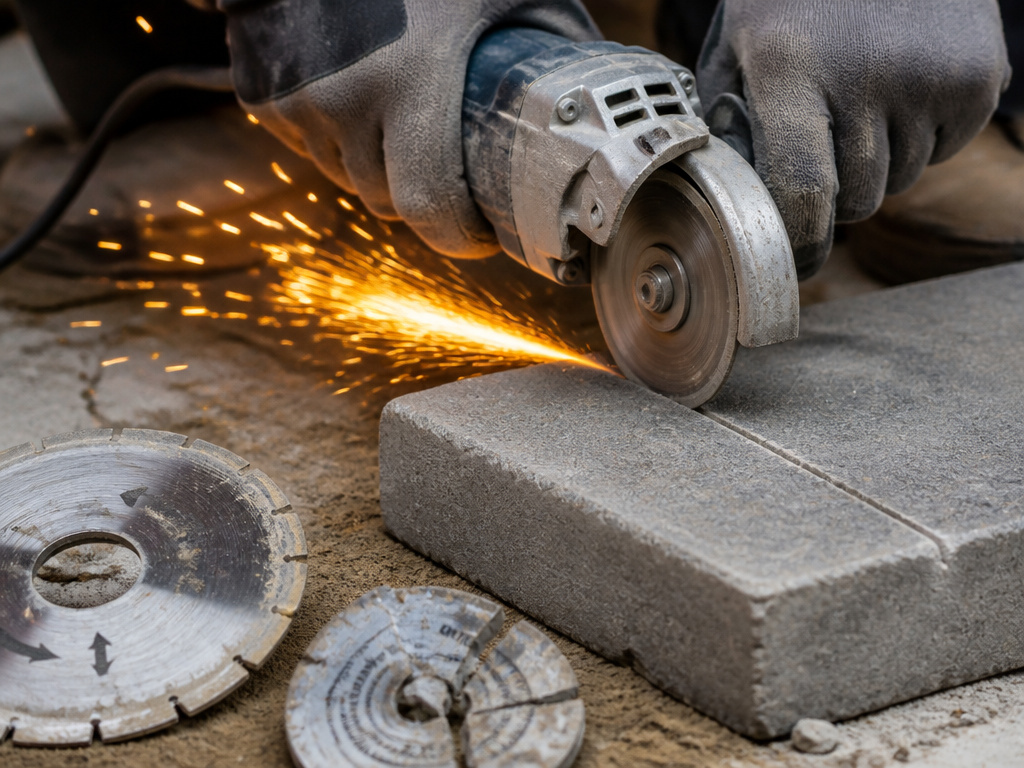
The angle grinder is the shop’s utility infielder. It might not hit the home runs, but it gets on base for a dozen different plays. For concrete and masonry, its role is defined by agility and surface work.
Its sweet spot is shallow-depth work. This is perfect for a huge range of common tasks: cutting pavers, scoring cinder blocks for clean breaks, notching block for pipes, cutting curves in asphalt (as noted in professional advice), or cleaning up the ragged edge of a concrete pour after the forms are stripped. The tool’s light weight, the Milwaukee M18 FUEL model weighs 4.6 lbs, the Bosch 5-inch model is 5.1 lbs, makes it easy to maneuver for detailed work.
I’ve used the same corded angle grinder for over a decade because it just works. The motor never bogs, even when I’m pushing through thick steel. That reliability is what matters when you’re shaping a piece of block to fit around a vent. You’re not thinking about the tool; you’re thinking about the line.
Common mistake: Using a warped, damaged, or incorrect disc. A diamond masonry blade for concrete is not the same as a metal cutoff wheel. A cracked disc can disintegrate at 9,000 RPM. Always inspect the disc before use and match it to the material.
Here’s where the grinder earns its keep:
- Cutting/Scoring Pavers & Thin Stone: The ideal job. Quick, clean, and no need for the depth of a saw.
- Shaping & Notching: Need to cut a half-circle in a block for a pipe? The grinder is your pencil.
- Surface Preparation: Grinding down a high spot on a slab, removing old thinset, or roughening a surface for bonding.
- Clean-Up: Trimming rebar, smoothing a rough cut made by a larger saw, or beveling an edge.
For these tasks, setting up a concrete saw is overkill. The grinder is already on your shelf, and it’s up to the job in minutes.
Power, Safety, and the Reality of Tool Wear
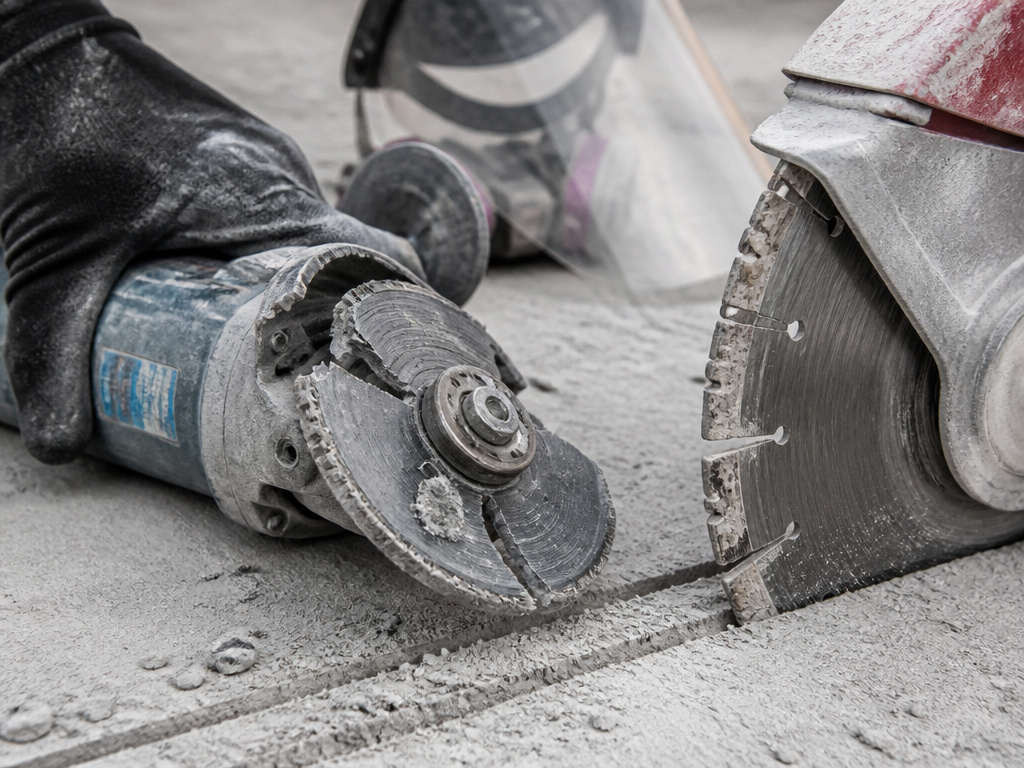
Here is what happens when things go wrong. Both tools are unforgiving, but in different ways. The concrete saw threatens with sheer power and kickback. The angle grinder threatens with speed, disc failure, and toxic dust.
First, power sources. Concrete saws are often gas-powered for ultimate portability and runtime, but electric models (corded and now cordless) are common for indoor and residential work. Angle grinders are dominated by the corded and cordless electric market. Cordless grinders like the Milwaukee M18 FUEL (8,500 RPM) and DEWALT FLEXVOLT (9,000 RPM) now offer serious power, but runtime for continuous concrete cutting will drain batteries fast. For a long job, corded is still king.
Second, safety is not a suggestion. The Consumer Product Safety Commission (CPSC) has issued recalls for both tools. In 2023, certain Milwaukee M18 FUEL Braking Grinders were recalled because the grinding wheel could detach during use. Earlier, in 2011, some DEWALT 18V Cordless Angle Grinders were recalled due to a switch that could fail to turn off. These are documented hazards from major brands.
Before you start: Wear ANSI-rated safety glasses, a face shield, hearing protection, gloves, and a respirator rated for silica dust. Ensure all guards are in place and secured. Never remove a guard to fit a larger disc. Check your tool for any active recall status using the model number.
Finally, tool wear. Concrete is abrasive. It eats tools. A concrete saw is built with sealed bearings and hardened gears to resist this. An angle grinder, while tough, is a more general-purpose tool. Forcing it to act as a concrete saw will burn out the motor bearings quickly because they aren’t designed for constant side-loading. The dust itself is the enemy, silica dust will infiltrate switch mechanisms, motor vents, and bearings, leading to premature failure. This is a key reason dedicated concrete tools cost more; they’re built for the abuse.
Cost comparison (buying vs. Renting)
The decision to buy or rent hinges on project frequency. An angle grinder is a common, relatively affordable tool for a workshop, useful for many tasks beyond concrete. Buying one makes sense for ongoing work. A dedicated flush cut concrete saw is a specialized tool for demolition and concrete repair. For a one-time project or very occasional use, renting this saw is the practical choice. It avoids a large upfront cost and the responsibility of long-term maintenance. Assess how often you’ll need to make deep, precise flush cuts against walls or slabs. If it’s rare, rent the saw; if it’s a core part of your trade, the investment may be justified.
Frequently Asked Questions
Can an angle grinder cut through concrete?
Yes, but with a major caveat. An angle grinder can score and cut through thin concrete materials like pavers, tiles, or cinder blocks. For cutting through a standard 4-inch concrete slab, it is not the right tool. The effective cutting depth for scoring is limited. Attempting to plunge-cut or make deep passes will overheat the blade, overload the tool, and pose a severe kickback risk.
What is the best tool for cutting concrete block?
For most DIY projects, a angle grinder with a diamond masonry blade is the best tool. It’s lightweight, manageable, and perfect for the 1.5-inch depth of a standard block. You can score it and snap it cleanly. For high-volume block cutting (like for a whole foundation), a dedicated masonry saw or a concrete saw with a diamond blade would be faster and more precise.
How deep can a 9-inch concrete saw cut?
The depth of cut depends on the blade size and the saw’s design. The depth of cut for a concrete saw depends on the blade size and saw design. For deeper cuts, you make multiple passes. A flush-cut saw’s depth is also “typically several inches,” as noted by Blades Direct, but is limited by its smaller, side-mounted blade designed for precision over maximum depth.
Can I use a circular saw to cut concrete?
You can, but only with the correct equipment and for specific jobs. You need a robust circular saw (often called a “worm drive” style) and a specialized diamond blade designed for masonry. This setup is excellent for cutting plywood forms with embedded concrete or for long, straight cuts in thin concrete slabs or asphalt. It lacks the depth and flush-cutting ability of a dedicated concrete saw and is more cumbersome than an angle grinder for small jobs.
The Bottom Line
Choose the tool that matches the job’s deepest requirement. If your cut needs to be deeper than 1.5 inches or perfectly flush against another surface, you need a concrete saw. For everything else, scoring, shaping, notching, grinding, or cutting thin materials, the angle grinder is ideal.
The common wisdom to “use the right tool for the job” is about safety, tool longevity, and your own time. Renting a concrete saw for a Saturday costs less than a trip to the emergency room or replacing a burned-out grinder. Conversely, using a 5-pound grinder to cut a paver is faster, safer, and easier than wrestling a 50-pound saw into position.
Look at your project. Measure the depth. Look at the finish you need. The answer is almost always in those two numbers. Let them make the choice for you.
