
Forced Rotation vs Free Spinning Dual Action Polisher
This post contains affiliate links. As an Amazon Associate, we earn from qualifying purchases.
A forced rotation polisher has a gear-driven spindle that forces the pad to spin, preventing stalling under pressure for aggressive correction. A free-spinning dual action polisher uses a counterweight-driven, free-floating spindle that can stall if pressed too hard, making it safer for beginners and better for finishing. For quick swirl removal on flat panels, a free-spinning DA wins. For heavy oxidation or correction on edges and complex curves, a forced rotation polisher is the only tool that won’t quit.
Which one lives in your garage depends entirely on the paint you’re touching and the time you’re willing to spend. Jumping to a forced rotation tool because it’s more powerful is like buying a chainsaw to trim a bonsai tree, you’ll do more harm than good. But trying to correct a neglected classic car finish with a tool that stalls at the first sign of pressure is just wasted effort. Understanding the difference between a forced rotation vs free spinning dual action polisher is key.
What follows: the physics behind each stalling mechanism, the three scenarios where you absolutely need forced rotation, and the checklist to decide which type you should buy first.
Key Takeaways
- Forced rotation polishers prevent pad stalling via a gear-driven spindle, making them the choice for aggressive correction on edges, curves, and hard clear coats.
- Free-spinning dual action (DA) polishers are safer and easier to use, but stall under pressure, ideal for beginners, finishing work, and maintaining soft paints.
- The Harbor Freight Hercules 59561 is the entry point for forced rotation at a fraction of the cost of a Flex XC3401VRG, offering professional-grade correction.
- Technique is essential: forcing a free-spinning DA will burn pads; babying a forced rotation tool will leave defects. Each machine demands a specific pressure and angle.
- Your first polisher should match your most common job. If you’re fixing minor swirls twice a year, get a free-spinning DA. If you’re reviving oxidized single-stage paint, buy forced rotation.
The Core Difference in Plain English
This isn’t about brands or price tags. It’s about a single mechanical part inside the polisher head: the spindle. That’s the rod your backing plate screws onto.
A forced rotation polisher uses a gear-driven spindle. The motor’s power is transmitted directly through a set of gears to the spindle, forcing the backing plate to rotate no matter how hard you press against the paint surface. A free-spinning dual action polisher uses a counterweight-driven, free-floating spindle. The motor spins a counterweight, whose inertia creates the orbital oscillation; the spindle itself is not directly geared and can stop rotating if pad friction overcomes that inertia.
Think of it like two types of drills. A corded drill (forced rotation) will keep turning the bit even if it binds in the wood, the motor fights you. A cordless drill with a clutch (free-spinning) will disengage and stop spinning to prevent over-torquing a screw. One forces the action; the other allows it to stop under stress.
That fundamental difference in a forced rotation vs free spinning dual action polisher dictates every aspect of use: the correction power, the risk of burning the paint, the learning curve, and the final finish quality. All other specs, throw length, OPM, motor amperage, are secondary to this one mechanical fact.
Forced Rotation: The Gear-Driven Muscle
Why does it have more cutting power? Because the pad never stops spinning. On a free-spinning DA, a significant amount of your correction power vanishes the moment the pad stalls. A forced rotation tool delivers 100% of its designed abrasive action for every second it’s on the paint, regardless of the angle or pressure you use.
The Three Jobs Where Forced Rotation Is Non-Negotiable
- Correcting Edges and Tight Curves: When only the outer inch of your pad contacts a sharp body line, a free-spinning DA stalls instantly. The Harbor Freight manual notes the tool will restart automatically if stalled, but that’s a band-aid. A forced rotation polisher, like the Hercules 59561, maintains rotation even when just the pad edge is engaged, this is its killer feature for complex panels.
- Removing Severe Defects: Heavy oxidation, deep water spots, or sanding marks from a 1000-grit disc require sustained, aggressive abrasion. As noted in the Dr. Beasley’s review, removing these defects requires maintaining pad rotation and pad oscillation. A free-spinning DA will stall under the necessary pressure, turning a 30-minute job into a 3-hour fight.
- Working on Hard, Modern Clear Coats: Many factory clear coats are incredibly hard. To get a cutting compound to bite, you need to pair it with a microfiber pad and significant downward pressure. Only a forced rotation tool can handle that load without quitting.
The Trade-Off: Vibration and Finish
Here’s the physical catch. That direct gear connection transmits more vibration to your hands and arms. The Dynabrade Renny Doyle DB8 has a vibration measurement of 4.5 m/s², and users should be aware of vibration exposure. You’ll feel it after an hour.
Furthermore, the constant, unforgiving rotation can make it harder to achieve a perfect, hologram-free finish on soft paints. Many pros, like in the Dr. Beasley’s review, will follow a forced rotation correction step with a free-spinning DA like a Rupes BigFoot for the final finishing polish.
| Forced Rotation Polisher | Best For | The Trade-Off |
|---|---|---|
| Harbor Freight Hercules 59561 | Budget entry into forced rotation, 8mm throw, 3200-9600 OPM. | Heavier (6.3 lbs), more vibration, louder gear noise. |
| Flex XC3401VRG (The Benchmark) | Professional correction, consistent power, 8mm forced rotation. | Significant investment, still heavier than free-spinning DAs. |
| Dynabrade Renny Doyle DB8 | Commercial detailing, low 150-350 RPM for controlled cutting. | Premium price, geared for pros, not DIY beginners. |
The part nobody mentions: The gears inside a forced rotation polisher require lubrication. Some forced rotation polishers may require gear lubrication as part of maintenance. Skip it, and the whine gets louder, the vibration worsens, and the tool’s life shortens. It’s a maintenance step free-spinning tools don’t have.
Free-Spinning DA: The Safe Finisher
Why is it recommended for beginners? Because its failure mode is safe. If you press too hard, tilt the pad, or hit an edge, the pad simply stops rotating. The polisher keeps oscillating, but it stops cutting. This prevents you from generating the concentrated friction and heat that burns through paint, the number one fear for new users.
Where Free-Spinning DAs Excel
Their gentleness is their superpower. They are the ideal tool for:
- Applying waxes and sealants: You want even, thin application without product sling. The stalling characteristic prevents you from overworking the product.
- Final finishing polish: After the heavy cutting is done, you need to refine the paint to a high gloss. A Makita PO5000CX2, with its variable speed up to 6,800 OPM and an electronic controller that provides constant speed control, provides a smooth, controllable motion perfect for this step.
- Working on soft or single-stage paints: Older lacquers and some modern reds/blacks are notoriously soft. The forgiving nature of a free-spinning DA drastically reduces the risk of instilling new swirls or holograms.
The Stalling Problem in Detail
The stalling isn’t a design flaw; it’s the direct result of the free-floating spindle. When pad friction exceeds the rotational inertia from the counterweight, rotation ceases. This happens predictably in three scenarios:
- Too much downward pressure. The manual for the Hercules polisher advises starting at the minimum speed setting for polishing to avoid damage. On a free-spinning DA, exceeding the tool’s pressure limit doesn’t risk damage, it just kills all cutting power.
- Pad not flat on the surface. Tilting the polisher so the pad contacts at an angle dramatically increases friction on one side, causing an immediate stall.
- Using too-aggressive a pad/compound combo. A stiff microfiber cutting pad with a heavy compound creates more drag than a soft foam finishing pad, making stalling more likely.
Common mistake: Trying to “power through” a stall by pressing harder. This is exactly wrong. Increased pressure only increases friction, locking the pad solid. The correct fix is to lighten your pressure, ensure the pad is flat, and let the tool’s inertia re-establish rotation.
Side-by-Side Comparison: Which One When?
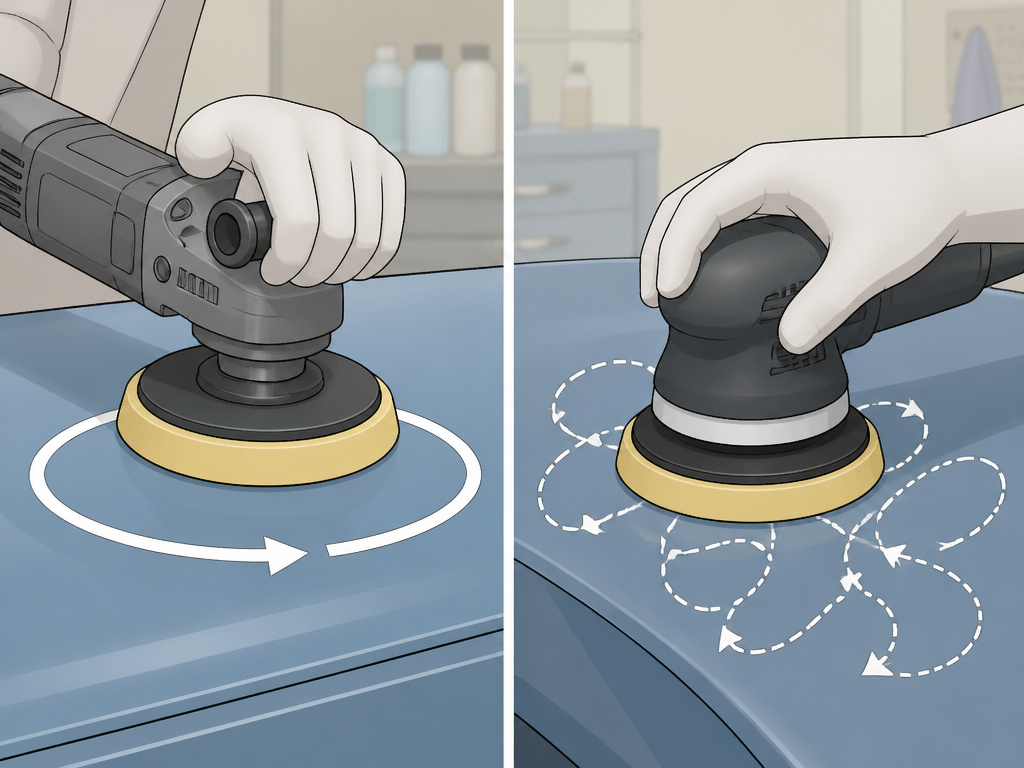
Don’t just pick the “better” tool in the forced rotation vs free spinning dual action polisher comparison. Pick the forced rotation or free spinning tool based on your specific next job. This decision matrix cuts through the marketing.
| Your Situation / Goal | Forced Rotation | Free-Spinning DA | Why? |
|---|---|---|---|
| First-time user, maintaining a daily driver | Avoid | Strong Buy | Safety and forgiveness are paramount. Stalling is a good teacher. |
| Correcting severe oxidation or deep scratches | Strong Buy | Avoid | You need guaranteed rotation under pressure. Stalling equals failure. |
| Detailed final polish on a show car | Use with caution | Strong Buy | A tool like the Makita PO5000CX2 will produce a finer, swirl-free finish on soft clear coats. |
| Working on complex panels with sharp edges | Strong Buy | Avoid | Only forced rotation maintains correction power on edges where pad contact is minimal. |
| Budget under $200 | Hercules 59561 | Many options | The Hercules is a unique value in forced rotation. In free-spinning, you have more budget-friendly choices like the Bauer or Porter-Cable lines. |
| Long sessions, user comfort | Not ideal | Strong Buy | Lower vibration and less aggressive handling reduce muscle fatigue. |
The Buyer’s Checklist: 5 Questions Before You Choose
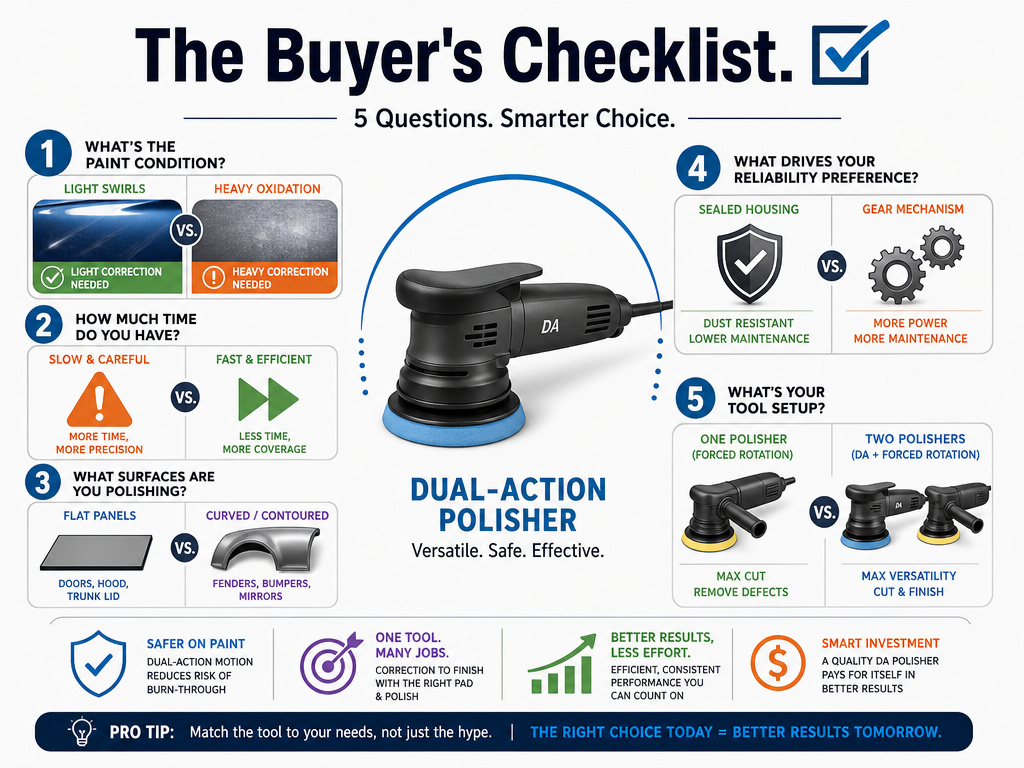
Answer these honestly. Your answers point directly to the polisher type you need.
- What’s the worst defect on the car I’ll be working on most often? If the answer is “light swirls,” get a free-spinning DA. If it’s “chalky, faded oxidation,” you need forced rotation.
- Am I more afraid of burning the paint or of the job taking forever? Fear of damage points to a free-spinning DA. Impatience with a stalling tool points to forced rotation.
- How many curved vs. Flat panels do I typically work on? Mostly flat hoods and doors? A free-spinning DA is fine. Lots of bumpers, fender flares, and tight body lines? You’ll want forced rotation.
- What’s my patience level for tool maintenance? Forced rotation tools have gears that may need occasional attention. Free-spinning DAs are generally sealed and require less internal care.
- Will this be my only polisher, or am I building a system? If it’s your one-and-only, a forced rotation tool is more versatile, it can do everything, albeit not always perfectly. For a dedicated paint correction system, many professionals own both types, using each for its specific strength in their workflow.
Beyond the Basics: Throw Length, Pad Size, and Technique
The forced vs. Free-spinning debate is the biggest fork in the road, but two other specs critically affect performance.
Throw Length (Orbit Diameter): This is the distance the backing plate deviates from the center. A longer throw (like 12mm, 15mm, or 21mm) means each orbit covers more paint, increasing cutting efficiency and reducing vibration. Both forced and free-spinning polishers come in various throws. An 8mm throw (like the Hercules) is a short throw, good for control. A 15mm+ long throw (common on free-spinning DAs like Rupes) cuts faster on large, flat areas.
Pad Size: The Hercules uses a 6-inch backing pad, while the Makita PO5000CX2 uses a 5″ round pad. A larger pad covers more area but is harder to keep flat on curves and uses more compound. Smaller pads are more maneuverable and better for tight spaces. Your polisher often dictates the max pad size.
Technique Adjustments Are Mandatory.
- For Forced Rotation: You must keep the pad moving constantly. The tool won’t stall, but it can generate excessive heat in one spot if you linger. Use slower arm speeds and overlap your passes by 50%.
- For Free-Spinning DA: You must use the minimum pressure required to keep the pad rotating. Let the tool and the compound do the work. The moment you feel or hear the rotation slow, lighten up.
Forced rotation polisher pad compatibility
Forced rotation polishers demand specific attention to pad and backing plate selection. The gear-driven mechanism that prevents pad stalling also transmits more torque directly to the pad interface. Using a pad that is too soft or not properly centered can lead to uneven wear, reduced performance, or even pad failure. Always ensure the polishing pad is firmly and correctly centered on the backing pad before starting work. The constant rotation means any imbalance or loose attachment will be immediately apparent, so test the tool for a short time before applying it to the surface. Stick to pads designed to handle the consistent mechanical rotation and avoid any with loose strings or fibers that could get caught.
Frequently Asked Questions
Can a free-spinning DA do the same work as a forced rotation polisher?
Given enough time and patience, yes. But it’s a question of efficiency and risk. To cut through severe defects, you’d need to make dozens of slow, light-pressure passes with a free-spinning DA, changing pads frequently as they gum up. A forced rotation polisher might do it in three or four assertive passes. For a hobbyist with one car, the DA is fine. For a professional or someone restoring a neglected vehicle, the forced rotation tool pays for itself in time saved.
Is forced rotation the same as a rotary polisher?
No. This is a critical distinction. A rotary polisher spins in one continuous direction only. It can burn paint very quickly if mishandled. A forced rotation dual action polisher combines that forced spin with a simultaneous orbiting oscillation (the “dual action”), which dissipates heat and makes it much safer. It sits between a rotary and a free-spinning DA for aggressiveness and safety.
I already own a free-spinning DA. When should I upgrade to forced rotation?
When you encounter a job your current tool fails at. That’s usually one of three moments: you’re working on a panel with sharp edges and the pad constantly stalls; you’re using a aggressive compound and microfiber pad and can’t maintain rotation without babying the tool; or you’re simply frustrated by how long it’s taking to remove defects that a gear-driven polisher would zip through. Until then, master your free-spinning DA, its skills transfer directly.
Are cordless polishers available in both types?
Yes, but the landscape is different. True forced rotation cordless polishers (geared) are less common and tend to be premium tools. Many cordless “DA” polishers are actually free-spinning. When looking at cordless, check the specifications for “geared dual-action” or “forced rotation” explicitly. The performance trade-offs (battery life, peak power) are the same, but cordless adds incredible convenience for mobile detailing.
What about long-throw polishers? Where do they fit?
Long-throw polishers (like Rupes, Griot’s G15/G21) are almost exclusively free-spinning. Some sources state that long-throw polishers have an orbit of 12mm, 15mm, or 21mm, which can increase cutting efficiency. However, they can still stall on edges or under heavy pressure. They are a fantastic middle-ground choice for experienced users who want more cutting power than a standard DA but don’t want to step up to the vibration and learning curve of a geared tool.
Before You Go
The polisher you reach for should feel like the right extension of your arm for the task at hand. Forced rotation is the power tool you lean on; free-spinning is the precision instrument you guide.
If you’re building a detailing kit from scratch and can only have one, make this call: are you mostly preserving good paint or rescuing bad paint? Preservation is the job for the free-spinning DA. Rescue demands forced rotation. Most home garages need the former. Project garages need the latter.
Start with the tool that matches 80% of the work you see yourself doing. You can always add the other type later, and your skills will be ready for it. The worst choice is buying a tool so intimidating or ill-suited that it stays in the box. A used free-spinning DA polisher that gets weekly exercise is infinitely more valuable than a forced rotation beast that gathers dust because you’re afraid to turn it on.
