
Hammer Drill vs Regular Drill: Which Should You Buy?
This post contains affiliate links. As an Amazon Associate, we earn from qualifying purchases.
A hammer drill rotates a bit and adds a rapid, hammering impact to pulverize masonry, while a regular drill only rotates for cutting into wood, metal, and plastic. Sources disagree on this point: PowerToolsInsider.com recommends a hammer drill if you might ever need it, while HandymanStartup.com and Stucco Safe state a regular drill with a masonry bit can work for a few small holes.
The distinction concerns the mechanism rather than raw power. A hammer drill’s impact force is measured in Blows Per Minute (BPM), and it’s this hammer action, not just higher torque, that makes it effective on concrete. Understanding the hammer drill vs regular drill difference clarifies this: a regular drill with 1,400 in-lbs of torque will still struggle where a hammer drill with 300 in-lbs and 26,250 BPM breezes through.
What follows: a clear breakdown of how each tool works, the specs that actually matter, and honest advice on when you can get away with the drill you already own versus when you’re better off stepping up. We’ll use real model numbers and the specific scenarios where each tool earns its keep.
Key Takeaways
- A hammer drill’s hammering action (BPM) is what breaks masonry, not just its rotational torque. Turn the hammer function off, and it works as a regular drill.
- For holes in brick, block, or light concrete up to 1/2-inch to 5/8-inch, a hammer drill is the right tool. For wood, metal, and driving screws, a regular drill is perfect.
- You can drill a couple of small holes in masonry with a regular drill and a carbide-tipped masonry bit, but it takes about twice as long and requires more force.
- If you regularly drill concrete or need holes larger than 5/8-inch, neither tool is ideal; you should look at a rotary hammer.
- The price difference between a regular drill and a hammer drill from the same brand is often minimal.
The Core Difference: How They Work
A regular drill is a rotary cutter. The motor spins the chuck, and the chuck spins the bit. The sharp edges of the bit, whether a twist bit for wood or a spade bit for rough holes, shear away material. It’s simple, effective, and all you need for drilling and driving in wood, metal, plastics, and similar materials.
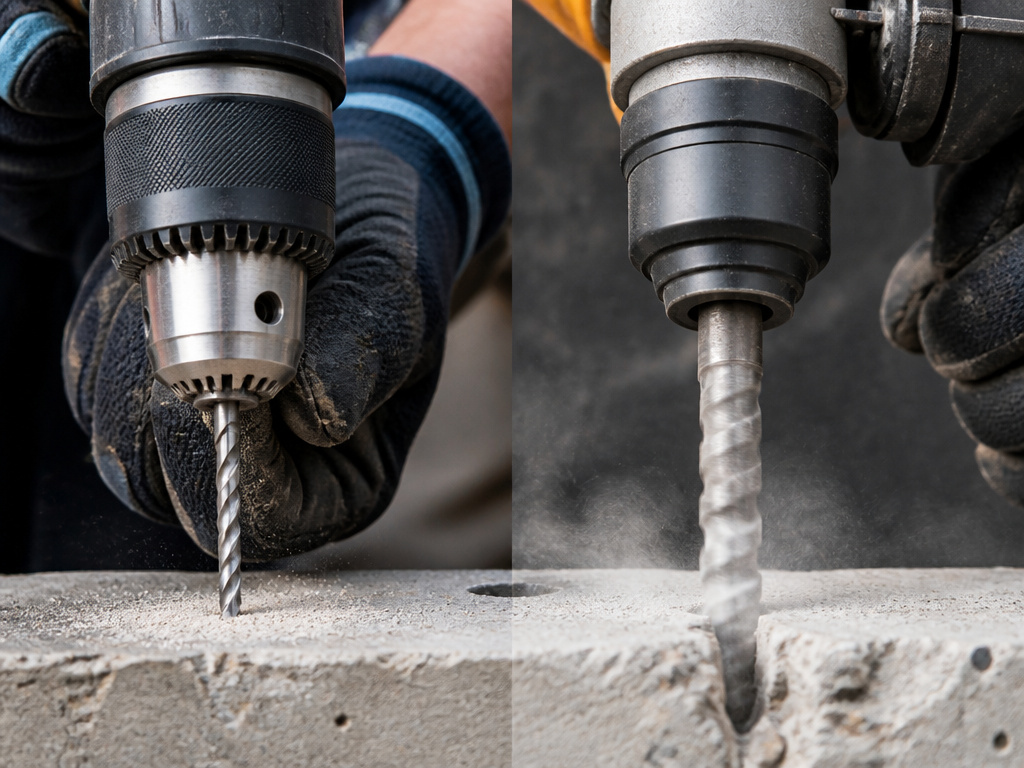
A hammer drill does that, plus it adds a percussive punch. Inside the tool, a mechanical cam or a pneumatic piston mechanism slams the entire chuck (and the bit) forward thousands of times per minute while it rotates. This combination of pounding and spinning crushes brittle materials like concrete and brick instead of trying to slice through them.
A hammer drill uses a cam or piston mechanism to deliver rapid forward impacts (measured in Blows Per Minute) alongside rotation. This dual action pulverizes masonry aggregate, while a regular drill relies solely on rotational force to shear material.
That’s why you can’t just use a stronger regular drill. Pushing a wood bit into concrete doesn’t cut; it grinds, polishes the tip, and generates enough heat to ruin the bit’s temper in under a minute. The fix requires the right action, not more muscle.
When to Use a Regular Drill (and When You Can Push It)
Your regular drill is the default for a reason. It’s lighter, often cheaper, and perfectly suited for many common home DIY jobs.
Stick to a regular drill for:
- Drilling pilot holes and clearance holes in wood.
- Driving screws, from cabinet hardware to 3-inch deck screws (using the clutch).
- Drilling into metal and plastics.
- Any task where a clean, precise cut matters, like hinge mortising or dowel holes.
Now, the contentious part: can it drill into concrete? The sources disagree, but the practical answer is a qualified yes.
Common mistake: Using a wood or metal bit on masonry. The tip geometry is wrong. It dulls fast, heats up, and just polishes the hole face. The fix is always a tungsten-carbide masonry bit.
HandymanStartup.com states a regular cordless drill will work for a couple of holes, though it takes about twice as long and requires more pushing. The Stucco Safe guide agrees, noting a standard drill is acceptable for a few small pilot holes in stucco (3/8 inch or less), but a carbide masonry bit is still preferred.
When you compare a hammer drill vs regular drill for this task, the progress was achingly slow. It’s possible, but it’s a brute-force method that wears on both you and the tool.
A common guideline: If you have several holes to make, or if the material is hard masonry, using the right tool is advised. The time and effort you’ll spend justify using, or renting, the right tool.
When You Absolutely Need a Hammer Drill
The hammer drill’s job description is narrow but critical. It’s for making holes in brittle, non-ductile materials that need to be smashed, not cut.
Switch to hammer mode for:
- Drilling into brick or concrete block for anchors, masonry screws, or conduit.
- Making holes in poured concrete for light-duty anchors (think shelves, handrails), for holes typically up to 1/2-inch to 5/8-inch.
- Working with stone or tile (carefully, and often with the hammer function off for tile to prevent cracking).
The BuildToolHQ guide specifies hammer drills are best for occasional drilling into brick, block, and light concrete, specifically for holes up to 1/2-inch to 5/8-inch. Beyond that size, or for frequent concrete work, you step up to a rotary hammer.
The difference in experience is night and day. With a hammer drill in the correct mode, the tool does the work. You provide steady pressure, and the hammer action does the pounding, which is the core of the hammer drill vs regular drill comparison. You’ll hear a rapid, loud brrrrrrrrt and feel a distinct vibration in the handle.
Specs in the Real World: Torque, Speed, and Weight
Looking at spec sheets can be confusing. Higher torque (in-lbs) sounds better, but it’s not the whole story for masonry. Here’s what the numbers mean, using verified data from BuildToolHQ and DIYToolGuide.
| Spec | What It Means | Regular Drill Example | Hammer Drill Example |
|---|---|---|---|
| Max Torque | Rotational twisting force for driving screws or tough materials. | Milwaukee 2903-20: 1,400 in-lbs | Milwaukee 2904-20: 1,400 in-lbs |
| No-Load Speed (RPM) | How fast the bit spins with no load. Two speeds offer high torque (low speed) or fast drilling (high speed). | DeWalt DCD791B: 0-550 / 0-2,000 RPM | DeWalt DWD520 (Corded): 0-1,200 / 0-3,500 RPM |
| Blows Per Minute (BPM) | The hammering impact rate. The key spec for masonry performance. | N/A | Bosch GSB12V-300N: 0-26,250 BPM |
| Weight | Impacts fatigue during overhead or prolonged use. Lighter is better for general use. | Bosch GSR12V-300N: 1.6 lbs (bare tool) | Makita XPH12Z: 4.0 lbs (with battery) |
Notice the Milwaukee 2903 regular drill and the 2904 hammer drill have the same max torque (1,400 in-lbs). The hammer drill’s advantage comes from the added BPM, not more twisting power. Also, hammer drills are typically heavier due to the internal hammer mechanism.
For a direct model-to-model comparison, look at the DeWalt DCD800B (drill-driver) and DCD805B (hammer drill-driver). According to DIYToolGuide, they share almost identical specs: same brushless motor, same 1/2″ metal chuck, same no-load speed (0–650 / 0–2,000 RPM). The price difference is often minimal.
Hammer Drill vs Impact Driver: Clearing the Confusion
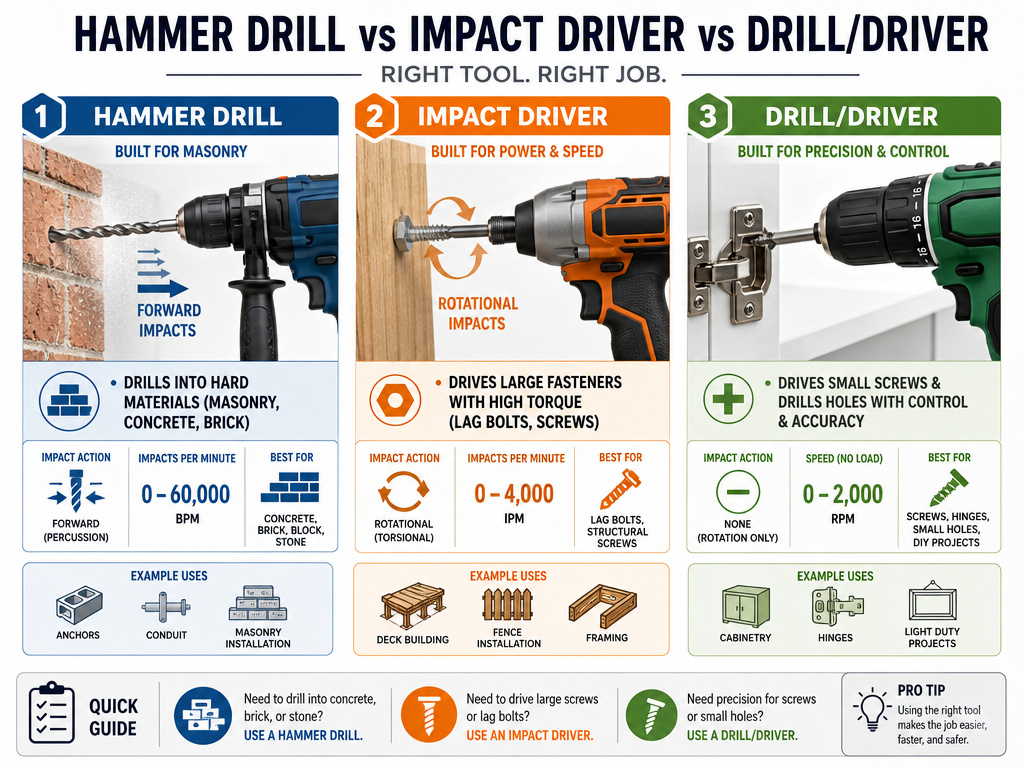
This is a frequent point of confusion. An impact driver is a specialized screw-driving tool, not for drilling masonry.
While a hammer drill combines rotation with forward-facing impacts to break material, an impact driver combines rotation with rotational impacts (twisting blows) to break loose stuck fasteners or drive long screws without stalling. The mechanism and sound are different, an impact driver makes a loud, stuttering pop-pop-pop sound.
- Use a hammer drill for making holes in concrete, brick, or block.
- Use an impact driver for driving large lag bolts, deck screws, or any fastener where you need high rotational force.
- Use a regular drill for precise drilling and general screw driving.
Many professionals and serious DIYers own a combo kit containing both a hammer drill and an impact driver because the tools complement each other perfectly. For more on that pairing, our guide on impact drivers versus drills breaks it down.
How to Choose: Your Decision Checklist
Don’t overthink it. Work through these three questions.
-
What materials will I drill 90% of the time?
- Only wood, drywall, metal, plastic: A regular drill/driver is the right choice. It’s lighter and less expensive. The Bosch GSR12V-300N at 1.6 lbs is a fantastic example.
- Mostly wood, but maybe a few masonry holes in the future: Get a hammer drill. The added capability costs little and saves a future rental or purchase.
-
How many masonry holes are we talking about?
- A few small holes, very rarely: You can likely use your regular drill with a carbide-tipped masonry bit, accepting it will be slow. As PowerToolsInsider.com notes, “PowerToolsInsider.com advises: ‘If you might EVER need to drill into concrete or brick, get a hammer drill. The price difference is minimal.'”
- More than 3, or any hole over 1/2-inch: You need a hammer drill. For anything more than light occasional use, or for larger diameters, you should consider the difference between a hammer drill and a rotary hammer and likely step up to the rotary hammer.
-
What’s my budget for the system?
- This is about the battery platform. Brands like DeWalt, Milwaukee, and Makita sell tools “bare” (without a battery). If you’re buying your first cordless tool, invest in a kit with a hammer drill, two batteries, and a charger from a brand you like. You’re buying into an ecosystem. Future tools will be cheaper because you only need the “bare tool.”
For most people, the answer is a cordless hammer drill. It covers all your bases. If you later get into serious concrete work, you can add a dedicated rotary hammer. If you drive a huge number of screws, add an impact driver for high-torque driving. This approach is smarter than buying two separate, single-purpose drills.
Safety and Technique for Masonry Drilling
Before you drill into any masonry, concrete, or stucco, proper safety gear is crucial.
Before you start: Concrete dust contains crystalline silica, a respiratory hazard. Wear a dust mask or respirator. Always wear safety goggles to protect from flying chips. Hammer drills are loud, hearing protection is a must.
The process is straightforward but requires a different touch than drilling wood.
- No exceptions.
- Mark your spot: Use a pencil or a center punch to prevent the bit from “walking.”
- Start slow: Begin at a low speed without hammer mode to create a small dimple and ensure accurate placement.
- Engage hammer mode, drill perpendicular: Hold the drill straight. Let the tool do the work, apply steady, firm pressure, but don’t lean on it.
- Clear dust: Periodically pull the bit out while it’s spinning to clear dust from the hole. This prevents binding and overheating.
- Mind the depth: Drill at least 1/4 inch deeper than your anchor length to account for debris.
If you hit rebar or a hard aggregate, you will likely encounter significant resistance. Stop. You can try a different spot, or if you must go through it, you’ll need a specialized bit and to switch the drill to rotary-only (no hammer) mode.
The Bottom Line
For the one-tool solution, buy a hammer drill. The capability gap is vast, while the price and weight penalties are small. A tool like the DeWalt DCD805 or Milwaukee 2904-20 gives you a competent regular drill and a masonry tool in one.
But be honest about your projects. If you’re hanging a single shelf on a brick wall this decade, use your existing drill, buy a carbide-tipped masonry bit, and brace for a workout. If “someday” involves a patio, a pergola, or basement shelves, the hammer drill is the clear winner.
And remember, this is just one category.
Power, torque, and speed differences
Some regular drills and hammer drills from the same brand can have similar rotary power specifications. The key difference is the hammer drill’s additional hammering action, measured in blows per minute (BPM), which is what tackles masonry. This means a hammer drill delivers its power in two ways: rotational force for driving and a percussive force for breaking. A regular drill applies all its power solely to rotation. Therefore, comparing just torque and RPM between the two types doesn’t tell the whole story; the hammer mechanism is the defining factor for hard materials.
Frequently Asked Questions
Can a hammer drill be used as a regular drill?
Yes. Every hammer drill has a mode selector switch. Turn the hammer function off, and it operates exactly like a standard rotary drill. This makes it a versatile, do-it-all tool for drilling wood, metal, and driving screws.
Is a hammer drill better than a regular drill?
It’s not “better” universally; it’s more specialized. For masonry, it’s definitively better. For everyday wood and metal tasks, a regular drill is just as good and often lighter. The hammer drill’s advantage is combining both capabilities in one tool.
I already own a regular drill. Do I need a hammer drill?
You need one if you have a masonry project that goes beyond a couple of very small holes. Renting a hammer drill for a day is a smart, cost-effective option for one-off projects. If you find yourself borrowing or renting repeatedly, it’s time to buy.
What’s the difference between a hammer drill and a rotary hammer?
Hammer drill uses a mechanical cam action for impact, suitable for light masonry. A rotary hammer uses a pneumatic piston system, delivering significantly more impact energy for faster drilling in concrete and the ability to chisel.
