
HEPA vs Standard Shop Vac Filter: Which Is Worth It?
This post contains affiliate links. As an Amazon Associate, we earn from qualifying purchases.
The HEPA vs standard shop vac filter choice comes down to particle size and health risk. A true HEPA filter is certified to capture at least 99.97% of particles 0.3 microns and larger, making it essential for fine, hazardous dust like silica or fine wood dust. A standard filter is for general debris. For most home shops doing occasional cleanup, a standard filter works; for any sanding, drywall, or woodworking that creates fine dust, a HEPA filter is the only responsible choice.
That certification number – 99.97% at 0.3 microns – is the line between marketing and medicine. It’s a certified performance threshold for a reason. The dust that hangs in the air after you sand a joint or cut MDF includes fine, respirable particles that can be hazardous to lung health. When you compare a hepa vs standard shop vac filter, a standard paper or foam filter might catch the visible sawdust, but it is not designed to capture the fine, respirable particles that a HEPA filter can.
What follows is a breakdown of the specs, the real-world suction trade-offs, and the step-by-step on retrofitting an old vac. By the end, you’ll know exactly which filter your next project needs, and whether your current setup is protecting you or just moving dust around.
Key Takeaways
- Insist on true HEPA certification (99.97% at 0.3 µm); reject “HEPA-like” or “99% HEPA” labels, which are not verifiable standards.
- For fine, hazardous dust (silica, sanding, MDF), a HEPA filter is essential for health; a standard filter is only for chips and coarse debris.
- Expect a measurable drop in suction and airflow with a HEPA filter due to its finer, more restrictive media.
- Use a disposable filter bag and a pre-filter with any HEPA setup to prevent rapid clogging and protect the expensive cartridge.
- A retrofit can work, but success depends on seal integrity and airflow matching; verify performance with particle testing if health is a concern.
What “True HEPA” Means for Shop Dust and Why It Matters
The term gets thrown around. True HEPA isn’t an adjective; it’s a measurable performance threshold. By definition, a filter earning this certification must capture at least 99.97% of particles that are 0.3 microns in diameter. That specific size is used because it’s the “Most Penetrating Particle Size” (MPPS) – the hardest size for mechanical filters to catch. If it’s efficient at 0.3 µm, it’s even better at catching larger and smaller particles.
A True HEPA filter is certified to remove at least 99.97% of particles ≥0.3 µm. This is a measurable performance threshold used by DOE standards, not a marketing label. The certification applies to the filter media under lab conditions.
This matters because the dust that causes long-term health issues is invisible. Silica from cutting concrete, fine wood dust from sanding, drywall compound – this is respirable dust. It hangs in the air for hours and gets deep into lung tissue. The hepa vs standard shop vac filter choice is critical here: a standard filter, often made of pleated paper or foam, might stop the visible chips, but it is not designed to capture fine, respirable dust. You’re vacuuming up a hazard and aerosolizing it right back into your breathing zone.
The next level up includes medical-grade H13/H14 filters (approximately 99.95–99.995% efficiency at sub-0.2 µm) and ULPA filters (99.999% at 0.12 µm). You’ll pay more for these, and they’re almost never needed outside a lab or medical setting. For a wood or home shop, true HEPA is the target.
Where this goes sideways: Buying a “HEPA-type” or “HEPA-like” filter. These are unregulated terms. They might capture 95% or 99% of particles, but that last few percent is the difference between a clean shop and a compliance violation on a regulated job. If the packaging doesn’t state “99.97% at 0.3 µm,” it’s not a true HEPA filter.
System Sealing: The Make-or-Break Factor Nobody Checks
You can drop a certified HEPA cartridge into your shop vac and still be breathing dust. The filter’s rating only matters for the air that actually passes through it. If your vac isn’t a sealed system, contaminated air will bypass the filter entirely through gaps, poor gaskets, or the motor cooling vents.
Think of it like a water hose with a hole in it. No matter how good the nozzle is, you’re getting wet. Shop vacs are notoriously leaky. Their design prioritizes high suction power and debris capacity over airtight containment. Common bypass points include:
- The seal between the filter and the housing.
- The lid or body latches.
- The motor shroud or cooling vents.
- Hose connections and accessory ports.
A purpose-built dust extractor is engineered differently. Its entire chassis is designed to be a sealed vessel, with gaskets at every junction and motors cooled by already-filtered air. This is why for regulated tasks involving silica or lead, DOE-compliant HEPA extractors are mandatory. A retrofit shop vac, even with a true HEPA filter, does not guarantee full containment.
Easy to miss: The motor cooling vents on most shop vacs pull in unfiltered room air to cool the motor, then exhaust it right back out, bypassing the filter completely. In a dusty shop, this turns the vac into a dust circulator.
When you’re evaluating any vac for fine dust, your first question shouldn’t be about the filter. It should be: “Is this a sealed system?” Look for machines marketed as “dust extractors” and check for third-party test reports on whole-unit leakage, not just filter media specs.
The Suction Trade-Off: What You Gain in Filtration, You Lose in CFM
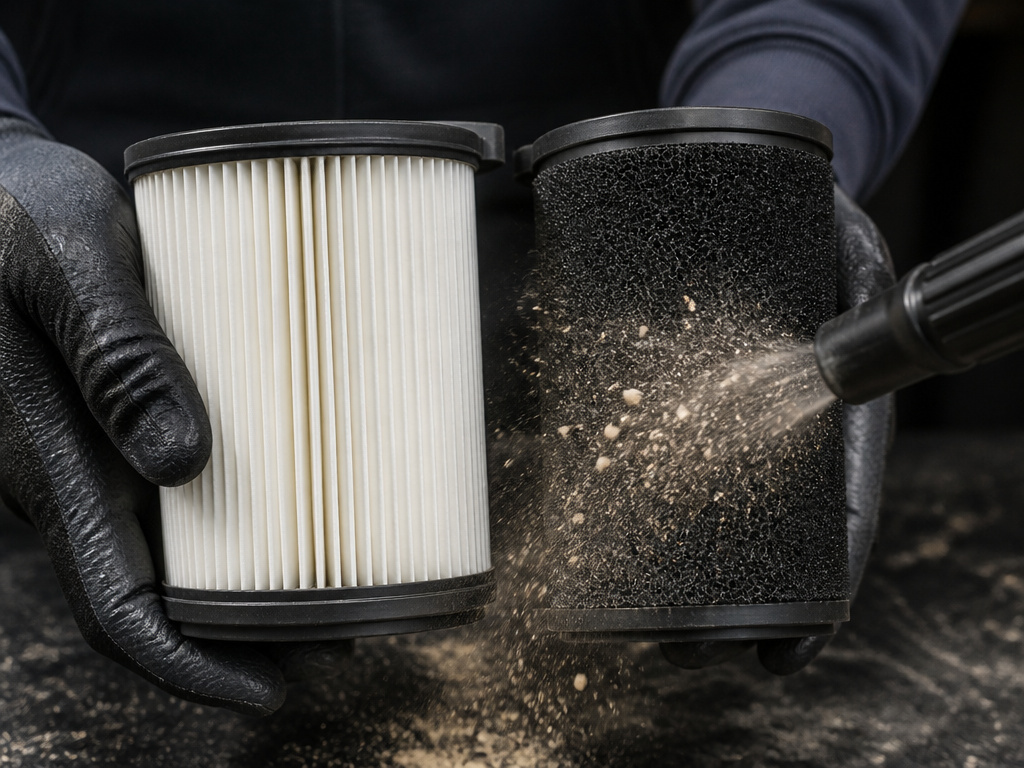
Be realistic. A HEPA filter will slow down your shop vac. There’s no free lunch. The filter media is vastly more dense and fine than the open foam or paper of a standard filter, creating higher resistance to airflow. This results in a measurable pressure drop and a reduction in CFM (cubic feet per minute).
You’ll notice it most when trying to pick up heavy material like wet drywall debris or a pile of planer shavings. The motor will sound more strained, and the material might “dance” at the end of the hose instead of getting sucked up cleanly.
| Performance Aspect | Standard Filter | True HEPA Filter | Consequence of Switching |
|---|---|---|---|
| Airflow (CFM) | Higher | Lower | Slower pickup, especially for bulkier debris. |
| Static Pressure (Water Lift) | Less affected | Reduced | Decreased ability to pull through a long hose or clog. |
| Filter Resistance | Low | High | Motor works harder, may run hotter. |
| Primary Benefit | Debris capacity, suction power | Health protection, fine dust capture | You trade raw power for clean air. |
This is why the advice to always use a HEPA filter is wrong for some jobs. If you’re cleaning up after a flood or sucking up wood chips from a router, the standard filter is the better tool. It moves more air, fills up slower, and doesn’t strain the motor. The key is matching the tool to the task. Use the HEPA for the fine, dangerous stuff. Use the standard filter for everything else.
HEPA Filter Setup Showdown: Bag, Pre-Filter, or Naked?
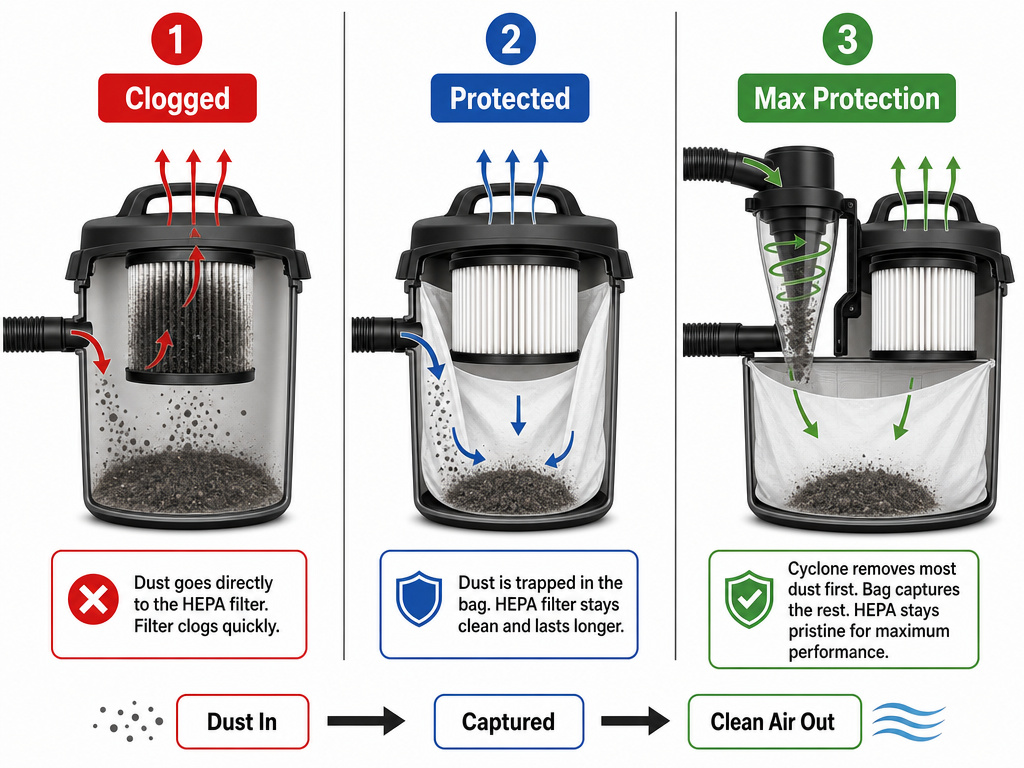
You have three main ways to configure your HEPA vac. Each has a different cost and performance profile over time. Most people get this wrong and blame the filter when the setup is the problem.
1. Filter-Only (The Clog Special)
This is just the HEPA cartridge installed directly in the dirty tank. It’s the cheapest upfront option and the worst long-term choice. Fine dust loads the filter’s surface almost immediately, causing a catastrophic drop in suction. You’ll be tapping it clean every five minutes. This setup is only acceptable for very light, intermittent use.
2. Filter + Disposable Bag (The Smart Default)
You line the vacuum tank with a disposable paper or cloth bag, then install the HEPA filter. The bag catches the bulk material, and the HEPA filter acts as a final polish. This preserves the filter’s life and maintains suction far longer. The bag is a consumable cost, but it’s cheaper than a new HEPA cartridge. For most hobbyists, this is the best balance of protection and performance.
3. Filter + Bag + Cyclonic Separator (The Pro Setup)
This is the gold standard. You attach a cyclonic separator between the hose and the vac inlet. The cyclone spins out and drops the majority of the dust into a separate bucket before it even reaches the vac. What enters the tank is mostly air. Your bag and HEPA filter last exponentially longer, and suction remains near-peak. The upfront cost is higher, but if you generate dust regularly, it pays for itself in filter savings alone.
Maintenance, Clogging, and the 6–12 Month Rule
Shop vacs clog. It’s what they do. With a HEPA filter, the problem is accelerated because the media is so fine. Without proper maintenance, you’ll buy a performance marvel and turn it into a noisy paperweight in a month.
The maintenance triad for a HEPA vac is non-negotiable:
- Pre-Filter: Always use the foam sleeve that fits over the HEPA cartridge if your model includes one. It catches larger particles and is easily rinsed.
- Bag: Always use a disposable collection bag. It’s your first and most important line of defense.
- Seal Checks: Before each use, ensure the filter is seated perfectly and the lid gasket is clean. A small piece of debris can break the seal.
For intermittent hobby use, replace HEPA replaceable cartridges every 6–12 months. The trigger isn’t the calendar; it’s a noticeable, persistent drop in suction even after cleaning the pre-filter and checking the bag. The filter becomes loaded with particles so fine they can’t be dislodged.
Washable HEPA filters exist. They can match disposable filters for particle capture if they are certified to the same HEPA efficiency and are maintained properly. The caveat is that washing can degrade fiber spacing and seal integrity over time, increasing leakage. I treat washables as a stopgap. For guaranteed protection, I use certified disposable cartridges.
Can You Retrofit a Standard Shop Vac with a True HEPA Filter?
Yes, you can often retrofit a standard shop vac to accept a true HEPA filter. Success depends on three things: retrofit compatibility, seal integrity, and airflow matching.
First, find a compatible HEPA cartridge or an adapter made for your vac model. Don’t assume a filter that “fits” will work. The gasket surface must mate perfectly. Second, you may need gasket upgrades. The standard rubber ring might not be sufficient. Closed-cell foam tape can help create a better seal. Third, consider airflow matching. A more restrictive filter can cause the motor to overheat by working against too much backpressure. There’s no easy fix for this; it’s a design limitation.
Before you start a retrofit: Verify certified HEPA performance after installation with particle testing if you’re using it for hazardous dust. A DIY retrofit is great for general air quality, but don’t rely on it for compliance on a silica job.
Is it worth it? If you have a shop vac and only need HEPA-level cleaning occasionally, a $50 retrofit filter beats a $400 new extractor. But if you’re dealing with hazardous dust daily, the investment in a purpose-built, sealed system is a health imperative, not a tool upgrade.
Finding the Right HEPA Filter for Your Shop Vac
Focus on performance, not brand names. Insist on a true HEPA certification, which means the filter is documented to capture 99.97% of particles at 0.3 microns. Reject any labels like ‘HEPA-type’ or ‘99% HEPA’ as these are not certifiable standards. When choosing a filter, evaluate the system’s integrity. The filter must be installed in a fully sealed housing with verified gaskets to prevent air bypass, which is a common issue in shop vacs. For the most reliable performance, check for third-party test reports that verify whole-unit leakage and efficiency, not just the filter media specs.
Frequently Asked Questions
Is a HEPA filter worth it for a shop vac?
For fine dust from sanding, drywall, or MDF, absolutely. It’s a health investment. For picking up sawdust, leaves, or construction debris, a standard filter is more effective and economical. Match the filter to the dust.
What are the downsides of using a HEPA filter?
The main downsides are reduced suction power (lower CFM), higher initial cost, and more frequent maintenance to prevent clogging. You also must use disposable bags to protect the filter, adding to the ongoing cost.
Can HEPA filters remove odors or VOCs from shop air?
No. HEPA filters won’t reliably remove odors or VOCs from shop air. They capture particulates. Odor and VOC filtration require a separate stage with activated carbon or other chemical adsorbents. For a complete solution, you’d need a vac with both a HEPA and a carbon filter.
How do I clean a HEPA filter?
Most true HEPA cartridges are not cleanable and are meant to be replaced. Some are marketed as “washable.” If you wash one, follow the manufacturer’s instructions exactly and allow it to dry completely for at least 24-48 hours before reuse. A damp filter will clog instantly and can mildew.
Can I put a HEPA filter in any shop vac?
Not directly. You need a filter specifically designed to fit your vac’s housing and gasket system. Many major brands (Shop-Vac, Ridgid, DeWalt) offer HEPA filter upgrades for their models. For others, you may need a universal adapter, which can compromise seal integrity.
The Bottom Line
Don’t overthink it. If your project creates dust you can’t see settling – the kind that hangs in a sunbeam – you need a true HEPA filter in a sealed system. That’s the rule. For everything else, the standard filter that came with your vac is the right tool for the job.
The long-term data on fine wood and silica dust is not thin. It’s clear and it’s damning. Your shop vac isn’t just a cleanup tool; it’s your first line of respiratory defense. Equip it accordingly. Start with the bag-and-HEPA combo. If you find yourself emptying the bag too often, add a cyclonic separator. That progression covers 99% of home shop needs without turning a simple choice into a research project.
And if you’re working in a basement or attached garage, this isn’t just about your health. It’s about keeping that dust out of your living space. A HEPA filter is the only thing that does that. I can confirm this.
