
How Accurate Are Portable Tire Inflator Gauges? Key Tests
This post contains affiliate links. As an Amazon Associate, we earn from qualifying purchases.
Portable tire inflator gauges show errors ranging from ±0.5 PSI to +4.0 PSI against a calibrated reference, based on a direct-pressure test of 22 units. While most (14 of 22) hold within ±1.0 PSI, the error direction matters, a gauge reading 3 PSI high means you consistently drive underinflated. The most accurate models in testing were the AstroAI, Milwaukee M12, and Milwaukee M18, all staying within ±0.5 PSI.
That 3 PSI gap is the whole story. It is large enough to hide inside your vehicle’s tire pressure monitoring system (TPMS) warning threshold, small enough to go unnoticed at the gas station air pump, and persistent enough to cost you fuel economy and tire wear. The question isn’t just about the gauge’s numbers. It’s about whether you can trust the tool to tell you the truth or if it’s quietly steering you wrong every time you use it. This leads directly to the question: how accurate are portable tire inflator gauges?
What follows: the test data, the manufacturer tolerances they don’t print on the box, a three-minute method to verify your own gauge, and when you should ignore the built-in display entirely.
Key Takeaways
- Portable inflator gauge error spans from ±0.5 PSI (excellent) to +4.0 PSI (dangerous). Fourteen of twenty-two units tested held within ±1.0 PSI.
- Error direction decides risk. A gauge that reads high leaves your tire underinflated; a gauge that reads low risks overinflation and blowout.
- European Standard EN 12645:2014 permits an error of 8 kPa (≈1.16 PSI) for pressures under 58 PSI between 15-25°C. It mandates environmental and mechanical durability testing.
- You can verify your gauge’s accuracy in three minutes using a cold tire and a second pressure source. Check it at two different pressures, as error can vary across the scale.
- For mission-critical accuracy (motorcycles, road bikes, track use), trust a standalone digital gauge like the Intercomp 360045-BC (±0.1% accuracy) over any built-in inflator display.
The Cold, Hard Numbers on Gauge Accuracy
You want to know if the number on the screen is the number in the tire. You want to know if the number on the screen is the number in the tire, which is the core of how accurate are portable tire inflator gauges. A direct test of 22 portable inflator units provides specific performance data.
Featured Snippet Target: In a controlled bench test, portable tire inflator gauges showed worst-case errors from ±0.5 PSI to +4.0 PSI when checked against a calibrated digital reference at 20, 32, and 50 PSI. The median performance was ±1.0 PSI or better, achieved by fourteen of the twenty-two units tested.
The spread is wider than most people expect. On the good end, three units, the AstroAI, Milwaukee M12, and Milwaukee M18, stayed within ±0.5 PSI across all three test pressures. That’s as good as the ±0.5 PSI accuracy of a workshop gauge.
On the other end, one unit read a consistent 4 PSI high. That second flaw is the real problem. A fixed error you can subtract, like the 1.5 PSI high reading from the analog Kensun AC/DC and Slime 40051 units, is manageable. An inconsistent gauge is useless.
The test shows price doesn’t guarantee accuracy. The cheapest unit, the AstroAI, tied the professional-grade Milwaukees for the top spot.
| Performance Tier | Worst-Case Error | Units in Tier | Example Model(s) |
|---|---|---|---|
| Excellent | ±0.5 PSI | 3 | AstroAI, Milwaukee M12, Milwaukee M18 |
| Good | ±1.0 PSI | 11 | (Various mid-range digital units) |
| Fair | ±1.5 PSI (fixed high) | 2 | Kensun AC/DC, Slime 40051 (both analog) |
| Poor | +2.0 PSI to +4.0 PSI | 6 | (Higher-error digital units) |
Why does a ±1.0 PSI error not matter for most cars? Your tire loses about 1 PSI a month naturally through permeation. Placard pressures (like 35 PSI) have a built-in safety margin wider than that. But chronic underinflation of just 3 PSI costs roughly 1% in fuel economy and wears the tire shoulders prematurely. It’s an expense, not a crisis.
The crisis starts when the gauge error pushes the tire pressure below the TPMS warning threshold. As noted by Inflator.org, TPMS is legally required to trip only at roughly 25% below placard pressure. On a 35 PSI tire, that’s about 26 PSI. A gauge reading 3 PSI high could have you driving at 29 PSI, severely underinflated but with no dashboard warning, for months.
The Manufacturer Specs vs. The Real World
Manufacturers publish accuracy claims, but they live on a spec sheet. Real-world conditions, temperature, humidity, vibration, hundreds of connect/disconnect cycles, are what your inflator actually experiences.
The European Standard EN 12645:2014 defines the baseline. It’s the metrological rulebook for tyre pressure measuring instruments, covering everything from the valve connector to the display. For the pressures most of us deal with (≤ 400 kPa, or about 58 PSI), it sets a Maximum Permissible Error (MPE) of 8 kPa (≈1.16 PSI) for the 15°C to 25°C temperature band.
Where this goes sideways: Ignoring the temperature clause in EN 12645. The permitted error grows outside the 15-25°C range. Below 15°C, the MPE increases according to the formula 0.5 * (15 – tamb) + 8 kPa. Your gauge is legally allowed to be less accurate on a freezing morning.
This standard isn’t just about the number on the screen. It requires instruments to pass climatic tests (cold, dry heat, damp heat) and mechanical tests (vibration, free-fall). A gauge that passes has proven it can survive the trunk of your car and a summer in the garage.
Now look at the specs from manufacturers who design to this standard or beyond:
| Model | Claimed Accuracy | Key Spec / Standard | Typical Use Case |
|---|---|---|---|
| Jamec Pem ACS1500 | ± 1 psi @ 25–75 psi | Ceramic sensor, IP44 rated | Professional workshop |
| Matco Tools DT8 | +/- 1.0 PSI | 0.1 psi resolution, 32-104°F range | General automotive service |
| Air Boy® eXact | ± 0.1 psi | IP65, Force Technology certified | High-precision / TPMS work |
| Intercomp 360045-BC | ± 0.1% of applied pressure | 0.1 psi resolution | Calibration reference / racing |
Notice the pattern? Some workshop-grade tools like the Jamec Pem ACS1500 and Matco DT8 claim about ±1 PSI, while the Jamec Pem TDR3000 claims ±2 psi. The ultra-precise Air Boy eXact and Intercomp gauge, often used as the reference standard, claim an order of magnitude better accuracy (±0.1 PSI). Your $50 big-box inflator almost never publishes a formal accuracy spec, it just shows a number.
The gap between a published ±1 PSI and an unknown error is where trust evaporates when you compare a how accurate are portable tire inflator gauges. An NHTSA investigation illustrates the public safety consequence. Their study found a direct link between gas station air pumps that over-reported pressure and higher rates of tire under-inflation in those regions. The tool’ inaccuracy created a systemic problem.
Digital vs. Analog: Which Gauge Type Is More Accurate?
The display technology, digital LCD versus analog dial, doesn’t inherently dictate accuracy. It dictates precision and the kind of mistakes you can make.
Digital gauges tempt you with a false sense of certainty. A display reading “35.0” invites you to believe the pressure is exactly 35.0 PSI. If the underlying sensor is poor, that’s a lie told in high definition. But a good digital sensor, like the ceramic one in the Jamec Pem ACS1500, can be extremely stable and repeatable.
Analog dial gauges are brutally honest about their imprecision. You can’t read a needle position to the tenth of a PSI. In the inflator test, the two analog units (Kensun and Slime) both read a consistent 1.5 PSI high. That’s a fixed offset error. You can mentally subtract 1.5, or aim for 36.5 on the dial to get a true 35 PSI. It’s a knowable, correctable flaw.
I’ll take a consistent analog error over a wandering digital one any day. Write the correction on the housing with a paint pen, and you’ve got a tool you can trust. A digital gauge that jumps 2 PSI between readings is just guessing.
For the average user topping up a car tire monthly, a digital tire inflator with a known, stable error under ±1.5 PSI is perfectly adequate. For a mechanic dealing with sensitive TPMS systems or a cyclist inflating a road bike tire to 100 PSI, the ±0.1 PSI accuracy of a tool like the Intercomp or Air Boy eXact isn’t overkill, it’s the minimum viable standard.
How to Verify Your Gauge in 3 Minutes
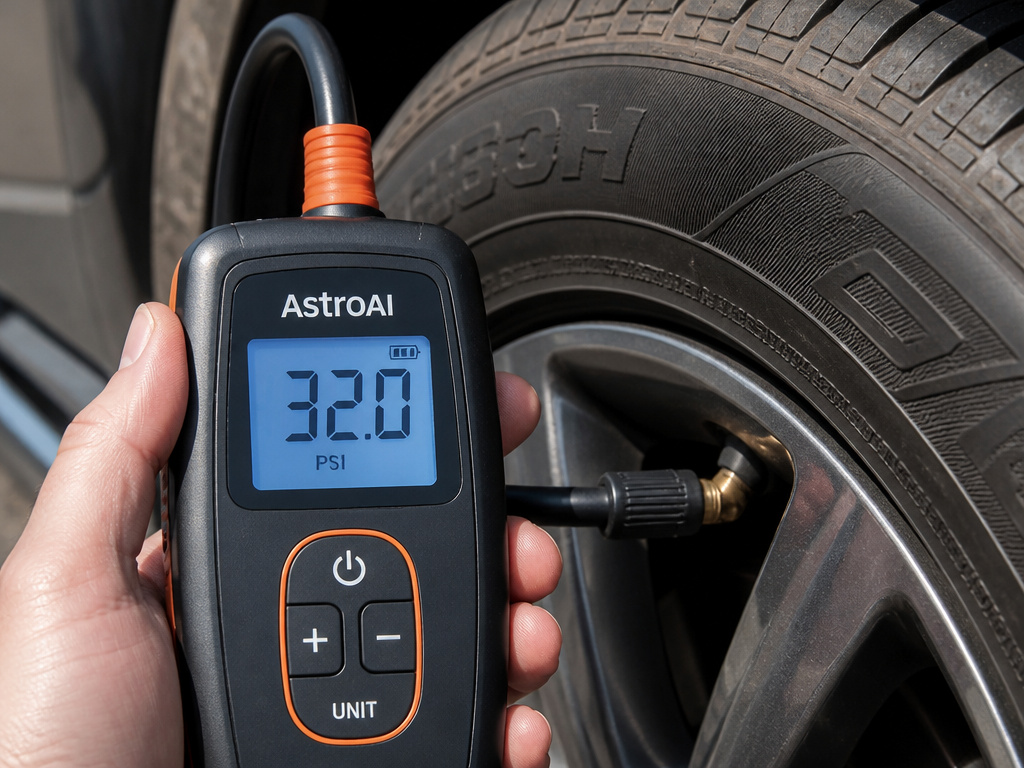
Don’t trust. Verify. You can check your portable inflator’s gauge with one other pressure source and a few minutes. You don’t need a lab.
Before you start: Work on a cold tire, one that’s been parked for at least three hours and driven less than a mile. A warm tire’s pressure can be several PSI higher and will corrupt your comparison.
- Establish a Baseline. Use a known-accurate gauge to measure your tire’s cold pressure. A handheld pressure gauge designed as a standalone measuring instrument can be used to establish a baseline. Note this true pressure.
- Read with the Inflator. Without adding or releasing air, immediately connect your portable inflator. Read its display. Note the difference. This is your gauge’s error at that specific pressure.
- Test a Second Point. Gauge error isn’t always linear. To see if it’s consistent, adjust the tire pressure. Either bleed down to about 20 PSI or add air up to 45 PSI. Repeat steps 1 and 2 at this new pressure.
If the error is the same at both pressures (e.g., always reads 2 PSI high), you have a simple offset. You can correct for it. If the error changes (reads 1 PSI high at 30 PSI but 3 PSI high at 45 PSI), your gauge is non-linear. You’ll need to remember its error is worse at higher pressures.
Common mistake: Verifying at only one pressure. A gauge can be spot-on at 32 PSI and wildly off at 50 PSI.
This process also checks the inflator’s chuck seal. If you hear a hiss while trying to read, you’re losing pressure and the reading is meaningless. A proper seal is silent.
When to Trust the Built-In Gauge (And When to Bring Backup)
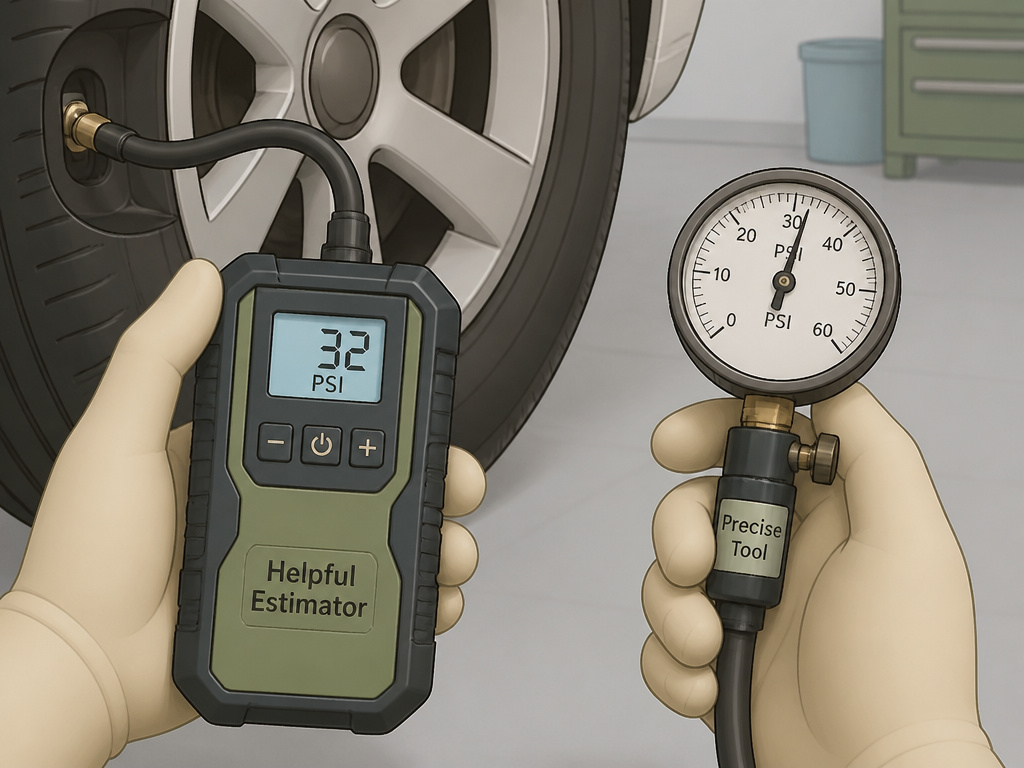
Your inflator’s gauge is a tool for a job. Define the job before you decide to trust it.
Trust it for:
- Monthly top-ups on passenger car or truck tires where ±1.5 PSI is acceptable.
- Ballpark work like inflating a lawn tractor tire from flat to a usable pressure.
- Any situation where you’re using the inflator’s pump to adjust pressure and its own gauge to track the relative change. Even an inaccurate gauge can show you’re adding 5 PSI.
Do not trust it for:
- TPMS reset procedures or diagnosing a tire pressure warning light. The system is calibrated, and your gauge needs to be more accurate than it is.
- Motorcycle, bicycle, or motorsport tires where the pressure window is narrow (e.g., 30-32 PSI cold).
- Final setting after using a shop air compressor. Use a standalone gauge for the final measurement.
- Any time absolute accuracy is legally or practically required.
Here’s the operational rule: treat your portable inflator as a pump with a helpful estimator. Use it to get close. Then, for the final, precise setting, switch to a dedicated, high-quality standalone tire gauge.
This separation of duties is how pros work. They’ll use a noisy, high-volume air compressor to fill the tire quickly, then disconnect it and screw on a silent, precise dial gauge to set the final pressure. The compressor’s gauge, if it has one, is ignored.
What do real-world tests show about inflator gauge accuracy?
Independent testing reveals a wide spread in gauge performance. In one test of 22 portable inflator units, the worst-case deviation from the true pressure ranged from ±0.5 PSI to +4.0 PSI. Fourteen of those units held an accuracy of ±1.0 PSI or better. The three best-performing units stayed within ±0.5 PSI at common test pressures. On the less accurate side, two analog units were found to read a consistent 1.5 PSI high at every checkpoint. For a typical passenger car, an error of ±1.0 PSI is considered negligible, as a tire naturally loses about 1 PSI per month.
Frequently Asked Questions
Which tire inflator gauge is the most accurate?
Based on direct testing, the AstroAI, Milwaukee M12, and Milwaukee M18 portable inflators showed the best gauge accuracy, staying within ±0.5 PSI at 20, 32, and 50 PSI. For standalone measurement, the Intercomp Digital Air Pressure Gauge (model 360045-BC) offers laboratory-grade accuracy of ±0.1% of applied pressure.
Are handheld tire pressure gauges accurate?
Quality handheld digital or dial gauges are significantly more accurate than most built-in inflator gauges. They are designed solely for measurement, without the compromises inherent in combining a sensor with a pump motor, battery, and air hose. Look for models that publish a specific accuracy spec (e.g., ±1% or ±0.5 PSI).
Do portable tire inflators actually work?
Yes, they work excellently as air pumps. Their primary function, moving air into a tire, is reliable. The common point of failure is the accuracy and consistency of the built-in pressure gauge, not the pumping mechanism. You should always verify the gauge’s readings if precise pressure matters.
How do I know if my tire pressure gauge is accurate?
You can verify it by comparing its reading to a known-accurate reference at two different tire pressures (e.g., 30 PSI and 45 PSI) on a cold tire. A consistent error (like always reading 2 PSI high) is correctable. A variable or wandering error means the gauge is unreliable.
The Bottom Line
Your portable inflator’s gauge is probably fine for keeping your car’s tires aired up. The median error is about ±1 PSI, which is less than the pressure a tire loses in a month. But “probably fine” isn’t the same as “trustworthy.”
The threshold for action is error direction. A gauge that reads high is a silent budget killer, nudging you into underinflation that wastes gas and eats tires. A gauge that reads low is a safety gamble. You can’t know which you have until you check it against something you know is right.
So here’s your first step this week: verify your gauge. Use a friend’s quality standalone gauge or even the often-more-reliable digital readout from your car’s TPMS (when the tires are cold). Know your tool’s bias. Once you do, you can stop worrying about the number on the screen and start trusting the air in the tire.
