
How to Cut a Straight Line With a Jigsaw: Step-by-Step
This post contains affiliate links. As an Amazon Associate, we earn from qualifying purchases.
To cut a straight line with a jigsaw, you must defeat blade deflection. This is done by using a clamped straightedge guide as a physical barrier, selecting a stiff, wide blade with fewer teeth per inch (TPI), and running the saw at a high, steady speed without forcing it. The guide eliminates steering error, the rigid blade resists bending, and the speed maintains momentum for a clean cut.
That last point about blade stiffness is the whole game. A jigsaw blade is a thin piece of metal being pushed and pulled through a dense material; it wants to bend. Fighting that bend with just your hands is a losing battle. The key is learning how to cut a straight line with a jigsaw. You need a system that removes the guesswork.
What follows is that system: the right guide, the right blade, and the technique that ties them together. By the last section, you’ll know why your cuts wander, how to fix it immediately, and when to admit a circular saw is the better tool for the job.
Key Takeaways
- A clamped straightedge guide is essential for a truly straight cut; trying to follow a pencil line freehand guarantees a wavy result.
- Blade choice dictates straightness. Use a wide, stiff blade designed for clean woodcuts to minimize deflection.
- Orbital action should be set to zero (off) for the cleanest, most controlled line in wood, plastic, or laminate, according to manuals from SKIL and others. For metal, sources disagree: SKIL recommends orbital 0 for all materials, while Makita recommends a small orbital setting for mild steel, and BENCHMARK advises always using straight reciprocating action for metal.
- If the saw bogs down or shuts off, you’re forcing it. Ease up on the pressure and check that you’re using the correct blade for the material.
- Let the blade stop completely before lifting the saw from the cut to prevent damaging the workpiece or the blade.
Why Your Jigsaw Blade Wanders (And How to Stop It)
A jigsaw isn’t designed for dead-straight lines. Its genius is in curves and plunge cuts. The primary enemy of straight cutting is blade deflection—the side-to-side bending of the blade during the cut.
Think of the blade as a long, flexible rod. As it moves up and down, the cutting forces push it sideways, especially when the grain of the wood changes. Your eye sees the blade drift off the line, your hand tries to correct it, and you end up with a gentle, frustrating wave. The fix isn’t better steering. It’s making steering irrelevant.
Common mistake: Trying to muscle the saw back on line. This twists the blade, increases friction and heat, and often makes the wander worse. The cut starts to burn, and the blade can snap.
The solution is a three-part system: a physical guide to follow, a blade stiff enough to resist bending, and a technique that lets the tool work without fight. We’ll start with the single most effective upgrade you can make.
The 7-Step Guide to Cutting with a Straightedge
This method bypasses your eyes and hands entirely. The saw’s base plate rides against a fixed guide, producing a line as straight as the guide itself.
Before you start: Wear safety goggles that comply with ANSI Z87.1, secure loose clothing, and clamp your workpiece firmly to a stable surface. A slipping workpiece is the fastest route to a ruined cut and a potential injury.
- Mark Your Line and Guide Position. Draw your cut line on the workpiece. Measure the distance from the edge of the saw’s base plate to the blade. Clamp a perfectly straight board or a metal straightedge parallel to your cut line, offset by that exact distance.
- Install the Right Blade. For straight cuts in wood or plywood, use a wide, stiff blade like a Bosch T101B or similar. The wider body resists deflection. For clean cuts in splinter-sensitive material like veneered plywood, the SKIL JS313101 manual explicitly states to always select orbital setting “0”.
- Set the Saw. Turn the orbital action to “0” (straight up-and-down motion). This provides the most control and the cleanest edge. Set the speed to high; a faster stroke helps maintain cutting momentum.
- Start the Saw, then Engage. Place the saw on the workpiece with the blade clear of the edge. Start the motor at full speed, then gently slide the base plate against your guide and feed the blade into the material.
- Feed with Steady, Light Pressure. Don’t push. Let the blade do the cutting. Your only job is to keep the base plate firmly against the guide. If you hear the motor straining, you’re pushing too hard.
- Manage the Exit. As you near the end of the cut, support the off-cut piece with your free hand to prevent it from splintering or tearing as the blade exits.
- Let the Blade Stop. Once through, release the trigger but keep the saw in place. Wait for the blade to come to a complete stop before lifting it away. This prevents the still-moving blade from marring the cut edge.
The BENCHMARK 1268-001 manual reinforces a critical safety step here: never hold the workpiece in one hand and the tool in the other. Always clamp the material and guide the tool with both hands.
Choosing the Right Blade: Your #1 Tool for Straight Cuts
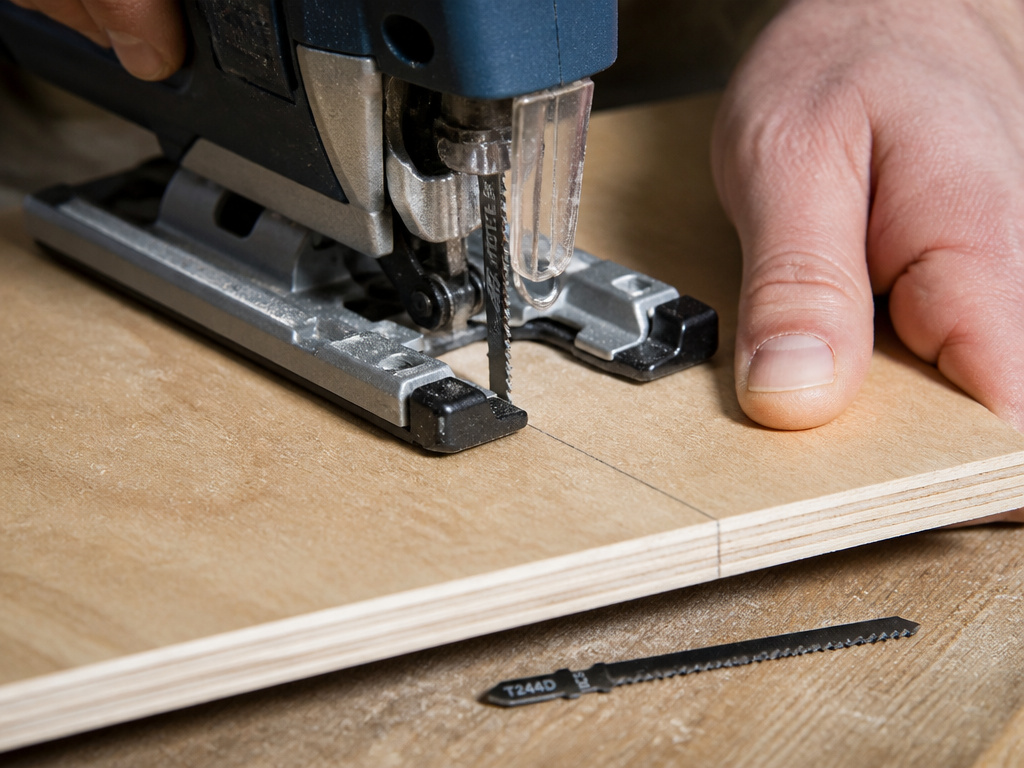
The blade is more important than the saw. A cheap saw with a great blade will outperform an expensive saw with a dull, flimsy one every time.
Blade deflection is a physics problem. A wider blade has a higher moment of inertia, meaning it resists sideways bending forces more effectively. Look for wide, stiff blades designed for clean cuts.
| Blade Type | Best For | Why It Helps Straight Cuts |
|---|---|---|
| Wide, Stiff Blade (e.g., Bosch T101B) | Clean, straight cuts in wood & plywood | Resists deflection; produces a smoother kerf. |
| Bi-Metal Blade | Cutting metal or mixed materials | Stays sharp longer; less likely to bend under hard material. |
| Scroll Blade (Narrow) | Intricate curves | Avoid for straight cuts – deflects easily. |
Tooth count matters. For straight cuts in most wood, a blade with a lower tooth count is ideal. Fewer teeth mean larger gullets that clear sawdust efficiently, preventing the blade from getting clogged and overheated. A clogged blade binds, increases friction, and gets pushed off course.
The BENCHMARK 1268-001 manual specifies to use only “U” or “T” shank blades designed for jigsaws and to never use a broken blade. After changing a blade, always check that it’s securely held in the blade holder. A loose blade won’t just cut poorly—it can be thrown from the tool.
The Orbital Action Debate: When to Use It (And When to Shut It Off)
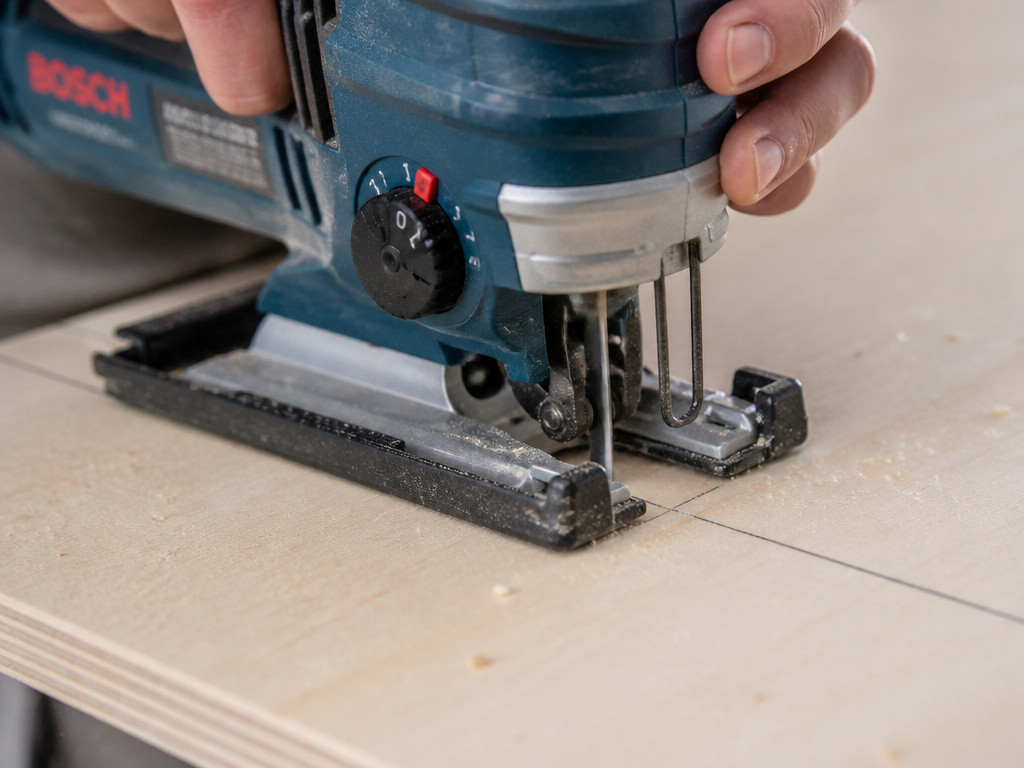
Orbital action is a feature that angles the blade forward on the upstroke, making it more aggressive. It’s great for speed, but terrible for control and edge quality. Here’s where manufacturers don’t fully agree, and you need to know both sides.
The SKIL JS313101 manual is clear: “Setting 0 [is for] accurate cutting in all materials (straight and curved cuts).” It adds, “Always select ‘0’ when sawing splinter-sensitive material.” For them, straight and clean means orbital off.
The Makita JV002G manual, however, suggests a small orbital setting (Position I) for “cutting mild steel, aluminum and hard wood,” and a medium orbital (II) for “fast cutting in aluminum and mild steel.”
Where this goes sideways: Using high orbital action on a straight cut in wood. The aggressive forward thrust can cause the blade to “plunge” ahead, making the saw harder to control and increasing tear-out on the top surface of the workpiece.
The Bottom Line: For the straightest, cleanest line in wood, plastic, or laminate, set orbital to 0. If you’re cutting thick hardwoods or metal and need more speed, you might experiment with a low orbital setting (I on Makita), but be prepared for a rougher edge. The BENCHMARK manual takes the strictest stance: “Always use the straight reciprocating action when cutting metal.”
What to Do When Your Jigsaw Stops Mid-Cut
An overload shutdown is a protective feature, not a defect. It means the tool is being asked to do more than it can handle. The Ozito PXBJSS-018 manual gives the direct fix: “reduce cutting pressure and/or increase pendulum action to reduce load on the tool.”
To put it plainly. If your jigsaw switches off:
- You’re forcing it. Ease up. Let the blade teeth do the cutting.
- The blade is wrong. A fine-tooth blade trying to cut thick material will clog and bind. Switch to a blade with fewer TPI.
- The orbital setting is wrong for the material. Try increasing orbital action slightly (per Ozito) for wood to clear chips faster. For metal, per BENCHMARK, ensure orbital is off.
- The blade is dull. A dull blade requires immense force. Replace it.
The sound tells you first. A high-pitched whine means the motor is straining. A drop in pitch means it’s bogging down. Ease off before it clicks off.
Jigsaw vs. Circular Saw: Picking the Right Tool
Sometimes, the best answer to how to cut a straight line with a jigsaw is to use a different saw. Know the limits.
A jigsaw excels at curves, plunge cuts, and cuts that aren’t all the way from an edge. A circular saw is built for straight lines. The larger, rigid base and bigger blade below the table make it inherently more stable.
| Factor | Jigsaw | Circular Saw |
|---|---|---|
| Straight Line Ease | Requires guide, technique, perfect blade. | Built for it; long base aids stability. |
| Cut Quality | Can be clean with guide & good blade. | Typically smoother, faster. |
| Versatility | Cuts curves, plunge cuts, intricate shapes. | Straight lines only (without major jigs). |
| Best Use Case | Cutting a sink hole in a countertop, shaping a curved shelf. | Ripping down a sheet of plywood, cutting deck boards. |
If you have more than a few feet of straight cutting to do, save yourself the hassle. Use a circular saw. The jigsaw is a brilliant problem-solver, but it’s not a dedicated straight-line tool.
How to Check a Jigsaw’s Guide Bearing
For the blade to move correctly, the back of the blade must rest in the groove of the guide roller. This bearing supports the blade to minimize side-to-side deflection. Before you start, inspect this area. Ensure the blade is facing straight forward and seated properly in the roller’s groove. The saw’s foot must also be positioned all the way forward for the orbital mechanism to function as designed. A blade that is not seated in this guide bearing will flex and wander, making a straight cut impossible. Always check this simple mechanical connection first.
How to Start a Jigsaw Cut Straight
Begin with the saw’s blade not touching the material. Position the front edge of the saw’s foot firmly against your clamped straightedge or the workpiece itself. Start the motor and let the blade reach full speed. Only then, gently pivot the saw forward from the foot, lowering the moving blade onto your cut line. If you are starting from an interior point, drill a pilot hole first. Never force the stationary blade into the material. This controlled start prevents the blade from grabbing and jumping off your intended line, which is a core principle of how to cut a straight line with a jigsaw from the very beginning.
Frequently Asked Questions
What is the best jigsaw blade for cutting straight lines?
The best blade is a wide, stiff blade with a low tooth count. The width is key—it fights the deflection that causes wandering.
Why does my jigsaw cut at an angle?
This is called blade lead. It’s often caused by a dull or bent blade, excessive side pressure from your hand, or a misaligned base plate (shoe). Check that your base plate is square to the blade (0° bevel). If it is, try a fresh, stiff blade and focus on guiding the saw without leaning it.
Can you cut a 2×4 straight with a jigsaw?
Yes, but it’s a test of patience and setup. You must use a sharp, coarse blade (6 TPI or fewer), a clamped guide, and likely no orbital action. Cut slowly and let the blade work. For more than one or two cuts, a circular saw or a handsaw will be faster and straighter.
How do you make a perfect straight cut without a guide?
You don’t. “Perfect” and “without a guide” are mutually exclusive with a jigsaw. You can get acceptable cuts by using a factory edge of another board as a temporary guide, but for repeatable, reliable straightness, a dedicated clamped guide is the only professional method.
Before You Go
Here’s the takeaway most guides miss: a straight cut is a mechanical process, not an artistic one. Your job isn’t to steer; it’s to set up a system that makes steering unnecessary. That means a guide, the stiffest blade you can find, and the discipline to let the tool run at its own pace.
If you find yourself constantly fighting the saw, stop and diagnose. Is it the blade? The orbital setting? Are you forcing it? The answer is almost always in the setup, not in your hands. And if you need to cut down a full sheet of plywood into perfect rectangles, do yourself a favor—reach for the circular saw. Use the jigsaw for the jobs it was built to win.
