
How to Dispose of Power Tool Batteries: The 5-Step Process
This post contains affiliate links. As an Amazon Associate, we earn from qualifying purchases.
To dispose of power tool batteries, you must separate the battery from the tool and deliver it to a certified recycling program, never the household trash. For example, DEWALT advises that for tools with removable batteries, you return the battery to Call2Recycle and the tool body to the Terracycle Tool Program. For example, DEWALT directs tools with non-removable batteries to the Terracycle Lithium-Ion Program. Before drop-off, tape the battery terminals to prevent a short-circuit fire.
That last step, taping the terminals, isn’t a suggestion. A bare terminal contacting a stray key or coin in a collection bin can deliver enough current to start a fire, which is why Milwaukee’s manual states it as a mandatory pre-disposal step. The process isn’t just about recycling; it’s about managing a dormant hazard. Always check local guidelines for how to dispose of power tool batteries.
What follows is the full breakdown: why the trash is illegal, how to prep any battery safely, where each major brand wants its products returned, and what to do if a battery is swollen or damaged, all centered on the core question of how to dispose of power tool batteries. By the end, you’ll know exactly where your dead DEWALT, Milwaukee, STIHL, or Bosch battery needs to go.
Key Takeaways
- Never put any power tool battery in household trash or curbside recycling. Lithium-ion and nickel-cadmium cells contain toxic materials and can cause landfill fires.
- Tape the battery’s metal terminals with electrical tape before handling. This prevents a short circuit, which Milwaukee warns can cause fire or explosion even in a depleted battery.
- Use the Call2Recycle locator for drop-off. Many retailers participate in Call2Recycle, providing free recycling for common battery sizes.
- Follow your brand’s specific end-of-life guide. DEWALT splits the battery and tool to different programs; STIHL and Milwaukee use RBRC partners; Bosch notes special shipping rules for third-party transport.
- Swollen or damaged batteries are a special case. Do not attempt to ship them; take them directly to a Household Hazardous Waste (HHW) facility for professional handling.
Why You Can’t Just Toss Them in the Trash
A dead 20V MAX battery looks inert. It isn’t. Inside, the lithium-ion cells contain chemistry that doesn’t belong in a landfill and, as STIHL warns, even discharged batteries may still deliver a dangerous short-circuit current. The environmental reason is clear, but the immediate safety reason is what should stop you: compaction in a garbage truck can rupture a cell.
When a lithium-ion cell is crushed or pierced, it can undergo “thermal runaway.” This is a rapid, self-sustaining chemical reaction that generates intense heat, sparks, and often flames. In an enclosed space like a garbage truck or recycling facility, this is a serious fire hazard.
Common mistake: Throwing a seemingly dead battery in the trash. The consequence isn’t just a fine; it’s providing the fuel for a waste facility fire that’s difficult to extinguish.
Beyond fire, heavy metals like cobalt, nickel, and lead can leach into groundwater from a cracked battery in a landfill. Recycling recovers these materials for reuse. Due to the fire risk and toxic metal content, many jurisdictions prohibit disposing of lithium-ion or nickel-cadmium batteries in municipal waste.
The 5-Step Disposal Process
Follow this sequence every time. Skipping a step, especially terminal preparation, turns a simple errand into a risk.
1. Identify Your Battery Type
First, know what you’re holding. Most modern cordless tools use lithium-ion (Li-ion) batteries, recognizable by their light weight and high voltage labels (12V, 18V, 20V MAX). Older tools may use nickel-cadmium (NiCd) or nickel-metal hydride (NiMH). The disposal path is often the same, but understanding how to dispose of power tool batteries for your specific type is good to know. If you’re unsure, check your tool’s manual or the battery label. For a deeper dive on the differences, our guide comparing NiCd and lithium-ion power tool batteries breaks it down.
2. Prepare the Battery: The Terminal Tap
This is the single most important action you will take. You need a roll of standard electrical tape.
- Power off the tool and remove the battery.
- Locate the two metal contact points (terminals) on the battery.
- Tear off a strip of electrical tape large enough to cover the terminals.
- Firmly press the tape over both terminals, ensuring no bare metal is exposed. A single strip covering both is fine, but two separate pieces are safer.
Milwaukee’s safety instructions state this plainly: “Before disposing, use electrical tape to cover terminals to prevent shorting.” Why? A short circuit can happen if those terminals touch any conductive material, another battery, loose change, or the metal edge of a collection bin. The resulting spark can ignite flammable materials or cause the battery to vent toxic gas.
3. Separate Battery from Tool (If Possible)
If your battery is removable, take it off the tool. The tool body and the battery now have different destinations. For example, DEWALT’s guide specifies that for tools with removable batteries, you return the battery to Call2Recycle and the tool alone (without the battery) to the Terracycle Tool Program.
If the battery is non-removable, built into the tool’s handle or casing, treat the entire unit as a single item. DEWALT directs these to the Terracycle Lithium-Ion Program.
4. Find a Drop-Off Location
You have three main options, ranked from most convenient to most comprehensive:
| Option | Best For | How to Find | What They Accept |
|---|---|---|---|
| Retail Drop-Off | Convenience, single batteries | Call2Recycle website locator | Single Li-ion, NiCd, and NiMH battery packs. |
| Household Hazardous Waste (HHW) | Damaged/swollen batteries, large quantities | Your city/county government website | All battery types, often also the old tools, chemicals, paint |
| Manufacturer/Servicing Dealer | Following brand-specific take-back | Brand website (e.g., STIHL dealer locator) | Only that brand’s batteries, sometimes tools |
Retail Drop-Off: Many major retailers have Call2Recycle collection bins, usually near the entrance. Use the Call2Recycle locator and select “Retail Drop-Off” to find the nearest one. This is the easiest path for one or two standard batteries.
HHW Facility: This is your only safe option for a swollen, leaking, or physically damaged battery. These facilities are equipped to handle unstable chemistry. Find yours by searching “[Your County] household hazardous waste.”
5. Drop Off and Document
Take your taped battery (and tool body, if separate) to your chosen location. Some programs, especially manufacturer ones, may offer a mail-in option. For standard retail drop-off, there’s no paperwork. For HHW, you might need to prove residency. If you’re mailing a battery, note Bosch’s critical warning: while user road transport is unrestricted, shipping by third parties (e.g., air transport) requires special packaging, labeling, and consultation with a hazardous material expert.
TL;DR: Tape terminals, split battery from tool if you can, use Call2Recycle for normal batteries, use HHW for damaged ones. That’s the whole sequence.
Manufacturer-Specific Recycling Programs
Brands have their own partnerships and instructions. Ignoring these can mean your battery doesn’t get processed correctly.
DEWALT
DEWALT provides a clear, bifurcated guide:
- For tools with removable batteries: Remove the battery. Return the battery to Call2Recycle. Return the tool alone (without the battery) to the Terracycle Tool Program.
- For tools with non-removable batteries: Return the entire tool to the Terracycle Lithium-Ion Program.
- For tools without batteries: Return to the Terracycle Tool Program.
This separation is crucial, sending a whole tool to Call2Recycle clogs their system, which is designed for battery packs only.
STIHL & Milwaukee (RBRC Partners)
Both STIHL and Milwaukee partner with the Rechargeable Battery Recycling Corporation (RBRC). Look for the RBRC seal (three chasing arrows) on the battery.
- STIHL: States that you can return spent batteries to any authorized STIHL servicing dealer free of charge. The RBRC seal indicates STIHL has prepaid for the recycling. They also provide the RBRC toll-free number for location info: 1-800-822-8837.
- Milwaukee: Similarly, users can return batteries to Milwaukee Branch Offices/Service Centers or call the same RBRC number (1-800-822-8837) for other recycling locations.
Where this goes sideways: Assuming all stores take all brands. Your local STIHL dealer won’t accept a Milwaukee battery, and vice-versa. Stick to the brand’s designated take-back network.
Bosch
Bosch’s instructions add a critical layer for shipping. Their manual states lithium-ion batteries are subject to Dangerous Goods Legislation. While road transport by the user is unrestricted, shipping by third parties (e.g., air transport or a forwarding agency) requires special packaging, labeling, and consultation with a hazardous material expert. If you’re mailing back a Bosch battery under a warranty or recall, contact them first for instructions. For drop-off, they advise sorting batteries for environmentally friendly recycling and not disposing with household waste.
Handling Damaged or Swollen Batteries
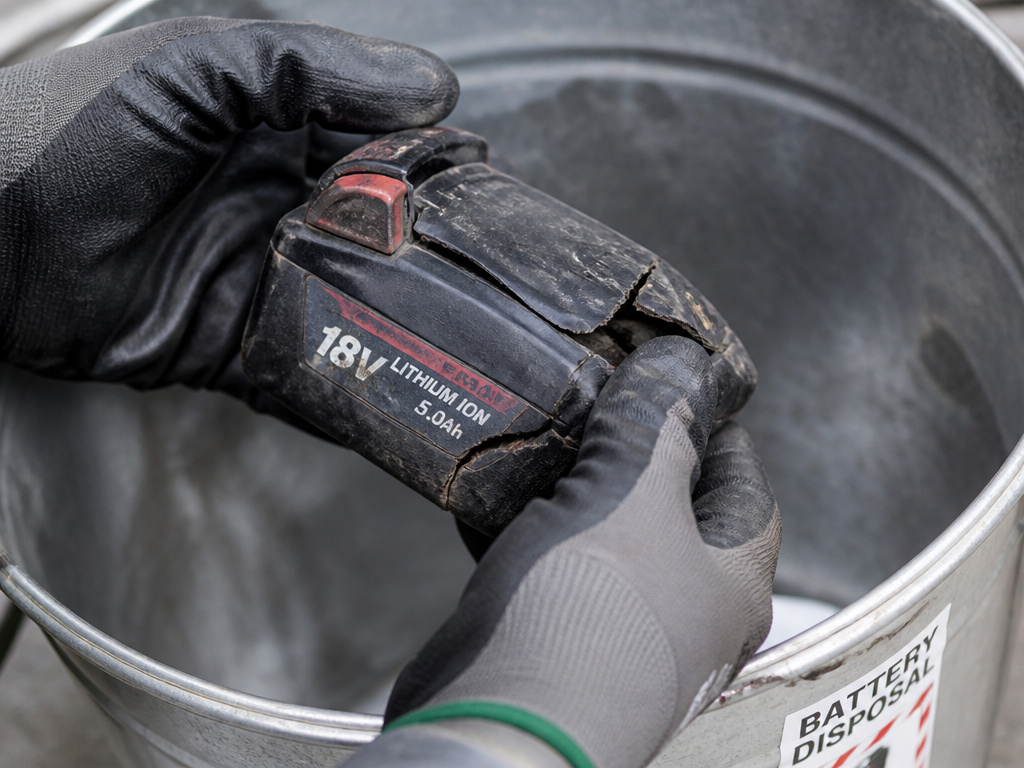
A battery that’s bulging, cracked, or leaking is in a failure state. It’s unstable. Your process changes completely.
Do Not:
- Try to charge it.
- Place it in a standard retail drop-off bin.
- Attempt to ship it without explicit, professional guidance.
- Puncture or disassemble it. STIHL warns against opening, disassembling, crushing, dropping, or subjecting the battery to heavy impact.
Do:
- Isolate it immediately. Place it in a non-flammable container (like a metal bucket or ceramic pot) away from other batteries, flammable materials, and direct sunlight.
- Take it directly to a Household Hazardous Waste (HHW) facility. This is essential. These facilities have the containment and expertise to manage the risk.
- If the battery got wet, STIHL’s protocol is specific: allow it to dry for at least 48 hours between 15°C and 50°C with less than 70% humidity before attempting any further handling. Higher humidity may extend drying time.
The swollen casing is a sign of internal gas buildup, often from a failed cell. This battery is a pressure vessel waiting for a trigger. Your goal is to deliver it to professionals without providing that trigger.
Battery Disposal FAQs
Does Home Depot recycle power tool batteries?
Yes, most Home Depot stores have a Call2Recycle collection bin, usually at the front entrance. They accept single lithium-ion, nickel-cadmium, and nickel-metal hydride battery packs. It’s a free service. Use the Call2Recycle locator to confirm your local store participates.
What batteries can you put in the garbage?
Almost no modern power tool battery should go in the garbage. Lithium-ion, nickel-cadmium (NiCd), and nickel-metal hydride (NiMH) are all banned from municipal solid waste in most jurisdictions due to fire risk and toxic metal content. The only possible exception might be very old, single-use alkaline batteries, but you should check your local regulations.
What do you do with a bad DEWALT battery?
Follow DEWALT’s end-of-life guide: if it’s removable, tape the terminals, take the battery to a Call2Recycle drop-off point, and return the tool body (without the battery) to the Terracycle Tool Program. If the battery is non-removable, tape its terminals and send the whole unit to the Terracycle Lithium-Ion Program.
Can I get money for my old power tool batteries?
Typically, no. While some scrap metal operations pay for lead-acid car batteries, the lithium and other metals in tool batteries are not economical to extract at small scale. Beware of any “cash for batteries” offers online; they are often scams or illegal export operations. The legitimate incentive is free recycling, which every major program provides.
The Bottom Line
Disposing of a power tool battery is a five-minute task with a fixed procedure: tape the terminals, separate it from the tool, and drive it to a certified drop-off. The brand-specific details. DEWALT’s split program, STIHL’s dealer network, Bosch’s shipping rules, are there for a reason; following them ensures the material actually gets recycled and doesn’t become someone else’s hazard.
If you remember one thing, let it be the tape. That single strip of electrical tape is the barrier between a safe recycle run and an avoidable incident. Everything else, the locator tools, the brand partnerships, the HHW facilities, is built around that fundamental act of safety. Do that, and the rest is just a trip to the store.
