
Industrial vs Automotive Air Couplers: How to Spot Them
This post contains affiliate links. As an Amazon Associate, we earn from qualifying purchases.
Industrial interchange couplers connect to plugs made to the MIL-C-4109F and ISO 6150-B standards, feature a short nose with two thin machined stripes, and are built for 300 PSI shop systems. Automotive interchange couplers (Tru-Flate style) mate with brands like Amflo, Dill, and Milton, have an even shorter nose with one thin stripe, and while often rated to 300 PSI, high-end models like the TCH J-Series push to 500 PSI working pressure.
That distinction between a standard and a brand-compatibility list is the whole game. It’s not about which one is “better” in a vacuum, it’s about which ecosystem your tools, compressor, and local suppliers already live in. The difference between industrial vs automotive air couplers is a prime example. A mismatch here doesn’t just mean a trip back to the store; it means a tool that sits idle because you can’t get air to it.
What follows: a foolproof visual ID method, a breakdown of the pressure and flow specs that actually matter, a look at the universal coupler gamble, and the one safety rule nobody should skip.
Key Takeaways
- Identify couplers by the plug’s nose length and stripe count: two thin stripes (industrial) vs. One thin stripe (automotive).
- Standardize on one interchange type across your entire shop; mixing them guarantees dead-end tools and wasted adapters.
- Manufacturers recommend using a whip hose on vibrating tools; Dixon recommends 3 to 10 feet, while TCH Industries advises using at least 18 inches of hose between the tool and coupling.
- Universal couplers promise compatibility, but sources disagree on their reliability; some user experience reports indicate they are more prone to leakage under side load, while other sources suggest they should rarely cause connection problems.
- For high-flow tools (sanders, grinders), step up to a 3/8″ coupler body size; a 1/4″ body at 26 CFM can starve them.
How to Spot the Difference in 10 Seconds
Lay a plug on your bench. Look at the business end. The nose length and the machined grooves, the “stripes”, tell you everything.
Industrial interchange plugs have a short nose with two thin, closely spaced stripes. Automotive interchange (Tru-Flate) plugs have an even shorter nose with just one thin stripe. ARO-style plugs show one thick stripe on a longer nose, and Lincoln styles have a long nose with one thick and one thin stripe.
This visual trick, noted in distributor guides, is the fastest field check. The stripes aren’t decoration; they’re machining artifacts from the manufacturing process that became reliable identifiers. An industrial plug will not seat in an automotive coupler, and vice versa. The internal ball-lock mechanism is spaced differently.
The confusion starts because both types commonly use 1/4″ NPT threads. You can screw an industrial plug into a tool port designed for an automotive fitting, and it will thread in perfectly. It just won’t lock into the coupler on your hose. That’s why so many people buy the “wrong” one when you compare industrial vs automotive air couplers, the threads match, so they assume compatibility.
Where this goes sideways: Stocking both types “just in case.” You’ll grab the wrong hose for a tool, waste five minutes troubleshooting, and eventually buy a drawer full of adapters that become single points of failure. Pick one standard for your primary air lines and stick to it.
The Pressure, Flow, and Material Specs
On paper, the pressure ratings look similar. Dig into the manufacturer spec sheets, and the differences, and debates, become clear.
| Specification | Industrial Interchange (e.g., Dixon Air Chief, AFP 20 Series) | Automotive Interchange (e.g., TCH J-Series, Dixon Automotive) | | :— | :— | :— | | Rated Pressure | Up to 300 PSI (Dixon, AFP) | 300 PSI (Standard), 500 PSI (TCH J-Series Brass/Steel) | | Burst Pressure | Not typically specified in public docs | 11,500 PSI (TCH 1/4″ Brass/Steel), 18,000 PSI (TCH 3/8″ Steel) | | Temperature Range | -40°F to +250°F (Standard seals) | -40°F to +250°F (Standard Nitrile seals) | | Common Body Sizes | 1/4″, 3/8″, 1/2″ | 1/4″, 3/8″, 1/2″ | | Typical Materials | Steel, Brass, 303 Stainless Steel (Dixon) | Brass (1/4″), Steel (3/8″, 1/2″) (TCH), Steel/Brass (Dixon) | | Flow Rate (at 100 PSI) | Not specified in fact sheet | 26 CFM (1/4″), 58 CFM (3/8″), 91 CFM (1/2″) (TCH J-Series) |
The first point of disagreement is right at the top: maximum working pressure. The Dixon Air Chief catalog lists its industrial and standard automotive lines at 300 PSI. Yet, the TCH Industries J-Series sheet, which adheres to the automotive Tru-Flate interchange, rates its 1/4″ brass coupler and steel plug combo for 500 PSI working pressure with an 11,500 PSI burst rating. That’s not overkill; it’s a different grade of component for the same style.
Flow rates matter more than you think. A 1/4″ TCH J-Series coupler flows 26 CFM. Many air tools require high CFM, which can leave little headroom. If your compressor can’t deliver a steady 26 CFM at the tool, performance drops. Stepping up to a 3/8″ coupler body nearly doubles the flow to 58 CFM, eliminating that bottleneck. This is why fitting size (1/4″, 3/8″) is a separate decision from interchange style.
Materials follow a pattern. Industrial couplers are commonly offered in steel, brass, and 303 stainless steel for corrosion resistance in harsh environments. Automotive lines, especially in the common 1/4″ size, often use brass for its machinability and corrosion resistance, with higher-end models like the TCH J-Series using machined steel bar stock and stainless steel internal springs.
Industrial vs Automotive: Where Each One Belongs
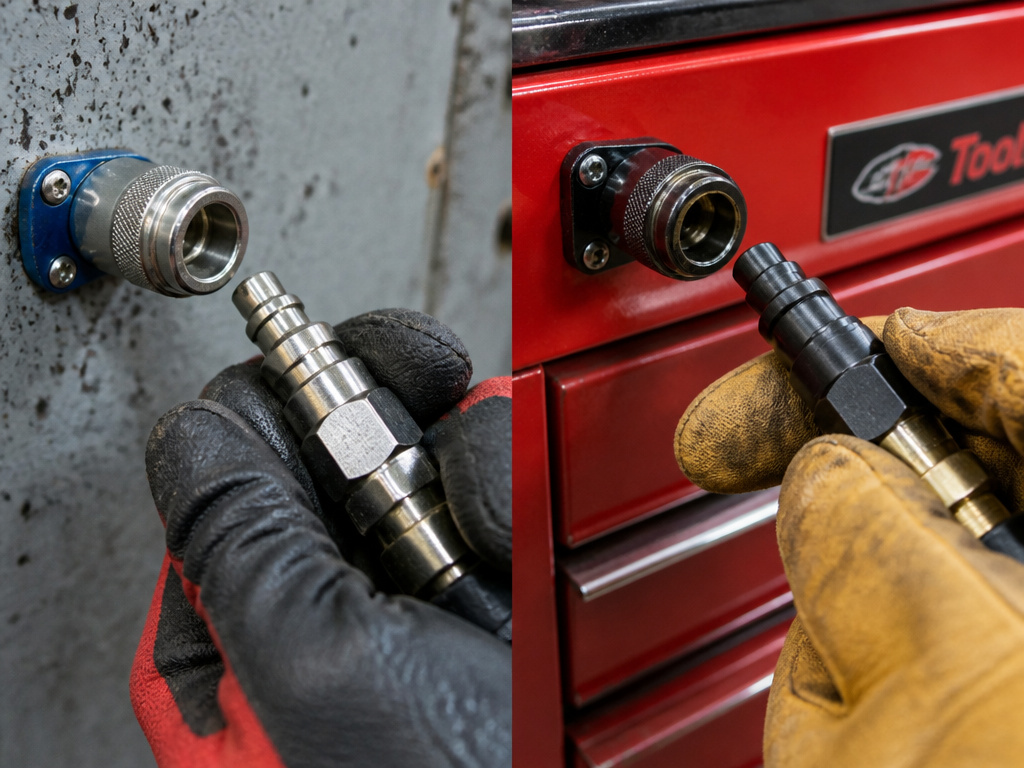
The names aren’t marketing. They’re a map of where you’ll find these fittings bolted to the walls.
Industrial Interchange (ISO 6150-B / MIL-C-4109F) is the language of factories and large workshops. If you walk into a manufacturing plant, woodshop, or metal fab shop, the drops from the ceiling and the connections on stationary tools will likely be industrial style. The standard is governed by a military specification (MIL-C-4109F) and its commercial counterpart (A-A-59439), which dictates precise dimensions for the plug nose profile and ball-lock placement. This guarantees that a Dixon coupler will mate with an AFP Industries plug, a Parker 20-Series plug, and so on. It’s about universal interoperability within a regulated standard.
Automotive Interchange (Tru-Flate / Parker 10-Series) is the dialect of tire shops, auto garages, and home workshops. Its compatibility is brand-based: it interchanges with products from Amflo, Dill, Milton, and Truflate. This is both its strength and its weakness. It’s ubiquitous. You can buy automotive plugs and couplers at any big-box hardware store. However, Dixon’s own literature includes a caveat: “There are some makes however, which do not interchange with any others.” Not every brand playing in this space adheres perfectly to the unwritten Tru-Flate dimensions.
So which should you choose?
- If you’re setting up a home garage, buying common consumer pneumatic tools, or ever plan to take a tool to a friend’s shop or a tire center, standardize on Automotive Interchange. It’s the path of least resistance.
- If you’re outfitting a professional woodworking or metal shop, connecting to an existing industrial air system, or buying higher-end industrial pneumatic tools, adopt the Industrial Interchange standard.
Common mistake: Assuming a “universal” coupler solves everything. Sources disagree on their reliability; some user reports note that universal couplers from major retailers can be more prone to leakage, especially under side load. The mechanism that tries to accommodate multiple plug profiles often doesn’t seal as positively as a dedicated design.
The Universal Coupler and Safety Considerations
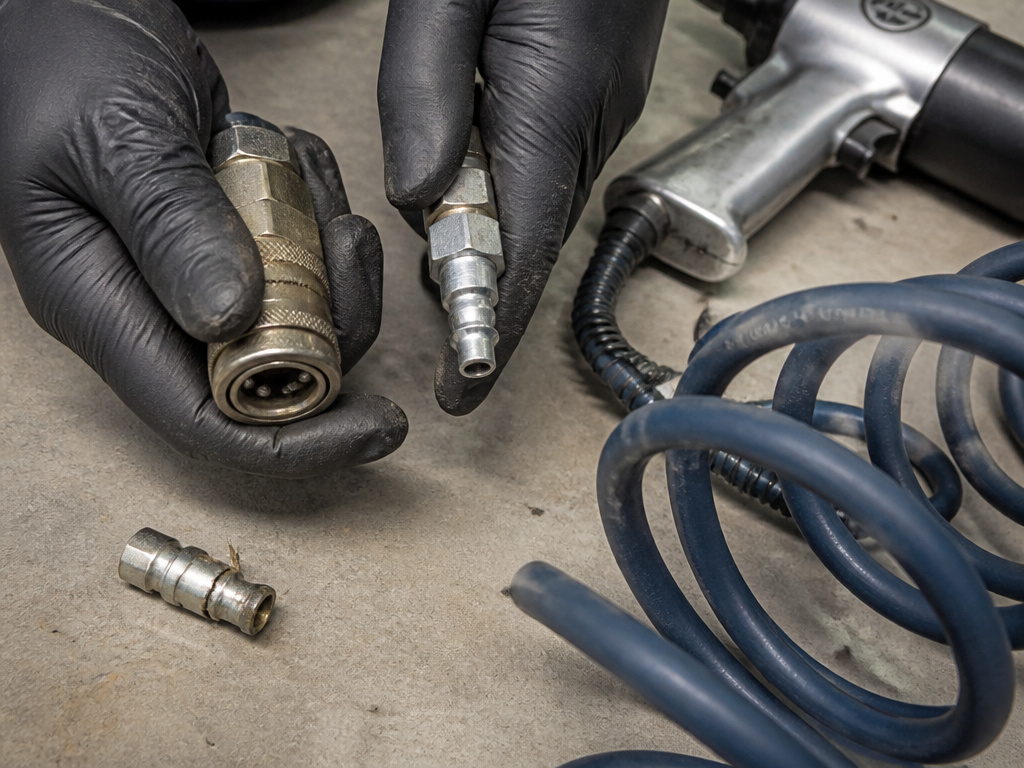
The universal coupler seems like a perfect solution. Brands like Prevost market systems like the prevoS1 Safety Coupling that support ISO 6150 B, Truflate, ARO 210, and European profiles in one unit. The promise is simple: one coupler on your hose for any tool.
The situation is more complex. Sources disagree on reliability; while a high-end unit like the Prevost may perform well, some user experience reports indicate that commodity universal couplers can have leakage problems. The design compromise required to fit multiple profiles can prevent a perfect seal.
Safety isn’t optional with compressed air. Two manufacturer recommendations are essential.
First, the whip hose. Dixon’s application guide is explicit: “A short length whip hose is recommended on impact tools connected with these couplers to prevent premature wear caused by excessive vibration.” They specify 3 to 10 feet. The constant shock and vibration from an impact wrench or pavement breaker travels directly into the coupler, work-hardening the metal and eventually cracking it or fatiguing the seals. A whip hose absorbs that vibration.
Second, inspection and testing. Dixon states that hose assemblies should be “tested in accordance with the Association for Rubber Products Manufacturer’s (ARPM) recommendations and inspected regularly (before each use).” Look for cracks, worn seals, and damaged nipples. A damaged nipple will ruin the seal in any coupler, leading to immediate leakage.
TCH Industries adds another rule: “Never install a pneumatic coupling directly into an air tool. Use a piece of hose that is at least 18″ long between the tool and the coupling.” This differs from Dixon’s recommendation of a 3 to 10 foot whip hose, highlighting a point where manufacturer advice varies.
How to Retrofit Your Shop to One Standard
You’ve got a mix. Your compressor hose has an industrial coupler, but your new impact wrench came with an automotive plug. Converting is straightforward and costs less than a pizza.
You need to change the coupler on your hose and the plugs on your tools to match. Don’t just swap the coupler and use adapters on every tool, that adds two extra leak points per tool.
Here’s the process:
- Identify your target standard. Use the visual guide earlier. Decide if Automotive or Industrial makes more sense for your shop’s future.
- Purchase a new coupler. For Automotive, a Milton S-211 or a Dixon automotive model. For Industrial, a Dixon Air Chief industrial model or a Parker 20-Series style.
- Purchase matching plugs. Buy one for each tool you own. Don’t forget the plug on your air blow gun.
- Gather tools: Two wrenches (for threaded connections), a sharp utility knife or hose cutter, and possibly thread tape for NPT threads.
- Cut the old coupler off your hose cleanly. If it’s a reusable style, unscrew it.
- Install the new coupler according to its type (screw-on, push-on, or barb-and-clamp). For NPT threads, apply sealant tape or paste clockwise, looking at the thread end.
- Swap the plugs on your tools. Use two wrenches to avoid straining the tool’s aluminum port, one to hold the port, one to turn the plug.
This is also the time to assess your air hose diameter. If you’re running high-CFM tools, upgrading from a 1/4″ hose to a 3/8″ hose and matching coupler can reveal performance you didn’t know you were missing.
What is the difference between T-style, M-style, and Tru-Flate?
The names T-style, M-style, and Tru-Flate all refer to Automotive Interchange couplers. These are the fittings commonly found in auto shops, used for tire work and with many consumer tools. The Tru-Flate name comes from one of the original manufacturers, and this style is designed to interchange with products from other brands like Amflo, Dill, and Milton. They are not the same as Industrial Interchange couplers, which follow a different global standard. The confusion in the industrial vs automotive air couplers debate arises because both main types often share the same thread sizes, like 1/4″ NPT, so they can screw into the same ports but will not connect to each other.
Frequently Asked Questions
What is the difference between an industrial and an automotive air compressor coupler?
The core difference is the plug profile standard they accept. Industrial couplers mate with plugs manufactured to the MIL-C-4109F / ISO 6150-B dimensional standard. Automotive couplers accept the “Tru-Flate” style plug used by brands like Milton and Amflo. Visually, an industrial plug has two thin machined stripes; an automotive plug has one thin stripe.
Are universal air couplers any good?
High-end, multi-profile safety couplers like the Prevost prevoS1 are engineered for robust performance across standards. However, generic universal couplers have a documented track record among users of increased leakage, particularly when side pressure is applied to the connection. For a permanent shop setup, dedicated couplers are more reliable.
What are the best air hose couplers?
For Automotive Interchange, the TCH Industries J-Series stands out for its 500 PSI working pressure and machined solid-bar construction. For Industrial Interchange, the Dixon Air Chief series offers proven reliability with steel, brass, and stainless steel options.
Do high-flow air fittings make a difference?
Yes, significantly. Fitting size (1/4″, 3/8″, 1/2″) dictates maximum potential airflow more than the interchange style. A 3/8″ coupler body can flow over twice the CFM of a 1/4″ body. If your tools (like sanders or large grinders) are air-hungry, stepping up your hose diameter and coupler size is one of the most effective performance upgrades you can make.
Can I use an adapter to connect mismatched couplers?
You can, but you shouldn’t make it a permanent solution. A simple brass adapter adds two extra threaded connections, each a potential leak point and a restriction to airflow. It also creates a clunky, extended connection more likely to get snagged or broken. Use an adapter only as a temporary fix while you order the correct permanent parts.
The Bottom Line The choice between industrial and automotive air couplers isn’t a quality judgment, it’s a compatibility decision. Look at the tools you own and the shops you interact with. For many home garages and auto enthusiasts, the automotive interchange is the right default. The parts are everywhere, and it just works.
If you’re building a professional shop from scratch, especially in woodworking or metalworking, the industrial interchange standard offers guaranteed interoperability between manufacturers. Whichever you pick, commit to it completely across all your hoses and tools.
One rule to take with you: never connect a vibrating tool directly to a coupler. That 3-to-10 foot whip hose isn’t a suggestion; it’s the cheapest insurance policy you can buy for your air system. It’s the difference between couplers that fail in a year and a setup that lasts for decades. Your compressor and your tools are a significant investment. Connect them with the same care.
