
Portable Tire Inflator vs Air Compressor: Key Differences
This post contains affiliate links. As an Amazon Associate, we earn from qualifying purchases.
Choosing between a portable tire inflator and an air compressor comes down to a single question: do you need to move air into tires, or do you need to move air. A tire inflator is a specialist, designed for one job with speed and portability. An air compressor is a generalist, built to store pressure and power tools. For most drivers topping off tires, a dedicated inflator is the simpler, faster tool. For a garage that needs to run a nail gun or sandblaster, a compressor is essential.
That gap between moving air into something and having air on tap is where the whole decision lives. One is a direct line from motor to valve stem. The other is a reservoir you draw from, like a water tank versus a hose connected straight to the well. The core comparison is portable tire inflator vs air compressor.
The rest of this guide walks you through the specs that actually matter in the portable tire inflator vs air compressor decision. CFM, PSI, duty cycle, and how they translate to real jobs. You’ll get a side-by-side breakdown, a clear decision guide based on your vehicle, and the honest reliability notes owners don’t put in marketing copy.
Key Takeaways
- Duty cycle is your real-world limit. A VIAIR 400P EF runs at 100% duty cycle at 40 PSI, meaning it can operate continuously for roadside tire fills. A compressor with a tank might have a 50% duty cycle but still run a nailer all day because the tank does the work.
- Match your largest tire. The VIAIR 450P-RVS is rated for tires up to 275/80R22.5, making it an RV essential. The NOCO AIR15, however, is only suitable for tires 33-inches or less.
- Some owners report gauge inaccuracy. For the VIAIR 400P EF, one owner reported the gauge was off by a significant amount, while for the 450P-RVS, an owner stated it showed 5-7 lbs lower than actual pressure.
- CFM matters more than max PSI for speed. A San Hima 12V compressor moves 7.06 CFM, filling a 4WD tire from 18 to 38 PSI in under two minutes. High PSI with low CFM is slow.
- Choose cordless for total portability, 12V for unlimited runtime. A cordless inflator like the AsperX runs for 25+ minutes on a charge. A 12V unit like a VIAIR draws from your car’s battery, effective as long as the engine runs.
Tire Inflator vs. Air Compressor: A Side-by-Side Comparison
Forget the vague “one is bigger” advice. The difference is in architecture, and that dictates everything you can do.
Portable Tire Inflator: A compact, direct-drive pump. The motor runs only while you’re inflating, pushing air directly into the tire. It’s a specialist, optimized for one job: getting a specific pressure into a closed volume as fast as possible.
Portable Air Compressor: A motor-pump unit that fills a storage tank with compressed air. You then draw from that tank, either through a hose for inflation or to power pneumatic tools. It’s a reservoir system, trading some immediate portability for sustained air supply.
The portable tire inflator vs air compressor choice isn’t about good versus bad. It’s about matching the tool’s architecture to your task. The following table lays out what each type is built for.
| Feature | Portable Tire Inflator | Portable Air Compressor |
|---|---|---|
| Core Design | Motor pumps directly to hose; no storage tank. | Motor fills a storage tank; air is drawn from the tank. |
| Primary Job | Inflating tires, sports balls, air mattresses. | Running pneumatic tools (nailers, impacts, spray guns). |
| Best For | Roadside emergencies, routine tire top-offs, cyclists. | Workshops, construction, sustained high-air-demand tasks. |
| Power Source | Typically 12V car outlet or built-in battery. | Typically 120V AC wall outlet, larger 12V/24V DC systems. |
| Key Spec | CFM (Cubic Feet per Minute) at a given PSI. | Tank Size (Gallons) & CFM @ PSI for tool operation. |
| Portability | High. Often under 10 lbs, fits in a trunk corner. | Low to Moderate. Tank and motor add significant weight/size. |
| Example Model | Xiaomi Portable Electric Air Compressor 2 Pro | VIAIR 450P-RVS (12V, tankless but high-duty-cycle) |
Where this goes sideways: Assuming a high-PSI inflator can run a tool. PSI is only half the story. A tool like a die grinder needs sustained CFM, which a tankless inflator cannot provide. You’ll stall the tool and burn out the inflator’s motor.
To be clear. If your job starts and ends with tire valves, the inflator’s direct-drive design is more efficient. You’re not paying to compress air you might not use.
Decoding the Specs: What PSI, CFM, and Duty Cycle Really Mean
You see these numbers on every box. Most people gloss over them. That’s how you end up with a tool that takes 20 minutes to air up a single truck tire.
PSI (Pounds per Square Inch) is the maximum pressure the unit can create. It’s a ceiling. For passenger car tires (32-36 PSI), even an entry-level inflator’s 60-80 PSI ceiling is plenty. The VIAIR 400P EF’s 150 PSI max is for truck or RV tires.
CFM (Cubic Feet per Minute) is the volume of air moved. This is your speedometer. A higher CFM fills a tire faster. The San Hima 12V compressor boasts 7.06 CFM, which is why it can pump a large 4WD tire from 18 to 38 PSI in under two minutes. The Xiaomi 2 Pro inflates a 205/55 R16 car tyre from 2.0 Bar to 2.5 Bar in 45 seconds (±10%).
Duty Cycle is the most ignored, most critical spec for real work. It’s the percentage of a 10-minute or 60-minute cycle the motor can run without overheating.
A VIAIR 400P EF has a 100% duty cycle at 40 PSI, meaning it can run non-stop at that pressure. At 100 PSI, its duty cycle drops to 33%, run for 3.3 minutes, cool for 6.7.
Now, the NOCO AIR15 states it can fully inflate five tires in a single duty cycle. That’s a practical, real-world translation of its duty cycle and CFM. If you have a fleet of four sedan tires to fill from flat, that’s the number you care about.
Ingress Protection (IP) Rating tells you where you can use it. The VIAIR 400P EF carries an IP54 rating. The ‘5’ means it’s protected against dust that could interfere with operation. The ‘4’ means it can handle water splashes from any direction. It’s not submersible, but it can sit on damp ground during a roadside fix.
Power Sources: 12V, Battery, or Wall Outlet?
This decides where your tool lives and how it fails.
12V (Car Outlet/Battery Clamps) plugs into your vehicle’s electrical system. The benefit is effectively unlimited runtime as long as your engine is on. The drawback is tethering you to the car. A model like the VIAIR 88P draws up to -20A. Many lighter circuits are fused at 10A or 15A. That’s why heavy-duty units come with battery clamps, they bypass the car’s lighter circuit entirely. You’ll find the clamps essential for any tire larger than a standard sedan tire.
Cordless/Battery-Powered inflators, like the AsperX or Xiaomi 2 Pro, offer total freedom. The AsperX runs for 25+ minutes per charge and can inflate 8-10 car tires per charge. The trade-off is finite energy. On a cold morning, battery chemistry sags, and that 25-minute runtime can shrink. It’s perfect for a bike shop, a sports field, or tossing in any car without worrying about cables.
120V AC (Wall Outlet) is the domain of true air compressors with tanks. This is shop power. You’re trading all portability for maximum air delivery and the ability to run high-demand tools. You wouldn’t choose this for a roadside flat, but you’d be lost in a woodshop without it.
If you’re comparing cordless vs 12V inflators as covered here, the question is simple: is your primary use in the garage/driveway (where a cordless platform makes sense) or on the road (where 12V’s unlimited runtime wins)?
Matching the Tool to Your Tires (and Your Garage)
The “right” tool is the one that does your job without complaining. Here’s how to match them.
For Sedans, SUVs, and Daily Drivers: A dedicated portable tire inflator is almost always the answer. Look for auto-shutoff, a clear digital display, and a CFM that delivers a quick top-off. The NOCO AIR15 inflates a 205-65R16 95H tire from 0 to 40 PSI in 2.9 minutes. For most people, that’s more than adequate. These models are among the best portable tire inflators for trunk duty.
For Trucks, RVs, and Off-Road Vehicles: You cross into portable air compressor territory. The demand isn’t just for high PSI, but for sustained high-volume air flow to fill large cavities. The VIAIR 450P-RVS is explicitly “for use with Class A and smaller RV’s” and handles tires up to 275/80R22.5. The San Hima, with its 7.06 CFM, is built for 4WD tires. These are the workhorses often recommended in overlanding guides for portable air compressors.
For Workshops and DIY Projects: You need an air compressor with a tank. The tool isn’t for tires; it’s for the nail gun, the impact wrench, the paint sprayer. The compressor’s tank acts as a buffer, supplying bursts of air that a direct-drive inflator never could. This is a different category of purchase, focused on tank gallons and tool CFM requirements.
Common mistake: Buying a massive 12V compressor for a sedan because “more power is better.” You’re carrying extra weight, dealing with longer cooldown periods, and possibly overloading your vehicle’s electrical system for a job a smaller, cheaper inflator does faster.
Here’s a quick diagnostic table. Find your scenario, and it points you to the tool type.
| If you mainly need to… | Then buy a… | And look for… |
|---|---|---|
| Top off car tires monthly, fix bike flats. | Cordless Tire Inflator | 25+ min runtime, +/- 1 PSI accuracy. |
| Handle roadside flats on any vehicle. | 12V Tire Inflator | Duty cycle >50% at your tire’s PSI. |
| Air up large truck/RV tires regularly. | Heavy-Duty 12V Compressor | CFM > 1.5, 100% duty cycle near your target PSI. |
| Run pneumatic tools in a workshop. | Air Compressor (with tank) | Tank size > 6 gal, CFM matched to your tools. |
The Reliability Fine Print: What Manufacturers Don’t Highlight
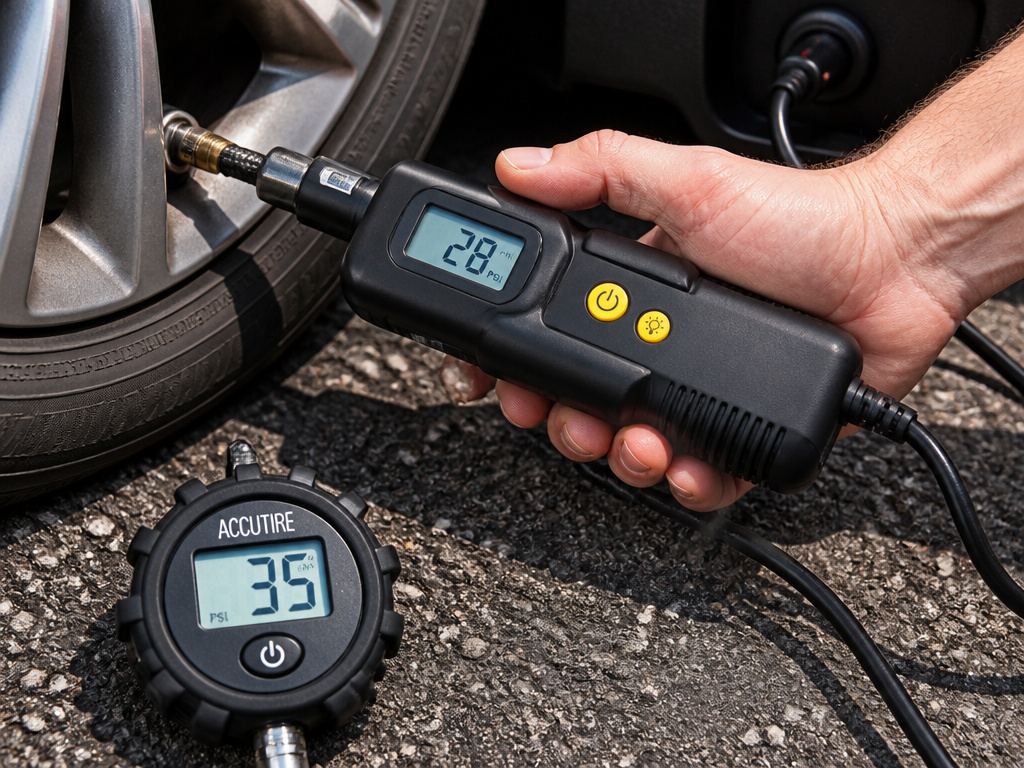
Spec sheets are a best-case scenario. Real-world use adds friction, heat, and human error. A few patterns emerge from owners that you won’t find in marketing.
Gauge Inaccuracy. It’s remarkably common. Multiple owners of the VIAIR 400P EF and 450P-RVS report the inline gauge reading 5-7 PSI lower than actual pressure, verified with standalone gauges. VIAIR has shipped replacement gauges in some cases. The takeaway? Never rely solely on the tool’s built-in gauge. A separate, high-quality dial or digital gauge is a necessary $20 investment. This is noted in the Inflator.org Viair 88P review as a point of critique for the platform.
Duty Cycle in the Real World. A published duty cycle assumes ideal cooling. Sticking the unit in a sun-baked footwell, then placing it on hot asphalt, changes the math. The VIAIR 400P EF has a max ambient temperature rating of 158°F. You’ll get longer life and fewer cooldown interruptions if you let the unit rest on a cool surface and provide shade.
Battery Degradation. Cordless inflators are convenient until they’re not. A lithium battery stored in a trunk through summer heat and winter cold loses capacity faster than one kept in a climate-controlled garage. The AsperX can inflate 8-10 car tires per charge. It’s still useful, but it’s a hidden long-term cost.
The Cordless Platform Trap. If you’re buying a cordless tire inflator from a tool ecosystem as your first tool in that brand (like Ryobi or DeWalt), you’re making a long-term investment in batteries. That’s fine if you plan to buy more tools. If the inflator is a one-off, a 12V model is simpler and cheaper over a decade.
The Verdict: Which One Should You Buy?
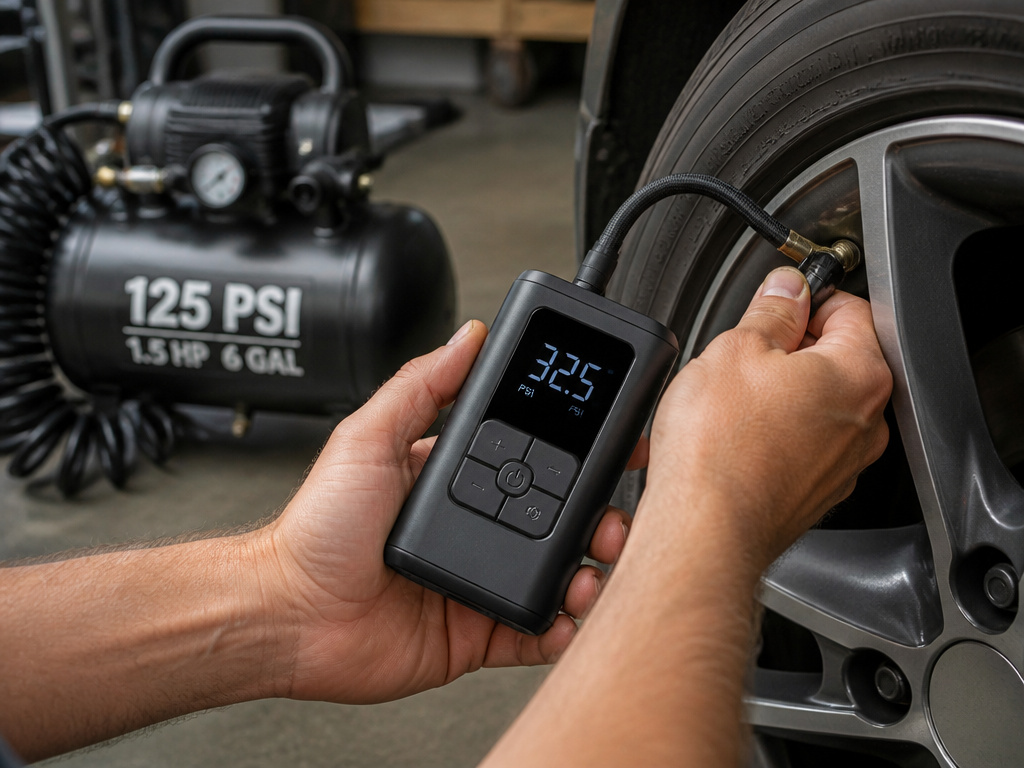
Don’t overthink it. Start with the most demanding task you’ll do regularly.
For 90% of drivers, a quality 12V portable tire inflator is the single most sensible choice. It lives in your car, works anytime the engine runs, and handles every routine inflation task from cars to bike tires. The performance gap between a good inflator and a cheap one is vast, so lean towards models with proven duty cycles like the VIAIR or NOCO lines. This is the category covered in our guide to the best 12V inflators on the market.
If you own a truck, RV, or go off-roading, step up to a heavy-duty portable compressor like the VIAIR 400P EF or San Hima 12V. The higher CFM and robust duty cycle are what you pay for, and they’re worth every penny when you’re airing up four large tires after a day on the trail.
Only consider a tank-based air compressor if your need list includes “run air tools.” Inflation is a side hustle for these units. Their core purpose is delivering the sustained, high-volume air that drills, sanders, and nailers demand.
Buying the wrong type is a frustration that sits on a shelf. Buying the right type is a tool you’ll use for years. When in doubt, err on the side of the simpler, more portable tool, the dedicated tire inflator. It solves the problem you actually have today.
How loud are portable tire inflators and compressors?
Noise levels vary significantly. Some models operate at a level comparable to a loud conversation. For instance, the VIAIR 400P EF produces 73 decibels when running with no load, while the NOCO AIR15 is rated at 83 decibels. In practical terms, a quieter unit is less disruptive for late-night garage use or in a residential area. If noise is a concern, check the manufacturer’s specifications for a decibel rating before purchasing, as this detail is often listed but not always prominently featured.
Frequently Asked Questions
Should I get an air compressor or a tire inflator?
Get a tire inflator if your primary use is inflating tires, sports equipment, or pool toys. Its design is optimized for that single job, offering better portability and often faster inflation for the task. Get an air compressor if you need to run pneumatic tools like nail guns, impact wrenches, or sandblasters. The storage tank is essential for tool operation.
Can I use a portable tire inflator as an air compressor?
No, not for running air tools. A portable tire inflator lacks a storage tank and cannot deliver the sustained, high-volume airflow (CFM) that pneumatic tools require. It can only push air directly into an inflatable object. Using it to try to run a tool will stall the tool and likely overheat the inflator’s motor.
Are portable tire inflators worth it?
Absolutely, for their intended purpose. A portable tire inflator is worth it for the convenience, safety, and time savings. It turns a 20-minute trip to the gas station air pump into a 3-minute task in your own driveway. For roadside emergencies, it’s a potential trip-saver. The key is buying one with adequate CFM and a duty cycle that matches your vehicle’s tire size.
Can a portable air compressor fill a flat tire?
Yes, but the speed depends on the compressor’s CFM and the tire’s size. A heavy-duty portable compressor like the San Hima 12V can fill a large 4WD tire from 18 to 38 PSI in under two minutes. A smaller, cheaper inflator might take 10-15 minutes for the same job and could overheat midway, requiring a cooldown period.
How long does a tire inflator last?
The lifespan depends heavily on use and care. A 12V tire inflator like a VIAIR, used occasionally for top-offs and stored properly, can last 5-10 years. Cordless models are more dependent on battery lifespan, which may degrade noticeably in 3-5 years with frequent use and exposure to temperature extremes. Avoiding continuous use beyond its duty cycle is the single biggest factor in longevity.
What is the difference between PSI and CFM?
PSI (Pounds per Square Inch) measures pressure, how much “push” is behind the air. CFM (Cubic Feet per Minute) measures volume, how much air is moving. A high PSI with low CFM means you can reach a high pressure, but it will be very slow (like filling a truck tire with a bike pump). A high CFM delivers air quickly, which is what you need for fast inflation.
The Bottom Line
Here’s the one-rule filter: if your use case fits entirely within the phrase “inflate a [tire/ball/mattress],” buy the best portable tire inflator your budget allows. Its specialized design will serve you better.
The moment your needs expand to include “and run a [tool name],” you’ve entered air compressor territory. That’s a different tool for a different set of problems.
Most people overbuy, imagining they need compressor-level power for occasional tire fills. They don’t. Start with an accurate assessment of your actual, regular tasks. The right tool is the one that disappears into the job, not the one that demands you work around its limitations.
