
Rubber vs PVC vs Hybrid Air Hose: Which to Buy
This post contains affiliate links. As an Amazon Associate, we earn from qualifying purchases.
Rubber, PVC, and hybrid air hoses differ in durability, flexibility, and price. Rubber is tough, handles extreme temperatures well, and resists oil and abrasion, but it’s heavy and less flexible. PVC is cheap, lightweight, and coils easily, but it gets brittle and splits in the cold, absorbs water, and tears easily. A hybrid hose blends synthetic fibers with rubber for a middle-ground option that feels like rubber but weighs less, offering greater flexibility and reasonable durability.
The material choice isn’t academic when selecting an air hose. It decides whether your hose lays flat on a 60-degree morning or fights you like a coiled spring, whether it survives a season of being dragged across shop concrete, and whether you’re buying a new spool next year. This is about matching the hose to the job you actually do, not the one you imagine, which is why understanding the different hose materials matters.
What follows is a side-by-side breakdown of the three materials across every metric that matters: cold-weather performance, weight, abrasion resistance, and real-world lifespan (see our hose buying guide for more). We’ll also cover the specific, documentable specs you should check before you buy, and name the top hose models that get this balance right.
Key Takeaways
- Choose rubber hose for demanding, daily shop use where abrasion and extreme temperatures are factors, it’s the most durable option.
- Use PVC hose only for occasional, light-duty home tasks in warm conditions; its low cost comes with brittleness in cold weather and low tensile strength.
- For day-to-day work, a hybrid hose is the safe option, offering a balance of flexibility, weight, and durability.
- Always verify the documented working pressure, temperature range, and minimum bend radius of the exact hose you’re buying, not just the material name on the box.
- Dragging a hose across abrasive surfaces will eventually tear holes in a PVC hose; rubber hoses withstand this abuse far better.
The Cold-Weather Flexibility Showdown
This is the single biggest practical difference, and it’s why so many people regret their first hose purchase. The YouTube demonstrations are unambiguous: at warm room temperatures, a PVC hose can form stubborn, uncooperative loops. It refuses to lay flat. As temperatures drop, it becomes a stiff, fight-you-every-inch mess. A rubber hose, by contrast, handles extreme temperatures well, remaining pliable.
A PVC air hose gets brittle and splits in colder temperatures. Over time it can absorb water that may rust your compressor or freeze inside the line. Rubber handles extreme temperatures well, not getting soft or brittle, whether in direct sun or a cold garage.
The mechanism is simple and central to the rubber vs pvc vs hybrid air hose comparison. PVC is a thermoplastic. Its polymer chains stiffen significantly as temperatures drop, losing the plasticizers that grant flexibility. Rubber, whether natural or synthetic, retains its molecular mobility across a much wider range. A small drop in temperature is all it takes for a PVC hose to transform from a usable tool into a tangled nuisance.
What most people get wrong: They buy a long PVC spool because it’s a “better deal,” not realizing much of its length may be unusable on a cool day. The extra length is literally wasted, coiled in a stiff, unusable loop. The full-length usability of rubber or hybrid hose often makes a shorter spool the more practical buy.
Rubber: The Shop Floor Workhorse
Rubber hose is the default for a reason. It’s the material you’ll find in professional shops where tools are used daily and hoses are treated like extension cords, dragged, kicked, and run over. Its reputation for toughness is earned.
The key strengths are abrasion resistance and temperature tolerance. As noted by AirCompressorHelp, it’s “tough enough to be dragged on an abrasive surface without tearing.” It also resists both oil and ozone exposure better than most plastics, which is critical in environments with pneumatic tool lubricants and welding equipment.
But that durability has trade-offs. The same source points out that rubber hoses are heavier and less flexible than other types. This weight makes them “a pain to move,” and their rigidity means they can kink if dropped or coiled too tightly, momentarily blocking airflow. That kink resistance you paid for? It’s not infinite.
Where this goes sideways: Overtightening a heavy rubber hose into a lightweight aluminum tool port.
The final trade-off is cost. A rubber hose typically carries a price tag double that of PVC options. You’re paying for longevity and performance under duress. If your hose sees concrete daily, it’s a smart investment. If it sits coiled in a corner for months, it’s overkill.
PVC: The Budget Compromise with Limits
PVC hose is the entry-level option. It’s super-cheap, super-flexible when warm, and lightweight. It often comes on a coiled 100-foot spool that costs significantly less than a comparable rubber hose. For the homeowner who needs to inflate bike tires, run a brad nailer for a weekend project, or do occasional light cleaning, it’s good enough.
Its advantages are real. It coils well, lays flat when warm, and stores without tangling. The low weight is a genuine benefit for quick jobs where you’re moving the compressor around.
The limitations, however, are severe and documented. AirCompressorHelp notes PVC “gets brittle and splits in colder temperatures.” Its low tensile strength means “dragging the PVC hose around will eventually tear holes.” Furthermore, it can absorb moisture over time, which may promote rust inside your compressor tank or freeze within the line itself.
| Scenario | PVC Hose Performance | Likely Consequence |
|---|---|---|
| Used on a cool morning (below 50°F) | Becomes stiff and uncooperative | Kinks, won’t lay flat, difficult to reel |
| Dragged across driveway gravel | Outer sheath abrades quickly | Tears and punctures within a season |
| Left outdoors seasonally | Absorbs moisture, UV degrades plastic | Internal rust, brittle/cracked hose wall |
| Used with oil-lubricated tools | Plastic can degrade with certain oils | Premature cracking and failure |
The takeaway is clear. PVC has a specific, narrow use case: infrequent, light-duty work in controlled, warm conditions. The moment your usage becomes regular, moves into colder environments, or involves any rough handling, PVC’s cost advantage vanishes behind early replacement costs and frustration.
Hybrid Hose: The Modern Middle Ground
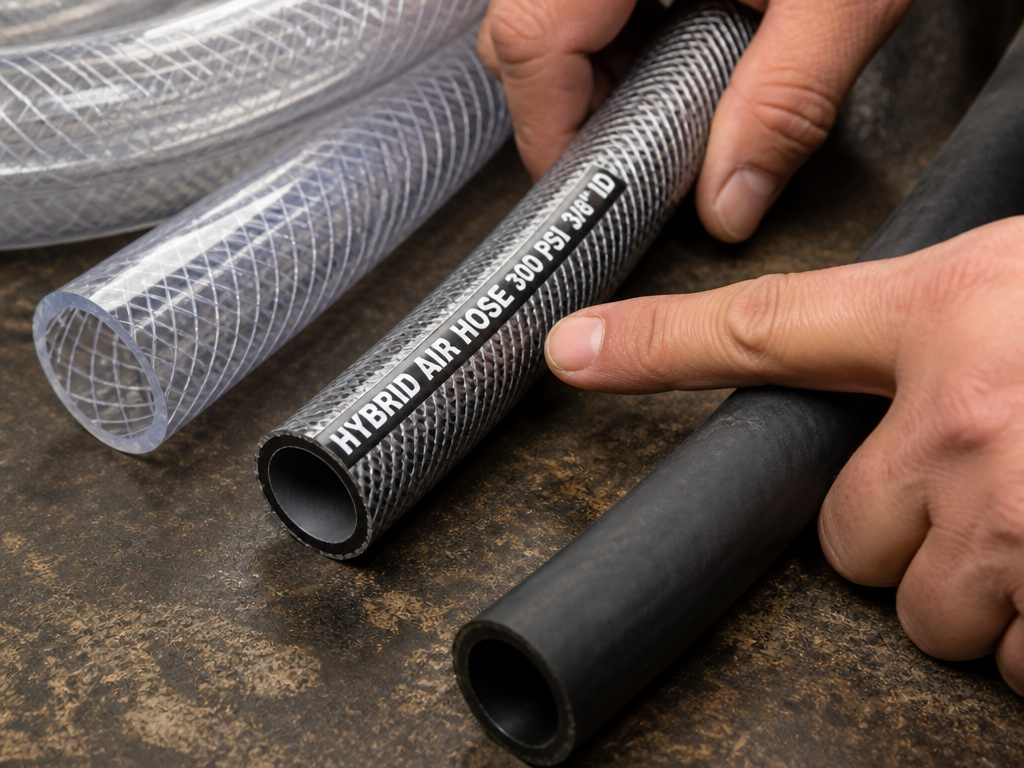
The hybrid hose exists to fill the gap in the rubber vs pvc vs hybrid air hose debate. Brands like Husky and AirKing sell these as a middle-ground option. They are designed with a combination of synthetic fibers and rubber, aiming to capture the best of both worlds.
In practice, they feel like rubber but don’t weigh as much. The strength comes from braided synthetic layers rather than solid rubber, which grants greater flexibility and reasonable durability. The result, as noted by AirCompressorHelp, is “a hose that doesn’t kink as easy as pure rubber and lasts longer than simple PVC.”
For day-to-day work, this is the safe option for most users. It’s not as bombproof as premium rubber in a harsh industrial setting, but it’s markedly better than PVC in harsher environments. It coils more easily than rubber and is better than PVC in harsher environments, offering a balance of performance and cost.
My take: For a busy home workshop or a contractor’s truck, a hybrid like those from Husky or AirKing is usually the right answer. It handles the occasional driveway drag, survives a cold garage, and doesn’t punish you with excessive weight or stiffness. It’s the practical choice.
Pressure, Specs, and the Fine Print You Must Read
The material is just the start of the rubber vs pvc vs hybrid air hose decision. The hose on the reel must match your system’s demands, and that comes down to the documented specs, not the marketing name.
Before you start: Always compare the exact temperature, pressure, bend, and chemical ratings for the hose supplied on the reel. Do not rely on a marketplace title for sizing or performance claims.
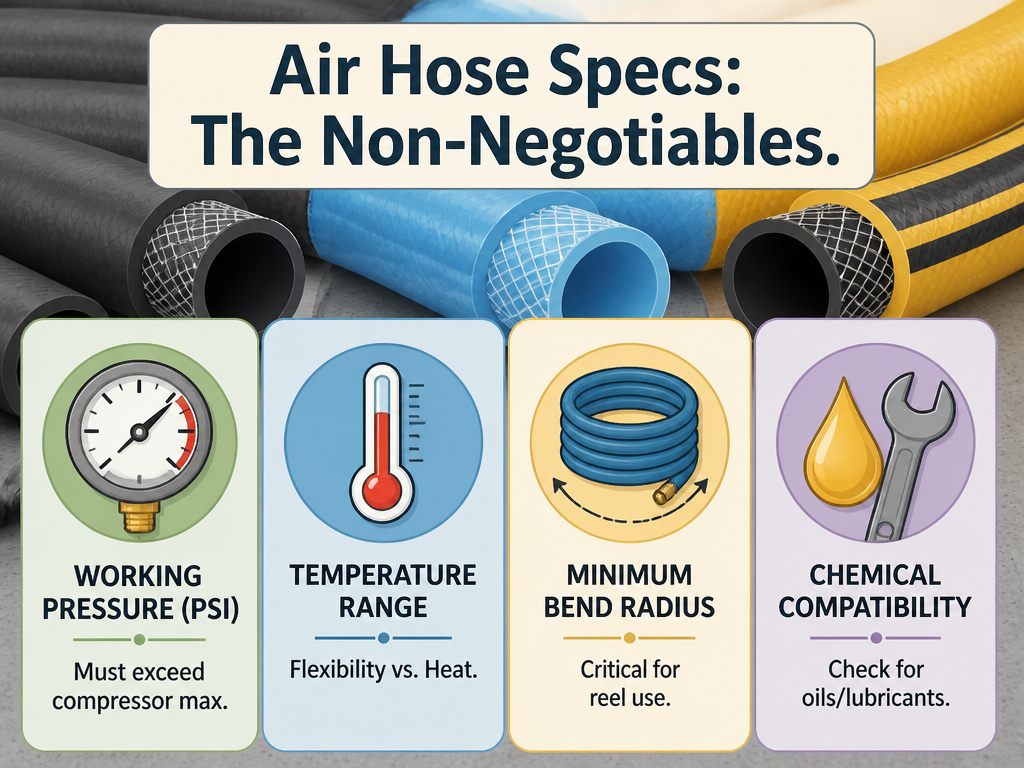
This isn’t scare talk. It’s the difference between a hose that works for years and one that fails under load. Here are the non-negotiable specs to verify, per the guidance from My Garage Products:
- Working Pressure (PSI): Must exceed your compressor’s maximum output pressure. A 150 PSI hose on a 175 PSI compressor is a safety risk.
- Temperature Range: Does the hose remain flexible at your lowest working temperature? Does it degrade at your compressor’s discharge temperature?
- Minimum Bend Radius: How tightly can you coil it without kinking or damaging the internal reinforcement? This is critical for reel use.
- Chemical Compatibility: Is it rated for the types of oils or lubricants you use in your pneumatic tools?
| Specification | Why It Matters | Where to Find It |
|---|---|---|
| Working Pressure | Safety and hose integrity; failure can be dangerous. | Printed on the hose jacket and in the product manual. |
| Temperature Range | Determines usability in cold shops or hot environments. | Often on packaging or spec sheet; sometimes only in manual. |
| Minimum Bend Radius | Dictates how it performs on a reel or in tight spaces. | Usually in technical data sheet from manufacturer. |
| Reinforcement Type | Predicts kink resistance and long-term durability. | Described in product listing (e.g., “braided synthetic”). |
The winning choice is the one supported by clear documentation installed within every stated limit. Buying a hose is a system purchase, not an impulse buy.
Frequently Asked Questions
Is hybrid air hose better than rubber?
For most users, a hybrid hose offers a better balance of flexibility and weight than pure rubber, making it easier to handle daily. However, for extreme abrasion resistance and longevity in a harsh industrial setting, a rubber hose is still the most durable option.
What is the best material for an air hose?
There is no single “best” material. The best hose is the one whose documented specifications, pressure rating, temperature range, bend radius, chemical compatibility, match the demands of your specific job. For demanding shop use, choose rubber. For occasional home use in warm conditions, PVC is acceptable. For balanced daily use, a hybrid hose is often the optimal choice.
What type of air hose is the most flexible?
At room temperature and above, PVC hoses are often the most flexible. However, this flexibility disappears rapidly as temperatures drop. Hybrid hoses maintain a high degree of flexibility across a wider temperature range, while rubber offers consistent flexibility that is generally good but not as high as warm PVC.
Can I use any air hose on a reel?
You can, but performance varies drastically. PVC hose has strong memory and will resist laying flat when unreeled, especially if cold. Rubber is heavy and can be stiff to reel. Hybrid hoses, with their synthetic fiber construction, often provide the best combination of flexibility and low memory, making them a fit for reel use. Always check the manufacturer’s specs for reel compatibility.
The Bottom Line
Here’s the straight answer. If you work in your shop daily and drag hose across concrete, buy rubber, it’s the only material tough enough for that life. If you need a hose for twice-a-year tire inflation and it will live in a heated closet, a PVC spool is a fine, cheap tool. For everyone else, the contractor, the serious DIYer, the homeowner with a busy garage, a hybrid hose is the default pick. It avoids the worst flaws of the other two.
The one rule to follow above all else: read the actual specs on the hose jacket or product manual. Match those numbers to your compressor’s output and your shop’s coldest temperature. That document is the only thing that tells you what the hose can actually do. The material name on the box is just a starting point.
