
T Shank vs U Shank Jigsaw Blades: Which Fits Your Saw
This post contains affiliate links. As an Amazon Associate, we earn from qualifying purchases.
T-shank blades have a T-shaped top on the tang and lock into a tool-free clamp, while U-shank blades have a U-shaped cutout and are secured by a set screw. They are not interchangeable.
The shank is the part of the blade that fits into the saw. The shape of that piece of metal, whether it’s a T or a U, decides three things: whether the blade fits your saw, how quickly you can swap it, and how many types of blades you can even buy. This is the core difference in t shank vs u shank jigsaw blades. Everything else, cut quality, speed, finish, comes from the blade’s teeth and your saw’s settings.
What follows is a breakdown of the physical shapes, a 30-second identification guide, and the real-world consequences of getting it wrong, including the specific blade codes that turn a generic “wood blade” into the right tool for the job.
Key Takeaways
- The T-shaped tang locks into a tool-free clamp with a lever or collar, while the U-shaped tang requires a screwdriver or hex key to tighten a set screw.
- Forcing a U-shank blade into a T-shank clamp can damage the saw’s clamping mechanism, and the blade will not be secured properly.
- If your jigsaw was made after the year 2000, it almost certainly requires T-shank blades.
- Bosch T-shank blade codes indicate specific purposes: T144D for fast rough cuts, T101B for clean finishes, and T119BO for scrolling curves.
- U-shank blades are still sold, but the selection is mostly general-purpose; for specialized tasks like cutting laminate or metal, you need the T-shank ecosystem.
The Tang Tells the Tale: Physical Shape and Clamp Design
Look at the back end of a jigsaw blade, the part that goes into the tool. That’s the tang. On a T-shank blade, the tang has a flat top with a distinct T-shaped profile and shoulders on both sides. A U-shank blade has a rounded top with a clear U-shaped cutout in the center. This is a mechanical key, not a minor cosmetic difference.
The tang shape dictates the clamping system. A T-shank blade is designed for a tool-free clamp. You push the blade in, and a spring-loaded lever, collar, or button clicks it into place. The T-shape’s shoulders lock against the clamp’s internal jaws. A U-shank blade slides into a different kind of clamp, one with a small screw or hex bolt. You must tighten that set screw with a tool to pinch the blade’s rounded tang and hold it.
A T-shank blade will not seat in a set-screw (U-shank) clamp, and a U-shank blade will not lock into a keyless (T-shank) clamp. The shapes are mechanically incompatible.
Trying to force the wrong combination doesn’t just fail. It breaks things. Forcing a U-shank blade into a modern T-shank clamp can permanently warp the internal spring-loaded locking pins. After that, the clamp won’t hold any blade securely. You risk the blade not being held securely, which can be dangerous.
How to Identify Your Jigsaw Shank Type in 30 Seconds
You don’t need the original box or a perfect memory. The saw tells you.
- Unplug the saw or remove the battery. Never handle the blade area with the tool connected to power.
- Look at the blade clamp. Do you see a lever, a collar you can twist with your fingers, or a button? That’s a T-shank saw. If you see a small screw or hex bolt head that looks like it needs an Allen key, that’s a U-shank clamp (or a rare universal one).
- Check an old blade. If there’s a blade in the saw, pull it out. Compare the tang to the descriptions above: T-shaped top or U-shaped cutout?
- Check the manual or parts page. Still unsure? The model number listed on the tool’s nameplate is the key. Look it up in the manual or on the manufacturer’s official parts website. It will list the required shank type.
T-Shank vs U-Shank: A Side-by-Side Breakdown
The choice depends on which system fits your tool and your workflow. The table below lays out the practical differences.
| Feature | T-Shank Blades | U-Shank Blades |
|---|---|---|
| Tang Shape | Flat tang with a T-shaped top, shoulders on both sides. | Flat tang with a U-shaped cutout in a rounded top. |
| Clamping Method | Tool-free clamp (lever, collar, or spring-loaded release). | Set screw tightened with a screwdriver or hex key. |
| Typical Saw Models | Nearly all current jigsaws (post-2000). | Older saws and some budget models. |
| Blade Selection | Widest range: wood, metal, laminate, scrolling, specialty. | Smaller range, mostly general-purpose blades. |
| Blade Change Speed | Seconds, no tools. | Longer, requires a tool. |
| Interchangeable? | No, will not fit a set-screw (U-shank) clamp. | No, will not lock into a keyless (T-shank) clamp. |
The historical shift is clear. The U-shank was once common, designed to fit many brands that used a screw-down system. The T-shank became the modern standard because it allows tool-free blade changes and provides a secure grip, which is the core of the t shank vs u shank jigsaw blades evolution. Today, if you’re buying a new jigsaw, you’re buying a T-shank tool. U-shank blades are still sold for older saws, like many older Black and Decker models, but the selection is mostly general-purpose.
Common mistake: Assuming “universal” means any blade fits any saw. Some jigsaws have a “universal” clamp that claims to accept both shanks. If yours has one, the manual will explicitly say so. When in doubt, trust the physical clamp you see, not the marketing term.
The Blade Beyond the Shank: Material and Tooth Design
The shank gets the blade into the saw, which is the first step in the t shank vs u shank jigsaw blades decision. What happens next, the quality of the cut, is governed by the blade material and its teeth. These options are available in both T-shank and U-shank formats, but you’ll find the full spectrum more readily in T-shank.
- High-Carbon Steel (HCS): Flexible and affordable. Use these for softwood and plastics. They dull quickly on hard materials.
- High-Speed Steel (HSS): Harder and more heat-resistant. The right choice for metal, aluminum, or hardwood.
- Bimetal: A hybrid with a flexible HCS body and hardened HSS teeth. The best all-rounder for wood with embedded nails, metal sheets, or plastic. They last significantly longer.
- Reverse-Tooth: The teeth point upward, so the blade cuts on the downstroke. This prevents splintering on the top surface of laminate, veneer, or countertop material.
The shank doesn’t make the cut cleaner. A U-shank HCS blade will cut softwood. A T-shank HCS blade will also cut softwood. The advantage of the T-shank system is access. If you need a reverse-tooth bimetal blade for cutting a kitchen countertop without chipping, you can find it easily in T-shank. Finding that specific blade in U-shank is a hunt.
The Bosch Blade Code System: What T144D, T101B and T118A Actually Mean
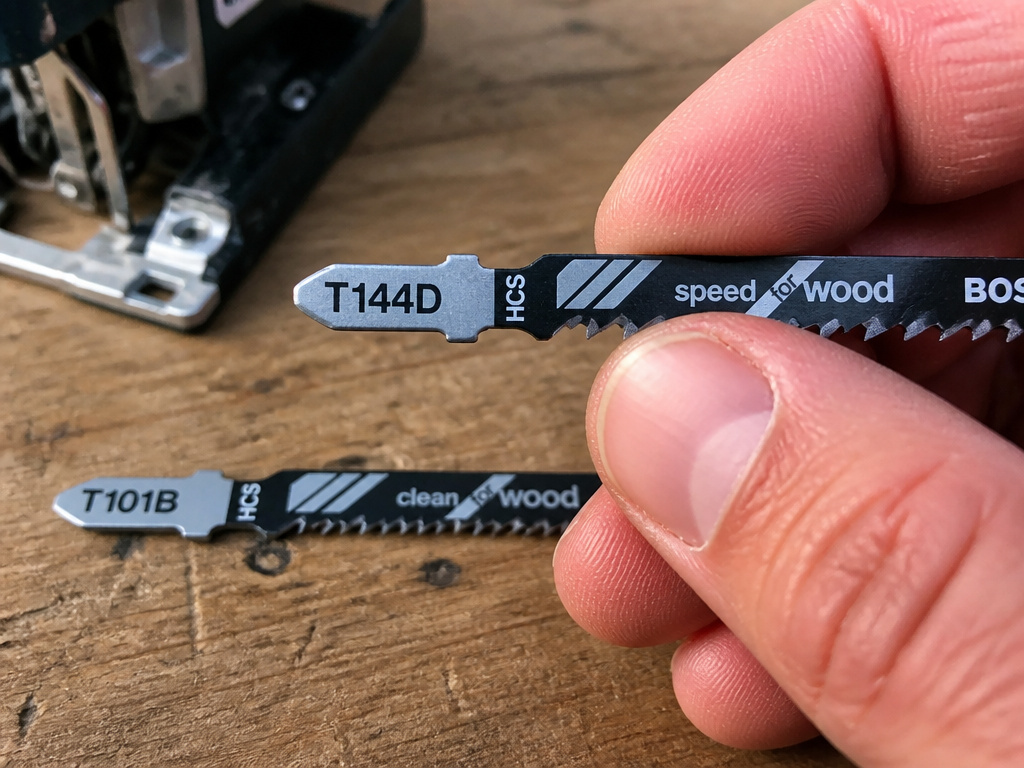
Once you’re in the T-shank world, you’ll see codes stamped on the tang, especially on Bosch blades. These codes are a precise material-and-task guide. Learning them stops you from buying a “wood blade” when you need a specific wood blade.
| Blade Code | Best For | Why It Works |
|---|---|---|
| T144D | Speed for wood (fast rough cuts in solid wood & plywood). | Aggressive, widely spaced teeth remove material quickly. |
| T101B | Clean for wood (smooth cuts with less top-face splintering). | More teeth per inch (TPI) and a ground tooth geometry for a finer finish. |
| T119BO | Basic scrolling (tighter curves in wood). | Narrow, flexible blade body allows it to maneuver around curves. |
| T118A | Basic for metal (thin sheet metal). | Very high TPI with fine teeth to prevent snagging and tearing thin metal. |
| T118B | Basic for metal (thicker metal). | Slightly coarser tooth pitch than T118A to handle thicker stock. |
This is where T-shank’s variety pays off. You wouldn’t use a T144D to cut a laminate shelf, it would splinter the surface. You’d use a reverse-tooth blade. The code tells you the job. For most DIYers starting out, a set that includes a variety of these blade types covers many common tasks (see our picks for the best jigsaw blades).
What About “Universal” Clamps and Adapters?
This is where owners get tangled. You might read that a U-shank is a “universal” blade. Sources disagree on what the term ‘universal’ refers to. EngineerSkill.blog states the U-shank is often called ‘universal’ because it was designed to fit many brands’ screw-clamp systems. WoodworkingAdvisor.com implies the term refers to a rare clamp that accepts both shank types.
Sources disagree on the reliability of ‘universal’ clamps. WoodworkingAdvisor.com states a few jigsaws have a universal clamp that accepts both shank types, and the manual will say so. EngineerSkill.blog suggests skepticism about such claims and recommends checking a compatibility chart. If your saw has a screw clamp, it likely takes U-shank blades; if it has a lever, it likely takes T-shank blades.
As for adapters to make a U-shank blade fit a T-shank saw? They exist, but I won’t recommend them. You’re adding a loose, third-party piece of metal between the blade and the precision clamping jaws. That introduces wobble, kills accuracy, and defeats the entire purpose of the T-shank’s secure lock. It’s a hack, not a solution.
Are Bosch blades T-shank or U-shank?
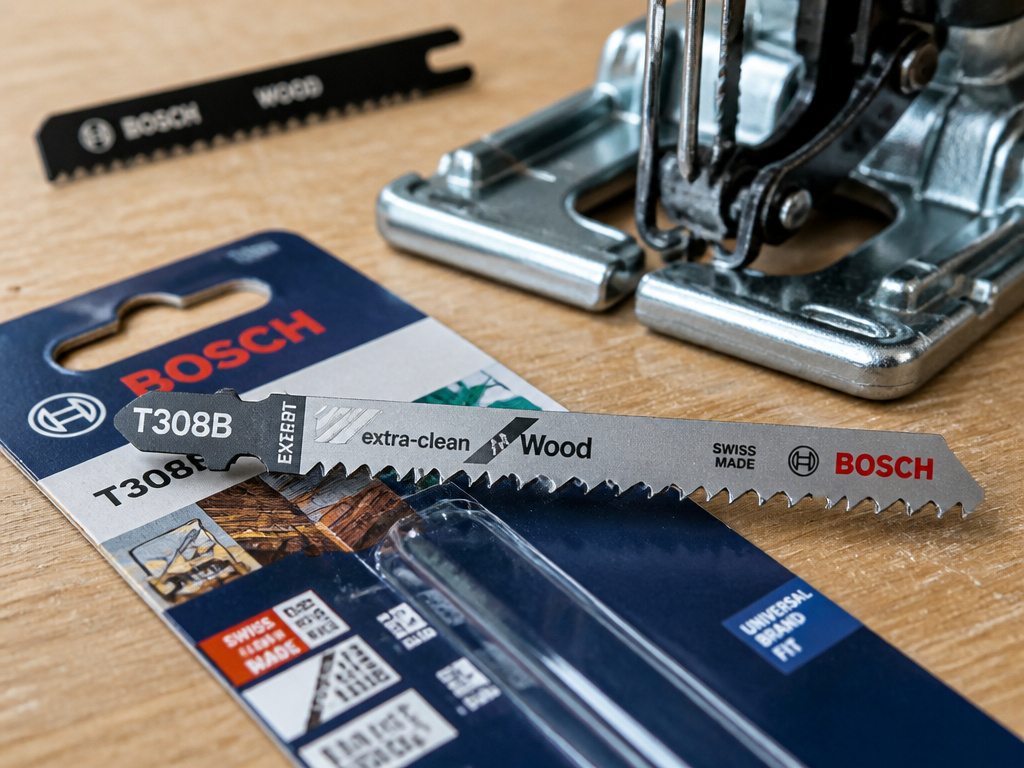
Bosch is a major manufacturer of T-shank blades, offering a wide range for specific tasks. Their blade codes indicate the material and cut type. For example, a T144D is designed for fast, rough cuts in wood, while a T101B provides a cleaner finish with less splintering. For scrolling work in wood, they offer blades like the T119BO. For cutting metal, options include the T118A for thin sheet metal and the T118B for thicker metal. These examples are all T-shank, which is the standard for nearly all current jigsaws. Older saws and some budget models may still use the U-shank system.
Frequently Asked Questions
Are T-shank and U-shank blades interchangeable?
No. They are mechanically incompatible. A T-shank blade will not lock into a U-shank clamp, and a U-shank blade will not be secured properly in a T-shank clamp. Forcing them can damage your saw’s clamping mechanism.
What type of blade is best for a jigsaw?
The “best” blade is the one that matches your saw’s shank type and the material you’re cutting. For a modern T-shank saw, a bimetal blade is the most versatile for mixed materials. For clean cuts in finished wood or laminate, a reverse-tooth blade is essential.
How do I know if my Black and Decker jigsaw takes T or U shank?
Look at the clamp. If it has a tool-free lever or collar, it takes T-shank blades. If it has a small screw that needs a tool to tighten, it takes U-shank blades. Many current Black and Decker models are T-shank, while older ones use the screw-in U-shank clamp.
Can I use a reciprocating saw blade in my jigsaw?
No. Reciprocating saw blades are longer, thicker, and while some also have a T-shank, they are designed for a different tool’s clamp and stroke length. They will not fit or function safely in a jigsaw.
The Bottom Line
The reality is this. This is a question of compatibility and evolution, not quality. The T-shank system won because it’s faster and offers more specialized tools for the job. If you own a jigsaw made in this century, you almost certainly need T-shank blades.
Your next step is to walk to your saw, unplug it, and look at the clamp. That 30-second check saves you a trip to the store for the wrong pack. Once you know you need T-shank, you can make the real choice: picking the right blade material and tooth design for your project from the vast selection available. That’s how you get a clean, controlled cut, by matching the system first, then the blade, as detailed in our how to use a jigsaw guide.
