
Types of Angle Grinder Discs: Which One for Your Job?
This post contains affiliate links. As an Amazon Associate, we earn from qualifying purchases.
Angle grinder discs are specialized attachments designed for distinct tasks: grinding wheels remove material, cut-off wheels slice, flap discs finish, wire brushes clean, and diamond blades cut masonry. The right disc is defined by four specs: abrasive material (like aluminum oxide for steel), grit size, bond hardness, and disc shape (Type 27 for grinding, Type 1 for cutting).
That “universal disc” you see advertised? It’s a myth. One disc cannot cut steel, grind welds, strip paint, and polish concrete. Using the wrong disc wastes time, ruins your workpiece, and turns a powerful tool into a serious safety risk, which is why understanding the types of angle grinder discs is so critical.
What follows is the decoder ring. We’ll break down the coding system stamped on every disc, match each type to the job it’s built for, and give you the rulebook for safe, effective disc selection. By the end, you’ll be able to pick the disc for metal, wood, or concrete without a second guess.
Key Takeaways
- Match the abrasive material to your workpiece: aluminum oxide for steel, silicon carbide for masonry, zirconia alumina for aggressive metal removal.
- Never use a cutting disc for grinding. Its thin design can shatter under side pressure, while a thick grinding disc will bog down if used to cut.
- Always check the disc’s maximum RPM against your grinder’s speed. A disc rated for 13,300 RPM will explode on a 15,000 RPM grinder.
- Type 27 discs (depressed center) are for surface grinding at an angle. Type 1 discs (flat) are only for cutting at a 90-degree angle.
- Resin-bonded discs have a shelf life. LUKAS notes a shelf life of up to three years, with an expiry date (month and year) stamped on the metal ring. A brittle, expired disc is a flying hazard.
The Decoding System: Grit, Material, Shape, and Speed
Every angle grinder disc carries a label full of codes. Think of it as the disc’s resume, listing its qualifications and limits, which is your guide to the types of angle grinder discs. Ignoring it is how you get a disc that either wears out in seconds or fails catastrophically.
The marking system on bonded abrasives, governed by standards like EN 12413, provides a consistent way to identify a disc’s abrasive grain (A for aluminum oxide), grit size (24 for medium-coarse), bond hardness (S for hard), and reinforcement (BF for fiberglass). It’s a non-negotiable spec sheet, not marketing.
Translate the three most critical specs.
Abrasive Material & Grit: This determines what you can cut and how smooth the finish will be.
- Aluminum Oxide (A): The general-purpose workhorse for steel and ferrous metals. It’s tough and durable.
- Zirconia Alumina (ZA): A premium grain that stays sharper longer. Brands like CGW ULTRA use it for high stock removal on steel and stainless steel.
- Ceramic: An extremely hard, self-sharpening grain. LUKAS ceramic discs are engineered for high productivity on hard materials like Inox (stainless steel) with minimal blueing.
- Silicon Carbide (C): A sharper, harder grain used for non-ferrous metals, stone, and masonry. It’s the go-to for concrete grinding discs.
- Grit Size: The FEPA-standard number (like G 24 or G 30) indicates the abrasive particle size. A lower number (e.g., 24) is coarser for fast removal; a higher number (e.g., 80) is finer for smoothing.
Disc Shape (Type): This isn’t about preference; it’s about safe application geometry.
| Disc Type | Shape | Primary Use | Required Guard |
|---|---|---|---|
| Type 1 | Flat, with a flat center. | Cutting at a 90-degree angle. Only the edge contacts the material. | Type 1 guard (often not included). |
| Type 27 | Flat, with a depressed center. | Grinding or sanding on the disc’s face, used at an angle. | Standard guard that comes with most grinders. |
| Type 29 | “Saucer” shaped, with a depressed center angled ~5°. | More aggressive surface grinding on flats, as the angle increases contact. | Standard Type 27 guard. |
Speed & Size Limits: The most dangerous line to ignore. The maximum RPM printed on the disc is its absolute ceiling. Exceed it, and centrifugal force can tear the disc apart. This rating is a function of the disc’s diameter and its maximum operating speed (e.g., 80 m/s). For a common 115 mm (4-1/2″) disc, many manufacturers like Forney, PFERD, and CGW rate some of their general-purpose wheels at 13,300 RPM, but specific disc types can have different ratings. The arbor hole (for example, 22.23 mm or 7/8″ for many small-angle grinder discs) must match your grinder’s spindle.
Common mistake: Assuming all 4-1/2″ discs are interchangeable. A flap disc, a strip and finish disc, and a depressed center wheel for the same grinder can have different max RPMs; for example, Forney rates its 4-1/2″ Strip and Finish Disc at 10,000 RPM and its 4-1/2″ Metal Grinding Wheel at 13,300 RPM. Always check the label.
Grinding Discs: The Workhorse
When you need to remove a lot of metal fast, shaping a weld, beveling an edge, stripping rust, you reach for a grinding disc. It’s the thickest, most robust disc in your kit.
You’ll find discs made with different abrasive materials and bonds, such as resin-bonded aluminum oxide (like the Bosch PRO Metal series) and ceramic abrasive grain (like the LUKAS CER line). The resin-bonded ones use a phenolic resin to hold aluminum oxide or zirconia grains; they’re common and effective. Ceramic grains, as used in LUKAS ceramic discs, are engineered for high productivity on hard materials like Inox (stainless steel).
The hard grade matters. Referencing the DIN ISO 525 standard, a disc marked with an S is hard, ideal for maintaining its form under pressure on steel. A Q grade is softer, better for conforming to contours. Using a soft disc on a flat weld will dish it out; using a hard disc on a curved surface will leave gouges.
Cut-Off Wheels: The Precision Saw
These are the opposite of grinding discs: thin, focused, and fragile if misused. A cut-off wheel is a Type 1 disc, designed to be used perpendicular to your work. Its entire job is to make a narrow kerf and part material cleanly.
The thickness is key. A thinner wheel (e.g., 1.0 mm) may cut faster with less material waste but can be less stable than a thicker wheel. A thicker wheel (e.g., 1.6 mm or 2.5 mm) provides more stability for straight cuts. They are not interchangeable with grinding discs.
Where this goes sideways: Using a cut-off wheel to “clean up” a edge by tilting it. The side load on the thin wheel can cause it to pinch, bind, and shatter. The fragments fly out at the speed your grinder is spinning. If you need to clean after a cut, switch to a flap disc or grinding wheel.
Flap Discs: The Sander and Grinder Hybrid
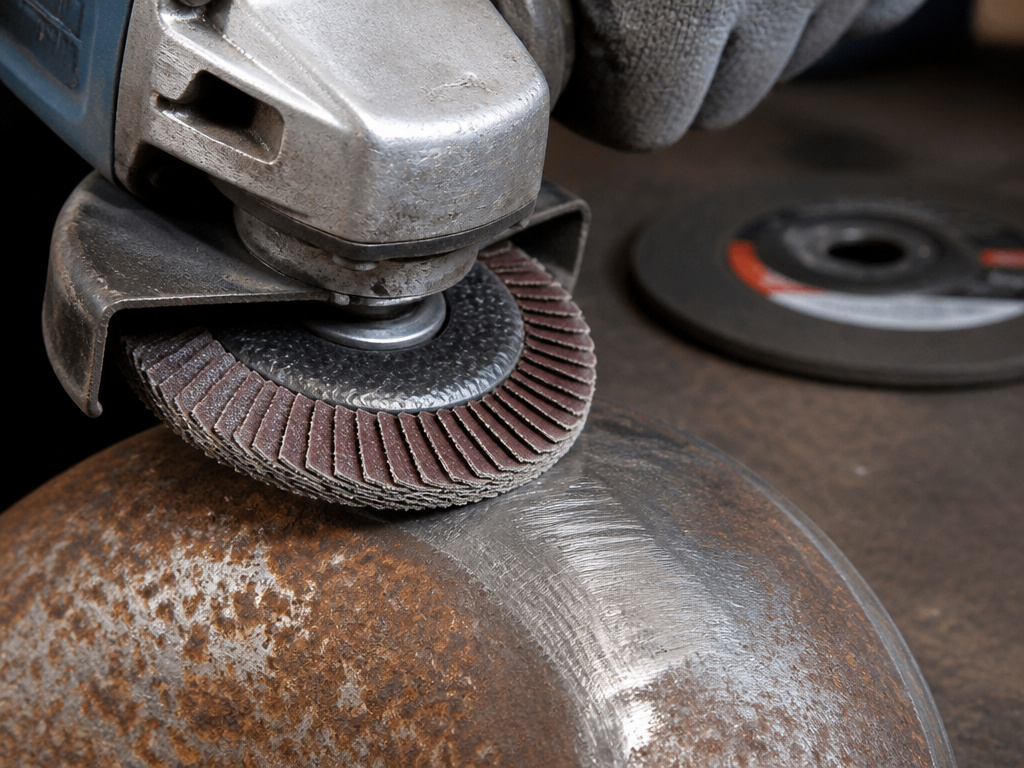
A flap disc looks like a sunburst of sandpaper flaps glued to a backing plate. It’s the multitasker: it can grind, blend, and finish in one step, making it perfect for weld preparation, deburring, and paint stripping. The flexible flaps conform to curves, which a rigid grinding disc cannot do.
The choice between Type 27 and Type 29 flap discs is about shape; a Type 29 has an angled “saucer” shape. A Type 27 is better for general-purpose work and contours. Grit is your finish control: 40-grit for heavy stock removal, 80-grit for a smooth pre-paint finish.
I learned this the hard way trying to finish a curved metal sculpture with a rigid grinding disc. It skipped and gouged with every pass. Switching to a 60-grit Type 27 flap disc let the surface follow the curves, and the job was done in half the time with a finish ready for primer.
Wire Brushes and Cups: The Cleaners
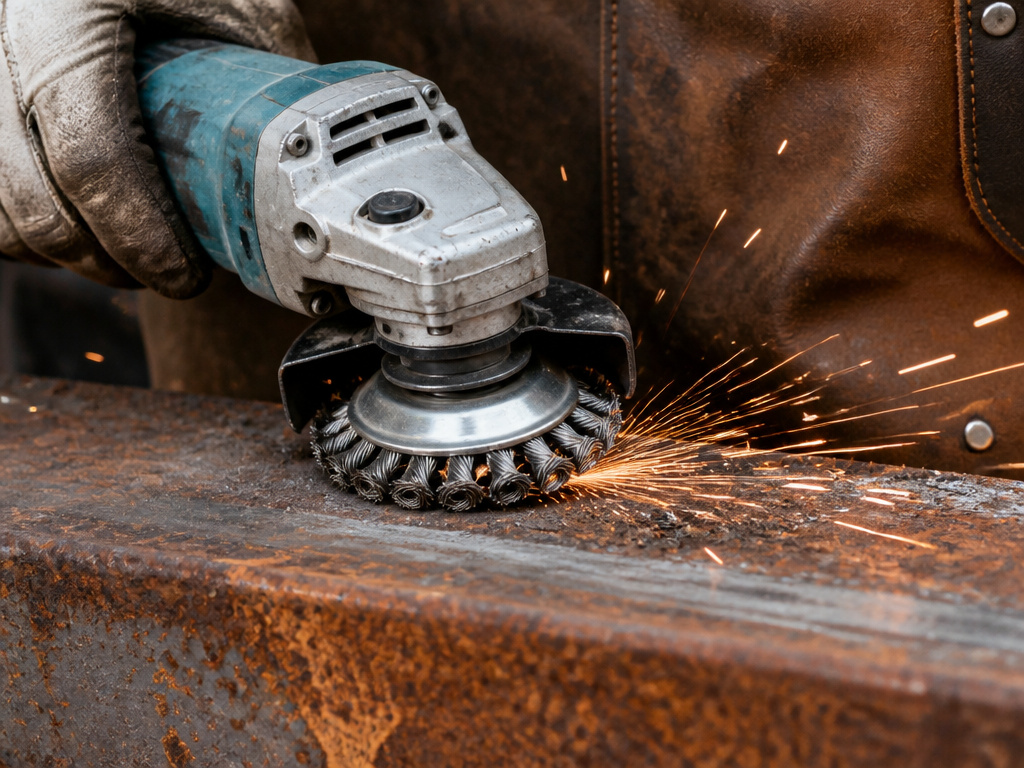
When you need to remove rust, paint, slag, or corrosion without removing base metal, a wire brush or cup is your tool. It’s a cleaning and prepping accessory, not a heavy remover. The wires (typically steel or brass) scrape away surface contaminants.
Knotted wire wheels are the most aggressive, great for stripping thick rust or weld splatter. Crimped wire brushes are softer and provide a cleaner, polished finish. Safety is paramount here, wires will break off and fly. Full face protection and a heavy apron are essential.
Diamond Blades and Cup Wheels: For Masonry and Concrete
For brick, block, tile, or cured concrete, abrasive discs wear out in seconds. You need diamond. Diamond blades (segmented for dry cutting, continuous rim for wet) are for slicing. Diamond cup wheels, which look like a grinding wheel studded with diamond segments, are for grinding down concrete surfaces or removing tile mortar.
Diamond blades and cup wheels are categorized by the bond that holds the diamond grit, which affects their performance on different materials.
Specialty Discs: Strip, Polish, and Carve
Beyond the core five, several niche discs solve specific problems.
- Strip and Finish Discs: Non-woven, fiber-based discs (like the Forney Strip and Finish line) are for light paint removal, cleaning, and final surface prep. They’re less aggressive than wire brushes and won’t embed metal fragments in your workpiece.
- Resin Fiber Discs (Sandpaper Discs): These are literally sandpaper discs with a resin fiber backing that you attach to a rubber backing pad. They’re for fine sanding and polishing metals or wood. CGW’s Zirconia Resin Fibre Discs, for example, have a maximum RPM rating (e.g., 13,300 RPM for a 4-1/2″ disc).
- Carving Discs: Specialized chainsaw-like or toothed discs designed for shaping wood, foam, or soft stone. They are not for metal and require specific techniques to avoid dangerous kickback.
The Disc Selector: Which One for Your Job?
This table moves from listing types to making decisions. It pairs common tasks with the first-choice disc and the critical “why.”
| Your Task | Best Disc Type | Key Specs to Look For | Why It Works (The Why-Layer) |
|---|---|---|---|
| Cutting a steel rebar | Cut-Off Wheel (Type 1) | 1.0–1.6 mm thickness, Aluminum Oxide (A) grain. | The thin profile minimizes material waste, and the reinforced fiberglass bonding (BF) is a common safety feature for cut-off wheels. |
| Grinding down a weld on steel plate | Grinding Disc (Type 27) | 6.0–7.0 mm thickness, Zirconia Alumina (ZA) grain, hard (S) bond. | The thickness provides robustness for grinding, and zirconia alumina (ZA) is a premium grain known for durability on steel. |
| Smoothing and finishing that same weld | Flap Disc (Type 29) | 60–80 grit, Zirconia grain. | A Type 29 flap disc has an angled shape designed for aggressive stock removal on flat surfaces. |
| Removing rust from a cast iron skillet | Knoted Wire Cup Brush | Coarse, knotted steel wire. | Knotted wire wheels are an aggressive option for removing rust, paint, or weld splatter. |
| Grinding the high spot off a concrete floor | Diamond Cup Wheel | Soft bond, segmented. | Diamond cup wheels are used for grinding hard materials like concrete due to the extreme hardness of diamond abrasive. |
| Prepping a wood panel for carving | Carving Disc (Wood Sabre) | Specifically designed for wood (not metal). | Carving discs are specifically designed for shaping wood, foam, or soft stone and require specific techniques to use safely. |
Are Angle Grinder Discs Universal? The Three Checks.
No. A disc is compatible only if it passes these three checks. Fail one, and you risk damage or injury.
- Arbor Size: The hole in the center must match your grinder’s spindle lock nut. Many small-angle grinders use a 22.23 mm (7/8″) arbor, but you must check your grinder’s specifications. Larger grinders may use a different arbor size; always check your grinder’s specifications. Adapters exist, but they add instability.
- RPM Rating: The disc’s max RPM must be equal to or greater than your grinder’s no-load speed. A 13,300 RPM disc on a 15,000 RPM grinder is a bomb. This is why you can’t use a smaller-diameter disc’s higher RPM rating as justification, the rating is for that specific disc size and construction.
- Guard Compatibility: A Type 1 cutting disc requires a Type 1 guard, which encloses the disc more fully. Using it with a standard Type 27 guard leaves the sides exposed. The standards are clear: EN 60745-2-3 and ANSI B7.1 require proper guarding for the specific disc type in use.
How to Use Strip and Paint Stripping Discs
These specialized discs are designed for removing paint, rust, and coatings without damaging the underlying material. They are distinct from aggressive grinding discs. LUKAS advises to never exceed the maximum permitted speed specified on the disc. Different models, even within the same diameter, can have different speed ratings; for example, Forney rates its 4-1/2″ Strip and Finish Disc at 10,000 RPM and its 4-1/2″ Metal Grinding Wheel at 13,300 RPM. Always check the label on the specific disc you are using. LUKAS advises to only use discs that can be mounted on the machine without requiring force and to use all tools with the appropriate grinding disc protective cover.
Frequently Asked Questions
What are three different types of angle grinder discs?
The three most fundamental types are grinding discs (Type 27, for material removal), cut-off wheels (Type 1, for slicing), and flap discs (for grinding and finishing). These cover the majority of metalworking tasks.
What is the difference between a type 27 and type 29 flap disc?
Both are depressed-center discs, but a Type 29 has a 5-10 degree angled saucer shape. This angle puts more of the abrasive flap in contact with a flat surface, making it more aggressive for stock removal on flat welds or plates. A Type 27 is flat and better for general use and contoured surfaces.
Can I use a cutting disc to grind?
Never. A cutting disc is thin (1.0–2.5 mm) and reinforced for edge strength, not side load. Using it to grind applies lateral pressure it isn’t designed to handle, which can cause it to shatter. Always use a thicker, dedicated grinding disc or flap disc for grinding tasks.
How do I know what RPM my disc can handle?
The maximum RPM is printed on the disc itself, often near the center. It’s also calculated from the maximum operating speed (like 80 m/s) and the disc’s diameter. For example, LUKAS specifies a 115 mm disc at an 80 m/s operating speed has a max speed of 13,300 RPM, and at a 100 m/s operating speed, a max speed of 16,650 RPM. Never exceed this number.
Do grinding discs expire?
Yes, resin-bonded discs can degrade. LUKAS specifies a shelf life of up to three years for its handheld grinding discs, with an expiry date stamped on the metal ring. An old, brittle disc is more likely to crack or disintegrate under stress. Store discs in a dry, room-temperature environment to maximize their life.
The Bottom Line
Forget finding one disc to rule them all. The real skill is building a small, intentional kit. That covers 90% of shop tasks safely and efficiently.
Everything here assumes you’re using the right guard, wearing your PPE, and respecting the tool’s power. But the single most important rule is the one stamped in tiny numbers on the disc itself: the max RPM. That’s the line. Cross it, and all the other advice doesn’t matter. Your grinder’s label and your disc’s label must agree before you ever pull the trigger.
