
Types of End Mills Explained: A Practical Selection Guide
This post contains affiliate links. As an Amazon Associate, we earn from qualifying purchases.
End mills are rotary cutting tools used in CNC machining centers and manual milling machines to remove material from a workpiece. They are categorized by their end shape (square, ball, corner radius), flute count (1-10), and structure (solid, indexable), with each type optimized for specific materials and operations like slotting, profiling, and contouring.
That definition is the textbook version. The real version is messier. Choosing an end mill isn’t about memorizing categories; it’s about matching three things: the shape you need to cut, the material you’re cutting, and how you want the chips to behave. A guide to the types of end mills explained can help with this matching. Get one wrong and the tool chatters, breaks, or leaves a finish that looks like it was chewed.
What follows is a breakdown of the major types, square, ball, roughing, corner radius, tapered, but more importantly, the rules that decide which one you should actually load into the collet as part of the types of end mills explained. We’ll cover the specs that matter, the common mistakes that burn through tools, and how to read a manufacturer’s chart without getting lost in the marketing.
Key Takeaways
- Match flute count to material: Use 2- or 3-flute end mills for aluminum and other non-ferrous metals where chip clearance is king; for steel, stainless, and cast iron, sources vary, with MSC recommending 4-flute as standard and Brother suggesting 4 to 6 flutes for surface finishing.
- Center-cutting end mills can plunge; ones with a center hole cannot. This single spec determines whether you can drill straight down into material or must ramp in from the side.
- Helix angle drives chip evacuation and finish. General-purpose tools use 25°–30°, while specific high-efficiency cutters like Kyocera’s 3UFSM (45°) or 4PGSS (50°) are designed for certain applications.
- Shorter, larger-diameter end mills are more rigid. For faster cuts and maximum rigidity, use shorter end mills with larger diameters.
- Ball end mills have a formal ISO standard (ISO 15917:2012) that defines short (Type 1) and long (Type 2) types with precise dimensions for cutting diameter and overall length.
The Anatomy Lesson You Actually Need
Before diving into the types of end mills explained, you need to speak the language. An end mill isn’t just a stick with teeth; each part has a job, and getting the names right lets you decode a spec sheet.
The flutes are the helical cutting edges. Their count, anywhere from 1 to 10, decides how much chip space you have versus how rigid the tool core is. The shank is the part held by the collet. Plain shanks are most common for tools up to 3/4 inch diameter, while Weldon shanks have one or two flats secured by set screws to prevent rotation during heavy cuts. The helix angle is the spiral of the flute relative to the centerline. Different angles are used for different purposes; for example, general-purpose tools often use 25°–30°, while roughing end mills may use a lower angle like 20° for toughness.
The business end is defined by its end cut shape (square, ball, radius) and whether it’s center-cutting. A center-cutting end mill has cutting edges that meet at the center, allowing it to plunge straight down like a drill. A non-center-cutting tool can’t do that; you must ramp or side-cut into the workpiece. OSG’s technical guide points out that end mills with a center hole can be accurately re-ground but sacrifice the ability to plunge altogether.
Square End Mills: The Workhorse
Square end mills, with a flat bottom and 90° corners, are the default. They’re for slotting, profiling, shoulder milling, and plunge cutting. When someone says “end mill” without a qualifier, this is usually what they mean.
Their versatility is their strength and their weakness. Because they’re general-purpose, they’re rarely the absolute best tool for a specific job, a ball end mill will always contour a curve better, a roughing end mill will always remove stock faster. But for squaring a block, cutting a keyway, or facing a surface, they’re the first tool you reach for.
Common mistake: Using a square end mill for finishing a curved surface. The sharp corner leaves a stepped, faceted finish that requires hours of hand work to clean up. Switch to a ball end mill for any contouring.
The material matters here. According to MSC Industrial Supply, a 4-flute square end mill is the standard configuration for steel, stainless steel, and cast iron. For aluminum, sources like MSC Industrial Supply recommend a 2-flute version for optimal chip clearance (see our picks for the best end mills for aluminum). The reason is chip clearance. Two flutes have deep, open pockets that let the bulky, sticky chips from aluminum escape easily. Four flutes have a stronger core and more cutting edges, giving a finer finish on harder metals, but they provide less chip clearance, which can be problematic for aluminum.
Ball End Mills & The ISO Standard That Sizes Them
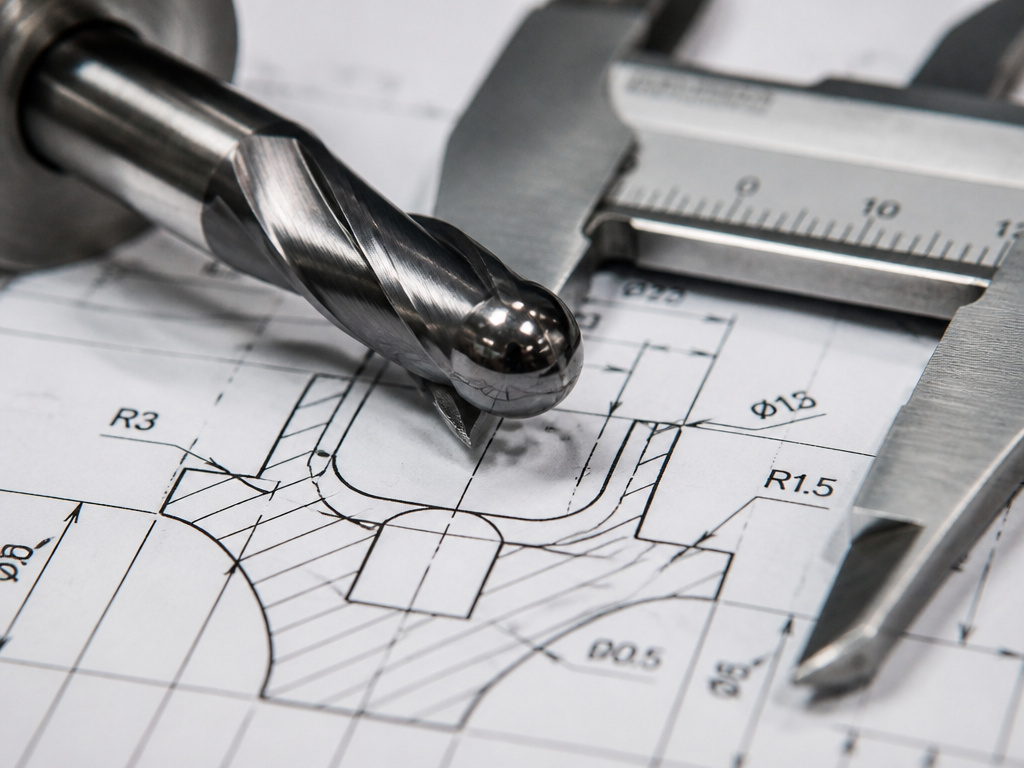
Ball end mills have a hemispherical tip. They’re for 3D contouring, pocketing, and machining concave radii. Think mold cavities, impellers, or any complex curved surface. The rounded tip produces a smoother finish than a square end mill could ever manage on a curve.
There’s a whole ISO standard dedicated to them. ISO 15917:2012 specifies the types and dimensions of solid ball-nosed end mills made of carbide and ceramic. It defines two types: Type 1 (short) and Type 2 (long). The standard provides tables with exact values for cutting diameter (d1), length of cut (l1), and overall length (l3). For example, ISO 15917:2012 Table 1 lists a Type 1 ball end mill with a cutting diameter of 16.0 mm and an overall length of 104.0 mm.
| Ball End Mill Type (per ISO 15917:2012) | Typical Use | Key Advantage |
|---|---|---|
| Type 1 (Short) | Shallow cavities, high rigidity needed | Maximizes tool strength, reduces deflection |
| Type 2 (Long) | Deep pocketing, reaching into cavities | Extra reach without needing a longer tool holder |
A related variant is the spherical ball end mill. According to Travers Tool, these have 220° of arc instead of the standard 180°, giving them a slightly different engagement for specialized applications.
When selecting a ball end mill, the radius is half the cutting diameter. A 10 mm diameter tool has a 5 mm radius. Kyocera’s lineup includes models like the 2SEB with a 30° helix angle for a range of materials, and the 4YEBM with a 38° helix for harder steels.
Roughing End Mills: The Stock Removal Specialists
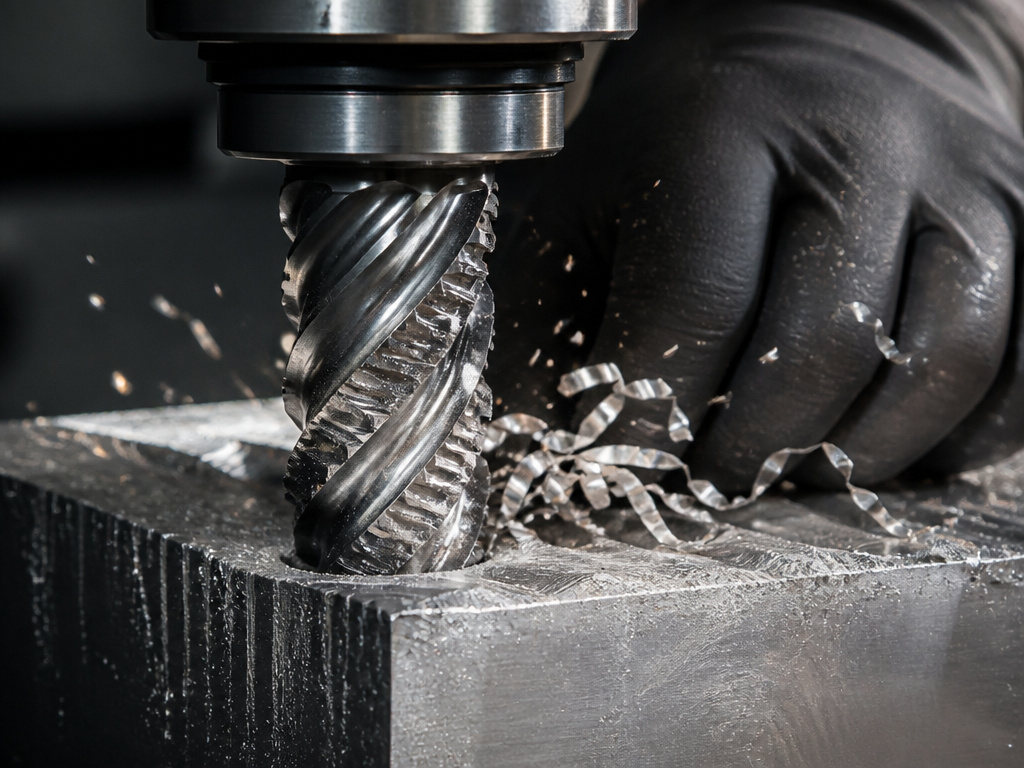
Roughing end mills, or “hog mills,” are built for one job: removing metal fast. Their flutes are serrated or notched, breaking chips into small, manageable pieces. This design reduces vibration and cutting forces, allowing you to take deeper, wider cuts without overloading the spindle or workpiece.
You use them for the initial bulk material removal, leaving a intentionally rough finish that is then cleaned up by a finishing end mill in a subsequent pass. Trying to use a roughing end mill for a final pass is a classic beginner error, the serrated edges will leave noticeable marks.
Kyocera’s 3RDSM roughing end mill, for instance, has a 20° helix angle and handles diameters from φ4 to φ25 mm.
Where this goes sideways: Using a roughing end mill on thin-walled or delicate parts. The aggressive chip-breaking action can induce harmonics and cause chatter in flexible workpieces. Switch to a fine-tooth roughing end mill or reduce axial depth of cut.
Corner Radius & Corner Rounding End Mills
These two sound similar but do opposite jobs. A corner radius end mill has a rounded cutting edge at the bottom corners. It’s used for milling pockets or profiles that require a specific internal fillet radius. The rounded edge also makes the tool far more durable than a sharp corner, which is a stress concentration point and prone to chipping.
A corner rounding end mill, on the other hand, is used to put a rounded external edge on a workpiece. It looks like a inverted version of the corner radius tool and is for deburring or creating a finished look on a part’s edge.
For steel and stainless steel, a corner radius end mill is often a better choice than a square end mill. That tiny radius adds significant life to the tool.
The 2-Flute vs. 4-Flute Decision That Cuts Chatter
Flute count is the single biggest selector after material type. Here’s the rule of thumb, straight from the industrial guides:
- Single-flute: According to MSC Industrial Supply, these provide maximum chip clearance for high-speed machining of aluminum and other non-ferrous materials.
- Two-flute: MSC Industrial Supply calls these the go-to choice for aluminum, brass, and copper, and Travers Tool notes they have the greatest chip carrying capacity.
- Three-flute: Travers Tool states they balance chip clearance with rigidity, and MSC Industrial Supply notes they are good for aluminum at high feed rates.
- Four-flute (or more): MSC Industrial Supply states these are the standard for steel, stainless steel, and cast iron. Travers Tool notes they allow for faster feeds and a finer finish but have less chip space.
The Brother Speedio guide clarifies this: for groove machining, use lower flute counts (like 2) for chip carrying. For surface finishing, 4 to 6 flutes produce a smoother, more uniform finish.
| Material | Recommended Flute Count | Why It Works |
|---|---|---|
| Aluminum, Copper, Plastics | 2 or 3 | Deep flutes provide essential chip clearance; prevents built-up edge. |
| Steel, Stainless Steel, Cast Iron | 4 or more | Stronger core withstands cutting forces; multiple edges improve finish. |
Tapered, Drill, & Specialty End Mills
Once you move past the core four types, you get into specialty territory. These tools solve specific problems.
Tapered end mills cut a taper into a hole or along an edge. They’re essential in mold and die work for creating draft angles. Drill mills are hybrid tools that can spot, drill, countersink, chamfer, and light mill. They’re incredibly handy for CNC work where tool changes are time-consuming, but they’re a master-of-none compromise.
Undercutting or “lollipop” end mills have a cutting diameter larger than the shank, allowing them to reach under a lip or machine a T-slot. You use them when no other tool can reach the geometry.
Then there are thread mills for cutting internal or external threads, and finishing end mills designed with specific geometries or coatings for ultra-fine surface finishes. The choice to use one comes down to a simple question: can a standard end mill do this job at the required tolerance and in a reasonable time? If not, the specialty tool pays for itself.
Shanks, Helix Angles, & Carbide: The Specs Beneath the Surface
The end shape gets the attention, but the tool’s body dictates its performance. The shank style is critical for holding. Plain shanks are most common. Weldon shanks, with one or two flats, lock into a set-screw holder to prevent tool rotation during heavy, interrupted cuts, think milling castings with hard spots.
Helix angle is a powerful but subtle spec. General-purpose end mills typically have a helix between 25° and 30°. A higher angle, like the 45° on Kyocera’s 3UFSM or the 50° on their 4PGSS, is used in specific models for certain applications. Conversely, a roughing end mill might use a low 20° angle for more toughness.
The substrate is almost always carbide for solid end mills today. It holds an edge far longer than High-Speed Steel (HSS) at modern machining speeds. Coatings like TiAlN or AlCrN add lubricity and heat resistance, extending life further in hard materials.
Variable helix design: Some end mills, like Kyocera’s 4MFK (with a variable helix lead of 42°, 44°), feature a slightly changing helix angle from flute to flute.
Frequently Asked Questions
What is the difference between an end mill and a drill bit?
Drill bit is designed only to cut axially (straight down) to create a round hole. An end mill can cut axially and laterally (along the side), enabling it to profile, slot, contour, and face. Center-cutting end mills can plunge like a drill bit.
When should I use a 2-flute vs a 4-flute end mill?
Use a 2-flute end mill for aluminum, plastics, and other non-ferrous materials where chip clearance is the priority. Use a 4-flute end mill for steel, stainless steel, and cast iron where you need more rigidity, a finer finish, and can tolerate smaller chips.
What does “center-cutting” mean?
Center-cutting end mill has cutting edges that extend to the center of its tip, allowing it to plunge directly into material like a drill. A non-center-cutting end mill cannot do this; you must ramp or side-cut into the workpiece. Always check this spec before planning a toolpath that involves plunging.
How do I choose the right end mill diameter?
Select the largest diameter tool that can fit your geometry. Larger diameters are more rigid and allow faster material removal. For deep pockets, you may need a long-reach tool with a smaller diameter to avoid rubbing, but know that you’ll sacrifice some stability and feed rates, especially on best benchtop mills with lower power.
Are more flutes always better?
No. More flutes mean less space for chips to escape. In gummy materials like aluminum, this leads to clogging, built-up edge, and tool failure. More flutes are better for harder materials where the chips are small and brittle, and where the added strength and finish quality are needed.
The Bottom Line
Start with the shape of the cut you need to make, square for flat bottoms and walls, ball for curves, radius for fillets. Then, let the material choose the flute count: 2 or 3 for non-ferrous, 4 or more for ferrous. Finally, dial in the specifics: a stub-length tool for rigidity, a high helix for efficient chip evacuation, and a carbide substrate with a coating for longevity.
The one spec to double-check every time is center-cutting. Assuming your new tool can plunge when it can’t is a quick way to break a tip and ruin a part, a fundamental mistake covered in how to use a milling machine. Everything else, the brand, the coating, the fancy variable helix, is optimization. The fundamentals of shape, count, and material match are what keep the spindle turning and the parts coming out right.
