
What Are Hex Shank Drill Bits: The De Facto Standard
This post contains affiliate links. As an Amazon Associate, we earn from qualifying purchases.
Hex shank drill bits feature a shank, the end that fits your tool, with a hexagonal (six-sided) cross-section, most commonly measuring 1/4 inch (6.35 mm) across the flats. This design snaps directly into quick-change chucks on impact drivers and many cordless drills, enabling tool-free bit swaps in seconds and providing a positive grip that prevents slippage under high torque, unlike round shanks in standard three-jaw chucks.
That no-slip claim is mechanical, not marketing. The six flat faces are a direct drive interface. A round shank relies on friction from chuck jaws squeezing a cylinder; a hex shank transmits torque through positive engagement with the flats of a matching collet or holder. The difference decides which jobs you win and which ones stall or strip a fastener. To understand this key distinction, one might ask: what are hex shank drill bits?
What follows is a breakdown of the 1/4″ hex standard, the ISO torque specs that define its strength, a direct comparison to round shanks, and how to spot a hex bit that meets ISO 2351-3:2014 torque standards versus a cheap one that will fail. We’ll also cover when you should avoid using a hex shank altogether, because for some tasks, it’s the wrong tool for the job.
Key Takeaways
- The 1/4 inch (6.35 mm) hex shank is a common quick-change standard, designed for impact drivers and fast bit swaps without a chuck key.
- Hex shanks transmit torque through positive flat-face engagement, eliminating the slippage risk inherent in round shanks gripped by chuck jaws.
- ISO 2351-3:2014 specifies minimum proof torque values for screwdriver bits with a male hexagon drive, for example, a 3mm bit must withstand at least 7.7 Nm.
- Quality is defined by tolerances and construction, not just the presence of six sides; mismatched corners or undersized flats cause runout and early failure.
- Use hex shanks for speed and high-torque driving in wood, light metal, and with hole saws; switch to a round shank for precision drilling in metal or when runout matters.
The 1/4″ Quick-Change Hex Shank: The De Facto Standard
When you hear the phrase “what are hex shank drill bits,” the default assumption is a 1/4 inch hex. This didn’t happen by accident. The size migrated from the world of screwdriver bits, where a 1/4″ Quick Change Hex Shank with a recessed snap-in ring became the default for locking into drill chucks on cordless drivers. Manufacturers like ICS Cutting Tools then adapted it for actual drill bits, creating sets designed for “cordless screwdrivers, handheld drills, and impact tools.”
The benefit is pure speed. As Zhonghuan Tools notes, a 1/4″ hex shank allows single-handed bit swap in under 2 seconds. You pull one bit out, push the next one in, no chuck key, no twisting a collar, no fuss. It’s impact-driver compatible by design, which is why you’ll see these bits marketed for impact drivers. The trade-off is a hard size limit: the shank diameter is fixed at 1/4 inch, which caps the maximum drill bit size you can physically fit onto that shank. While larger drill bits exist, the 1/4″ hex shank itself has a fixed diameter, which limits the size of drill bit that can be practically mounted on it.
Where this goes sideways: Assuming any bit with a hexagonal shank will fit your quick-change holder. The nominal 1/4″ size is just the start. A bit intended for a quick-change system must match the full interface, corner form, groove position, insertion length, not merely have six sides.
Hex vs. Round Shank: The Torque and Grip Difference
This is the core mechanical distinction behind the what are hex shank drill bits question. A round shank works by friction. The three jaws of your drill chuck squeeze the smooth cylinder, and hope that the clamping force is enough to overcome the torque you’re applying. When it isn’t, the bit spins inside the chuck. You hear a grinding whine, see smoke, and find shiny score marks on your bit.
A hex shank doesn’t rely on friction. It uses positive mechanical engagement. The six flat faces sit squarely against the matching flats inside the hex collet or bit holder. Torque is transferred directly through those faces. As Zhonghuan Tools states, hex shanks cannot slip in a hex collet under any practical load. However, Bestwin Tools notes that poor tolerances can lead to slop and wear, which may affect performance.
The numbers bear this out. Looking at typical max torque ranges:
- Round shank (3-jaw chuck): 40–80 Nm (moderate slippage risk at high torque)
- Hex 1/4″ (6.35 mm) shank: 50–100 Nm (very low slippage risk)
The hex shank isn’t just stronger on paper. In your hand, the difference feels like a direct mechanical connection versus a clamped one.
| Shank Type | Torque Transfer Method | Max Torque (Typical) | Slippage Risk | Best For |
|---|---|---|---|---|
| Round Shank | Friction from chuck jaws | 40–80 Nm | Moderate at high torque | Precision drilling, metalworking, any task where low runout is critical |
| Hex Shank (1/4″) | Positive flat-face engagement | 50–100 Nm | Very low | Quick changes, high-torque driving (impact drivers), general DIY & construction |
| SDS-Plus | Spline & groove lock | Up to 10 Nm rotary + impact | None (axial float design) | Masonry, concrete drilling with rotary hammers |
The table shows the trade-off. The hex shank wins on grip and speed. The round shank wins on precision and versatility. You give up one to get the other.
The ISO Standards: What “Hex” Actually Means
If you want to know what separates a real hex shank from a piece of bar stock with corners ground off, look at the ISO standards. They define the dimensions and performance.
ISO 3109:1974 specifies the dimensions for hexagon insert bits. It lists standard hexagon drive sizes including 2.5, 3, 4, 5, 6, 8, 10, and 12 mm. More importantly, it references corresponding male hexagon dimensions from ISO/R 1173, such as 3.5, 4.5, 6, 7.5, 9, 12, 16, and 18 mm. This is the blueprint for interchangeability.
ISO 2351-3:2014 is where the rubber meets the road. It prescribes technical specifications for machine-operated screwdriver bits for hexagon socket screws, and it applies to bits with a male hexagon drive or cylindrical flat-end drive. This standard includes a torque test: the drive end must be fully engaged in a female holder and inserted into a test socket adapter with a minimum hardness of 62 HRC. Then, it must withstand a minimum proof torque without failing.
Here are a few of those minimum proof torque values from the standard for screwdriver bits: – A 2mm hex bit must withstand 2.2 Nm. – A 3mm hex bit must withstand 7.7 Nm. – A 6mm hex bit must withstand 60 Nm.
These aren’t marketing claims. They are the verified, testable thresholds a bit must pass to meet an international standard. When a manufacturer says their bit is “impact rated,” testing for mechanical strength, such as the torque test in ISO 2351-3, is one way to back it up.
Identifying Quality: More Than Just Six Sides
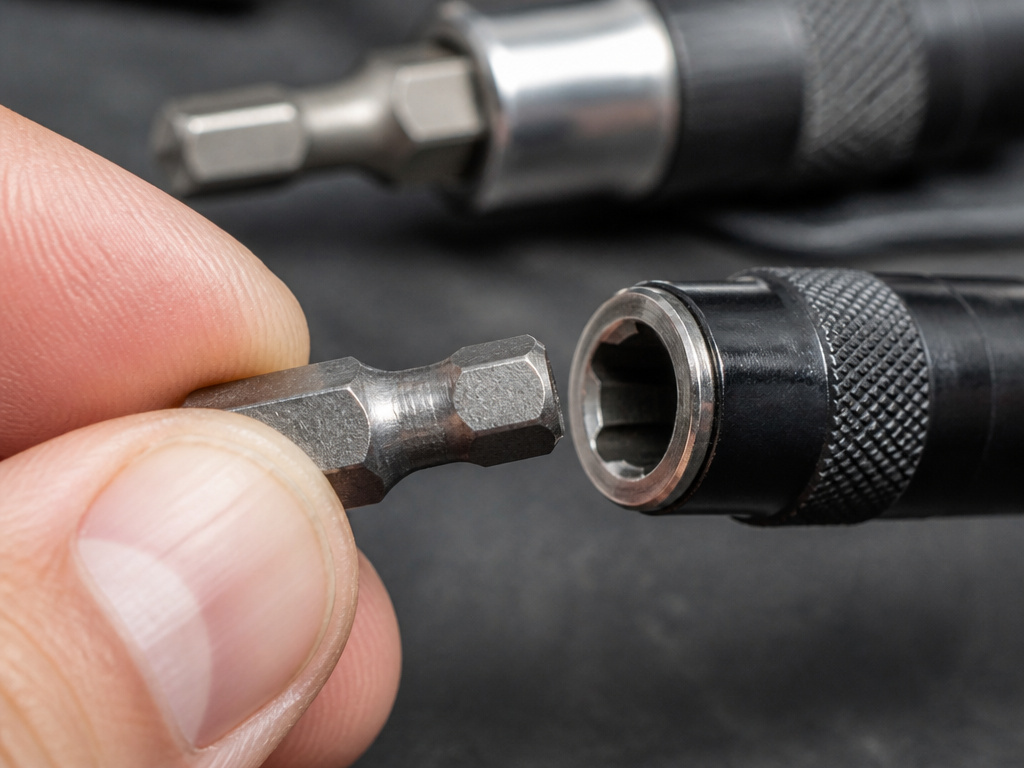
The truth is. The market is flooded with cheap hex-shank bit sets. They have six sides. They fit in your holder. They also vibrate, wobble, and snap. The problem is tolerance.
As Bestwin Tools explains, the nominal size alone doesn’t cut it. A manufacturer should specify across-flat size, across-corner condition, corner radius, straightness, groove profile, and insertion length. When these are off, you get problems no amount of tightening will fix.
- Oversize corners prevent the bit from fully inserting into the holder.
- Undersize flats create slop, leading to impact wear, runout, and a wobbling drill point.
- Shallow engagement concentrates stress on a tiny portion of the shank, a classic failure point.
- Poorly formed grooves compromise the snap-ring retention, so the bit either falls out or is impossible to remove.
A quality bit, like the Flintools 13 Piece HSS Hexagonal Shank Drill Bits Set, specifies its construction: High-Speed Steel (HSS) with a titanium coating, a 135-degree split point, and a double flute design. The shank is a standard 1/4-inch hex.
When to Use (and When to Avoid) Hex Shank Bits
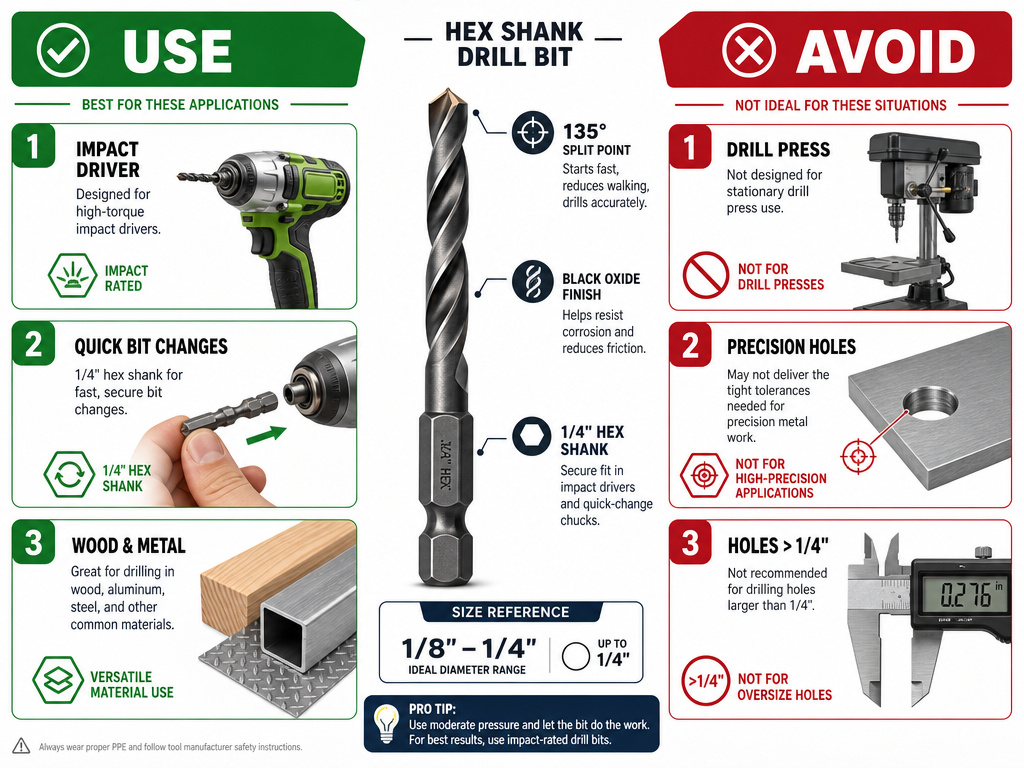
Hex shank bits have a specific job. As Flintools states, they are built for general purpose applications and are ideal for use in steel, copper, aluminum, zinc alloy, cast iron, wood, and plastics, which covers most DIY projects and maintenance work.
Use a hex shank bit when:
- You’re using an impact driver or a drill/driver with a quick-change chuck.
- The job requires frequent bit swaps (e.g., drilling pilot holes then driving screws).
- You’re driving large screws or lag bolts and need maximum torque without slippage.
- The material is wood, plastic, or light-gauge metal where extreme precision isn’t the primary goal.
Avoid a hex shank bit when:
- You need high-precision, low-runout drilling in metal. The potential for runout, especially with a cheap holder, makes a round shank in a three-jaw chuck the better choice.
- You’re using a standard drill press. The hex shank’s quick-change advantage is wasted, and a round shank is often more secure in a drill press chuck.
- The bit diameter exceeds 1/4 inch (6.35 mm). While larger hex shanks exist, they are not compatible with standard 1/4″ quick-change tools.
- You’re working with a cheap, worn-out bit holder that already has noticeable play. This amplifies runout and defeats the purpose.
Can You Use a Hex Shank Bit in a Regular Drill Chuck?
Yes, but with a caveat. A standard keyless or keyed drill chuck can grip a hex shank. The three jaws will close on the flats and corners. It will work for light-duty tasks.
However, you lose the key advantage (the positive drive) and potentially gain a disadvantage (increased runout). The chuck jaws are designed for round surfaces. When they clamp on a hex, the contact is uneven, a tiny point on each corner versus a broad surface on the flats. This can lead to less consistent centering. For rough work, it’s fine. For anything requiring accuracy, it’s a compromise.
Most people, though, use hex shank bits with the tool they were designed for: the impact driver or quick-change drill/driver.
Frequently Asked Questions
Can I use hex shank drill bits in a regular drill?
Yes, a standard three-jaw drill chuck can clamp onto a hex shank. It will hold for light to medium duty work, but you may experience more runout (wobble) than with a round shank because the chuck jaws don’t make perfect contact with the hexagonal shape. For best results, use them in the quick-change chucks they were designed for.
What is a hex shank drill bit used for?
Hex shank drill bits are used for fast, tool-free bit changes in impact drivers and drills with quick-change chucks. They excel in high-torque applications where slippage is a risk, such as driving large screws, drilling in wood and light metals, and powering hole saws. They are the go-to for contractors and DIYers who value speed over ultra-precision.
What are the differences between hex shank and round shank drill bits?
The core difference is how they transfer torque. A round shank relies on friction from chuck jaws clamping a cylinder. A hex shank uses positive mechanical engagement through its six flat faces, which virtually eliminates slippage. Hex shanks allow instant bit changes but can introduce more runout; round shanks offer superior precision and centering but require a chuck to tighten and can slip under high load.
Are hex shank bits impact rated?
Many are, but it’s not automatic. A truly impact-rated hex shank bit is manufactured from tough steel and is hardened to withstand the hammering action. Look for a mention of “impact rated” or “for impact drivers” on the packaging. The ISO 2351-3:2014 torque standards provide a benchmark for the mechanical strength of screwdriver bits.
The Bottom Line
A hex shank drill bit is a time-saving tool for the toolbox, not a universal replacement. Its 1/4″ quick-change design is a direct answer to the need for speed on a job site or in a busy workshop. The mechanical truth, positive flat-face drive versus frictional round-shank grip, is why they don’t slip when you lean on them.
But that speed comes with a precision trade-off. For drilling a clean hole in metal or any task where runout is the enemy, the round shank and a good chuck still win. The real skill is knowing which shank type matches the job’s priority. Keep your precision round-shank bits safe for the drill press or your best handheld drill. Trying to make one type do everything is how you end up with stripped screws, wandering holes, and a pile of broken bits.
