
What Size Air Compressor for Sandblasting: The CFM Formula
This post contains affiliate links. As an Amazon Associate, we earn from qualifying purchases.
You need a compressor that delivers 9-10 CFM at 90-100 PSI for a standard 3/32” nozzle, and 17-20 CFM for a 1/8” nozzle. Most small shop compressors fail because they’re rated by horsepower or tank gallons, not the sustained CFM volume the nozzle actually eats every second.
That’s the rule from Ikonics, straight from their CrystalBlast manual. It’s not about peak pressure. It’s about whether your compressor can keep filling a hole in the air hose fast enough. A key question is what size air compressor for sandblasting. Think of it like filling a bucket with a massive hole in the bottom, your pump’s gallon-per-minute output is what matters, not how big the bucket is.
Manufacturers provide different rules for sizing margins when you compare a what size air compressor for sandblasting. Ikonics says the compressor should exceed the nozzle requirement by at least 75 to 100%, while S&H Industries advises using 70% of the compressor’s rated output for continuous operation. This guide walks through the math, the conflicting advice, and the specific setups for common cabinets so you don’t buy a compressor that overheats in ten minutes.
Key Takeaways
- Match CFM to nozzle size first. A 3/32” nozzle wants 9-10 CFM at 90-100 PSI; a 1/8” nozzle needs 17-20 CFM. Your compressor’s delivered CFM at that pressure is the only spec that matters.
- Pressure is a ceiling, not a fuel. Operating between 90-125 PSI is standard for inlet pressure, but Ikonics explicitly states: “Do not blast above 60 PSI.” Blasting above this pressure accelerates abrasive breakdown and part wear without improving cleaning speed.
- Expect a worn nozzle to consume 30–50% more CFM. Measure the orifice weekly and replace it after it wears 1/32”. A nozzle worn one size larger can overwhelm a perfectly sized compressor.
- Add a moisture separator or dryer. On a high-humidity day, a supply tank can drain 3-4 gallons of water. Wet air clogs abrasive and stops flow.
- Isolate your compressor from blasting dust. Abrasive dust destroys compressor rings, pistons, and valves. Keep the unit upwind or in a separate, clean space.
The PSI Myth
Everyone starts by looking at the pressure gauge. It’s the wrong place to focus. Pressure is just the push behind the air; the volume of air moving is what carries the abrasive and does the work.
Manufacturers set a safe operating window. For the Ikonics CrystalBlast Pro Stage II, that’s 90 PSI minimum, 125 PSI maximum inlet pressure. The Harbor Freight Abrasive Blaster manual lists 65-125 PSI. The S&H Industries cabinet has a 110 PSI max work pressure.
Common mistake: Cranking the regulator to 100 PSI thinking it will blast faster. The Ikonics CrystalBlast Pro Stage II manual explicitly states: “DO NOT BLAST ABOVE 60 PSI. This machine is designed for operation at low pressures.” Higher pressure just breaks down abrasive faster and wears out hoses and nozzles prematurely.
You’ll feel the difference when the compressor is undersized, which is the classic answer to what size air compressor for sandblasting. The needle on the tank gauge will bounce wildly with each pull of the trigger, and you’ll hear the compressor motor straining, never cycling off. The work takes longer because the abrasive stream is starved and inconsistent.
The CFM Formula Every Manual Gets Wrong
Here’s where the real confusion lives. Every manual gives you a nozzle’s CFM requirement, but they disagree on how to translate that into a compressor purchase.
For Ikonics CrystalBlast models, the standard 3/32” nozzle requires 5.7 CFM at 30 PSI. To ensure your compressor can supply that and overcome system losses, Ikonics says your compressor should exceed this requirement “by at least 75 to 100%”. That means you need a compressor capable of 9-10 CFM at 90-100 PSI.
The S&H Industries manual takes a different angle. For their cabinet, a 7/32” nozzle requires 15 CFM at 80 PSI. They recommend you “Use 70% of the rated output” of your compressor for continuous operation. If your nozzle needs 15 CFM, this rule implies your compressor should be rated for about 21.4 CFM (15 ÷ 0.7). That’s a different margin calculation entirely.
The 3/32” i.d. Nozzle requires 5.7 cfm @ 30 psi. Make sure that your air compressor exceeds this requirement by at least 75 to 100% (9-10 cfm for the 3/32” nozzle). Premature compressor failure can be a secondary result of using a marginally sized air compressor. . Ikonics CrystalBlast Manual (2017)
| Nozzle Size | CFM @ 30 PSI (Ikonics) | Recommended Compressor CFM (Ikonics Rule: +75-100%) | Typical Use Case |
|---|---|---|---|
| 3/32” | 5.7 CFM | 9-10 CFM @ 90-100 PSI | General cabinet work, light restoration |
| 1/8” | 8.5 CFM | 17-20 CFM @ 90-100 PSI | Faster cleaning, thicker rust |
| 7/32” (S&H) | 15 CFM @ 80 PSI | ~21.4 CFM (using 70% rule) | Larger cabinet, industrial cleaning |
The Blasttrader.com knowledge base offers a third, pragmatic rule: match the compressor’s actual CFM to the nozzle’s requirement, then add 25% headroom for line losses. They argue a 75-100% margin is overkill for a well-setup system with large air lines. This is the professional contractor’s take, enough headroom to work, but not so much you’re wasting money on an oversized compressor.
The takeaway? There is no single formula. You have to know which rule your blaster’s manufacturer follows. When in doubt, size up.
Sizing for Specific Blast Cabinets
Generic advice breaks down when you own a real cabinet. Here’s what the manuals say for three common models.
For the Harbor Freight Abrasive Blaster with a 3/32” nozzle and a 3/8” hose 50 feet long, the manual recommends a 2 HP compressor delivering 6 CFM at 125 PSI for sand use, consuming about 60 lbs per hour. For faster work with a 9/64” nozzle and a 25 ft hose, the Harbor Freight manual recommends a 10 HP compressor delivering 25 CFM at 125 PSI, consuming 200 lbs of sand per hour. They recommend “a compressor that is 5 HP and above with a minimum of a 12 CFM rating.”
For Ikonics CrystalBlast Cabinets: The requirement is consistent across models: 9-10 CFM at 90-100 PSI for the 3/32” nozzle. They strongly recommend a two-stage compressor but note any compressor hitting that CFM/PSI will work. The critical warning here is about moisture and undersizing leading to “premature compressor failure.”
For the S&H Industries Abrasive Blast Cabinet 41800: This cabinet uses larger nozzles. The 7/32” nozzle needs 15 CFM at 80 PSI; the 9/32” needs 20 CFM at 80 PSI. They advise a minimum 1/2” air hose (larger than Ikonics’ 3/8” minimum) and highlight humidity problems, noting it’s “not unusual to drain three or four gallons of water from the supply tank on a high humidity day.”
Where this goes sideways: Buying a compressor based on the “HP” or “tank gallon” sticker for a specific cabinet. The Harbor Freight table ties HP to delivered CFM at pressure, a 2HP unit for 6 CFM, a 10HP for 25 CFM. Most home 5HP “60-gallon” compressors deliver about 15-18 CFM, which fits nicely in the middle of their range for mid-sized nozzles.
Nozzle Wear: The Silent CFM Thief
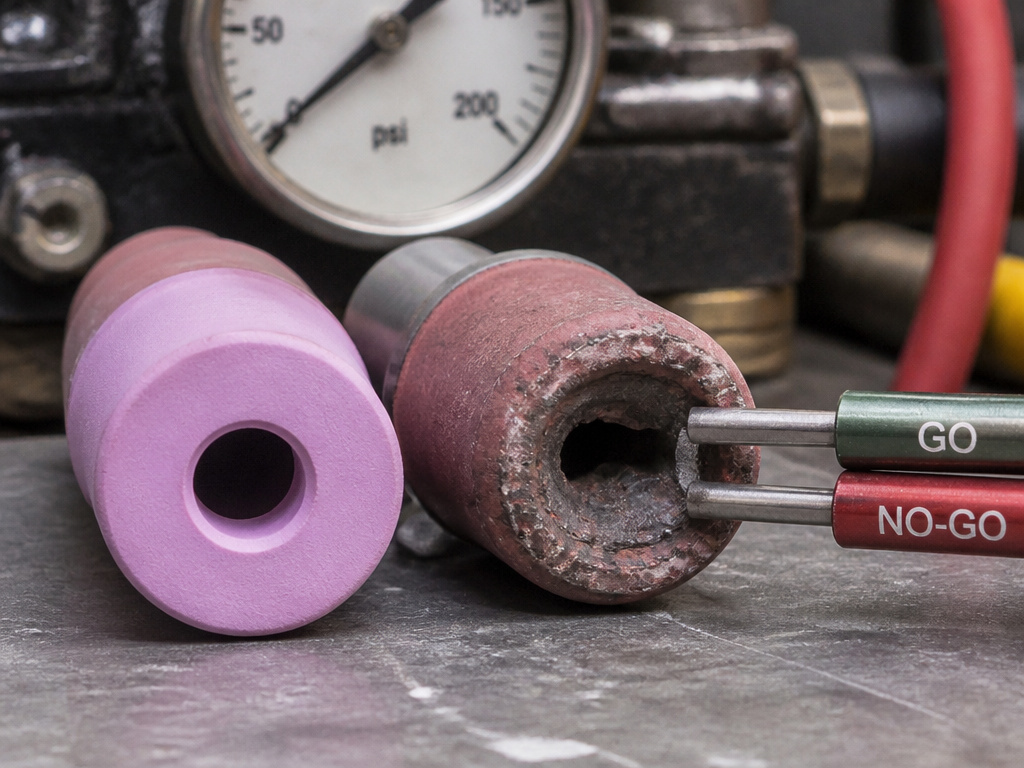
A new nozzle is a known quantity. A worn nozzle is a liability that changes your entire setup. As the hard ceramic orifice erodes, the hole gets larger. A larger hole requires more air volume (CFM) to maintain the same pressure.
The Ikonics manual states: “As the blast nozzle wears, the air requirements for the system will increase.” They instruct you to “replace the nozzle after it has worn 1/32”.” The Blasttrader.com article quantifies this: “Worn nozzles consume 30–50% more CFM than rated.”
Imagine you start with a 3/32” nozzle that requires 10 CFM. After significant wear, it might now act like a 1/8” nozzle. Suddenly it wants 17-20 CFM. Your compressor, sized perfectly for the new nozzle, now can’t keep up. Pressure drops, performance plummets, and you’re burning abrasive and time.
The S&H manual has a practical maintenance tip: “After 10-12 hours of blasting time, check the nozzle and turn it 1/4 turn if it shows uneven wear.” This rotation extends life by distributing wear.
| Condition | CFM Demand vs. New | Result on Undersized Compressor |
|---|---|---|
| New Nozzle | Baseline (e.g., 10 CFM) | Stable pressure, expected performance. |
| Moderately Worn | +15-25% | Pressure gauge dips with long trigger pulls; slower cleaning. |
| Severely Worn (1 size up) | +30-50% | Compressor cannot recover; pressure stays low; blasting becomes ineffective. |
You need a go/no-go gauge. It’s a simple set of pins that tell you if the hole is still within tolerance. Checking it weekly is the difference between a productive day and a frustrating one where you blame the compressor, the media, and the weather.
Compressor Types: Single-Stage vs. Two-Stage
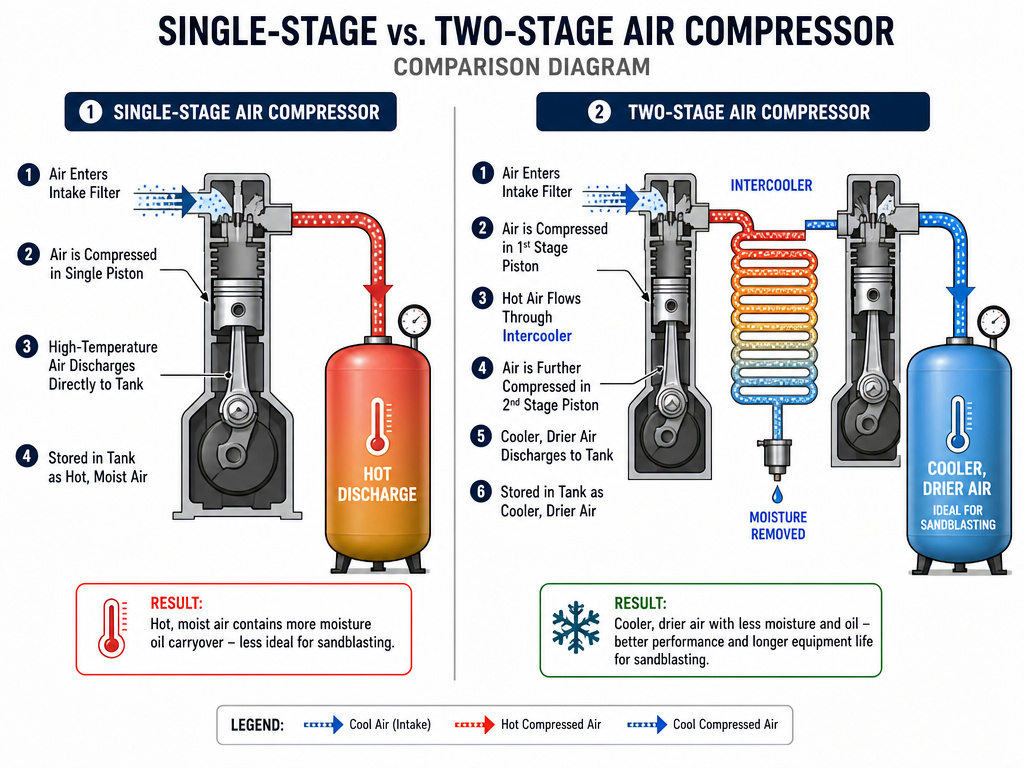
You’ll see “two-stage” recommended in the Ikonics manuals. It’s not marketing. It’s about efficiency and air temperature.
A single-stage compressor draws in air and compresses it to tank pressure in one piston stroke. It works hard, gets very hot, and is less efficient at higher pressures (like the 90-100 PSI range).
A two-stage compressor compresses the air to an intermediate pressure, cools it in an intercooler, then compresses it again to the final pressure in a second, smaller cylinder. This process results in cooler discharge air. Cooler air carries less moisture vapor, which is critical for sandblasting.
Ikonics warns: “Undersizing the air compressor will… not allow adequate time for the compressed air to cool in the air receiver tank. This warm compressed air can then enter the blast cabinet, cool and create moisture problems.”
For a small shop running a cabinet intermittently, a large 60-80 gallon single-stage compressor (often delivering 15-18 CFM) might suffice. But if you’re blasting for hours, the heat buildup and moisture will become a problem. That’s where a two-stage compressor, with its inherent cooling and higher efficiency at pressure, earns its keep.
For the massive CFM demands of large pressure pots (#8 nozzle and up), you move beyond reciprocating piston compressors completely. You step up to a rotary screw compressor, the diesel-powered workhorses on job sites that deliver 185, 375, or 750+ CFM continuously.
The Supporting Cast: Hose, Moisture, and Safety
Your compressor and nozzle are the stars, but the system around them can strangle performance.
Air Hose Diameter: This is a major point of disagreement. Minimum air hose size is a point of disagreement among manufacturers: Ikonics recommends at least 3/8” ID, S&H Industries recommends a minimum 1/2” air hose, and Escablast recommends a minimum 1.5” air hose for their respective systems. The larger the hose, the lower the pressure drop over distance. A too-small hose acts like a kinked garden hose, your compressor is working, but nothing comes out the end with force.
Moisture Control: This isn’t optional. The S&H manual’s note about draining 3-4 gallons of water on a humid day should be a wake-up call. Water in your air line mixes with abrasive, creating a cement-like paste that clogs everything instantly. A quality moisture separator after your compressor is the bare minimum. For longer run times or humid climates, a refrigerated air dryer is the next step.
Safety and Isolation: The Harbor Freight manual is adamant: “Keep the compressor completely isolated from your sandblasting environment… Airborne abrasive dust will destroy rings, pistons, valves, and bearings.” Place your compressor upwind, in another room, or at least behind a barrier. This, plus a proper NIOSH respirator and protective hood, are essential for health and equipment longevity.
Easy to miss: The quick-connect couplings between your air hose and compressor. Standard small shop couplers have a restrictive internal design. Switching to full-flow, industrial-style couplings can reduce pressure drop significantly, giving you back precious CFM at the nozzle.
Does the abrasive material change the air requirements?
The type of abrasive you use directly influences the air pressure and volume needed for effective blasting. Denser, heavier media like steel grit requires more force to accelerate and carry, often necessitating higher PSI to maintain cutting power. Lighter, finer abrasives like glass beads or certain fine-grit materials can be moved with less force but might require careful pressure adjustment to avoid fracturing the media. The particle size and shape also affect flow; sharp, angular media cuts better but can increase hose and nozzle wear, indirectly impacting system pressure over time. Always consult your equipment manual for specific media restrictions, as some blasters explicitly warn against using certain types like sand.
Frequently Asked Questions
What size air compressor do I need for a 3/8 sandblasting nozzle?
True 3/8” (#6) nozzle is for large pressure pots, not small cabinets. According to Blasttrader.com, a 3/8” nozzle at 100 PSI consumes about 196 CFM. Adding 25% for line losses to the 196 CFM requirement means you need a compressor capable of significantly more continuous output, with Blasttrader.com suggesting at least 245 CFM for a 3/8″ nozzle. This requires a large, industrial rotary screw compressor (e.g., a 250+ CFM tow-behind unit).
Can I sandblast with a 5 HP compressor?
Maybe, but with severe limits. According to Blasttrader.com, a 5 HP single-stage compressor produces roughly 15–18 CFM at 100 PSI. That’s only enough for small cabinet nozzles (like a 3/32” or very small 1/8”). It will cycle constantly and overheat during continuous use. For any serious or production work, it’s undersized.
What’s the difference between displaced CFM and actual CFM?
Displaced CFM (or piston displacement) is the theoretical volume the compressor pump moves. Actual CFM (free air delivery, or FAD) is the volume of compressed air that actually comes out the discharge at a given pressure. Actual CFM is what matters, and displaced CFM is typically 25–35% higher than the actual CFM number. Always shop by actual/delivered CFM at your working pressure.
How does nozzle size affect CFM requirements?
CFM demand increases with the square of the nozzle diameter. Doubling the nozzle size (e.g., from 1/8” to 1/4”) quadruples the CFM requirement. This is why stepping up one nozzle size often means a much larger, more expensive compressor.
Before You Go
The math is simple, but the application is tricky. Find your blaster’s manual. Look for the CFM requirement for your nozzle at a specific pressure. That’s your target. Then, decide which margin rule you trust, the conservative 75-100% from manufacturers, or the leaner 25% from pros who optimize their air lines.
Your first move this week should be to measure your current nozzle with a gauge. If it’s worn more than 1/32”, replace it before you blame your compressor. That single act often restores “lost” performance.
And remember, a cheap sandblaster really is worse than none. Pairing it with an undersized compressor just compounds the problem, creating a toxic, frustrating, and non-productive mess. The right compressor isn’t the biggest one you can afford, it’s the one that matches your nozzle’s appetite for air, with just enough room to breathe.
