
Why Does My Air Compressor Keep Tripping THE Breaker?
This post contains affiliate links. As an Amazon Associate, we earn from qualifying purchases.
Your air compressor keeps tripping the breaker because the electrical circuit is overloaded, the motor is failing, or a mechanical fault is creating too much work for the motor. The fix is a step-by-step process of elimination, starting with your power supply and working toward the compressor itself. A common question is, “Why does my air compressor keep tripping the breaker?” Never install a higher-rated breaker, that’s how wires overheat and fires start.
That sudden silence when the breaker pops isn’t just annoying; it’s a direct message from your electrical system that something is wrong. That sudden silence when the breaker pops isn’t just annoying; it’s a direct message from your electrical system that something is wrong. Ignoring it and repeatedly resetting the breaker is asking for a burned-out motor or a damaged panel, or worse.
This guide walks you through a logical diagnostic path, from the simplest, most common fixes to the more complex motor issues. You’ll start at the wall outlet and finish at the pump head, learning what to listen for and how to test safely along the way.
Key Takeaways
- Always start diagnostics at the wall outlet, an overloaded circuit or a long, undersized extension cord is a common culprit.
- Reset the thermal overload protector on the motor itself before you touch your house’s panel; this small red button trips independently of your breaker.
- Listen for the trip timing: an instant trip points to a short circuit or seized pump, while a delayed trip after running suggests an overload from a clogged filter or low voltage.
- A swollen or leaking capacitor can’t provide the extra startup torque the motor needs, causing the breaker to trip as soon as you hit the power switch.
- Never upsize your breaker to stop the tripping, you must fix the underlying overload condition, not mask it with a fuse that won’t blow in time.
The First Place to Check: Your Electrical Supply
You unplug everything else on that circuit. This isn’t optional. An air compressor is a high-draw tool, especially at startup. The Industrial Gold troubleshooting manual lists an overloaded or shared circuit as a primary cause of breaker trips. Your compressor needs its own dedicated 15- or 20-amp line, running on appropriately sized wire.
If you’re using an extension cord, stop right there. A cheap, skinny cord is a guaranteed path to a tripped breaker. The Industrial Gold guide puts it bluntly: “The longer the run of wire the larger the diameter must be to overcome the inherent voltage loss caused by the wire resistance.” Voltage drop means your motor has to work harder, pulling more amps, which trips the breaker. For a typical compressor, you need a heavy-duty extension cord of adequate gauge, and shorter is always better. Honestly, if you can move the compressor to plug directly into the outlet, do that first.
Where this goes sideways: Plugging a compressor into a garage outlet already feeding lights, a battery charger, and a radio. The combined load sneaks past the 20-amp limit only when the compressor’s startup surge hits, tripping the breaker at the worst possible moment.
Low voltage from the utility can also be a hidden culprit. If your house lights dim noticeably when the compressor kicks on, you’ve got a voltage sag. This forces the motor to draw more current to do the same work, pushing it over the amp limit of your breaker. An electrician can measure your supply voltage; if it’s consistently low under load, you may need to contact your power company.
Finally, check the breaker itself. Older breakers can go weak and trip below their rated capacity. Swap the compressor to a different, known-good circuit of the same amperage as a test. If the trips stop, you’ve likely found a faulty breaker that needs replacement by an electrician.
Mechanical Loads That Overheat Motors
The pump has to move air. Anything that makes that job harder makes the motor work harder, and that extra work shows up as heat and amperage. Your breaker is an amperage watchdog.
Start with the air filter. A clogged intake filter is like trying to breathe through a wet rag. The pump strains to pull in air, the motor labors, and the amp draw climbs until the thermal overload or the breaker gives up. Pull the filter and inspect it. If it’s caked with dust, clean it according to the manual or replace it. This is a two-minute check that solves a surprising number of trip issues.
Next, listen to the pump itself. A seized piston or a locked-up bearing creates an immediate, massive overload. If you can turn the flywheel by hand (with the power off, obviously), the pump isn’t seized. If it’s locked solid, you’ve found your problem, the motor is trying to move a brick. According to the Industrial Gold troubleshooting chart, a seized pump is a direct cause of breaker trips. This usually means a rebuild or a new pump.
Belt tension matters more than people think. A loose belt slips under load, making the motor spin without actually driving the pump efficiently. The slippage creates friction heat and wastes energy, again raising the amp draw. A belt that’s too tight puts a constant drag on the motor bearings, also increasing load. The manual will specify the proper deflection.
| Mechanical Problem | What Happens | How to Check |
|---|---|---|
| Clogged Air Filter | Pump intake restricted, motor labors. | Remove filter, hold to light. Replace if opaque. |
| Seized Pump/Bearing | Motor attempts to turn an immovable object. | Try to rotate flywheel by hand with power OFF. |
| Improper Belt Tension | Slippage (loose) or excessive drag (tight). | Check deflection per manual. |
| Faulty Check/Unloader Valve | Compressor tries to start against tank pressure. | Listen for a hiss of releasing air when motor stops. |
TL;DR: If your compressor trips after running for a minute, think airflow and friction. If it trips the second you hit “On,” think seized parts or a bad valve.
Capacitor Failure and Motor Issues
The capacitor is your compressor’s starter pack. Its job is to give the motor a powerful rotational shove to overcome initial inertia. When it fails, the motor just sits there and hums, drawing a huge locked-rotor current that trips the breaker instantly.
Visually inspect the capacitor, usually housed in a small box on the motor. A swollen top, leaking oil, or a burnt smell means it’s dead. Even if it looks fine, it could be weak. Testing with a multimeter set to capacitance (or ohms) is the only sure way to know. A critical safety step: Capacitors store a charge. You must discharge it by shorting the terminals with an insulated screwdriver before handling or testing to avoid a serious shock.
Common mistake: Assuming a motor that hums is just “tired.” That hum is the sound of a single-phase motor struggling to start without the capacitor’s phase shift. It will draw a very high locked-rotor current until something gives, usually the breaker.
Beyond the capacitor, the motor windings themselves can fail. A short between the windings or a winding shorted to the motor casing (a “ground fault”) will cause an immediate, hard breaker trip. This is a multimeter test: with power disconnected, check for continuity (or a low resistance reading) between each of the motor’s power terminals and the bare metal of the motor frame. Any reading other than “open” or infinite resistance means the motor is likely toast.
Thermal overload protectors built into the motor can also fail. These are little bi-metallic switches that open the circuit if the motor gets too hot. Sometimes they stick open. Find the small red reset button on the motor end bell and press it. If the compressor then runs, the overload did its job, your task is to find out why the motor overheated (see the sections on mechanical load and ventilation).
Startup Conditions: Cold Weather and Low Oil
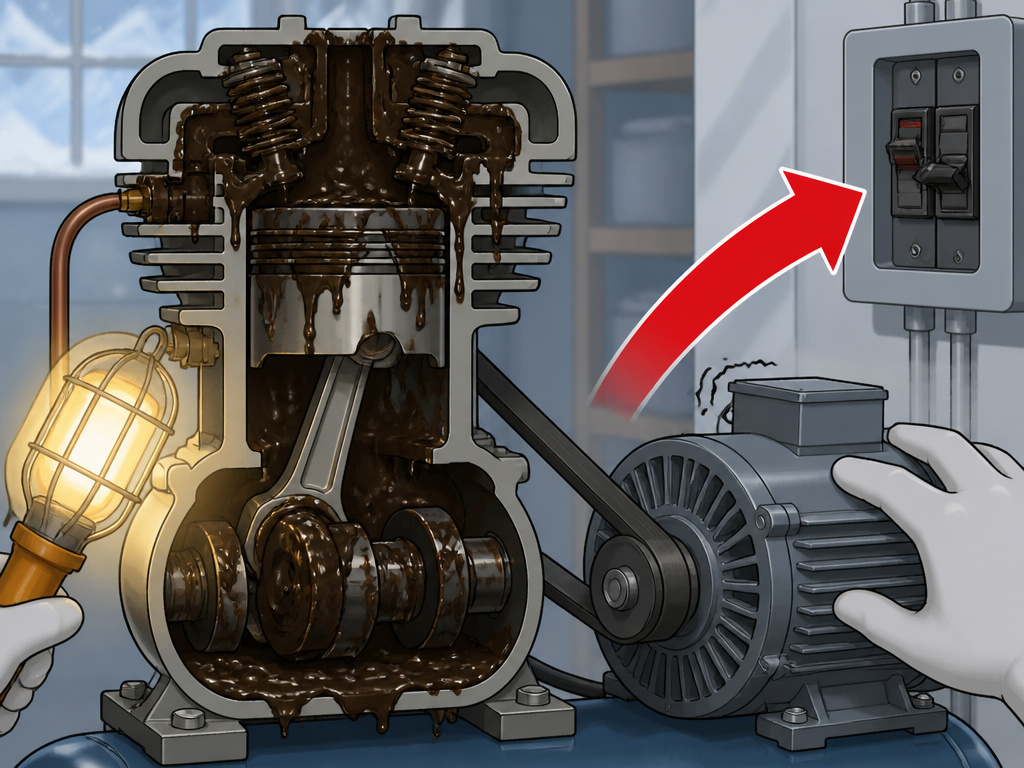
Your compressor doesn’t care about the weather, but the oil inside it does. In a cold garage, oil thickens. That thickened oil turns into molasses inside the pump, creating immense drag on startup. The motor groans, pulls a huge amperage spike, and trips the breaker before it even gets up to speed. Some manuals warn that low voltage or an overloaded circuit can cause sluggish starting, especially in cold conditions.
The fix is simple: let the compressor warm up. Move it to a warmer space for a few hours before use, or put a low-wattage trouble light or magnetic heater near the pump head for 30 minutes prior to starting. Switching to a manufacturer-recommended synthetic compressor oil formulated for cold weather can also make a dramatic difference, as it maintains its viscosity better in the cold.
Similarly, low oil level triggers a safety switch on many models, preventing startup altogether or causing trips. For compressors with a sight glass, like the Chicago Pneumatic RCP Series, the oil should be in the top third of the sight glass when the unit is level and off. Too little oil leads to increased friction and heat; too much can cause hydraulic lock or excessive crankcase pressure. Both are bad news.
The unloader valve is another startup-specific gremlin. This valve bleeds off the pressure between the pump and the tank when the motor stops, so the compressor doesn’t have to start against a full head of pressure. If this valve sticks closed, the motor faces an immediate, massive load. You’ll hear the motor strain and the breaker will pop almost immediately. A functioning unloader makes a distinct pssht sound right after the motor shuts off.
When Your Compressor Trips Immediately vs. After Running
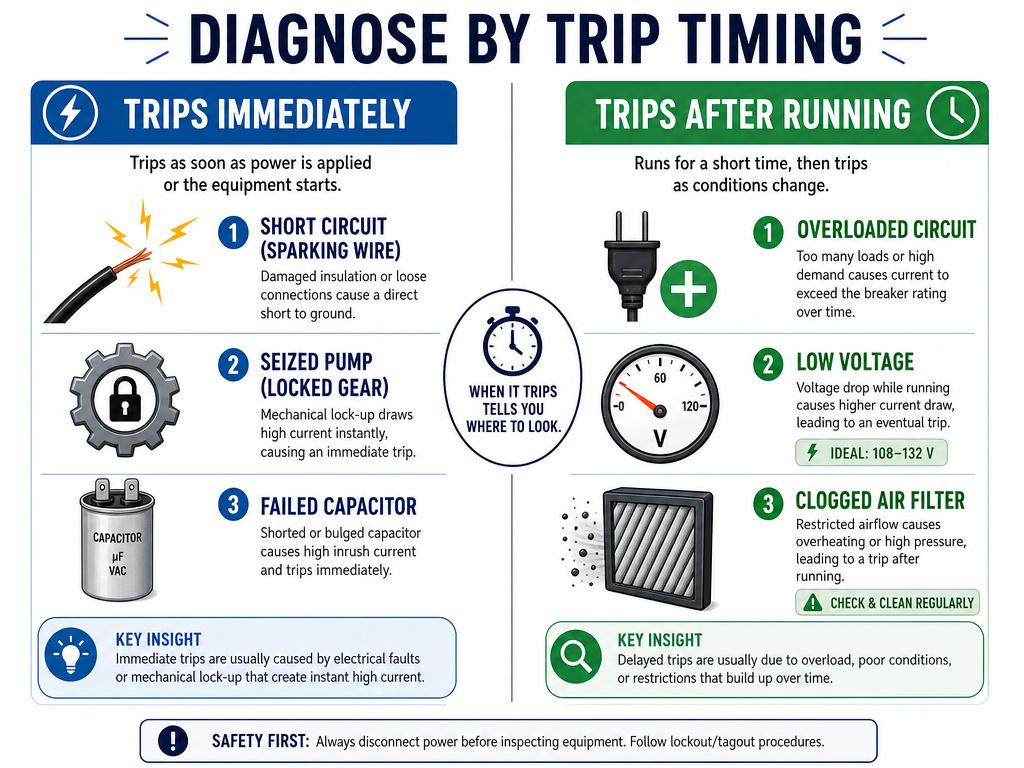
The timing of the trip is your best diagnostic clue. It tells you where to look first.
If the breaker trips THE INSTANT you flip the switch:
This screams “short circuit” or “locked rotor.” Your diagnostic path is:
- Electrical Short: Check for damaged power cords, loose wires in the pressure switch or magnetic starter box, or a motor winding shorted to ground (use a multimeter).
- Seized Pump: Try to turn the flywheel by hand. No movement means a seized bearing, piston, or connecting rod.
- Failed Capacitor: A dead start capacitor won’t provide the necessary phase shift, leaving the motor locked.
- Stuck Unloader Valve: No pssht sound after previous shutdown means the compressor is trying to start against tank pressure.
If the breaker trips AFTER the compressor has run for a few seconds or minutes:
This points to an “overload” condition that builds up over time. Your path is:
- Overloaded Circuit: Is something else turning on (a fridge, a dust collector) while the compressor runs?
- Voltage Drop: Measure the voltage at the outlet while the compressor is running. A sag below 110V is a problem.
- Restricted Airflow: Check the inlet filter, and ensure the compressor has proper ventilation (more on this next).
- Rising Thermal Load: As the pump heats up from low oil, tight bearings, or a dirty cooling fin, the motor amp draw climbs until it trips the thermal overload or breaker.
The Role of Ventilation and Maintenance
An air compressor is a heat engine. It gets hot. If you trap that heat, you’re asking for trouble. The Chicago Pneumatic (RCP Series) manual requires a minimum clearance of 18 inches, while the Husky manual advises operating at least 18 inches away from walls or objects that could restrict airflow. Stuffing your compressor in a tight corner or a closed cabinet is a recipe for thermal overload and repeated breaker trips.
That heat also affects the motor’s performance. Excessive heat can significantly shorten the lifespan of the motor’s insulation. An overheated motor winding has higher electrical resistance, which in turn causes it to draw more current to produce the same magnetic field, a vicious cycle that ends at the breaker box.
This is where routine maintenance isn’t just about longevity; it’s about preventing nuisances. The Chicago Pneumatic (RCP Series) manual states you must visually inspect air tanks yearly for corrosion. A small pinhole leak might not be obvious, but it forces the pump to run longer and more frequently to maintain pressure, cumulatively increasing the thermal load on the motor. Similarly, draining the tank daily (after reducing pressure below 30 PSIG, as both ABAC and Chicago Pneumatic warn) prevents moisture buildup that can corrode the tank from the inside and, more critically for our discussion, ensures the pump isn’t compressing against a partially water-filled chamber, which increases load.
Could the Circuit Breaker Be Bad or Loose?
A breaker that trips might be faulty or have loose connections. Loose wires at contact points are a known cause of breaker trips. Before you do anything, follow all local electrical and safety codes. To check this, first ensure the power is completely off at the main panel. Then, inspect the wire connections on the breaker itself and where the compressor’s power cord attaches. Make sure they are tight. Also, verify the compressor is on a dedicated circuit and that the incoming power wire size is adequate for the compressor’s needs, as undersized wiring can cause problems.
Frequently Asked Questions
What would cause an air compressor to trip a breaker?
The five most common causes are: an overloaded or shared circuit, a failing start capacitor, a clogged air intake filter, a seized pump or binding mechanical part, and the use of an undersized or overly long extension cord causing voltage drop.
Why does my air compressor keep tripping overload?
The “overload” is usually the thermal protector on the motor itself, not your house breaker. It trips because the motor is getting too hot from excessive load, caused by low oil, poor ventilation, a tight belt, or a dirty pump cooling system. Find and fix the source of the extra heat.
My air compressor keeps tripping even though I press the reset button. What could be causing this and how can I fix it?
The red reset button on the motor resets its internal thermal overload. If it trips again immediately, the overload is working correctly, it’s detecting an ongoing over-temperature condition. Don’t just keep resetting it. Investigate the mechanical causes of overheating (low oil, blocked airflow, seized components) or have the motor tested for a failing winding.
Why does my air compressor shut off after only a few seconds?
This is usually the motor’s thermal overload protector, not the main breaker. It indicates the motor is overheating almost instantly. Primary suspects are a failed cooling fan, a complete lack of oil in the pump, a seized bearing, or a severely restricted air intake. The motor starts, heats up dangerously fast, and the internal safety switch shuts it down.
Before You Go
Start with the wall plug and work your way to the pump. That’s the only sequence that makes sense. Most trips are solved before you ever touch a tool, by ensuring a clean, dedicated power supply. The moment you’re tempted to swap in a bigger breaker, stop. That’s the system telling you it’s already overloaded; masking it is how workshops burn down.
If your compressor trips on a cold morning but works fine in the afternoon, you’ve just diagnosed a cold-oil startup problem. Keep a space heater in the garage or switch to a winter-grade oil. And if you hear that humming instead of the satisfying chug of a starting motor, your capacitor has almost certainly given up the ghost. Replace it with an identical-rated part, discharge the old one safely, and you’ll likely be back in business.
