
15 vs 16 Gauge Finish Nailer: Which Should You Buy?
This post contains affiliate links. As an Amazon Associate, we earn from qualifying purchases.
A 15-gauge nailer fires a thicker nail (approx. 1.8mm / 0.0720″) for heavy-duty trim and structural tasks, while a 16-gauge nailer fires a thinner nail (approx. 1.6mm / 0.0625″) for delicate trim and cabinetry. For most cabinet and interior finish work, a 16-gauge nailer is the one to buy first.
That thickness difference drives everything else: the 15-gauge’s superior holding power, its larger hole that demands more filling, and its higher splitting risk on thin stock. The 16-gauge trades some brute strength for a cleaner finish and easier handling in tight spots. The choice between a 15 vs 16 gauge finish nailer is fundamental. Most pros own both, but they pull the 16-gauge off the shelf four or five times more often than the 15.
What follows is a breakdown of the three specs that decide the 15 vs 16 gauge finish nailer choice: nail gauge, magazine angle, and the thickness of your material. We’ll walk through when to commit to one, when to rent, and the single scenario where buying both upfront makes sense.
Key Takeaways
- A 16-gauge nailer handles 90% of cabinet and trim work. Professional cabinet shops use it 4-5 times more often than the 15-gauge for its versatility and cleaner finish.
- Match nail thickness to material thickness. Use a 15-gauge nailer for 3/4-inch thick hardwood trim or materials wider than 3 inches; use a 16-gauge for everything thinner.
- The magazine angle changes where you can work. An angled 15-gauge magazine can be a liability in tight corners, while a straight 16-gauge magazine fits where the angled one won’t.
- Finishing time is a real cost. The larger holes from a 15-gauge nail demand more putty and sanding, adding hours to a stained or painted project.
- If buying one nailer for cabinets, get a 16-gauge. You can always add or rent a 15-gauge later for the few heavy jobs that demand it.
What Are the Key Differences Between a 15-Gauge and 16-Gauge Nailer?
The difference isn’t subtle once you hold the nails. A 15-gauge nail shank is approximately 1.8mm thick, while a 16-gauge shank is approximately 1.6mm thick. That 0.2mm gap is the whole game.
A 15-gauge finish nailer uses thicker, angled-collation nails (usually 34-degree) for high holding power in heavy trim. A 16-gauge finish nailer uses thinner, straight-collation nails for lower splitting risk and a finer finish in delicate cabinetry and general trim work.
That extra metal in the 15-gauge nail gives it a higher load rating. It’s why you’d choose it for hanging a solid wood door or securing a 5-inch crown molding. But that strength comes with trade-offs. The nail head is bigger, so the hole it leaves is larger and more visible. The larger hole from a 15-gauge nail demands more putty and sanding.
The thinner 16-gauge nail, by contrast, is built for finesse. Its smaller head leaves a hole that fills almost invisibly with a dab of putty. The risk of splitting delicate face frame stock, think 3/4-inch maple or oak, drops significantly. This is why sources like The Cabinet Craftsmen LLC state that for cabinet work, they reach for the 16-gauge nailer 80% of the time.
Key Specifications Compared
This table lays out the hard numbers and practical consequences side by side. Note the two different thickness measurements reported by sources, one in inches, one in millimeters, which reflects a common point of confusion in the market.
| Specification | 15-Gauge Finish Nailer | 16-Gauge Finish Nailer |
|---|---|---|
| Nail Thickness | 0.0720 inches (The Cabinet Craftsmen) / ~1.8mm (AnyShelter) | 0.0625 inches (The Cabinet Craftsmen) / ~1.6mm (AnyShelter) |
| Typical Nail Length | 1-1/4″ to 2-1/2″ (NailerPros) | 1″ to 2-1/2″ (AnyShelter citing Metabo HPT) |
| Nail Head Shape / Collation | Angled (34-degree) | Straight |
| Primary Nailer Type | Typically an angled magazine nailer | Typically a straight magazine nailer |
| Best For | Heavy-duty trim, thick hardwood, large crown, exterior work | Delicate trim, cabinetry, face frames, general interior finish work |
| Splitting Risk | Higher on delicate or thin materials | Lower on thin materials |
This table is your fact sheet. The thickness dictates holding power. The head shape and collation dictate the tool you must buy. This explains how those details affect your work.
When to Use a 15-Gauge Finish Nailer
Pull the 15-gauge off the rack when the job asks for brute strength and you’re willing to spend extra time on finish work. The rule from NailerPros is straightforward: if what you’re nailing is 3/4-inch thick and also wider than 3 inches, use the 15-gauge.
Here are the specific jobs that meet that criteria:
- Hanging doors: Solid wood interior doors and heavier exterior doors need the holding power.
- Large crown molding (5-inch or bigger): The weight and size of big crown demand a thicker nail.
- Thick hardwood trim: Think oak or maple door casing over 3/4-inch thick.
- Heavy cabinet installations: Securing solid wood face frames on frameless Euro-style cabinets.
- Outdoor projects/exterior trim: The nail must resist seasonal wood movement and moisture.
- Siding applications: Where a finish nail is appropriate for siding.
- Base layer for two-piece crown molding on wavy walls: The first, structural layer needs a strong bite.
The part nobody mentions: Using a 15-gauge nailer on painted trim is a commitment. Every hole needs a fill-sand-prime-paint cycle. Skip a step, and that larger hole will shadow through the topcoat on a bright wall.
When to Use a 16-Gauge Finish Nailer
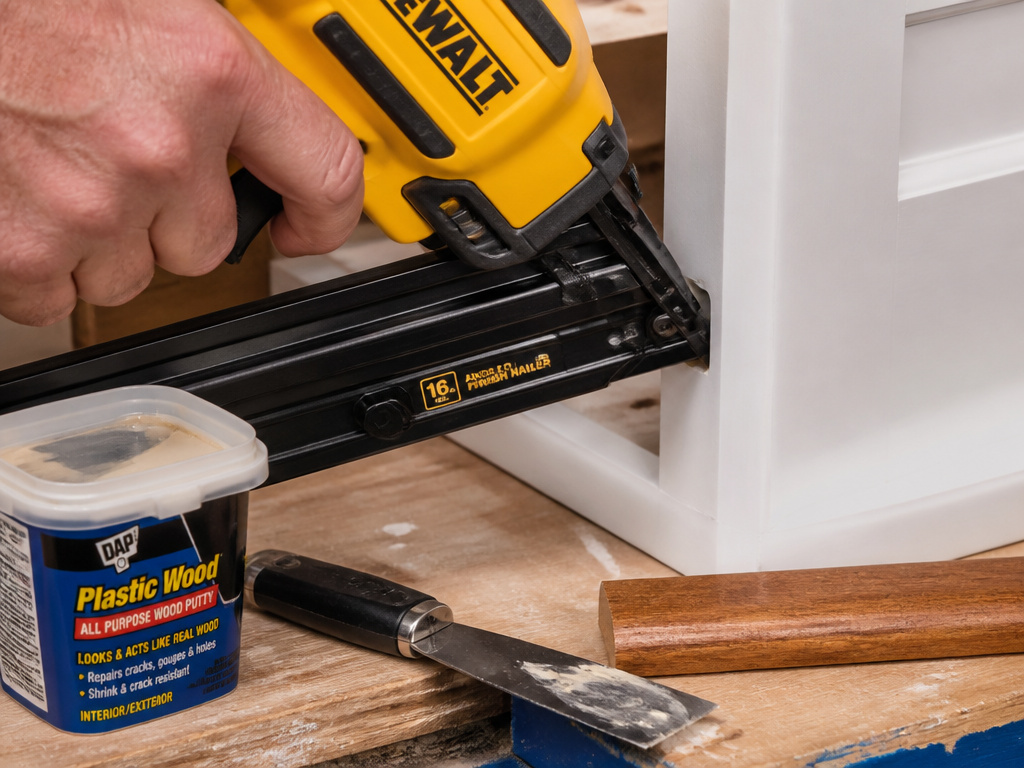
Reach for the 16-gauge for everything else. Its job is to hold things together securely while making your life easier before, during, and after the nail is driven.
Its domain is the interior, the delicate, and the finish-sensitive:
- Smaller casings and baseboards: Standard window and door trim.
- Cabinet face frames: Especially on painted or stained cabinetry where hole visibility matters.
- Paneling and wainscoting.
- All light trim work: Picture frames, shoe molding, quarter-round.
- Any application on material under 3/4-inch thick.
The 16-gauge’s advantage is speed. Not in driving the nail, but in finishing the job. The smaller hole fills with a swipe of putty, sands flat in seconds, and disappears under paint or a carefully matched stain filler. On a multi-day trim project, choosing the 16-gauge over the 15 can save significant cleanup and finishing time.
The Straight Magazine Advantage (and the Angled Myth)

Here’s where online advice gets tangled. Most sources say 15-gauge nailers are angled and 16-gauge nailers are typically straight, though NailerPros notes there are a few angled 16-gauge models available. The real question is: which design is better for tight spaces?
Sources disagree on which nailer is better for tight corners: NailerPros states an angled nailer (15-gauge) is easier to get into tight places, while The Cabinet Craftsmen LLC states the straight magazine on a 16-gauge nailer fits into tight spots where the angled 15-gauge magazine won’t.
Where this goes sideways: Assuming an angled nailer is always better for corners. In finish carpentry, the straight magazine on a 16-gauge nailer often fits into tight spots where the angled 15-gauge magazine physically won’t, like inside a 1-inch cabinet corner.
Now, the market is evolving. NailerPros points out there are a few angled 16-gauge finish nailers now, like the Dewalt Angled 16-ga model. So the advantage of angling is no longer exclusive to 15-gauge tools. But the core principle remains: when comparing the most common pneumatic tools, the straight magazine of a standard 16-gauge nailer is often the more maneuverable choice for intricate interior work.
15-Gauge vs. 16-Gauge: Decision Scenarios
Should you own both, or just one? Your project list decides. We can pair common situations with the right tool.
| Your Situation | Recommended Tool | Why This Choice |
|---|---|---|
| Buying your first finish nailer for general trim & cabinets | 16-Gauge Finish Nailer | It handles the vast majority of work with easier finishing. The best 16-gauge finish nailers are a perfect starting point. |
| Installing thick, solid wood crown molding or exterior trim | 15-Gauge Finish Nailer | You need the holding power. Rent one for a single project, or invest in a model from our best 15-gauge finish nailers guide. |
| Professional cabinet shop or frequent remodeler | Own Both | You’ll use the 16-gauge daily and the 15-gauge occasionally. The best finish nailers guide covers top models in each category. |
| Fine trim work (picture frames, small moulding) | 18-Gauge Brad Nailer | Even a 16-gauge is overkill. Step down to an 18-gauge nailer for near-invisible holes. |
| Confused about nailer types altogether | Read a Fundamentals Guide | Understand the bigger picture with our guide on brad nailer vs finish nailer differences. |
What about an 18-gauge brad nailer? As The Cabinet Craftsmen LLC states, 18-gauge nailers are too light for most cabinet work. They lack the holding power for face frames, door casing, or crown molding. They’re a specialty tool for attaching ultra-thin trim or holding parts for glue. Don’t confuse them with a finish nailer.
Tool Maintenance for Both Types
The mechanical needs of 15 and 16-gauge nailers are identical. They’re both pneumatic finish nailers. The maintenance routine doesn’t care about gauge.
You need to regularly clean and lubricate both types to keep them firing smoothly. That means a few drops of pneumatic tool oil in the air inlet before each day’s use, and clearing any sawdust or debris from the magazine and driver blade. A jammed nailer stops a project cold, regardless of whether it’s shooting a 0.072-inch or a 0.0625-inch nail.
One note on weight: a 15-gauge nailer is typically heavier due to its more robust construction. The Metabo HPT NT65MA4 15-gauge nailer, for example, weighs 4.2 lbs. A comparable 16-gauge nailer is often lighter. Over a full day of overhead work, like installing crown, the weight difference can add up in your shoulder and wrist.
Which nailer is larger and heavier?
A 15-gauge nailer is physically larger and heavier than a 16-gauge tool. This is due to the mechanism needed to drive its thicker nails. While specific weight can vary by brand, a 15-gauge nailer is typically heavier due to its more robust construction. The 15-gauge’s angled magazine also contributes to its bulkier profile. This makes the 16-gauge nailer the more nimble and less fatiguing option for general use, especially on cabinet and trim work where the tool is constantly in your hand.
Are 16-gauge nails easier to find and cheaper?
16-gauge nails are widely available as they are used for the majority of cabinet and trim applications. Because the 16-gauge nailer handles the majority of cabinet and trim applications, these nails are a standard stock item at most hardware stores and lumberyards. For a professional who goes through nails quickly, or a DIYer who wants to avoid specialty orders, the widespread availability of 16-gauge fasteners is a practical advantage.
Frequently Asked Questions
Should I get a 15 or 16 gauge finish nailer?
For your first and likely only finish nailer, get a 16-gauge. It covers about 90% of common trim and cabinet tasks with less fuss over hole filling. Buy a 15-gauge later only if you find yourself regularly tackling heavy moldings or exterior work.
What are 15 gauge finish nails used for?
Use 15-gauge finish nails for heavy-duty applications where maximum holding power is critical. This includes hanging solid wood doors, installing large crown molding (5-inch plus), securing thick hardwood trim, and fastening exterior trim exposed to the elements.
Are 15 gauge nails too big for trim?
Yes, 15-gauge nails are often too big for standard interior trim. Their thicker shank (approx. 1.8mm) creates a larger hole that requires more filling and presents a higher splitting risk on delicate woods like 1/2-inch pine or poplar face frames. For standard baseboards and casings, a 16-gauge nail is the better fit.
What would you use a 16 gauge finish nailer for?
Use a 16-gauge finish nailer for nearly all interior finish carpentry. This includes installing cabinet face frames, window and door casings, baseboards, chair rails, paneling, and any trim work where a clean, minimally visible fastener is the goal. Its thinner nail minimizes splitting and leaves a smaller, easier-to-conceal hole.
The Bottom Line
Here’s the one-sentence rule: if your trim is under 3/4-inch thick and you work indoors, buy a 16-gauge finish nailer.
In the 15 vs 16 gauge finish nailer debate, the 16-gauge is the default for a reason. Its balance of strength and finish quality fits the work most people actually do. The 15-gauge is a specialist. Owning both is ideal for a pro, but for the DIYer or even a many cabinet shops, the 16-gauge alone gets the job done the vast majority of the time.
Before you buy any nailer, check your project list against the specs. If it doesn’t include “hang solid oak doors” or “install 6-inch exterior crown,” start with the more versatile tool. You can always add the heavier hitter later, or better yet, rent it for the one-off job that demands it. Understanding the nail gun nail sizes and the implications of the angled vs straight finish nailer design makes this choice clear. Get the tool that matches the work in front of you, not the work you imagine doing someday.
