
10 Best Finish Nailers in 2026
This post contains affiliate links. As an Amazon Associate, we earn from qualifying purchases.
For a reliable, oil-free pneumatic finish nailer, the Bostitch Smart Point 16GA Finish Nailer Kit is our best overall. Its tool-free jam clearing and precise depth control make it a favorite for finish carpenters. For cordless speed, the Makita XNB05Z excels, while the Metabo HPT NT65M2S is the lightest pneumatic option.
Choosing a finish nailer means balancing power, weight, and your willingness to manage an air compressor. The right tool drives nails flush without marring the wood and fits comfortably in your hand for hours of installing trim or building cabinets.
Our recommendations come from comparing manufacturer specifications, analyzing expert round-ups, and identifying consistent patterns in owner feedback. This guide highlights ten standout models to match different needs and power preferences.
Top 10 Finish Nailers in the Market
Certain content that appears on this site comes from Amazon. This content is provided "as is" and is subject to change or removal at any time.
The Best Finish Nailers, Reviewed
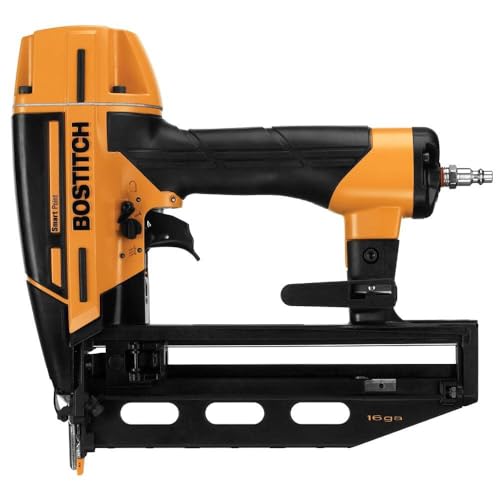
Bostitch Smart Point 16GA Finish Nailer Kit
What We Like
- Oil-free operation prevents stains on finished work
- Tool-free jam release clears misfires quickly
- Dial-A-Depth allows precise countersinking adjustment
- Carrying case and no-mar tips included in the kit
Trade-offs
- At 7.3 lb, it's heavier than the 3.7 lb Metabo HPT NT65M2S
- Requires a separate air compressor and hose to operate
- Rear air exhaust can direct exhaust air toward the user
A tool-free jam release and oil-free design mean you spend less time clearing jobsite headaches and more time driving clean nails. The selectable trigger gives you the safety of sequential mode for precision work or the speed of contact actuation for high-volume runs. This blend of reliability and user-focused features makes it a dependable choice for finish carpenters and serious DIYers who demand a pneumatic nailer that won’t let them down mid-project.
The trade-off is that you’re tethered to an air hose, which can limit mobility compared to a cordless option like the Milwaukee M18 Fuel. At 7.3 pounds, it also carries more heft than some ultra-lightweight pneumatics. For anyone with a compressor already on site, however, this nailer delivers a straightforward, professional-grade performance that justifies its weight with consistent power and minimal maintenance.
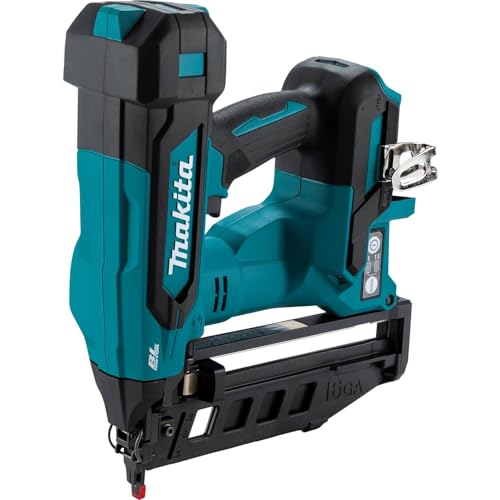
Makita XNB05Z Brushless Cordless Finish Nailer
What We Like
- Ultra-compact, ergonomic design improves maneuverability
- Class-leading cordless speed and nails-per-charge efficiency
- Slim nose allows access in confined spaces
- Tool-less depth adjustment and jam clearing
Trade-offs
- Tool only: requires separate purchase of Makita 18V LXT battery and charger
- At 6.6 lbs with a battery, it is heavier than some pneumatic competitors like the 3.7 lb Metabo HPT NT65M2S
The Makita XNB05Z finish nailer drives up to 2,750 nails per charge with a 5.0Ah battery, allowing for extended work sessions. It weighs 6.6 pounds with a battery for improved maneuverability, and its slim nose provides access in confined areas. A tool-less depth adjustment dial allows for precise flush and countersink nailing, while the brushless motor drives nails sub-flush in both hardwood and softwood.
This tool requires a Makita 18V LXT battery, which is sold separately. For users who already own these batteries, it integrates directly. Compared to pneumatic options, it removes the need for an air compressor and hose. The magazine holds up to 110 nails, and a tool-less nose allows for fast nail extraction if a jam occurs.
Product photos
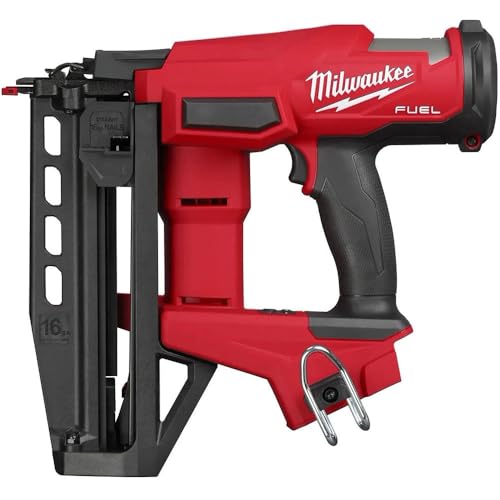
Milwaukee M18 Fuel 16GA Finish Nailer
What We Like
- Fires three nails per second for rapid work
- Clears jams and adjusts depth without tools
- No gas cartridge required for operation
- Integrated LED light and tip storage
Trade-offs
- At 8.1 lb, it's heavier than pneumatic models like the 7.3 lb Bostitch.
- Battery and charger are sold separately.
- 15.2-inch length can feel bulky in very tight spaces.
This cordless nailer fires three nails per second, a rate that can keep pace with continuous trim work. It uses the M18 battery system, offering cordless convenience while being compatible with 1 to 2.5-inch 16-gauge nails for hardwoods and softwoods. The tool includes sequential and contact actuation firing modes, so you can switch between precision and speed, and features tool-free jam clearing to minimize downtime.
The tool weighs 8.1 pounds, which is lighter than some pneumatic models like the 9.0-pound Senco FinishPro 42XP, but you still feel its presence during all-day use. For users already invested in the M18 platform, it provides cordless freedom without needing a gas cartridge. Research mentions that a different Milwaukee cordless nailer delivered performance on par with air-powered models, suggesting cordless power can be sufficient for demanding tasks.
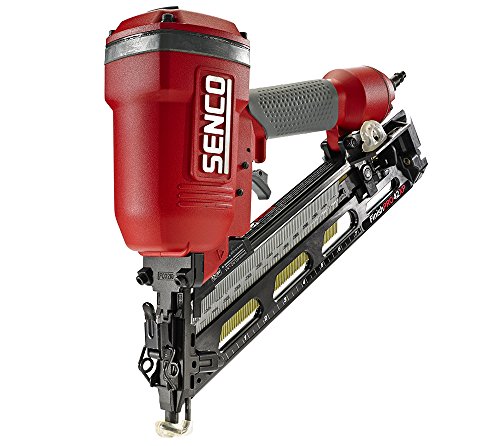
Senco FinishPro 42XP Pneumatic Finish Nailer
What We Like
- Oil-free design eliminates maintenance
- Quick-clear latch for tool-free jam removal
- Reinforced metal cylinder for durability
- Lightweight magnesium main body
Trade-offs
- Operates only in sequential firing mode
- Requires an air compressor to operate
An oil-free pneumatic design is the standout feature here, meaning you can skip the ritual of adding a few drops of oil after every session. This not only saves a small hassle but also prevents any chance of oil stains on your finished trim work. For the contractor or serious DIYer who already has a compressor setup and wants a reliable, maintenance-light tool for baseboards and casings, the 42XP’s durable build and consistent performance make it a solid, long-term choice.
Operating solely in sequential mode means this nailer prioritizes precise, controlled placement over rapid-fire speed. While this approach ensures clean, deliberate fastening ideal for detailed trim work, those needing the absolute fastest production times for large-scale jobs might find the pace limiting. The trade-off, however, is a tool designed for reliability and a maintenance-free experience, eliminating the need for post-session oiling that’s typical of most pneumatic nailers.
Metabo HPT NT65M2S Finish Nailer

What We Like
- Extremely light at 3.7 pounds
- Tool-free depth of drive adjustment
- Selectable bump or sequential fire
- Integrated air duster button
Trade-offs
- Pneumatic, requires an air hose and compressor
At 3.7 pounds, this nailer is a featherweight champion, which is the main reason it stands out in a crowded field. That weight, combined with its well-balanced design, means you can work overhead installing crown molding or crouched down on baseboard all day without your arm turning to lead. It drives 16-gauge nails up to two-and-a-half inches long, giving it enough muscle for most trim and cabinetry jobs. For a professional trim carpenter or a dedicated DIYer tackling a multi-room project, this tool minimizes fatigue and keeps the focus on precision.
Being a pneumatic tool means you are always connected to an air hose and compressor, unlike cordless models such as the Milwaukee M18 Fuel which are grab-and-go. Compared directly to another pneumatic nailer, the 7.3-pound Bostitch Smart Point 16GA kit, the Metabo HPT’s 3.7-pound weight is a tangible advantage that reduces fatigue during long jobs. This focus on a lightweight, efficient design makes it a purpose-built tool that excels at driving finish nails without extra bulk.
Metabo HPT NT1865DAA Cordless Finish Nailer Kit

What We Like
- Lightweight and compact for tight spaces
- Tool-less depth adjustment and mode switch
- Flush drives in hardwood and fiber cement
- Zero ramp-up time for immediate firing
Trade-offs
- Angled magazine limits nail length vs. straight
At 5.9 pounds without a battery, this nailer reduces arm fatigue for overhead trim work and long projects. Its air spring drive system provides pneumatic-like power to sink 15-gauge nails flush into hardwood, according to the manufacturer. This reliable drive force in a lighter package suits professionals and serious DIYers frequently working with dense materials.
Cordless design eliminates hoses and a compressor, but the tool measures over a foot long. While 13% lighter than previous models, its form may not suit every confined space. For general trim work, the ability to drive up to 700 nails per charge minimizes downtime for battery changes.
DeWalt DCN660B Cordless Finish Nailer
What We Like
- Tool-free depth adjustment for precise countersinking
- Integrated LED lights for workspace illumination and diagnostics
- Eliminates need for compressor, hose, or gas
Trade-offs
- Noticeable firing delay reported by some users
- Tool only: requires separate purchase of battery and charger
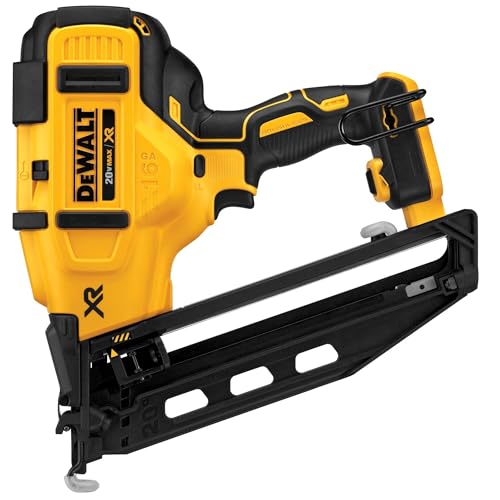
This cordless finish nailer is 100% battery powered, eliminating the need for a compressor, hose, or gas cartridges, so it’s a self-contained system for mobile work. It’s among the lightest in its class, according to expert comparisons, which makes it easier to handle overhead or carry all day. The multi-functional LED lights provide both workspace illumination and tool diagnostics, a helpful feature for troubleshooting on a jobsite.
While owners report reliable performance, the tool’s head is bulkier and there’s a slight firing delay, which can feel less snappy than a pneumatic or some other cordless models. For pure speed and a more compact profile in tight spaces, a pneumatic option like the Senco FinishPro 42XP remains the benchmark. This DeWalt excels as a cordless solution where convenience and diagnostics outweigh the need for the absolute fastest cycle time.
Product photos
Makita XNB02Z Cordless Finish Nailer

What We Like
- Cordless design eliminates compressor and hose
- Anti-dry fire prevents blanks and surface damage
- Compact nose for visibility in tight spots
Trade-offs
- Tool only: requires separate battery and charger purchase
- Larger footprint than the compact Makita XNB05Z model
- Limited to straight 16-gauge nails
The anti-dry fire mechanism is the standout feature here, a smart piece of engineering that stops you from driving a blank and marring your finished work. That makes this nailer a serious contender for detailed trim and cabinet work where every shot counts. Its cordless 18V LXT platform offers genuine job-site convenience, letting you move freely without hunting for an outlet or wrestling an air hose. You can expect to sink about a thousand finish nails on a single 5.0Ah battery, which covers a lot of baseboard or crown molding before needing a swap.
The tool requires a commitment to Makita’s battery system, as the battery and charger are sold separately. This increases the initial cost for users not already invested in the 18V LXT platform. For those prioritizing a compact size, the Makita XNB05Z brushless model has smaller listed dimensions than the XNB02Z.
Product photos
Bosch GNH18V-15MAN Cordless Finish Nailer

What We Like
- One-handed activation streamlines workflow
- Wide view contact tip for precise positioning
- Tool-free jam clearing minimizes downtime
- Low recoil enhances comfort and control
Trade-offs
- Tool only: requires separate Bosch CORE18V battery purchase
- At 14.9 inches long, it's one of the larger cordless models
- 15-gauge angled nails are less common than 16-gauge straight
Fastening up to 1,200 nails per charge with a specific battery means a full day of trim work is possible without a compressor or hose. Pneumatic-like performance from the brushless motor provides the consistent power needed to sink 15-gauge angled nails. Its 3.7-inch width helps the tool fit into tight spaces where a straight magazine might not, and the wide-view contact tip offers a clear line of sight for precise nail placement.
You pay for that freedom with some heft and size; at 6.8 pounds and nearly 15 inches long, it feels more substantial in hand than something like the trim Metabo HPT NT65M2S. That’s the trade-off for the sturdy build and large battery capacity. Compared to a dedicated pneumatic like the Senco FinishPro 42XP, you’re gaining portability but accepting a slightly bulkier tool body. For confined spaces like built-ins or under eaves, however, its angled design and superior sightline often make it the easier tool to maneuver, even if it’s not the absolute lightest.
Product photos
Bostitch BTFP72156 15GA Finish Nailer

What We Like
- Integrated 16-inch on-center measuring gauge
- Oil-free, low-maintenance operation
- Tool-free jam release for quick clearing
- Dial-A-Depth control for precise countersinking
Trade-offs
- Requires a separate air compressor to operate
- Angled magazine limits compatibility to specific FN-style nails
A 16-inch on-center gauge flips out from the nose, letting you space wall trim studs accurately without a separate tape measure. This pneumatic nailer drives 15-gauge angled finish nails from one and a quarter to two and a half inches long. Expert testers found it one of the most comfortable and easy to use in its group, firing a thousand nails consistently without jamming. It ran completely empty and drove the last nail as accurately as the first.
You trade battery-powered mobility for the lower cost and high reliability of a pneumatic tool. Its oil-free operation means less maintenance than many air nailers require. A selectable trigger offers either sequential or contact nailing modes. The integrated air blower clears debris from the work surface before driving a fastener.
Product photos
How We Evaluated Finish Nailers
Our research focused on manufacturer specifications and documented performance in expert round-ups. We looked for patterns in owner reviews to confirm reliability, ease of use, and common trade-offs. This method prioritizes real-world durability and function over marketing claims.
Key evaluation criteria were driving power for hardwoods, tool weight for user fatigue, and operational convenience like tool-free adjustments. We also considered the practical implications of power sources, comparing the freedom of cordless finish nailers against the consistent power of air-powered finish nailers.
A research-based evaluation cannot replicate years of daily jobsite use. Our findings highlight design strengths and reported limitations to help you anticipate how a nailer will perform in your specific projects, from crown molding to cabinet assembly.
What To Look For In Finish Nailers
Selecting a finish nailer involves more than just power. You need the right nail gauge for your material, a comfortable tool weight for all-day use, and a power source that fits your workflow. Consider where you’ll use it most, a cramped corner or an open floor.
Focus on nail gauge (15 for strength, 16 for versatility), tool weight (under 5 lbs is ideal for overhead work), and power source (cordless for mobility, pneumatic for consistent power). A tool-free depth adjustment is essential for flush driving.
Nail Gauge & Magazine Angle
Nail gauge determines holding power and visibility. A 15-gauge nail is thicker and stronger, ideal for heavier trim and hardwood. A 16-gauge nail leaves a smaller hole, making it a versatile choice for most interior trim and molding. Magazine angle is also crucial; a straight magazine is simpler, while an angled magazine offers better reach into tight corners but may limit maximum nail length.
Tool Weight & Balance
A lighter nailer reduces fatigue, especially during overhead installation or long workdays. Pneumatic models often win here, with some weighing under 4 pounds. Cordless models add the weight of the battery and motor. Balance is just as important; a well-balanced tool feels like an extension of your hand, improving accuracy and control in confined spaces.
Power Source & Features
Your choice between a cordless nail gun and a pneumatic one dictates your setup. Pneumatic models require a compressor and hose but offer consistent, maintenance-light power. Modern battery-powered models provide excellent mobility and have largely closed the power gap. Key features to seek include a tool-free depth adjustment for precise countersinking, an easy jam-clearing mechanism, and a no-mar tip to protect finished surfaces.
- Check the maximum nail length to ensure it meets your project needs.
- Verify the firing modes: sequential for precision, bump-fire for speed.
- Look for included accessories like a carrying case or spare no-mar tips.
Always test the tool’s balance and nose profile in-store if possible, as these feel factors greatly impact real-world usability.
Finish Nailers Compared
The table below summarizes key specs for our top picks, helping you compare power source, weight, and nail gauge at a glance.
| Product | Nail Gauge & Length | Weight | Depth Control |
|---|---|---|---|
| Bostitch Smart Point 16GA Finish Nailer Kit | 16GA, 1-1/4" to 2-1/2" | 7.3 Pounds | Tool-free Dial-A-Depth |
| Makita XNB05Z Brushless Cordless Finish Nailer | 16 Ga., 3/4" to 2-1/2" | 6.6 lbs | N/A |
| Milwaukee M18 Fuel 16GA Finish Nailer | 16GA, 1 – 2 ½" | 8.1 pounds | Tool Free Depth Adjustment |
| Senco FinishPro 42XP Pneumatic Finish Nailer | 15 gauge, 1-1/4" to 2-1/2" | 9.0 pounds | Tool-free |
| Metabo HPT NT65M2S Finish Nailer | 16-gauge, 1-in to 2-1/2-in | 3.7 lbs | Tool-free |
| Metabo HPT NT1865DAA Cordless Finish Nailer Kit | 15 gauge angled | 5.9 pounds | Tool-less |
| DeWalt DCN660B Cordless Finish Nailer | 16GA | 1.0 Pounds | Tool-free |
| Makita XNB02Z Cordless Finish Nailer | 16 gauge, 1" to 2-1/2" | N/A | N/A |
| Bosch GNH18V-15MAN Cordless Finish Nailer | 15-gauge angled, 1-¼ in to 2-½ in | 6.8 Pounds | Tool-Free |
| Bostitch BTFP72156 15GA Finish Nailer | 15GA FN style angled, 1-1/4-inch to 2-1/2-inch | 4.3 pounds | Tool-free |
Frequently Asked Questions
Which brand of finish nailer is considered the best?
No single brand is best for everyone. Bostitch and Senco are highly regarded for durable, oil-free pneumatic tools. For cordless systems, Milwaukee, Makita, and Metabo HPT lead in power and efficiency. The best brand for you depends on your existing battery ecosystem and whether you prefer air or battery power.
Should I get a 16 or 18 gauge finish nailer?
For finish work, a 16-gauge nailer is the standard recommendation. It offers a good balance of holding power and a small hole that’s easy to fill. An 18-gauge brad nailer is for lighter, more delicate trim where the smallest possible hole is the priority. Most finish carpenters start with a 16-gauge tool.
What’s better, a 15 gauge or 16 gauge finish nailer?
A 15-gauge nailer is better for heavier materials like stair treads, door jambs, and exterior trim where maximum holding power is needed. A 16-gauge nailer is better for general interior trim, crown molding, and cabinet assembly where the smaller nail hole is advantageous. Choose 15-gauge for strength, 16-gauge for finesse.
What’s better, a straight or angled finish nailer?
A straight finish nailer magazine is simpler and often allows for longer nails. An angled magazine provides better maneuverability, letting you get the nose into tight corners more easily. The choice often comes down to your specific nailing angles and whether you prioritize maximum nail length or maximum accessibility.
Can a cordless finish nailer drive nails into hardwood?
Yes, modern premium cordless finish nailers from leading brands have the power to drive full-length nails into hardwood and engineered lumber. Early cordless models struggled here, but current brushless motors and efficient drive mechanisms have largely solved this issue, as seen in models from Milwaukee, Makita, and Metabo HPT.
The Bottom Line
The Bostitch Smart Point 16GA Finish Nailer Kit is the best overall choice for anyone with an air compressor. Its oil-free operation and reliable drive make it a workhorse for finish carpenters and serious DIYers.
If you need maximum mobility, look to the Makita XNB05Z as the best lightweight cordless option. For those on a budget who still want pneumatic reliability, the Senco FinishPro 42XP offers excellent oil-free performance.
Ultimately, your decision hinges on power source. Choosing between the consistent performance of a pneumatic tool and the cordless freedom of a modern battery model will define your workflow for years of trim work to come.
