
2Ah vs 5Ah Power Tool Battery: Which Should You Buy?
This post contains affiliate links. As an Amazon Associate, we earn from qualifying purchases.
The difference between a 2Ah and a 5Ah power tool battery isn’t just runtime. While common wisdom states Ah only affects runtime, testing by Pro Tool Reviews shows that under heavy load, a 5Ah battery can deliver more usable power, thanks to its internal cell arrangement, while a 2Ah pack offers a lighter weight and more compact size for everyday tasks. Understanding the practical trade-offs of a 2ah vs 5ah power tool battery is key for users.
That gap between runtime and real power is where most buying advice gets thin. The internal resistance difference from parallel cell arrangements in higher Ah batteries changes how tools behave when you push them. This isn’t about marketing; it’s about the physics of how a battery pack delivers current when a circular saw binds or a drill starts to bog down.
What follows: a breakdown of the specs that matter, the test data that proves the power difference, and a clear guide on which tools genuinely earn the extra weight of a 5Ah battery, and which ones are better off with a compact 2Ah.
Key Takeaways
- While common wisdom states Ah only affects runtime, independent testing shows a 5Ah Makita battery delivered a 25% power boost drilling through lumber versus a 2Ah pack in the same drill.
- Match the battery to the tool’s draw. Use a compact 2Ah for light-duty tools (drills, drivers, lights). Use a 5Ah (or higher) for heavy-draw tools like circular saws, angle grinders, and rotary hammers.
- Weight is a daily comfort factor. A 2Ah pack weighs close to a pound; a 5Ah pack often weighs 2 to 3+ pounds. That extra mass matters during overhead work.
- Internal construction dictates performance. A 2Ah battery uses a single row of cells; a 5Ah uses two rows in parallel, which lowers internal resistance and reduces voltage sag under heavy demand.
- Consider lifespan and heat. Pouch-cell batteries like the DeWalt PowerStack 5Ah are claimed to offer a longer lifespan based on charge cycles and run cooler than cylindrical-cell packs, which can affect long-term value.
Does Ah Affect Power or Just Runtime?
The common answer is that amp-hours (Ah) only affect runtime. That’s half right. Under light use, driving a screw, drilling a pilot hole, it’s completely true. The tool draws only what it needs, and both a 2Ah and a 5Ah battery supply that current equally well.
Heavy loads change the picture. Here’s the part most explanations skip when you compare a 2ah vs 5ah power tool battery. A 2.0Ah battery is typically built from a single row of battery cells wired in series. A 5.0Ah battery of the same voltage class uses two rows of cells connected in parallel. That parallel arrangement matters under heavy current draw: with more cells sharing the load, the pack’s effective internal resistance drops (for more on this, see our guide to volts vs amps). This means it can sustain a higher discharge current with less voltage sag. A single row of cells physically cannot deliver very high instantaneous current as efficiently, so under a genuinely demanding load, the smaller battery’s voltage sags more, and the tool’s output drops along with it.
This isn’t theoretical. Pro Tool Reviews ran a direct comparison using identical Makita 18V LXT 2.0Ah and 5.0Ah batteries in the same drill: the 5.0Ah battery delivered roughly a 25% power boost drilling through untreated 2×4 lumber, and about a 10% boost drilling through five layers of OSB panel.
The takeaway is simple. For light work, Ah is purely a runtime number. However, Pro Tool Reviews testing indicates that for heavy, sustained load, higher Ah can genuinely deliver more real-world power thanks to lower internal resistance, not just a longer runtime.
The Physical Difference You Feel
You don’t need a spec sheet to understand the 2ah vs 5ah power tool battery difference. Pick them up. The weight difference is immediate and significant. A compact 2.0Ah pack typically weighs close to a pound, while higher-capacity packs (5.0Ah and up) commonly weigh 2 to 3+ pounds.
That extra pound or two is easy to dismiss on a workbench. It becomes very real during overhead work, extended one-handed use, or anything in a tight space. A jigsaw, an oscillating tool, or a compact drill used for an hour of ceiling work benefits far more from a lighter battery than from extra capacity it will rarely use at full draw. Your wrist and shoulder will tell you the difference by the end of the day.
The size difference is just as tactile. While a 5Ah pack is obviously larger, the ergonomic impact depends on the tool. On a bulky circular saw, the larger battery footprint barely registers. On a trim router or a compact impact driver, it can shift the center of gravity and make the tool feel nose-heavy. That’s the daily comfort trade-off.
| Physical Trait | 2Ah Battery | 5Ah Battery | Why It Matters |
|---|---|---|---|
| Typical Weight | ~1 lb | 2 – 3+ lbs | Overhead work, extended use |
| Size / Profile | Compact, narrow | Larger footprint, taller | Tool balance, tight spaces |
| Cell Count (Example) | Single row in series | Two rows in parallel | Affects internal resistance & power delivery |
| Hand Feel | Light, easy to maneuver | Substantial, can feel top-heavy | User fatigue on precision tasks |
Where this goes sideways: Putting a heavy 5Ah battery on a compact drill for a day of cabinet installation. Your forearm burns out by lunch, and the tool’s nimbleness is gone. For light, handheld tools, the lighter weight is a real, daily comfort benefit, not a compromise.
Inside the Pack: Cell Tech and Lifespan
Not all 5Ah batteries are built the same. The underlying cell technology is the real differentiator, and it directly impacts performance, heat, and how long the pack will last. The two main types you’ll encounter are cylindrical cells (like the common 18650 size) and newer pouch cells.
According to a ToolGuyd report, the DeWalt XR 5Ah battery (model DCB205) uses 18650-sized cylindrical cells. It’s the industry standard, proven and reliable. The newer DeWalt PowerStack 5Ah battery (DCBP520) is engineered with 5 Li-ion pouch cells. According to DeWalt, this pouch-cell design delivers 50% more power and a longer lifespan based on charge cycles compared to the DCB205 battery.
Why does cell type matter for lifespan and heat? Pouch cells have a larger surface area relative to their volume, which can help with heat dissipation. In testing by ToolGuyd, the PowerStack 5Ah was noted to operate cooler in high-demand usage compared to the cylindrical-cell XR 5Ah. Running cooler means less thermal stress on the cells over hundreds of charge cycles, which is a key factor in long-term pack longevity (learn more about battery lifespan).
I used to think you needed to drain cordless batteries completely before recharging. That misconception, leftover from older nickel-cadmium tech, shortened the life of several expensive packs. Modern lithium-ion batteries prefer shallow discharges. Leaving them fully charged on the charger for weeks is actually worse for them than regular use.
Both the DeWalt PowerStack 5Ah and the standard XR 5Ah carry the same 3 Year Limited Warranty, 1 Year Free Service, 90 Days Satisfaction Guaranteed. The warranty is a safety net, but the underlying cell technology and thermal performance are what determine if a battery is still holding a strong charge after year four.
The Tool-Specific Choice: 2Ah or 5Ah?
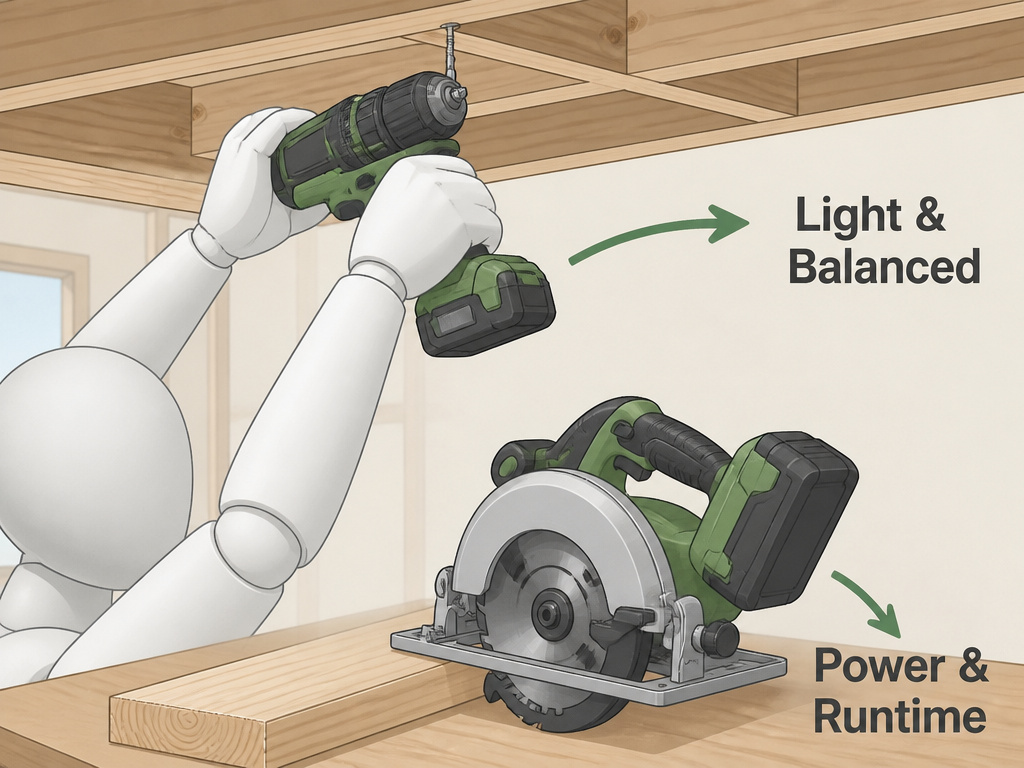
This is the only decision that matters: which battery makes the tool work better for your tasks? The answer splits cleanly down the middle based on power demand.
For Light-Duty, Handheld Tools: Grab the 2Ah.
This category includes drills, drivers, work lights, jigsaws, and oscillating tools. You won’t feel a power difference in this range because these tools rarely operate at their maximum current draw. The lighter weight and smaller size are tangible benefits that improve balance and reduce fatigue. If you’re doing a kitchen remodel and spending hours driving screws overhead, the last thing you want is a heavy battery pulling your drill down.
For Heavy-Draw Tools: You Need the 5Ah.
This category includes circular saws, rotary hammers, angle grinders, impact wrenches, and blowers. These tools regularly draw high current, and that’s where the 5Ah battery’s advantages, both in runtime and sustained power, earn its extra weight. If you’re regularly bogging down a tool or feeling it lose steam under load, stepping up in Ah is a legitimate fix, not just a convenience upgrade.
| Tool Type | Recommended Capacity | Reason | Example Tool |
|---|---|---|---|
| Drill/Driver, Impact Driver | 2.0Ah – 3.0Ah | Light weight, sufficient runtime | DeWalt DCD800, Milwaukee M18 Fuel |
| Jigsaw, Oscillating Tool | 2.0Ah – 3.0Ah | Better balance in tight spaces | DeWalt DCS331, Makita XMT04 |
| Circular Saw, Angle Grinder | 5.0Ah or higher | Sustains high current, prevents bogging | DeWalt DCS570, DeWalt DCG413 |
| Rotary Hammer, Demolition Hammer | 5.0Ah or higher (8Ah+ ideal) | Maximum power delivery, long runtime | DeWalt DCH133, Milwaukee 2713 |
| Work Light, Radio | 2.0Ah or smallest available | Minimizes weight for stationary use | Any |
The DeWalt PowerStack 5Ah is specifically called out as an ideal match for heavier duty tools such as angle grinders, larger rotary hammers, 7-1/4″ circular saws, and blowers, much like other high-output batteries. Its ability to stay cooler under load means it can deliver more work per charge in those punishing applications.
Common mistake: Using a single 5Ah battery for everything because it came in the kit. You sacrifice comfort and balance on light tools, and you have no backup when it’s charging. A mixed fleet, a couple of compact 2Ah packs and a larger 5Ah, covers more scenarios efficiently.
Mixing, Charging, and Error Codes
Can you use a 5Ah battery on a tool that came with a 2Ah? Yes. Compatibility within a voltage platform (like 20V MAX or 18V LXT) is almost universal. The tool doesn’t “know” the difference; it just draws the current it needs. The real questions are about weight, balance, and whether the battery’s physical shape fits the tool’s base.
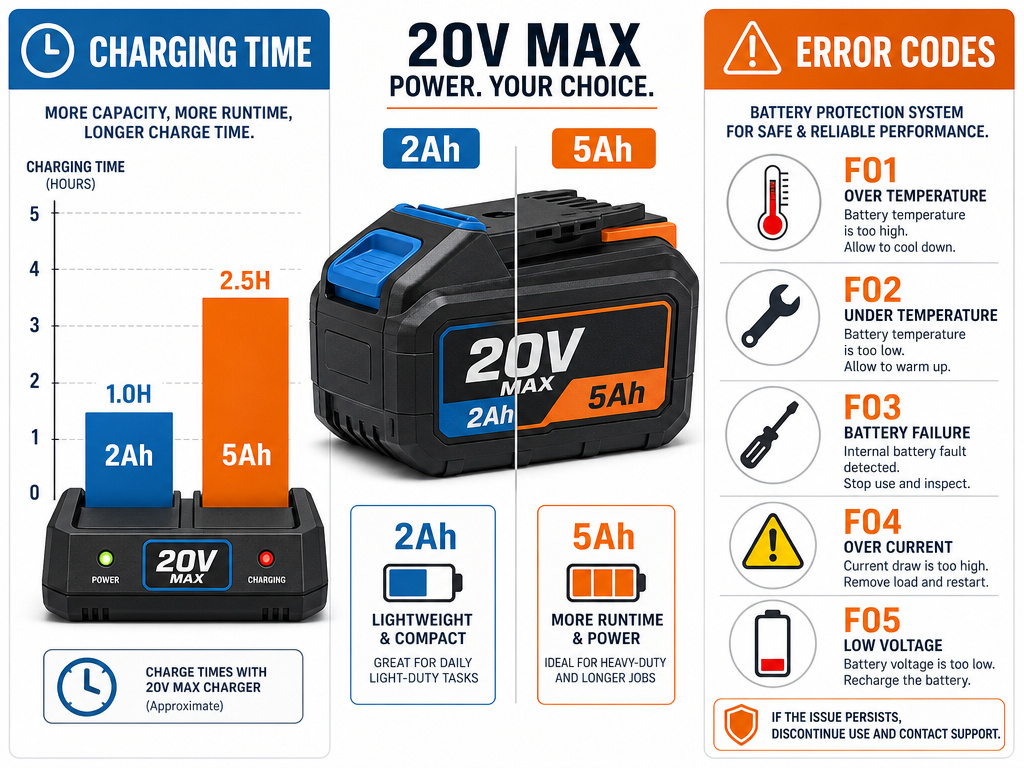
Charging times will differ. A higher-capacity battery takes longer to charge on the same charger. There’s no getting around the energy math. If you have a fast charger (like DeWalt’s 8A or 12A models), the gap closes, but a 5Ah pack will still take longer than a 2Ah pack.
Battery and charger error codes are your first clue something’s wrong. According to a DeWalt charger manual, common codes include:
- F01/F02: Battery too hot or too cold. Let it sit at room temperature (about 68°F/20°C) for a day.
- F03: Battery overloaded. Remove it from the tool and try again.
- F04: Battery defective. Do not use it.
- F05: Battery has undergone a partial exhaustive discharge. Just recharge it.
These codes are a diagnostic tool, not a death sentence. An F01 after heavy saw use just means the pack is hot; let it cool. An F04 is a hardware failure. Knowing the difference saves you from tossing a battery that’s merely tired, not dead.
Runtime in the Real World
Amp-hour is a capacity rating. A 5.0Ah battery can theoretically deliver 5 amps for one hour, or 1 amp for five hours. But real-world runtime is never that linear. A circular saw under heavy load will drain a 5Ah pack much faster than in light-duty applications. A drill on low speed might run for hours.
The more useful way to think about runtime is in comparisons. A 5Ah pack has a higher capacity than a 2Ah pack. So, if a 2Ah battery gives you a certain runtime, a 5Ah should provide significantly more runtime in the same tool, assuming similar usage. The gain is real, but it’s proportional, not magical.
Where higher capacity feels like more runtime is in the reduction of voltage sag. As a battery depletes, its voltage drops. A pack with higher capacity and lower internal resistance will maintain a higher voltage for a longer portion of its discharge cycle. This means the tool feels strong and responsive for more of its usable life, rather than feeling weak for the last quarter of the charge.
Cost Comparison of 2Ah and 5Ah Batteries
A higher amp-hour rating generally means a higher purchase price. The 5Ah battery’s construction, with two rows of cells in parallel, is more complex than the single-row 2Ah pack. Beyond the sticker price, consider long-term value. The DeWalt PowerStack 5Ah is noted for a longer lifespan based on charge cycles compared to its cylindrical-cell counterpart, which can offset the initial investment. For a user with heavy-draw tools, the performance gains and reduced need for frequent swaps make the 5Ah a cost-effective choice. For someone primarily using light tools, the lower-cost 2Ah battery is often the more economical and practical purchase.
Frequently Asked Questions
Which is better, a 2Ah or a 5Ah battery?
Neither is universally better. A 2Ah battery is better for light, handheld tools where weight and balance are priorities. A 5Ah battery is better for heavy-draw tools that need sustained high current. The right choice depends entirely on the tool and the task.
Does a higher Ah battery make my tool more powerful?
Under heavy load, yes, it can. Due to lower internal resistance from having cells wired in parallel, a 5Ah battery will experience less voltage sag than a 2Ah battery when the tool demands high current. This results in more consistent power delivery, which feels like more power. Under light load, there is no difference.
How long will a 2.0Ah battery last?
Runtime depends entirely on the tool and how hard you’re pushing it. In a compact drill driving small screws, a 2.0Ah battery could last over an hour. In a high-demand tool like a circular saw, a 2Ah battery will have a very short runtime. Think of Ah as the fuel tank size; the tool’s power demand is the engine’s throttle.
Can I charge a 5Ah battery with a 2Ah charger?
Yes, as long as the charger is designed for the same battery platform and voltage (e.g., both are DeWalt 20V MAX chargers). The 5Ah battery will simply take longer to charge because it has more capacity to fill. Using a higher-amperage “fast” charger will reduce the charging time for both.
The Bottom Line
To be honest. For most DIYers building a toolkit, the sweet spot is owning both sizes. Start with the battery that came in your kit, but your first addition should be a second pack of a different capacity (this is a key consideration when choosing bare tool vs kit).
If you mostly use a drill, driver, and maybe a jigsaw, invest in a couple of compact 2Ah or 3Ah batteries. The weight savings are worth it. Your tools will feel nimble, and you’ll have a backup ready to swap when one drains.
If you own a circular saw, angle grinder, or any tool that grunts under load, a 5Ah battery is a necessary upgrade. The goal is to achieve the tool’s advertised performance, not just convenience. The DeWalt PowerStack 5Ah, with its pouch cells and cooler operation, is a strong contender here, especially if you find your current packs getting hot and quitting early.
One rule most guides skip: your battery choice should be the last variable you tweak.
