
High Output Power Tool Batteries Pros and Cons: Your Guide
This post contains affiliate links. As an Amazon Associate, we earn from qualifying purchases.
High-output power tool batteries deliver more sustained power and runtime than standard packs, at the cost of added weight, size, and expense. The pros, more cuts per charge, reduced bog-down in demanding tools, outweigh the cons only if you regularly use high-draw tools like circular saws, grinders, or large cordless drills.
That power gain comes from higher-quality cells arranged in a pack that can deliver more current. But a 12.0Ah high-output pack feels like a brick compared to a 2.0Ah standard one. The weight penalty is real, and the cost is significant. It’s worth considering high output power tool batteries pros and cons.
This guide cuts through the marketing to show you which tools actually benefit, how to interpret conflicting manufacturer storage advice, and what the real-world trade-offs look like for weekend DIYers and pros when you compare a high output power tool batteries pros and cons. We will examine the engineering, the numbers from the manuals, and the stances worth taking.
Key Takeaways
- High-output batteries shine in high-demand tools like circular saws and angle grinders but offer little benefit in a drill/driver for light duty.
- Storage temperature matters more than capacity; Milwaukee warns permanent capacity loss can result if stored for long periods over 120°F (50°C), while Stihl’s absolute ‘do not store’ limit is higher, at 70°C.
- Conflicting storage charge advice exists: Stihl recommends 40-60% charge, Toro advises 2-3 green LEDs, and Ego self-discharges to 30% after one month.
- The 20/80 rule (charge between 20% and 80% state of charge) applies here to maximize cycle life, but is often omitted from OEM manuals.
- Brand ecosystems are sticky; investing in a high-output platform like Milwaukee M18 HO or Ego 56V is a long-term commitment to that brand’s tools.
How High-Output Batteries Deliver More Power
It’s not magic. A standard battery and a high-output battery might share the same voltage and amp-hour rating. The difference is under the hood: the cell quality and the pack’s ability to dump current without overheating. High-output packs use premium cells with a lower internal resistance. This allows the pack to provide the voltage your tool requires even under heavy load, like when cutting through wet lumber.
High-output lithium-ion battery packs maintain higher voltage under heavy load by using premium cells with lower internal resistance and a more robust Battery Management System (BMS). This design reduces voltage sag, allowing high-demand tools to maintain peak power and torque for longer periods before the low-voltage cutoff engages.
The BMS is the unsung hero here. It’s the circuit board inside the pack that manages cell balancing, temperature monitoring, and discharge limits. A standard pack’s BMS might throttle power to protect cheaper cells from overheating. A high-output BMS is tuned to let more current flow, confident the cells can handle it. That’s why a high-output pack can run a high-demand tool like a circular saw more effectively than a standard pack of the same capacity, due to different cells and BMS strategy.
You can feel the difference. A cordless angle grinder may bog down on a standard battery but can maintain performance better on a high-output pack. That’s sustained voltage.
Capacity (Ah) vs. Power Delivery
Amp-hours measure capacity, how long the battery can run. It’s like the size of your gas tank. But power delivery is about how fast you can empty that tank. A high-output 5.0Ah pack can deliver its energy faster than a standard 5.0Ah pack. This is critical for tools that need a lot of power quickly: table saws, cordless miter saws, and rotary hammers.
Think of it this way: both packs hold the same total energy, but the high-output pack has a bigger fuel line. For a tool that just sips energy, like a LED work light, the bigger fuel line is pointless. For a tool that gulps it, the bigger line prevents starvation.
Do you actually need this? If your most demanding cordless tool is a drill for driving screws, a high-output battery is overkill. Save the weight and money. But if you’re running a cordless framing nailer or a metal-cutting circular saw, stepping up to a high-output platform is often the difference between a professional workflow and constant frustration.
The Real-World Pros of High-Output Batteries
The benefits are tangible, but they’re tool-specific. We will specify the tools and situations.
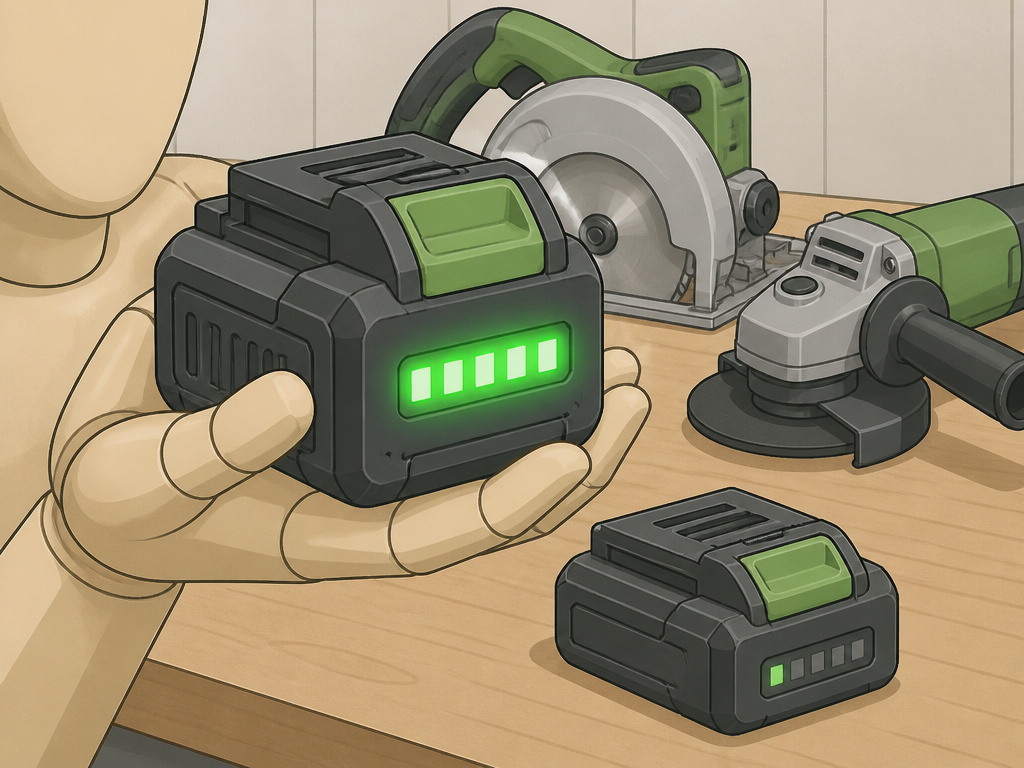
More Cuts, Less Bogging. A concrete example: a standard battery may bog down and deliver fewer cuts in 2x lumber with a 7-1/4″ circular saw, while a high-output battery could deliver more cuts with less perceived slowdown. The motor stays in its power band.
Cold Weather Performance. Lithium-ion batteries hate the cold. Their ability to deliver current plummets. Here, high-output cells with their lower internal resistance have an edge. A Bosch manual notes that at temperatures below 0°C, some devices may experience a loss of power. A high-output pack will experience less of that voltage sag, giving you more usable work on a frosty morning. It’s not a fix, but it’s a buffer.
Extended Tool Lifespan. This is counterintuitive. Running a high-demand tool on an underpowered battery strains the tool’s motor and electronics. The motor draws more current to try to maintain speed, generating excess heat. A high-output battery feeds the tool cleanly, reducing that electrical strain. Over hundreds of cycles, that can mean fewer burnt-out triggers or motor failures.
Which Tools Benefit Most?
Not all tools are created equal. Match the battery to the tool’s job.
| Tool Type | Standard Battery Performance | High-Output Benefit |
|---|---|---|
| Drill/Driver (light duty) | Excellent | Negligible; added weight is a drawback. |
| Circular Saw / Miter Saw | Bogs under load, shorter runtime | Significant; maintains cutting speed, more cuts per charge. |
| Angle Grinder | Slows quickly, overheats | Critical; sustains RPM for grinding/cutting, reduces stalling. |
| Rotary Hammer / Demolition | Short bursts, long recovery | High; delivers harder hits for longer, better for continuous drilling. |
| Leaf Blower / String Trimmer | Adequate for small yards | Moderate; longer runtime at peak airflow/rpm, better for large properties. |
The rule is simple: if the tool has a brushless motor and is marketed for professional use, it’s probably designed to extract every amp from a high-output pack, a key point in the high output power tool batteries pros and cons. Your decision on 12V vs 18V tools comes first, but within an 18V/20V platform, this is the next tier.
Weighing the Cons and Practical Drawbacks
For all their power, high-output batteries bring real compromises. The first one you’ll notice is in your hand.
Weight and Bulk. Physics doesn’t lie. More cells and a heavier-duty BMS mean a bigger, heavier pack. A Milwaukee M18 HO 12.0Ah battery is significantly heavier than a standard pack. That weight changes the balance of your tool, induces fatigue faster, and makes overhead work a chore. Compared to a slim 2Ah battery, it’s a different class of tool.
Cost. The premium for high-output technology is steep. A high-output battery typically costs significantly more than a standard pack of the same amp-hour rating. You’re paying for better cells, more sophisticated electronics, and the R&D. For a DIYer who might charge a battery six times a year, the payback period is never.
Compatibility Gotchas. Not all “high-output” batteries work with all tools from a brand, even if the voltage matches. Some older tools may not recognize the new battery communication protocol. Some brands require specific tools to activate a battery’s higher power mode. Always check compatibility before assuming a new high-output pack will supercharge your old tools.
The Heat Factor. Pushing more current generates more heat. While the BMS monitors this, a high-output pack can get hot to the touch during heavy use. The Ego manual states its pack will shut down if its operating temperature exceeds 158°F (70°C), resuming only when it cools to 152°F (67°C).
Where this goes sideways: Assuming any big battery is a high-output battery. Amp-hours don’t tell the whole story. A cheap, high-capacity pack with poor cells will sag under load just like a smaller one, giving you none of the performance benefits with all the weight.
Battery Care: Conflicting Advice and Clear Rules
Manufacturer manuals don’t always agree. Here’s how to navigate the noise.
Storage Temperature. This is a major point of disagreement. Who do you trust?
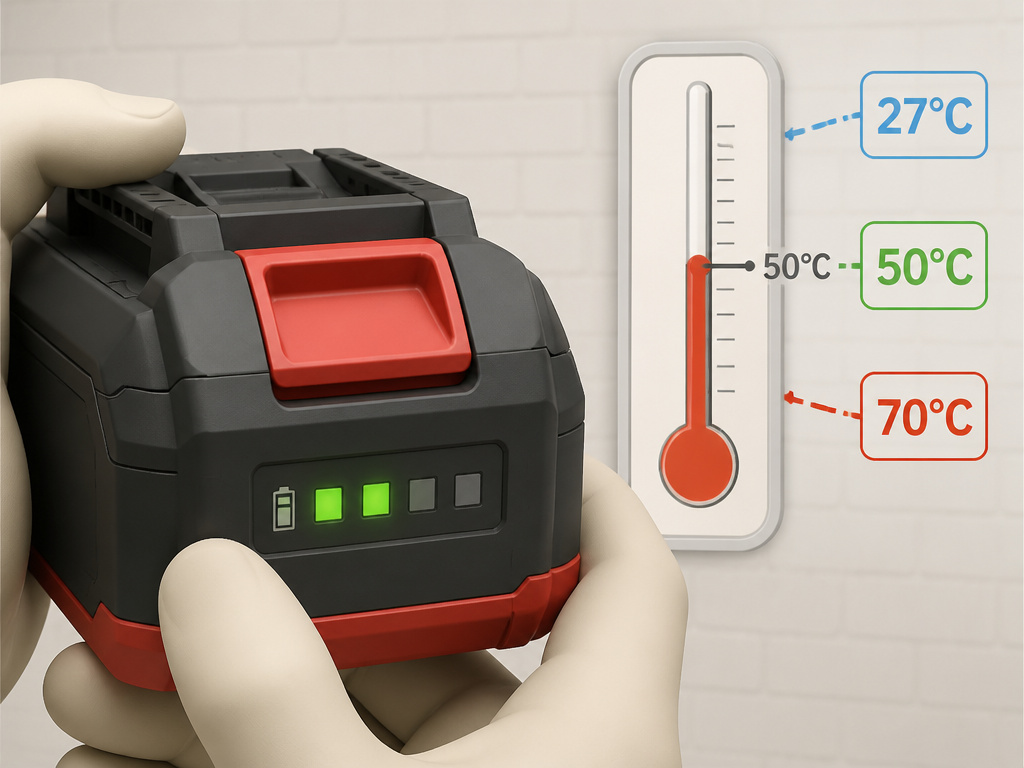
- Milwaukee Tool: Store battery pack and charger where temperatures do not exceed 120°F (50°C).
- Stihl: Do not store the battery below -20°C or above +70°C.
- Kincrome: Store the battery pack where the temperature is below 27°C.
Manufacturers disagree on the maximum storage temperature: Milwaukee and Kox.eu advise not above 50°C, Stihl sets a limit of 70°C, and Kincrome recommends below 27°C. A hot garage in summer can easily exceed that. Permanent capacity loss isn’t reversible. Milwaukee explicitly states that permanent capacity loss can result if the battery pack is stored for long periods of time at high temperatures (over 120°F).
Storage Charge Level. The “ideal” charge state for storage is all over the map. It’s the clearest example of where a simple “best practice” doesn’t exist.
- Stihl: Store batteries at a charge state between 40% and 60% (2 lit green LEDs).
- Toro: Store batteries for the off-season with 2 or 3 LED indicators green (partially charged).
- Kincrome: For long-term storage (6 months), battery packs should have a charge state of 2 indicator lights.
- Ego: After one month of storage, the battery self-discharges to 30% charge.
So what’s the takeaway? Don’t store batteries fully charged or fully dead. Aim for a partial charge, anywhere from 30% to 60% seems to be the safe consensus across brands. If your battery has a gauge, aim for two or three lights. For more on maximizing battery lifespan, this is the single most impactful habit.
The 20/80 Rule and Charging Practices
You won’t find the “20/80 rule” in most OEM manuals. It’s a lithium-ion longevity principle from the electric vehicle and consumer electronics world: avoid charging above 80% or discharging below 20% for daily use to maximize the number of charge cycles. It applies directly to your power tool batteries.
Easy to miss: Chargers don’t stop at 80%. You have to unplug them yourself. For long-term storage, the 40-60% rule takes precedence. For daily use, if you can break the habit of always charging to 100%, you’ll extend the pack’s useful life.
Charging temperature is another fixed rule. Stihl recommends charging between 5°C and 40°C. Bosch sets a range of 0°C to +35°C. Milwaukee’s recommended ambient charging temperature is 40°F to 105°F (approx. 4.4°C to 40.6°C). Manufacturers recommend different charging temperature ranges: Stihl recommends 5°C to 40°C, Milwaukee recommends 40°F to 105°F (~4.4°C to 40.6°C), and Bosch recommends 0°C to +35°C.
Making the Choice: Are High-Output Batteries Worth It?
This isn’t a yes-or-no question. It’s a “for whom?” question.
For Professional Tradespeople: Yes, absolutely. The productivity gain from fewer battery changes and more consistent power in tools like saws and grinders pays for the battery premium quickly. The cordless tool pros and cons calculation shifts heavily towards “pro” when you add high-output performance.
For Serious DIYers / Homeowners with Large Projects: Maybe. If you’re building a deck, fencing a yard, or renovating a room, renting one high-output battery for the duration might be smarter than buying. If you’re already invested in a platform and use high-demand tools regularly, buying one high-output pack for those tasks makes sense.
For Casual / Occasional Users: No. The added cost and weight aren’t justified. A standard battery, cared for properly, will serve you for years. Focus your budget on a better tool or more versatile cordless tools instead.
Your first step isn’t buying a battery. It’s auditing your tool use. How often does your circular saw actually bind? Does your grinder stall, or does it just get the job done? The answers there tell you more than any spec sheet.
What’s the difference between battery chemistries?
All high-output power tool batteries are lithium-ion, but the specific chemistry varies. The main types are NMC and LiFePO4. NMC is common for its high energy density, packing more runtime into a compact size, but it requires careful temperature management. Manufacturers specify strict temperature limits for charging, using, and storing these packs to prevent permanent capacity loss. LiFePO4 chemistry is known for greater thermal stability and a longer lifespan measured by charge cycles. Regardless of type, the core principles for longevity are the same: avoid extreme heat during storage and use, and follow the specific charging temperature guidelines from your tool’s manual to maintain performance and safety.
How does cell size and arrangement affect power?
The physical size of the individual cells, like 18650 or 21700, influences a battery’s potential. Larger cells can often store more energy, contributing to a higher amp-hour (Ah) rating for longer runtime. However, high output is more about how these cells are wired together. Cells connected in series increase the pack’s voltage, while cells in parallel increase its capacity and ability to deliver high current. A high-output pack combines these configurations with premium, low-resistance cells to supply massive bursts of power without a significant voltage drop. This internal design is what allows the tool to maintain speed under heavy load, like a circular saw cutting through dense material, without the battery overheating and shutting down.
Frequently Asked Questions
What is the 20/80 rule for batteries?
The 20/80 rule is a guideline for extending lithium-ion battery life. It suggests avoiding charging the battery above 80% of its full capacity and not letting it discharge below 20% for daily use. This reduces stress on the battery cells, potentially extending the total number of charge cycles before significant capacity loss occurs. Most power tool chargers don’t have a built-in 80% stop, so you must manually unplug the battery.
Which is better, 3.0 Ah or 4.0 Ah?
Amp-hours (Ah) measure capacity, not “better.” A 4.0Ah battery will generally run longer than a 3.0Ah battery of the same type (standard or high-output). However, a high-output 3.0Ah battery may deliver more power to a demanding tool than a standard 4.0Ah battery. Choose based on your need: longer runtime (higher Ah) or more sustained power (high-output). For a deep dive on this trade-off, see our comparison of 2Ah vs 5Ah batteries.
What is the holy grail of batteries?
In power tools, the “holy grail” is a battery that combines high energy density (long runtime in a small package), high power density (ability to deliver massive current instantly), long lifespan (thousands of cycles), fast charging, and safety, all at a low cost. Current lithium-ion technology, particularly with high-output designs, comes closest, but it still involves trade-offs between weight, cost, and performance.
Do high-output batteries work with all my old tools?
Not always. While they often fit physically, compatibility depends on the tool’s electronics and the battery’s communication protocol. Some older tools may not be designed to handle the higher current a high-output pack can provide, and the tool’s internal safeguards might limit performance. Others may not recognize the battery correctly. Always check your tool’s manual or the manufacturer’s compatibility chart before using a new high-output battery on an older tool.
Before You Go
High-output batteries solve a specific problem: power starvation in high-demand cordless tools. They are not an upgrade for every tool in your bag.
If you decide to step up, buy one high-output pack first. Use it exclusively on the tool that struggles most, your circular saw or angle grinder. See if the performance difference justifies the weight and cost before committing to more. And remember, the most advanced battery is worthless if mistreated. Store it cool, store it partially charged, and you’ll get the most from your investment.
The real shift isn’t in the battery tech itself; it’s in cordless tools becoming viable for truly heavy-duty work. That’s the promise high-output batteries deliver on, for the users who actually need it. For everyone else, a well-maintained standard battery is still the right tool for the job.
