
20v vs 40v Power Tools: Key Differences Explained
This post contains affiliate links. As an Amazon Associate, we earn from qualifying purchases.
A 20V battery platform uses five lithium-ion cells in series for 18V nominal (20V Max) voltage and is ideal for handheld indoor tools, prioritizing weight and portability. A 40V platform uses ten cells for 36V nominal (40V Max) voltage, delivering higher sustained power for demanding outdoor equipment, with a significant trade-off in battery weight and cost.
The distinction in the 20v vs 40v power tools debate isn’t just marketing. A 40V battery’s doubled cell count allows a tool to produce equal power while drawing less electrical current. Lower current means less heat buildup in the motor and wiring, which translates directly to better efficiency and less wear during extended, heavy-duty use.
What follows is a breakdown of when that trade-off matters in the 20v vs 40v power tools comparison: the specific tools where 40V earns its keep, the surprising areas where 20V still wins, and the real-world numbers on runtime, weight, and platform lock-in that decide the choice.
Key Takeaways
- The labels “20V” and “40V” refer to maximum voltage off the charger; nominal working voltages are 18V and 36V, a fact confirmed by OEM specs like the Husqvarna 40-B220X listing 36V.
- Compare total energy using watt-hours (Wh), not just voltage or amp-hours. A Makita BL4080F 40V pack stores 288Wh, while a typical 20V 5Ah battery holds about 90Wh.
- 40V tools excel where motors face high, sustained resistance: lawn mowers, chainsaws, and powerful blowers. 20V tools dominate in drills, drivers, and multi-tools where lighter weight reduces fatigue.
- Batteries and chargers are never cross-compatible between 20V and 40V platforms, even within the same brand. Starting a 40V system means investing in a separate battery ecosystem.
- Higher voltage provides a durability advantage for demanding tools by reducing current and heat, potentially extending motor life—a key but often overlooked benefit.
The Technical Reality of 20V and 40V
The first confusion point is the number on the battery. You see “20V Max” on a drill and “40V” on a lawn mower box, but the official manuals tell a different story.
The Bosch GOP18V-40 oscillating tool manual correctly lists its voltage rating as 18V. The Husqvarna 40-B220X product page correctly lists its battery voltage as 36 V (nominal). They’re both right. A 20V Max battery is built from five 3.6V lithium-ion cells in series, giving an 18V nominal working voltage that briefly peaks near 20V when fully charged. A 40V battery uses ten cells, resulting in 36V nominal. The “Max” label denotes that peak charge voltage.
This isn’t just semantics for the 20v vs 40v power tools discussion. It’s the foundation for everything that follows: power delivery, tool design, and your experience using them.
A typical 20V battery is made up of 5 cells in series (5 × 3.6V = 18V nominal; marketed as 20V max). A 40V battery uses 10 cells in series, giving you 36V nominal, marketed as 40V max. The doubled cell count is what allows significantly more sustained power delivery. (Source: Ronix Tools)
Why Higher Voltage Matters for Power
Power (Watts) = Voltage (V) x Current (Amps). If a tool needs 500 watts of power to spin a chainsaw chain through hardwood, a 40V system needs to draw less than half the current than a 20V system would to deliver the same wattage.
Lower current is a big deal. It means less heat generated in the motor windings and the battery pack’s internal circuitry. Heat is the enemy of efficiency and battery lifespan. For a tool that’s going to run flat-out for 15-minute stretches, like a Ryobi 40V HP Brushless 20″ Chainsaw that claims power equivalent to a 52cc gas model, running cooler isn’t a luxury—it’s what keeps the motor from cooking itself.
The Truth About Runtime: Watt-Hours Are King
Here’s where most comparisons go wrong. They assume a 40V battery lasts twice as long. It doesn’t—not automatically. Runtime depends on total stored energy, measured in watt-hours (Wh), though sources like Gearhead Grove note that a 40V battery does not automatically run twice as long as a 20V battery; runtime also depends on tool draw and other factors.
You calculate it: Voltage (V) x Amp-hour capacity (Ah) = Watt-hours (Wh).
Consider the actual specifications:
| Battery Model | Voltage | Capacity (Ah) | Energy (Wh) | Weight |
|---|---|---|---|---|
| Typical 20V Pack | 18V nominal | 2–6 Ah | 36–120 Wh | Under 1 lb to ~2 lbs |
| Makita BL4025 | 40V | 2.5 Ah | 100 Wh | 1.54 lb (700g) |
| Husqvarna 40-B220X | 36V nominal | 6.0 Ah | 216 Wh | 3.2 lbs |
| Makita BL4080F | 40V | 8.0 Ah | 288 Wh | 4.19 lb (1.9kg) |
Notice the Makita BL4025 (40V, 2.5Ah) stores 100Wh, which is in the same energy range as many mid-capacity 20V batteries. They’d run a similarly demanding tool for a similar time, but the 40V pack would do it with less strain. For truly long runtime, you need high watt-hours, which in the 40V world means heavy packs like the 288Wh BL4080F.
20V vs 40V: Weight, Cost, and Ecosystem Lock-In
Stepping up to 40V means carrying that weight. As noted by Mister Worker, a 4Ah 40V battery can weigh twice as much as a 2Ah 20V unit. On a lawn mower, that’s fine. Holding a 3.2 lb Husqvarna 40-B220X battery at the end of a string trimmer for an hour changes the game. Your shoulder feels every ounce.
Cost follows the same curve. The tools and batteries for a 40V platform command a higher price, positioned for “gas-equivalent” performance. You’re also often buying into a tool range focused on outdoor power equipment, whereas many brands’ 20V platforms include a wider variety of indoor and outdoor tools.
Where this goes sideways: Assuming you can mix and match. You cannot use a 40V battery on a 20V tool, or vice versa. The physical slots, terminals, and battery management systems are different. Investing in 40V means starting a second, entirely separate collection of batteries and chargers.
This ecosystem lock-in is the most critical long-term decision. If you already have several 20V cordless drills and chargers, adding a 40V mower means managing two distinct systems. For some, that’s a deal-breaker.
Tool-by-Tool Guide: Which Voltage Wins?
The “best” voltage depends entirely on the tool and the job. Here are the details:.
Drills, Drivers, and Indoor Tools
Winner: 20V. For driving screws, drilling holes in wood or metal, and using oscillating multi-tools like the Bosch GOP18V-40, 20V is the sweet spot. The power is ample, and the lighter battery makes overhead work or all-day use manageable. This is where the 12V vs 18V debate actually happens for compact needs, but 20V dominates the full-size category.
String Trimmers and Brushcutters
For small yards: 20V. A 20V trimmer handles grass and light weeds. For dense growth, large properties: 40V. The higher voltage maintains torque in thick stems, and the larger capacity batteries (like the 216Wh Husqvarna 40-B220X) let you finish the job without a battery change. The weight penalty is worth it.
Leaf Blowers
For patios and decks: 20V. It’s sufficient for clearing dry leaves. For wet leaves, large driveways, commercial use: 40V. Airflow (CFM) and airspeed (MPH) are directly tied to motor power. A 40V blower like the ones in Ryobi’s platform moves more material, faster, and sustains that power as the battery drains.
Lawn Mowers
For lawns under ¼ acre: 20V (Dual Battery). Some mowers use two 20V batteries to sum to 40V, offering a lighter option. For most suburban yards: 40V. This is the clearest case for the higher platform. As noted by Mister Worker, 40V mowers typically feature wider cutting decks up to 21 inches., better mulching/bagging performance, and enough runtime to finish the job. As one review bluntly put it, a 20-inch mower on two 18V batteries is “severely underpowered and has poor runtime.”
Chainsaws
For pruning and light limbing: 20V. For cutting firewood, felling small trees: 40V. The performance jump is stark. The Ryobi 40V HP Brushless 20″ Chainsaw delivers more power than a 52cc gas chainsaw and makes over 100 cuts per charge with an 8Ah battery. And claims over 100 cuts per charge with an 8Ah battery. For anything beyond light yard work, 40V is essential.
Power, Heat, and Long-Term Durability
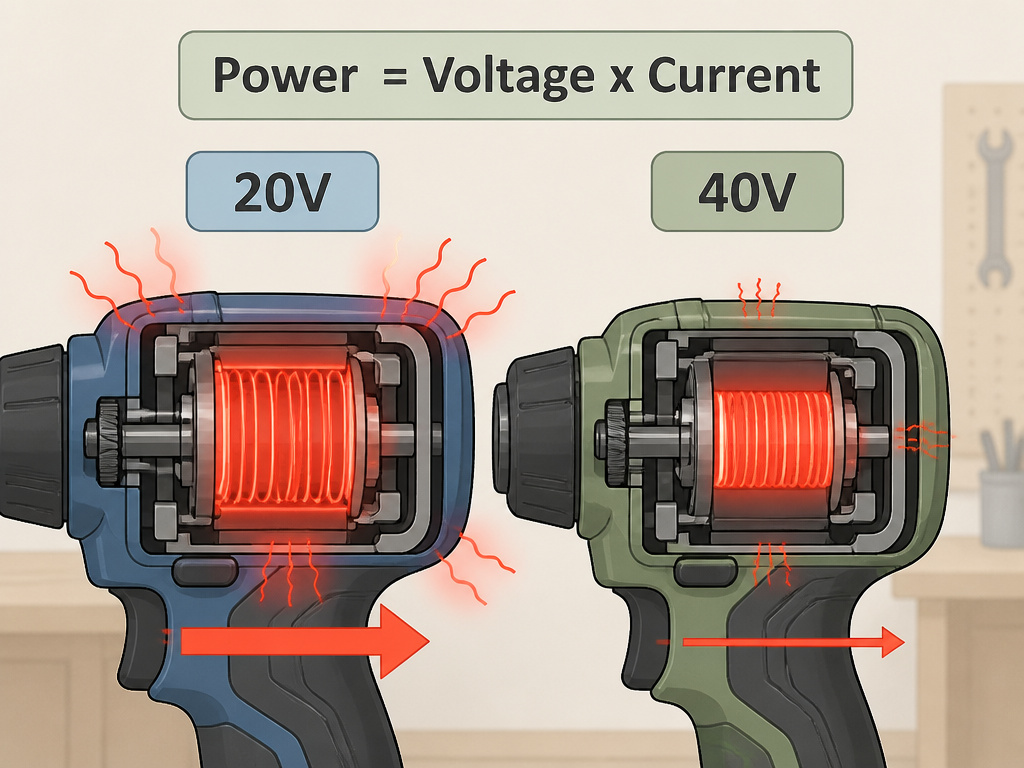
A less-discussed advantage of 40V tools is longevity under stress. Remember the power equation: higher voltage = lower current for the same work.
Inside a tool’s motor, resistance turns current into heat. Less current means less heat. Over thousands of cycles, that heat stresses insulation, weakens solder joints, and degrades lubricants. A 40V chainsaw motor running at a given power level draws less current than a 20V motor delivering the same power, which typically means less heat and electrical strain.
Common mistake: Judging a battery system only by its voltage. A 40V tool with a cheap, brushed motor and poor thermal design can overheat faster than a well-engineered 20V brushless tool. The voltage advantage enables durability; it doesn’t guarantee it.
This is why pro-oriented lines like Makita’s XGT (40V) or Husqvarna’s 40V series invest in robust construction and cooling. They’re built for the heat of daily professional use.
Making Your Choice: A Practical Framework
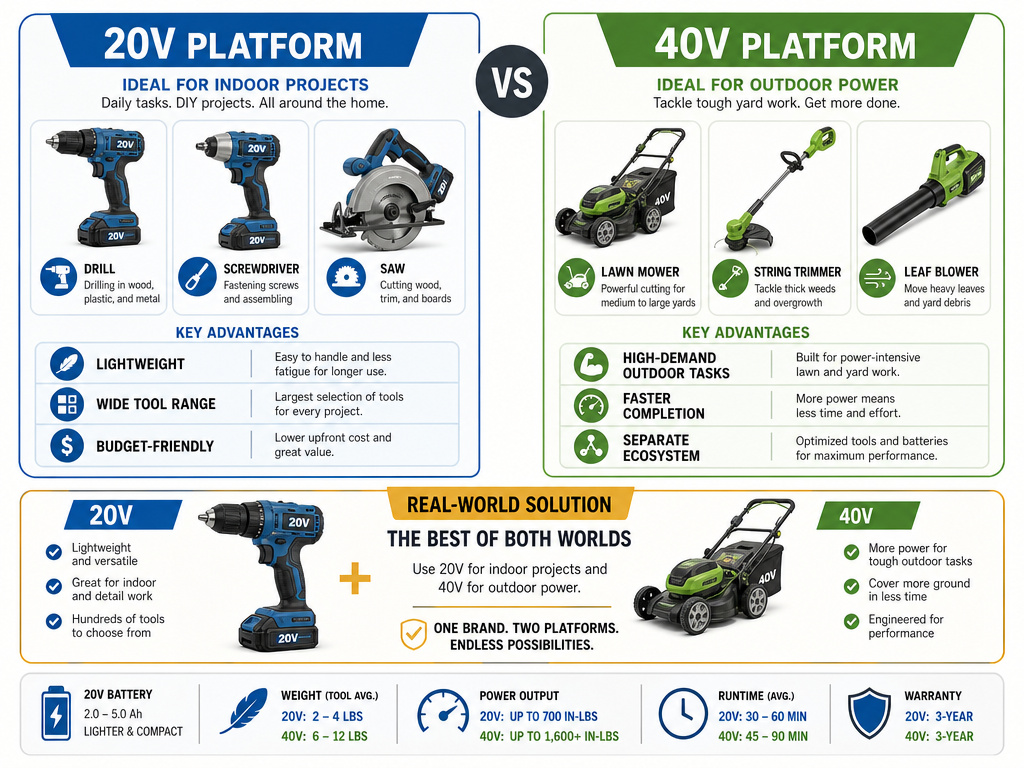
So, which should you buy? Stop looking at the voltage and start looking at your to-do list.
Choose a 20V platform if:
- Your primary projects are indoors (building, repairing, installing).
- You value a lightweight, easy-to-handle tool above raw power.
- You want access to the widest possible range of tools within one battery system.
- Budget is a primary concern for both initial purchase and future expansions.
Choose a 40V platform if:
- Your primary needs are outdoor yard maintenance (mowing, trimming, clearing).
- You regularly tackle demanding tasks that would stall a lesser tool (thick branches, wet leaves, dense grass).
- You prioritize completing jobs quickly and without battery swaps. *
What if you need both? This is the real-world scenario for many homeowners. The most practical path is to start with a robust 20V system for indoor and handheld work. Then, if your yard demands it, add a 40V outdoor tool kit (mower, trimmer, blower) as a separate system. It’s not ideal, but it matches the tool to the task.
How long does it take to charge a 20v vs 40v battery
Charging times are a practical difference between the two platforms. According to Mister Worker, 20V battery charging time is typically 30–60 minutes, while 40V battery charging time is typically 60–120 minutes. This is because the 40V battery has more cells and stores more energy, which simply takes longer to replenish. If you need to keep multiple tools running with minimal downtime, having a spare charged battery for your 40V system becomes more critical. Always charge batteries within the manufacturer’s specified ambient temperature range to ensure safety and battery longevity.
Frequently Asked Questions
Can I use a 40V battery on a 20V tool?
No. Never. The physical and electrical designs are incompatible. Forcing a 40V battery into a 20V tool can damage the tool’s motor and electronics, pose a fire risk, and void the warranty. Always use the battery specified by the tool manufacturer.
Is 40V twice as powerful as 20V?
Not exactly. Power depends on both voltage and current. However, the 40V platform’s higher voltage allows it to deliver more power with greater efficiency and less heat, which is why it feels significantly more powerful, especially under heavy load.
How long does a 40V battery last compared to 20V?
Compare watt-hours (Wh), not voltage. A 40V 2.5Ah battery (100Wh) will last about as long as a 20V 5Ah battery (90Wh) in a similarly demanding tool. For longer runtime, seek out high-capacity 40V batteries like the 8Ah Makita BL4080F (288Wh).
Are 20V and 40V chargers interchangeable?
No. Chargers are voltage-specific. A 20V charger cannot provide the correct voltage to charge a 40V battery, and using the wrong charger can damage the battery and create a safety hazard.
I have many 20V tools. Should I switch to 40V?
Not unless your work demands it. For indoor and light-duty tasks, your 20V system is perfectly capable and more economical. Consider adding 40V only for specific outdoor tools where you’ve consistently found your 20V tools lacking in power or runtime.
The Bottom Line
The 20V vs 40V debate isn’t about one being universally better. It’s about matching the platform to the punishment. For the vast majority of drilling, driving, and small cutting jobs, a modern 20V brushless tool is not just adequate—it’s the optimal blend of power and portability.
Save the 40V platform for the jobs that would brutalize a 20V tool. That means lawn mowers for anything beyond a postage-stamp yard, chainsaws for more than light pruning, and blowers for moving anything heavier than dry leaves on a calm day.
Your first step isn’t picking a voltage; it’s honestly assessing the most demanding, frequent task in your future. Buy the system that conquers that task without breaking a sweat. Everything else will fall into place.
