
10 Best Air Compressors For Pneumatic Tools in 2026
This post contains affiliate links. As an Amazon Associate, we earn from qualifying purchases.
Our best overall air compressor for pneumatic tools is the Metabo HPT EC914S Pancake, which delivers 200 PSI to run multiple nailers efficiently. We also like the DEWALT D55146 for jobsite portability and the Makita MAC2400 for oil-lubricated reliability. Choosing the wrong compressor means your air-hungry tools will stall mid-task. You need enough pressure and continuous airflow to match your tools’ demands. We built this guide using manufacturer specifications, expert round-ups, and patterns in owner feedback to help you find a compressor that won’t let you down.
Top 10 Air Compressors For Pneumatic Tools in the Market
Certain content that appears on this site comes from Amazon. This content is provided "as is" and is subject to change or removal at any time.
The Best Air Compressors For Pneumatic Tools, Reviewed
Metabo HPT EC914S Pancake Air Compressor

What We Like
- 200 PSI provides 25% more pressure than basic pancakes
- Can run multiple large nailers simultaneously
- Weighs 22% less than traditional twin-stack models
- Japanese-engineered with a 1-year warranty
Trade-offs
- At 41 lb, it's heavier than some 6-gallon pancake models
- Weighs 41 pounds, a substantial lift for a pancake design
With 4 CFM at 90 PSI from its 6-gallon tank, this compressor can keep a professional crew moving by running multiple nailers at once. Feature bullets confirm it can simultaneously power two framing nailers or five brad nailers, driving nails flush without delay from framing to finish work. A 200 PSI maximum provides a solid reserve for more demanding pneumatic tools, making it a versatile centerpiece on the job site.
The trade-off for that performance in a portable package is weight; at 41 pounds, it’s a substantial lift compared to lighter-duty options like the FORNAX pancake. For continuous high-demand tasks like sanding or spray painting, the 6-gallon tank will cycle more often than a larger wheeled unit like the DEWALT D55146. But for the core job of powering nailers, this Metabo HPT model delivers a rare balance of substantial air output and relative portability that defines the category.
DEWALT D55146 Wheeled Portable Air Compressor

What We Like
- High 225 PSI max pressure for strong tool performance
- Large 10-inch pneumatic tires for rough terrain
- Protective metal console shields gauges and couplers
- Oil-free pump requires no routine maintenance
Trade-offs
- At 88 pounds, it's heavy for frequent lifting into a truck
- Large footprint requires significant storage space
A 225 PSI max pressure and large pneumatic tires make this compressor a jobsite workhorse you can roll over uneven ground without a struggle. It’s built for the contractor or serious DIYer who needs reliable air for framing nailers or impacts across a large workspace, not just in one corner of a garage. The oil-free pump means you can forget about maintenance, and the protected console keeps the critical gauges safe from knocks and weather. This is a tool designed to be moved and used hard, not to sit pretty.
You’ll get more frequent motor cycles running a high-demand tool like a die grinder compared to a larger tank model like the DEWALT 27-Gallon Vertical. That’s the compromise. For sustained use of a single tool or moving between tasks, it’s excellent. For running two high-CFM tools simultaneously non-stop, you’d need a bigger reservoir. It hits a sweet spot between capability and mobility that smaller pancake compressors can’t match.
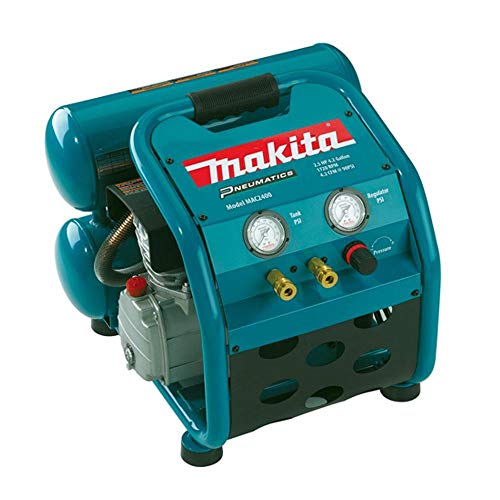
Makita MAC2400 Big Bore Air Compressor
What We Like
- Cast iron Big Bore pump for faster recovery.
- 4-Pole motor lowers noise and amp draw.
- Roll-cage protects against jobsite damage.
- Oil lubrication reduces wear and running temperature.
Trade-offs
- No wheels listed, unlike the DEWALT D55146.
- Oil-lubricated design requires periodic maintenance.
Its 4.2 CFM at 90 PSI air delivery is the key, meaning it can confidently run a framing nailer or finish nailer without constant waiting for the tank to refill. That makes it a serious choice for contractors or dedicated DIYers who need sustained power for sequential fastening. The oil-lubricated cast iron pump and 4-pole motor are built for longevity and cooler operation, so it’s engineered to handle repeated daily use.
The trade-off is in its form factor. It lacks the integrated wheels of the DEWALT D55146, a wheeled portable model. You’re getting a durable, roll-cage protected workhorse, but one that prioritizes pump performance over easy roll-away mobility. It sits between a portable pancake and a large stationary tank, offering pro-grade air for those who don’t need to wheel it long distances.
Ingersoll Rand SS3J5.5GH Gas Air Compressor

What We Like
- Gas engine provides cordless jobsite operation
- Wheelbarrow design offers maximum portability
- Two quick disconnects for simultaneous tool use
- Durable cast iron construction
Trade-offs
- At 226 pounds, it requires a strong back to maneuver
- Its 43-inch length demands significant truck or trailer space
A 5.5 horsepower Honda gas engine and 100% continuous duty operation mean it can run non-stop under ideal conditions, so you’re not limited by a cord and don’t have to pause for pump recovery. This compressor suits roofers or fence builders working where power outlets aren’t available. The wheelbarrow design handles its 226-pound weight over uneven terrain, bringing air power to remote parts of a jobsite.
The trade-off is sheer bulk. It weighs 226 pounds, significantly more than the 136-pound DEWALT 27-gallon vertical compressor, making it a chore to load alone. For a contractor with a crew and a truck bed, that’s a minor inconvenience for untethered power. For a homeowner with a garage shop, a large stationary unit or a quieter electric portable would be a more practical centerpiece.
DEWALT 27-Gallon Vertical Air Compressor

What We Like
- Quiet 78 dBA operation for indoor use
- Oil-free pump for maintenance-free service
- Low-voltage start for reliable power-up
- Vertical, space-saving 27-gallon footprint
Trade-offs
- At 136 pounds, it's not easily portable
- 54.5-inch height requires significant vertical clearance
- Air delivery is modest for larger framing nailers
A 27-gallon tank in a vertical footprint makes this compressor a solution for the home garage where floor space is tight. You get enough air to run a finish nailer or impact wrench without constant cycling. It’s built for the DIYer who wants to step up from a pancake compressor’s capacity but doesn’t have room for a wide horizontal tank. The oil-free pump means you can install it and forget about maintenance, while the 78 dBA rating lets you work without ear protection disturbing the household.
This air compressor operates at a modest 78 dBA, so it’s quiet enough for indoor projects without disturbing others. Its vertical design fits into tight spaces, making it a space-efficient choice for a home garage. The unit delivers 5.1 SCFM at 90 PSI, which is solid for tasks like trim work and inflation.
Makita MAC700 Big Bore Air Compressor

What We Like
- Cast iron pump with big bore design for durability
- Low amp draw reduces breaker trip risk
- Lower noise from large, slower-running pump
- Oil lubrication cools pump and minimizes wear
Trade-offs
- Oil-lubricated design requires periodic maintenance
A key feature is its low amp draw, which reduces incidences of tripped breakers and voltage drop that can cause premature motor failure. This electrical compatibility means it’s less likely to overload a shared circuit in a workshop. The large 1,720 RPM pump delivers performance while operating at substantially lower noise levels, a practical advantage for extended use.
This durability and electrical compatibility come with a cost in weight and maintenance. At 61 pounds, it’s a substantial lift compared to a lighter pancake model like the Metabo HPT EC914S. You also commit to checking and changing oil, unlike an oil-free unit.
Product photos
FORNAX 6-Gallon Pancake Air Compressor

What We Like
- Two couplers for running two tools simultaneously
- Oil-free pump for minimal maintenance
- Lightweight 28.8 lb pancake design for easy portability
Trade-offs
- Noise level is 95 dB(A), which is quite loud for indoor use
- 2.6 CFM at 90 PSI is insufficient for high-demand tools like sanders
- 6-gallon tank requires frequent motor cycles for sustained tool use
The dual couplers are the headline feature, letting you run a finish nailer and a brad nailer at the same time without swapping hoses. That makes this FORNAX a genuine workhorse for trim carpenters or framers looking to keep two crews moving. Its 28.8-pound weight and compact pancake footprint mean you can haul it up a ladder or toss it in a truck without a second thought. For a budget-minded user who needs basic dual-tool capability for intermittent nailing, this design hits a practical sweet spot.
You trade some capability for that convenience and low cost. The 2.6 CFM air delivery means it can’t keep up with a framing nailer for rapid-fire work; the motor will need to run frequently. It’s also noticeably loud at 95 decibels, so earmuffs are mandatory. Compared to the heavier, more powerful Metabo HPT EC914S, the FORNAX sacrifices air volume and maximum pressure for a lighter build and lower price, positioning it for lighter-duty tandem tasks.
Product photos
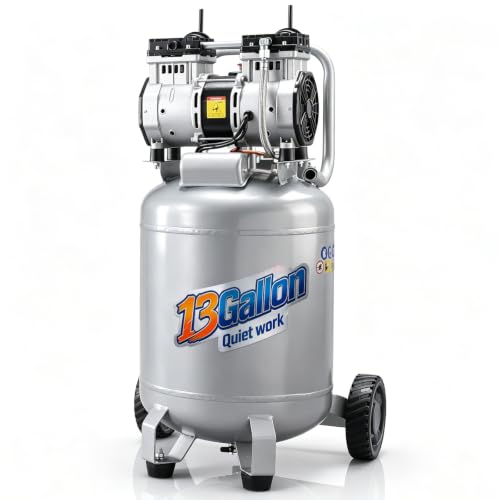
VEVOR 13-Gallon Quiet Air Compressor
What We Like
- Large 13-gallon tank for extended runtime
- Exceptionally quiet 66 dB operation
- Oil-free pump requires zero maintenance
- Includes wheels and pads for easy mobility
Trade-offs
- At 71 pounds, it's heavy for frequent lifting
This compressor operates at 66dB, a quiet level for a 2HP unit that allows use in a garage or home workspace without disturbing others. Its 13-gallon oil-free tank and motor deliver air for sustained tasks like spray painting, eliminating routine maintenance. The reinforced, leak-proof valve system ensures stable output for high-intensity or long-duration work.
This quiet, high-capacity operation comes from a unit with a substantial 71-pound footprint. While the included wheels help, it’s a unit you’ll roll into place for the day rather than toss in a truck. Compared to a compact model like the Metabo HPT EC914S pancake compressor, the VEVOR offers more air and far less noise. It sacrifices the true portability you’d need for quick jobs across multiple sites, making it a shop workhorse, not a jobsite nomad.
Product photos
Ingersoll Rand SS3L3 Stationary Air Compressor

What We Like
- Large 60-gallon tank for sustained tool use.
- All Season synthetic lubricant lasts 2,000 hours.
- Pre-wired and assembled for straightforward setup.
Trade-offs
- Stationary footprint is 67 inches tall.
- Not suitable for jobsites without heavy-duty transport.
A 100% continuous duty cycle and 11.3 CFM at 90 PSI mean this compressor won’t balk at running a framing nailer or die grinder for extended periods. The 60-gallon tank provides a deep reservoir of air, so you can work through long sanding or painting sessions without waiting for the pump to cycle constantly. This is the unit for a busy shop where the air compressor is a foundational tool, not an occasional accessory. It’s built for the user who needs reliable, all-day air without worrying about overheating or premature wear.
This Ingersoll Rand compressor is built as a permanent shop fixture, with a 60-gallon tank and a footprint over five and a half feet tall. That vertical design saves floor space, but you won’t be moving it to a jobsite. Compared to a portable 27-gallon vertical model, it provides more than double the air storage, which means longer run times for tools before the pump needs to cycle on again.
Product photos
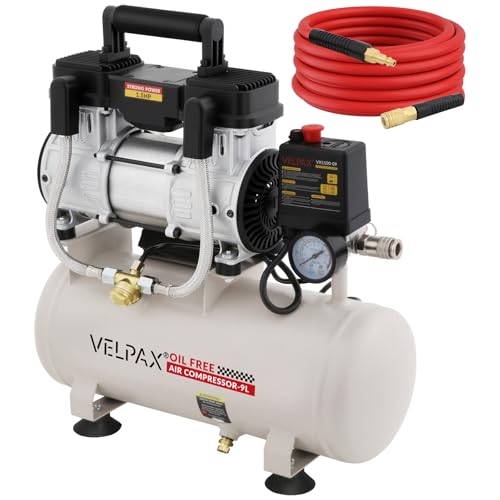
VELPAX Ultra Quiet Air Compressor
What We Like
- Ultra-quiet 60 dB operation for indoor use
- Oil-free, low-maintenance design
- Compact build with integrated handle
- Integrated safety valve and overload protection
Trade-offs
- Small 2.4-gallon tank limits continuous tool use
- 115 PSI maximum pressure may not drive some demanding tools
- Lower air volume than larger stationary compressors
At approximately 60 decibels, this compressor operates quieter than a normal conversation. You can run it in a garage or workshop without needing hearing protection or disturbing the household. That low noise floor, combined with its oil-free pump and portable 2.4-gallon size, makes it a strong fit for the hobbyist or DIYer. They can tackle intermittent tasks like inflation, brad nailing, or light spraying where noise is a primary concern. The 6.71 CFM air delivery is sufficient for many common tools, though you’ll need to manage its duty cycle carefully.
A quiet, compact package means accepting a smaller tank and lower pressure ceiling. You won’t be running a high-consumption tool like a die grinder or large sander for more than a few seconds at a time before the motor must cycle back on.
Product photos
How We Evaluated Air Compressors For Pneumatic Tools
Our research focused on manufacturer specifications and documentation to verify critical performance numbers like CFM, PSI, tank size, and motor type. We cross-referenced these specs with expert tool round-ups and analyzed recurring themes in owner feedback concerning reliability, noise, and real-world tool performance. The key criteria were maximum pressure (PSI) for driving tools, air delivery (CFM) for sustained use, portability for job site movement, and maintenance requirements like oil-free versus oil-lubricated pumps.
Because this is a research-based evaluation, we cannot verify long-term durability claims or performance in extreme conditions that only emerge after years of owner use.
What To Look For In Air Compressors For Pneumatic Tools
Matching your compressor to your air tools is the most critical step. A mismatch leads to frustration and stalled work.
Look for a compressor that meets or exceeds your tools’ required PSI and CFM ratings. Tank size dictates how long you can run a tool before the motor kicks on, and portability features like weight and wheels determine where you can use it.
Air Pressure (PSI) and Volume (CFM)
Pneumatic tools have minimum PSI (pressure) and CFM (air volume) requirements. A framing nailer may need 90 PSI, while an impact wrench might require 120 PSI. The CFM rating, measured at a specific PSI, tells you if the compressor can supply enough air for continuous operation.
For example, a tool needing 5 CFM at 90 PSI will drain a small tank quickly. Our research shows that running multiple impact tools or nailers simultaneously demands a compressor with a high CFM output and a larger tank to prevent constant motor cycling.
Tank Size and Duty Cycle
Tank capacity, measured in gallons, acts as an air reservoir. A larger tank lets you use a tool longer before the pump must recharge it, which is crucial for sequential nailing or sanding. The duty cycle indicates how long the pump can run safely; a 50% duty cycle means it should run only half the time. For extended sanding or spray painting, you need a large-tank compressor with a continuous or high-duty-cycle pump. Smaller portable compressors excel at short-burst tasks but will cycle frequently under sustained load.
Portability and Power Source
Consider where you’ll move the compressor. For shop use, a heavy vertical tank saves floor space. For job sites, wheels and a lightweight design are essential, with options ranging from lightweight pancakes to wheelbarrow-style gas models. Also, check the power source: standard 120V electric motors are common, but verify the amp draw to avoid tripping household circuits. Gas-powered models offer cordless operation for remote sites but add noise, weight, and maintenance.
.### Maintenance and Noise
Oil-lubricated pumps generally run cooler, quieter, and last longer but require periodic oil changes. Oil-free pumps are maintenance-free but often louder and can have a shorter lifespan in heavy use. Noise level, measured in decibels (dB), matters for home workshops; a 60 dB model is much quieter than a 95 dB one.
-## Quick Checklist
- Confirm your most demanding tool’s required PSI and CFM.
- Choose a tank size that supports your work duration, larger for sanding, smaller for nailing.
- Ensure the electrical specs (amps, voltage) match your workspace outlets.
- Decide if you prefer maintenance-free (oil-free) or quieter, long-life (oil-lubricated) operation.
Always buy a compressor that exceeds your highest tool requirement to ensure headroom for future needs.
Air Compressors For Pneumatic Tools Compared
The following table compares these ten air compressors across the key specifications we’ve discussed.
| Product | Tank Capacity | Max Pressure | Weight |
|---|---|---|---|
| Metabo HPT EC914S Pancake Air Compressor | 6 gallons | 200 PSI | 41 pounds |
| DEWALT D55146 Wheeled Portable Air Compressor | 4-1/2 Gallon | 225 PSI | 88.0 Pounds |
| Makita MAC2400 Big Bore Air Compressor | N/A | N/A | 0.0 Pounds |
| Ingersoll Rand SS3J5.5GH Gas Air Compressor | N/A | 135 psi | 226 pounds |
| DEWALT 27-Gallon Vertical Air Compressor | 27 gallons | 200 PSI | 136.0 Pounds |
| Makita MAC700 Big Bore Air Compressor | N/A | N/A | 61.0 pounds |
| FORNAX 6-Gallon Pancake Air Compressor | 6 Gallon | 150 PSI | 28.8 lbs |
| VEVOR 13-Gallon Quiet Air Compressor | 13 gallons | 125 PSI | 71.0 pounds |
| Ingersoll Rand SS3L3 Stationary Air Compressor | 60 gal vertical | 135 PSIG | 0.0 Pounds |
| VELPAX Ultra Quiet Air Compressor | 2.4 Gallon | 115 PSI | N/A |
Frequently Asked Questions
What is the best air compressor for pneumatic tools?
The best overall depends on your specific tools and workspace. For contractors needing to run multiple nailers, the Metabo HPT EC914S Pancake offers high pressure and good air delivery. For ultimate portability over rough ground, the DEWALT D55146 is a strong choice.
What is the most reliable brand of air compressor?
Reliability is tied to design and maintenance. Brands like Makita and Ingersoll Rand are frequently noted for durable, oil-lubricated pumps in professional settings. For low-maintenance use, oil-free models from brands like DEWALT and Metabo HPT also show strong patterns of owner satisfaction.
What size air compressor is needed to use air tools?
The size you need depends on your tools’ air consumption. Small nailers can run on a 6-gallon pancake compressor. However, air-hungry tools like sanders, grinders, or large spray guns require a compressor with a high CFM rating and a much larger tank, often 30 gallons or more, to maintain continuous operation.
What is the recommended air pressure for pneumatic tools?
Most common pneumatic tools like nailers and impacts operate within a typical pressure range. Always check your tool’s manual for its specific operating pressure range, and ensure your compressor’s maximum output exceeds that to account for pressure drop in the hose.
Can I run two tools off one air compressor?
Yes, if the compressor has multiple couplers and, more importantly, if its CFM output is high enough to supply both tools simultaneously. Many of our picks, like the FORNAX 6-Gallon, are designed for dual-tool use, but this works best with low-CFM tools like finish nailers, not high-demand tools.
The Bottom Line
For professional contractors and serious DIYers who need to drive multiple nailers efficiently, the Metabo HPT EC914S Pancake Air Compressor is a strong overall choice. Its high 200 PSI output and capable air delivery make it a versatile pick. If your budget is tight and you primarily use low-CFM nailers, consider the FORNAX 6-Gallon Pancake as a dual-tool budget option.
For those needing cordless operation on remote sites, the Ingersoll Rand SS3J5.5GH gas-powered model is the clear pick. Ultimately, the single most important factor is matching your compressor’s PSI and CFM ratings to the most demanding air-powered tools in your arsenal.
