
What Does IPM Mean on an Impact Driver? Key Takeaways
This post contains affiliate links. As an Amazon Associate, we earn from qualifying purchases.
IPM on an impact driver stands for “Impacts Per Minute.” It’s the count of how many times the tool’s internal hammer slams into the anvil in one minute, directly driving the rotational force that sinks screws and bolts. This spec, listed in every major brand’s manual, tells you the tool’s maximum striking speed, not its continuous rotational speed.
That number on the spec sheet defines the ceiling for the tool’s hammering action. A higher IPM means the tool can deliver its peak torque more frequently, which helps drive fasteners faster and can help overcome resistance in tough materials. If you’re wondering what does IPM mean on an impact driver, it’s this rate of impacts per minute. But it also dictates the noise level and how you should handle the tool for your own safety.
What follows: a breakdown of the hammer-anvil mechanism that creates IPM, the real-world ranges you’ll see from brands like DeWalt and Makita, and how this spec interacts with the variable speed trigger in your hand as you explore what does ipm mean on an impact driver. By the end, you’ll read any impact driver’s spec sheet in ten seconds and know exactly what that IPM rating is promising.
Key Takeaways
- IPM is a hard manufacturer spec, defined in manuals as “Impacts per minute” for models like the DeWalt DCF840 (0–4200 min⁻¹) and Makita DTD173 (0–3800 min⁻¹).
- Higher IPM generally means faster fastener driving, especially in dense materials, because the tool’s hammering action happens more frequently.
- You must wear hearing protection; DeWalt explicitly states to use protection conforming to ANSI S12.6, as the rapid impacts create hazardous noise.
- The IPM rating is a maximum under no load, and your variable speed trigger controls the actual rate, squeeze lightly for lower IPM.
- Battery care matters: manufacturers disagree on storage temperature limits, with DeWalt warning against 104°F (40°C) and Makita setting a limit of 122°F (50°C).
What Does IPM Stand For?
Open the manual for any major brand impact driver, and you’ll find the same definition. DeWalt’s DCF840, DCF887M2, and DCF887D2 manuals all state it plainly: IPM stands for “impacts per minute.” Makita, Ryobi, and Kobalt manuals use the identical phrase. This is a standardized measurement printed right next to the voltage and torque specs.
The “impact” is the literal, mechanical event inside the tool, central to the what does ipm mean on an impact driver question. It’s not a measure of how fast the chuck spins continuously. That’s RPM (Revolutions per Minute). IPM counts the discrete, hammering blows that make an impact driver unique from a standard drill. Think of it as the tool’s pulse rate, the number of times its heart beats each minute to generate its distinctive driving force.
The technical definition is consistent across OEM manuals: “IPM” is listed in the symbol glossary as “impacts per minute,” a unit for the tool’s impact rate.
The Hammer-Anvil Mechanism: Where IPM Happens
You hear it as a rapid brrrrrrt when the tool is working hard. That sound is the IPM counter. Inside the impact driver’s gearcase, a spring-loaded hammer is spun by the motor. As you press the tool against a fastener, resistance causes this hammer to disengage, fly backward, and then slam forward into a matching anvil connected to the chuck.
Each successful strike is one “impact.” The mechanism is designed so the hammer only hits the anvil when significant resistance is met. This is the core of the impact driver mechanism, it converts smooth rotational force into sudden, high-torque pulses. The IPM number tells you how many of these pulses the tool can theoretically deliver in sixty seconds at full throttle.
The design has a built-in safety. If there’s no resistance, like when the chuck is spinning freely, the hammer and anvil remain engaged, and the tool spins smoothly without impacting. This is why you won’t hear the characteristic sound until the bit bites into something. The IPM rating only comes into play under load.
How IPM Relates to Speed and Torque
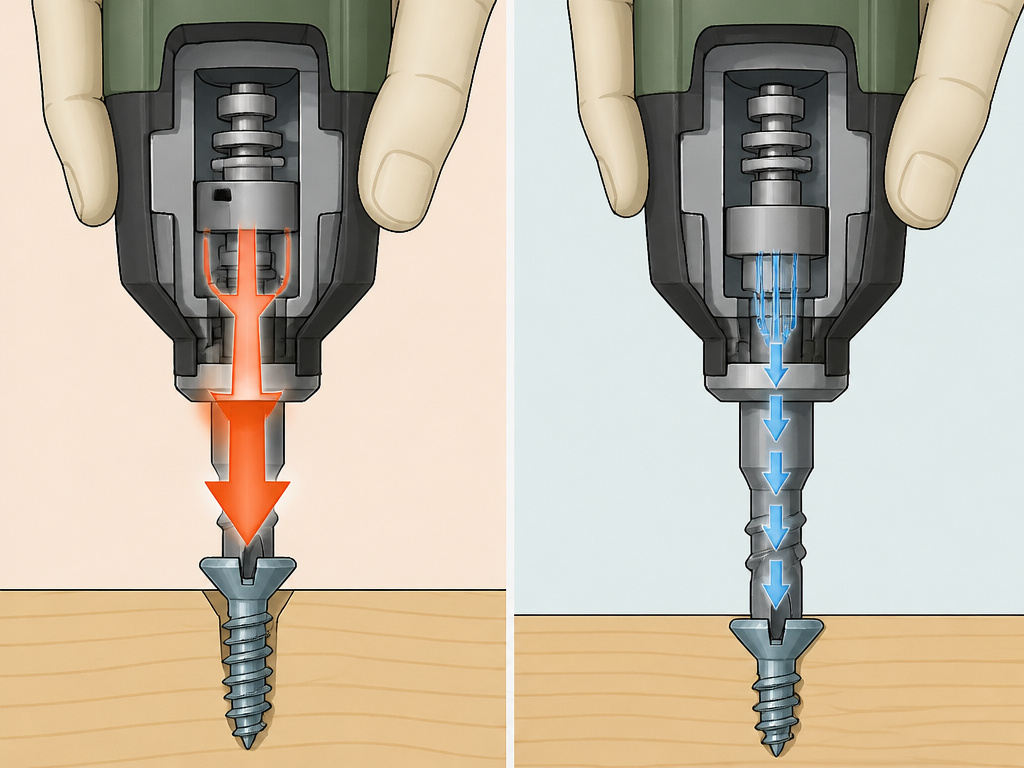
IPM and torque are partners, not the same thing. Torque (measured in Newton-meters or inch-pounds) is the twisting force. IPM is how often that force is applied. A high-torque tool with a low IPM will drive a stubborn bolt, but it might do so with slow, heavy thuds. A high-IPM tool with moderate torque will zip a screw home with a frenetic buzz.
Here’s the practical effect: a higher IPM helps prevent cam-out. When a screw head starts to strip, a standard drill keeps applying continuous rotational force, which can worsen the damage. An impact driver delivers its torque in pulses. If the bit slips during the micro-pause between impacts, it can re-seat before the next blow.
Where this goes sideways: Assuming higher IPM always means more power. IPM drives speed, not maximum torque. A lightweight model might have a high IPM but low overall torque, making it fast for deck screws but weak for lag bolts.
The relationship is direct in many modern tools with multi-speed gear settings. On a model like the Kobalt 24V impact driver, selecting a higher speed range increases both the no-load RPM and the IPM. The manual shows Speed Range 1 offers 0-1,900 IPM, while Range 3 jumps to 0-3,800 IPM. More impacts per minute, delivered at a higher rotational speed, equals faster driving.
Typical IPM Ranges for Consumer Impact Drivers
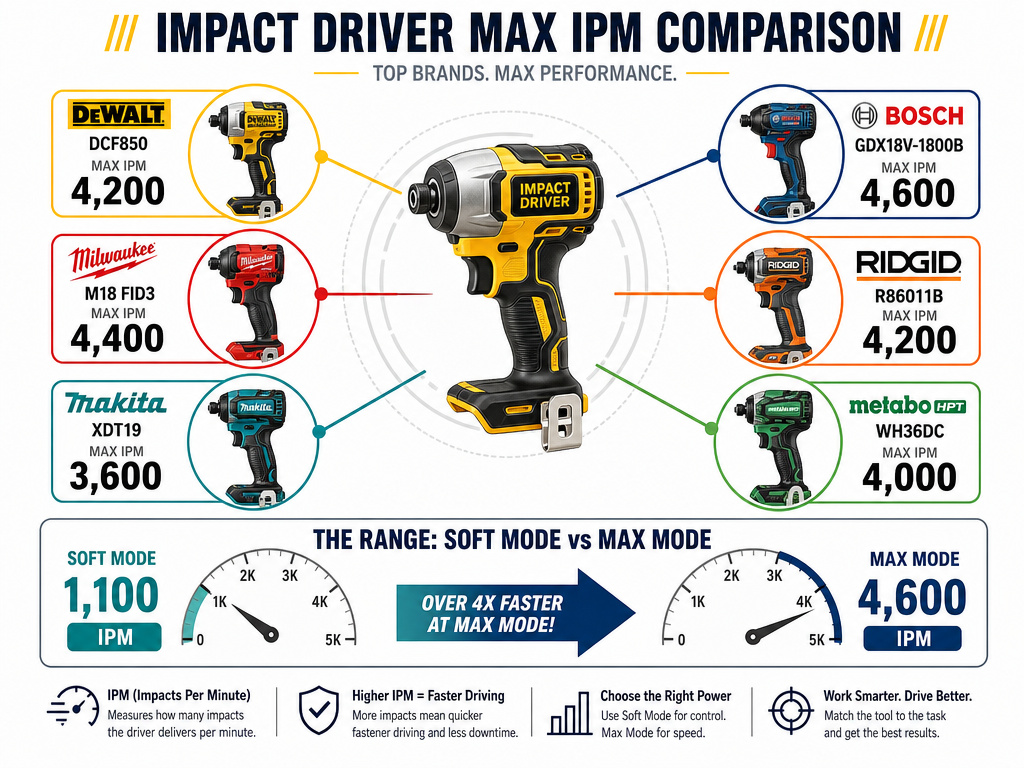
So what’s a normal number? Looking at the manuals gives us a clear benchmark.
| Model | Brand | Published IPM Range | Notes |
|---|---|---|---|
| DeWalt DCF840 | DeWalt | 0–4,200 min⁻¹ | Brushless compact driver |
| Milwaukee M18 FUEL 2957-20 | Milwaukee | 0–4,400 min⁻¹ | High-performance model |
| Makita TD002G (Max Mode) | Makita | 0–4,600 min⁻¹ | Top end for advanced model |
| Ryobi R18ID3 | Ryobi | 0–3,400 IPM | Common DIY-grade tool |
| Kobalt 24V (Speed 3) | Kobalt | 0–3,800 /min (IPM) | Store-brand option |
| Makita DTD173 (Soft Mode) | Makita | 0–1,100 min⁻¹ | Example of low-end setting |
These are the impact driver speed ceilings printed by the manufacturers. You’ll notice the Makita TD002G can vary its IPM dramatically based on mode, from 1,400 in Soft mode to 4,600 in Max mode. This highlights a key point: the max IPM on the box is just one setting. The usable range is what matters.
IPM, Variable Speed Triggers, and Your Control
Here’s the part that often gets missed: you are in control of the IPM. The spec sheet shows the maximum, but your finger on the variable speed trigger dictates the actual rate. Squeeze lightly, and the motor spins slowly, delivering impacts at a low, gentle pace. Pull the trigger fully, and you command the published maximum IPM.
This is why understanding speed settings is crucial. On tools with multiple speed ranges (often a button near the trigger), selecting a lower range caps the top speed and the maximum IPM. This gives you finer control for delicate work. Using a high-IPM tool on a low setting for installing cabinet hardware prevents you from over-driving and splitting the wood.
The trigger is an analog controller. The relationship between trigger pull and motor speed isn’t always linear, but the principle holds: more trigger, more IPM. This direct control is what makes an impact driver so versatile. It’s not a binary on/off jackhammer; it’s a precision instrument that can match its powerful pulse rate to the task.
Does Higher IPM Cause More Wear?
It’s a fair question. More impacts per minute means more cycles of the hammer slamming into the anvil. In theory, yes, a tool running at its max IPM for extended periods will accumulate wear faster than one used at a moderate pace. But in practice, it’s not the primary failure point.
The hammer and anvil are made of hardened steel precisely for this punishment. A far more common point of failure is the impact driver torque mechanism’s internal springs or the bearings that support the rotating mass. These components fatigue over time, but their lifespan is measured in years of professional use, not in IPM counts.
Where you will see accelerated wear is on your bits. A high-IPM driver applies its pulses rapidly. If a bit is slightly off-center or worn, each impact can twist it in the screw head, rounding it out faster. The solution is simple: use high-quality impact-rated bits. They are heat-treated and designed to handle the shock.
Let a hot battery cartridge cool down before charging it. This edge case from Makita’s manual highlights that heat from extended high-power use (which correlates with high IPM) is a bigger concern for battery life than mechanical wear.
IPM vs. BPM on a Hammer Drill
It’s easy to confuse IPM with another acronym: BPM, or Blows Per Minute. This spec belongs to a hammer drill. While both tools deliver impacts, the mechanism and purpose are different.
A hammer drill’s BPM refers to a direct, linear hammering action along the axis of the drill bit, designed to pulverize masonry. An impact driver’s IPM is a rotational hammering action around the axis, designed to generate torque. The numbers are in different leagues; a hammer drill might deliver 20,000 BPM or more, but with very little rotational force per blow.
Think of it this way: a hammer drill is a mini-jackhammer for drilling into concrete. An impact driver is a pulsed wrench for driving screws. They are different tools for different jobs, and their impact ratings are not comparable. If you’re looking at BPM on a hammer drill, you’re in the wrong manual for driving lag bolts.
Safety and Maintenance Implications of IPM
The IPM rating has direct safety consequences. The primary one is noise. All those metal-on-metal impacts create significant sound pressure. DeWalt’s DCF887 manual explicitly warns: “Always wear proper personal hearing protection that conforms to ANSI S12.6 (S3.19) during use.” That’s not a suggestion. It’s a requirement based on the tool’s emitted noise, which is a direct function of its impact mechanism and max IPM.
Vibration is another factor. The same hammer-anvil action that creates IPM also sends shockwaves back through the tool and into your hands and arms. Using the tool for long periods, especially at high IPM, can contribute to fatigue and strain. This is why many pro models feature advanced anti-vibration technology in their grips.
Battery care also connects to hard use. Running a tool at high IPM draws significant current, which heats the battery. Manufacturers have specific, and sometimes conflicting, storage guidelines. DeWalt advises not to store batteries where temperatures reach 104°F (40°C), while Makita sets a limit of 122°F (50°C). The takeaway is to consult your tool’s manual and store batteries in a cool, dry place, away from extremes.
Frequently Asked Questions
Is a higher IPM impact driver better?
Not necessarily. A higher IPM means faster driving speed, which is great for productivity. However, for precision tasks or with softer materials, a lower, controllable IPM is often better. The ideal tool has a high maximum IPM for power and a sensitive variable-speed trigger for control.
Can I control the IPM on my impact driver?
Yes, absolutely. The primary control is the variable-speed trigger. Squeeze it partially for lower speed and a lower impact rate. Many models also have multi-speed selectors that electronically cap the maximum IPM, giving you a preset range that’s safer for delicate work.
What is a good IPM for a DIY impact driver?
Does IPM affect battery life?
Indirectly, yes. Running the tool at its maximum IPM requires more power from the motor, which draws more current from the battery.
What’s the difference between an impact driver and an impact wrench?
This is a key impact driver vs impact wrench distinction. An impact driver has a 1/4″ hex chuck for screw-driving bits and prioritizes a higher IPM for faster fastening.
Before You Go
The real lesson of IPM is understanding the tool’s language. When a spec sheet says 3,800 IPM, it’s telling you the top speed of the hammering action that defines the tool’s capability. That number, combined with the torque rating and your own trigger control, dictates what you can build.
So the next time you pick up your impact driver, listen to that brrrrrrt. That’s the IPM counter at work. Match its rhythm to the job, a gentle purr for hinge screws, a full buzz for deck boards. And always, always respect the noise it creates. Put on your hearing protection. That simple habit, more than any spec, is what allows you to continue using the right tool for the job, year after year.
