
Hearing Protection for Power Tools Guide: How to Choose
This post contains affiliate links. As an Amazon Associate, we earn from qualifying purchases.
Hearing protection for power tools is required when noise levels reach or exceed 85 decibels (dBA) over an 8-hour period, per OSHA and NIOSH standards. Most power tools, like grinders (98-99 dBA) and chainsaws (which often exceed 100 dBA), exceed this limit, necessitating protection with a sufficient Noise Reduction Rating (NRR) or Single Number Rating (SNR).
That threshold, 85 dBA, isn’t an abstract number. It’s the line where sustained exposure starts causing permanent, irreversible damage to the tiny hair cells in your inner ear. A Makita cut-off saw hits 99 dBA. Many common workshop tools, such as table saws, often operate at levels that exceed the 85 dBA limit. You cross the line in minutes, not hours. A guide for selecting hearing protection for power tools is essential for selecting the right defense.
This hearing protection for power tools guide walks through the three-step process for choosing protection: measuring your tool’s noise, calculating the needed attenuation, and selecting a type that fits your job and comfort. We’ll ground every recommendation in manufacturer specs and agency standards, because hearing safety is one area where guessing is not an option.
Key Takeaways
- Start with the tool’s manual for its official sound pressure level (LpA), like the Makita M2402‘s 98 dBA, to calculate required protection.
- Aim for a protected level of 75-85 dBA, as NIOSH recommends; too much attenuation can isolate you from important workshop sounds.
- Combine earplugs and earmuffs for noise levels 100 dBA or greater or for impulse sounds, a practice called double hearing protection.
- Comfort dictates compliance; an uncomfortable protector removed for just 5 minutes in an hour can slash its effectiveness by more than half.
- Replace foam earplugs daily in dirty environments and inspect earmuff seals regularly, as worn protectors lose their attenuation properties.
How Loud Are Your Power Tools?
You need a number to start. That number is in your tool’s operator’s manual, listed as the sound pressure level (LpA). It’s a measurement taken at the operator’s ear under test conditions.
The Makita Portable Cut-off Model M2402 manual lists an LpA of 98 dB(A). The M2403 model is 99 dB(A). Both carry an uncertainty value (K) of 3.0 dB(A), meaning the actual noise in your shop could be a few decibels higher. Husqvarna manuals, like for the 525iDEPS powerhead, simply state “Use approved hearing protection” because chainsaws and pole saws routinely exceed 100 dBA. General power tool manuals from multiple brands universally advise using hearing protection “during extended periods of operation.”
Common mistake: Assuming a quick job doesn’t need protection. NIOSH notes that intermittent removal drastically cuts effectiveness. If you take off a 25 NRR protector for just 5 minutes in an hour, your maximum protection drops to about 11 dB.
A Quick Reference for Common Tools
While you should always check your specific model, these ranges illustrate the hazard. Remember, the decibel scale is logarithmic; an increase of 10 dB represents a tenfold increase in sound intensity.
| Power Tool | Typical Sound Level Range | Exceeds 85 dBA? | Protection Urgency |
|---|---|---|---|
| Angle Grinder | 95 – 105 dBA | Yes, significantly | High – consider double protection |
| Table Saw | 90 – 100 dBA | Yes | High – essential for all use |
| Circular Saw | 95 – 102 dBA | Yes | High – essential for all use |
| Jackhammer | 100 – 110+ dBA | Yes, severely | Very High – double protection required |
| Random Orbital Sander | 75 – 85 dBA | Borderline | Moderate – required for extended use |
| Drill/Driver | 70 –1590 dBA | Usually No | Low – may be optional for short tasks |
The main point? Most staple workshop tools live firmly in the danger zone. You can’t rely on your own perception of loudness either, as high-frequency noise can be damaging even if it doesn’t feel painfully loud.
How to Calculate Your Needed Protection Level
Once you have your tool’s dBA level, you can figure out how much noise reduction you need. The goal is to bring the noise at your ear down to a safe level, which agencies define as between 75 and 85 dBA.
Here’s the basic math, using the Noise Reduction Rating (NRR) or Single Number Rating (SNR) found on protector packaging:
- Start with the tool’s noise level (e.g., 98 dBA for the Makita M2402).
- Subtract the NRR or SNR of the protector (e.g., an NRR 27 earplug).
- Apply a safety de-rating. NIOSH historically recommends subtracting 7 from the NRR for earmuffs and 50% from the NRR for earplugs to account for real-world fit. A simpler, conservative method is to subtract 7 from any NRR before doing the calculation.
- The result is your estimated exposure level.
For a declared noise level of 98 dB(A) and a protector with an NRR of 27 dB, the estimated protected exposure level would be 71 dB(A) after applying a 7 dB safety factor, which is below the recommended range. Aim for a result between 75 and 85 dB(A) for optimal safety and situational awareness.
If your calculation leaves you below 75 dBA, you might be overprotected. This can make you less aware of your surroundings, unable to hear a shouted warning or the unusual sound of a tool straining, and may tempt you to remove the protection. NIOSH explicitly warns against this. If you’re above 85 dBA, you need a higher-rated protector or need to consider double protection.
The Two Main Types of Hearing Protection
All protectors fall into two camps: earplugs that go in the ear canal, and earmuffs that cover the outer ear. Your choice isn’t just about numbers; it’s about compatibility with your work, other safety gear, and plain old comfort over a long session.
Earplugs (Disposable, Reusable, and Molded)
Earplugs are the most common choice. They’re portable, inexpensive, and don’t interfere with hats, glasses, or respirators.
- Disposable Foam Plugs: The classic orange cylinders. You roll them down, insert them, and they expand to seal the canal. They offer high NRR ratings (often NRR 33). The catch: OSHA notes they should be changed every day or two, especially in dusty or oily shops. Reinserting them with dirty hands can cause infections. I keep a box in a clean, sealed bag on my shelf.
- Reusable Silicone or Plastic Plugs: These have multiple flanges or a custom shape. Brands like 3M and Howard Leight make versions with cords to hang around your neck. They’re washable, so hygiene is easier, but their NRR is often slightly lower (NRR 25-27).
- Custom Molded Plugs: The gold standard for fit and comfort, made from an impression of your ear. They’re a significant investment but can last for years with proper care. Their attenuation is consistent because the fit is perfect.
When to choose earplugs: For hot environments, when wearing safety glasses or a dust mask, for jobs requiring a lot of head movement, or if you find earmuffs cause pressure headaches.
Earmuffs (Passive and Electronic)
Earmuffs look simple, a headband with two cushioned cups. Their effectiveness depends on an unbroken seal around the ear.
- Passive Earmuffs: These rely on sound-absorbing foam in the cups. Good models, like the Howard Leight Impact Sport, offer NRR ratings around 22-25 dB. They’re easy to put on and take off, making them good for intermittent noise.
- Electronic Earmuffs: These contain circuitry that amplifies ambient sound (like conversation) but instantly clamps down on harmful impulse noises above a certain threshold (like a nail gun). This maintains situational awareness, a key NIOSH concern. They are ideal for environments where you need to hear machine sounds or talk to others.
When to choose earmuffs: For intermittent noise (easier to don/doff), in colder environments (they can warm the ears), when you have minor ear canal irritation, or when you need electronic features.
| Protector Type | Best For | Key Limitation | NRR Range |
|---|---|---|---|
| Disposable Foam Plugs | High attenuation, single-use hygiene, hot environments | Daily replacement; poor fit if not inserted correctly | 29 – 33 |
| Reusable Flanged Plugs | Moderate attenuation, good hygiene with washing, corded options | Lower max protection; can irritate some ears | II25 – 27 |
| Passive Earmuffs | Ease of use, compatibility with cold weather | Interferes with safety glasses; can be hot; lower max attenuation | 22 – 25 |
| Electronic Earmuffs | Situational awareness, communication in noise | Higher cost; requires batteries | 20 – 24 |
The right choice in a hearing protection for power tools guide often isn’t one or the other. For the loudest tools, like a jackhammer or a concrete saw, the standard is double hearing protection: earplugs and earmuffs worn together. NIOSH specifically recommends this for noise levels at or above 100 dBA.
The 5 “Cs” of Selecting Hearing Protection
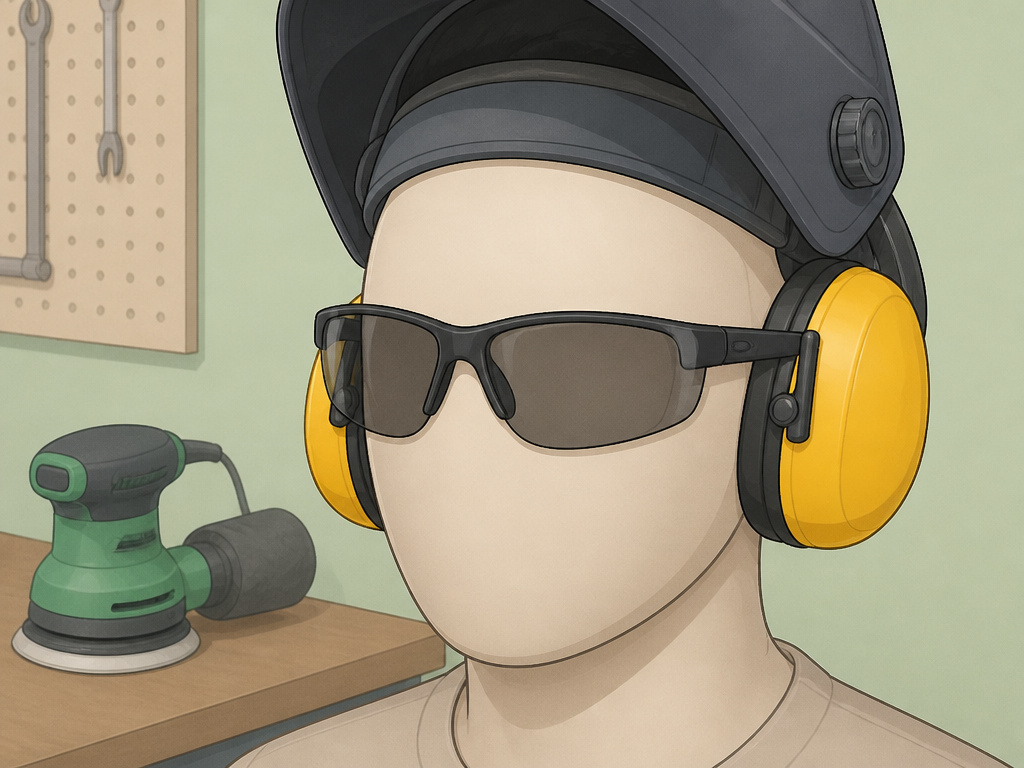
NIOSH frames the choice around five factors beyond pure decibel math. Getting these right means you’ll actually wear the protection.
- Comfort: If it’s not comfortable, you won’t wear it consistently. This is personal. I’ve used the same model of electronic earmuff for years simply because I forget I’m wearing them. Try different styles.
- Compatibility: Does it work with your other gear? Earmuffs can break the seal of safety glasses, and some don’t fit under welding helmets. CCOHS advises selecting hearing protection that is compatible with other required personal protective equipment. Neckband earmuffs solve the glasses issue. Earplugs are naturally compatible with everything.
- Convenience: How easy is it to use in your workflow? If you’re in and out of noise, easy-on earmuffs might win. For all-day grinding, pre-molded plugs you can leave in are less fuss.
- Communication: Do you need to hear warnings or talk? If so, level-dependent electronic earmuffs are not a luxury; they’re a safety feature. A 2021 systematic review in PMC found HPDs did not significantly harm sound localization or speech perception when designed for it.
- Cost: Balance initial price with longevity. A $5 pack of foam plugs used daily costs more per year than a $40 pair of reusable plugs that last five years. Your employer, if you’re on a job site and exposed to an 8-hour time-weighted average of 85 decibels, is required by OSHA to provide and pay for hearing protectors.
Maintenance, Hygiene, and When to Replace
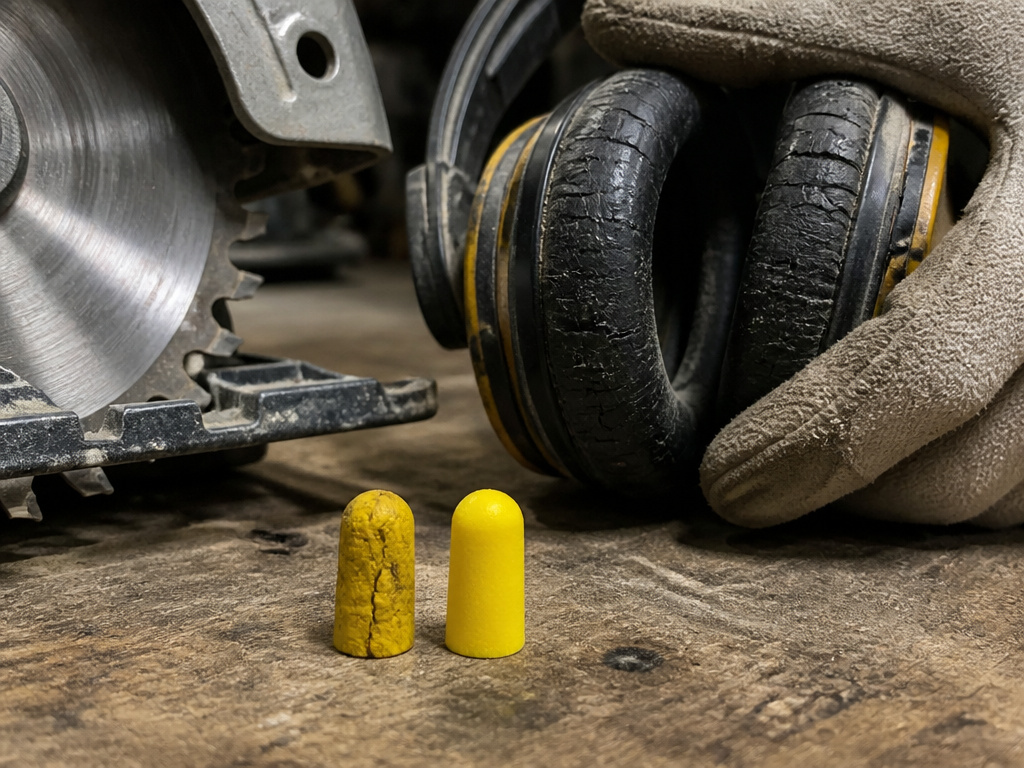
Hearing protection is a consumable item. It degrades.
Foam earplugs lose their elasticity and sealing ability. OSHA’s interpretation states they “should usually be changed every day or two, especially in dusty or oily environments.” Reusable plugs need washing with mild soap and water. Inspect the flanges for cracks.
Earmuff cushions compress and crack over time, breaking the acoustic seal. The headband can also lose tension. A visual inspection every few months is wise. If the vinyl is cracked or the foam feels stiff, replace the cushions. Most quality models like the 3M Peltor series have user-replaceable pads.
Where this goes sideways: Trying to wash foam plugs multiple times to save money. They’re designed to be disposable. The foam breaks down, and you won’t get a proper seal, giving you a false sense of security. The money you save isn’t worth the risk.
The rule is simple: if it looks worn, feels different, or no longer creates a tight seal, it’s time for a new one. Protect your hearing like you protect your eyes, with clean, undamaged gear.
Frequently Asked Questions
What is the best hearing protection for power tools?
There is no single “best.” It depends on the tool’s noise level, job duration, and your other PPE. For most woodworking with tools like table saws (95-100 dBA), a well-fitted disposable foam earplug with a high NRR is highly effective. For environments where you need awareness, electronic earmuffs are the best choice. For maximum protection against very loud tools like jackhammers, you need double protection: plugs and muffs.
What is the rule of five for hearing protection?
This isn’t a formal rule, but it highlights a critical point from CCOHS: if you remove a hearing protector for just 5 minutes in an hour, its effective protection plummets. For a protector rated at 25 dB, that 5-minute removal can drop your protection to no better than 11 dB for that hour. Consistency is everything.
What is the 60-60 rule for hearing?
This is a rule for listening to music, not power tools. It suggests listening at no more than 60% of maximum volume for no more than 60 minutes a day. It doesn’t apply to the unpredictable, high-decibel bursts of workshop noise. Rely on measured dBA levels and NRR ratings, not time-based music rules.
How many dB is good hearing protection?
“Good” is a protector that brings your exposure into the 75-85 dBA range. For a 100 dBA angle grinder, you’d need at least 15-25 dB of real-world attenuation. Since real-world protection is less than the labeled NRR, select a protector with an NRR high enough to bring your exposure down to 75-85 dBA after de-rating. For less noisy tools like a sander at 85 dBA, a protector with a lower NRR might be sufficient.
Before You Go
Hearing damage is cumulative and permanent. The ringing in your ears after a shop session is a warning sign, not a normal side effect. Start by finding the decibel rating for your loudest tool, it’s in the manual. Do the simple subtraction: tool dBA minus protector NRR (minus 7 for safety). Aim for a result between 75 and 85.
If you remember one thing, remember this: comfort is essential. An uncomfortable protector is a protector you’ll take off. Try a few types. Keep them clean. Replace them often. And for those brutal, 100+ dBA jobs, don’t hesitate to double up. Your future self will thank you for the silence.
