
Personal Protective Equipment for Power Tools Guide
This post contains affiliate links. As an Amazon Associate, we earn from qualifying purchases.
Personal protective equipment for power tools is a layered system of gear backed by regulations, not just a shopping list. It starts with mandatory eye protection meeting ANSI Z87.1 or CSA Z94.3, extends to hearing protection for any extended or noisy operation, and requires respirators for environments with dust containing silica, lead, or arsenic. For electrical tools, OSHA Standard 1910.243 mandates constant pressure switches on saws over 2 inches and guards that return automatically.
That guard rule isn’t optional. A circular saw blade over two inches in diameter legally must have an upper and lower guard that covers to the depth of the teeth, and the lower one must snap back the instant you pull the saw away. That’s a federal workplace safety standard. It exists because the alternative is an unguarded, spinning blade with nothing between it and your hand. For more details, see our personal protective equipment for power tools guide.
What follows is a breakdown of the regulations you’re actually accountable to, the specific gear those rules point to in a personal protective equipment for power tools guide, and the common mistakes that turn PPE from protection into a hazard. This section explains the core types, how to decode their ratings, and the critical differences between a DIYer’s best practices and a jobsite’s legal requirements.
Key Takeaways
- Eye protection is essential and must meet ANSI Z87.1 or CSA Z94.3; prescription glasses alone are not compliant and can shatter.
- For circular saws over 2″ blade diameter, constant pressure switches and automatic-return guards are required by OSHA Standard 1910.243.
- Hearing protection is mandatory for extended or noisy operations; permanent tinnitus has no fix, while most eye injuries are treatable.
- A respirator is needed for dust containing silica, lead, arsenic, or chromium; a simple dust mask won’t filter these microscopic particles.
- PPE is a last-resort layer in a safety system that starts with tool maintenance, proper technique, and hazard assessment.
The Core PPE Types Every Power Tool User Needs
You need three things on every job, as outlined in any personal protective equipment for power tools guide: something over your eyes, something in or over your ears, and something on your hands. The specifics of each change with the tool and the material.
Safety glasses are the entry ticket. The standard isn’t a suggestion. ANSI Z87.1 in the US or CSA Z94.3 in Canada means the lenses and frames are tested to withstand impact. Prescription glasses fail this test. The lenses aren’t impact-rated, and the frames aren’t designed to stay on your face when hit. A Benchmark manual states it plainly: non-compliant eyewear can cause serious injury if broken during operation.
Prescription eyeglasses are not a replacement for proper eye protection. Non-compliant eyewear can cause serious injury if broken during the operation of a power tool. . Benchmark Product Manual
Hearing protection is about duration. You might get away without it for a single cut. Run a router or a thickness planer for twenty minutes, and you’ve crossed into the zone where damage is cumulative and permanent. That high-pitched whine after you turn the tool off? That’s tinnitus setting up shop. Manufacturer manuals, like the one for an air reciprocating saw, state you should always wear hearing protection. It’s the one injury you can’t see coming and can’t fix later.
Gloves are tool-specific. For handling rough lumber or metal, a basic leather glove prevents cuts. For a table saw, drill press, or any rotating tool, gloves are a catastrophic hazard, they can catch and pull your whole hand in. The rule is simple: no gloves near spinny things.
| PPE Type | Mandatory Standard | When It’s Non-Negotiable | Common Mistake |
|---|---|---|---|
| Eye Protection | ANSI Z87.1 or CSA Z94.3 | Any power tool operation | Using only prescription glasses |
| Hearing Protection | NRR Rating (Noise Reduction Rating) | Extended use or noisy operations | Skipping it for “quick” jobs |
| Respirator | NIOSH Approval (e.g., N95, P100) | Sanding, cutting masonry, treated lumber | Using a simple dust mask for silica |
| Hand Protection | Task-specific (leather, nitrile) | Handling materials, not operating rotating tools | Wearing gloves on a table saw |
Decoding the Safety Ratings on Your Gear
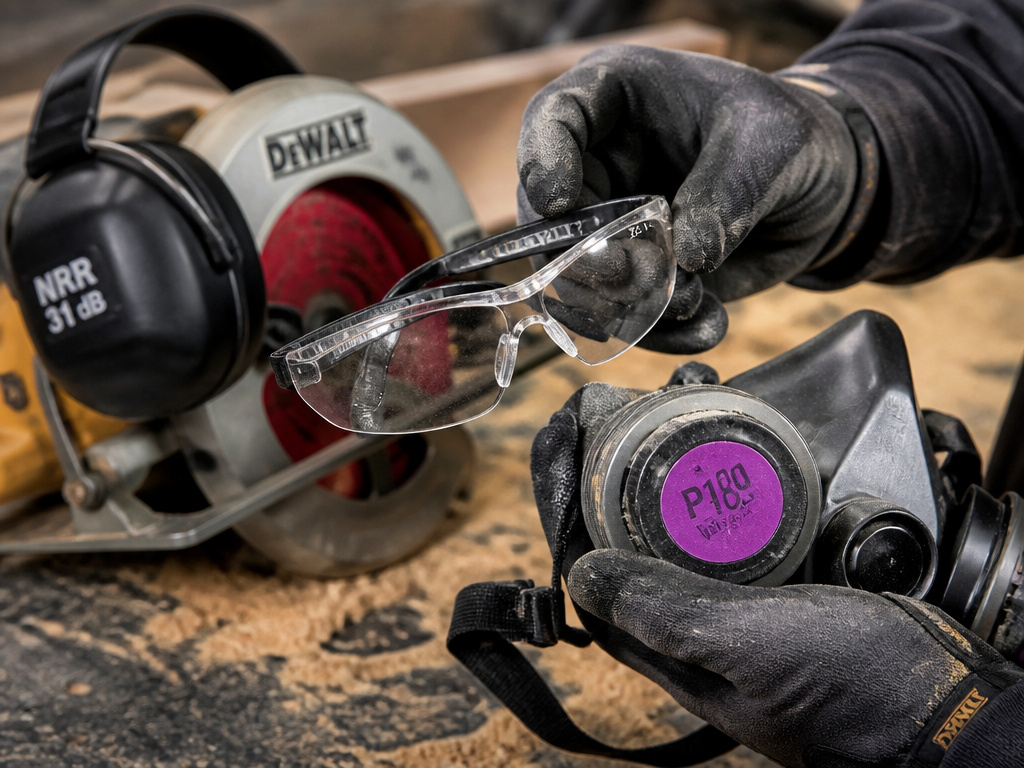
The letters and numbers on your safety gear are a contract, not decoration. ANSI Z87.1 means the glasses passed a test where a 1/4-inch steel ball was shot at the lens at 150 feet per second. If you see a “+” after the Z87.1, it means it also passed a high-mass impact test. This is the difference between glasses that stop a flying chip and glasses that might stop a nail.
Noise Reduction Rating (NRR) is a subtractive number measured in decibels. A tool’s noise level, paired with hearing protection rated with a specific Noise Reduction Rating (NRR), reduces your exposure. In practice, a perfect seal is impossible, so experts recommend derating the NRR by 50%. If your tool operates at a high noise level, even with hearing protection, your exposure may still be significant, which is why protection is critical for extended or noisy operations. This is why electronic earmuffs that amplify conversation but clamp down on harmful noise can be a useful option.
For respirators, NIOSH is the only stamp that matters for particulate hazards. An N95 filters 95% of non-oil-based particles. For the really nasty stuff, crystalline silica from cutting concrete, you need a P100 filter. A basic dust mask from the hardware store is for pollen, not poison. The dust from construction, as noted in the Benchmark manual, can contain lead, crystalline silica, arsenic, and chromium. A P100 respirator is the minimum for that fight.
Tool-Specific PPE: What to Wear with What You’re Using
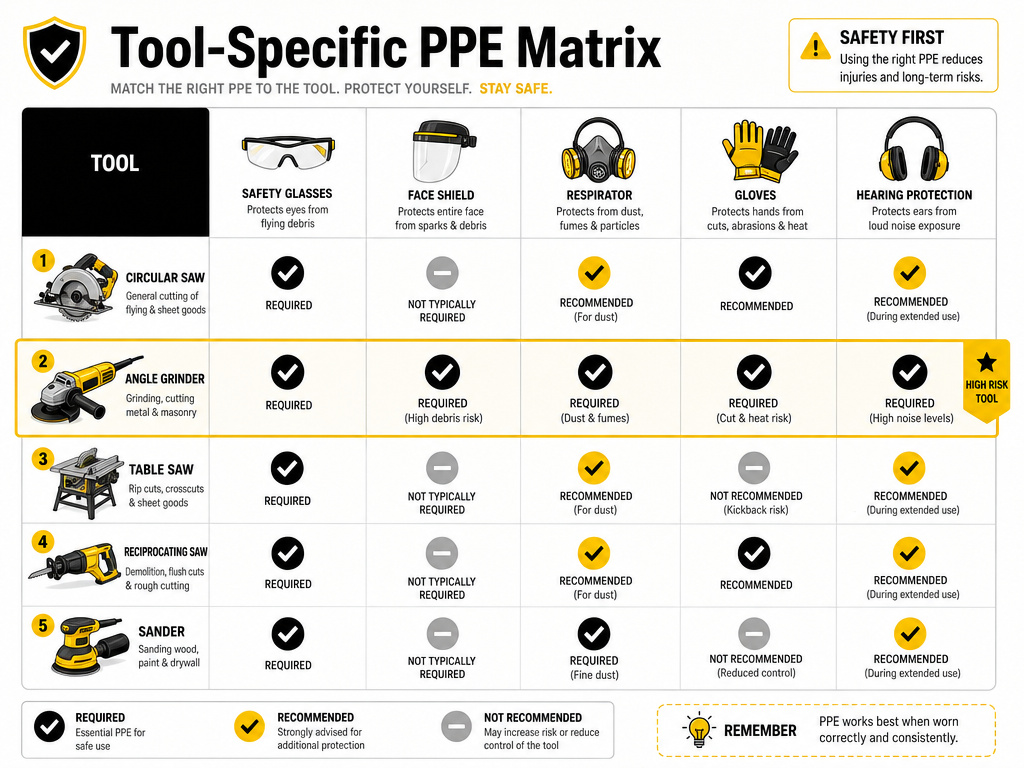
General advice is fine, but tools have personalities. A circular saw throws debris in a forward arc. An angle grinder sends a superheated stream of sparks sideways. A nail gun can ricochet a fastener.
Here is how they match up. This table isn’t just a recommendation; for professionals, parts of it are codified.
| Power Tool | Primary Hazards | Absolute Minimum PPE | Pro-Tier Addition |
|---|---|---|---|
| Circular Saw | Kickback, flying chips, noise | Z87.1 glasses, hearing protection | Face shield, dust mask for composites |
| Angle Grinder | Wheel rupture, sparks, silica dust | Z87.1 glasses, hearing pro, gloves (for handling) | Full face shield, respirator (P100), fire-resistant apron |
| Table Saw | Kickback, blade contact, noise | Z87.1 glasses, hearing protection | Push sticks/blocks (no gloves) |
| Reciprocating Saw | Vibration, noise, sharp debris | Z87.1 glasses, hearing protection | Anti-vibration gloves (for handling, not operation) |
| Sander (Orbital/Belt) | Dust inhalation, noise | Hearing protection, respirator (N95/P100) | Dust collection hookup, dedicated shop vac |
The angle grinder is in a league of its own. A shattered cutting wheel can disintegrate at 10,000 RPM. Safety glasses might stop a piece, but a full face shield stops the whole cloud. It’s the difference between a close call and a life-altering injury. Our dedicated guide to angle grinder safety dives deeper into wheel selection and cutting angles.
For nail guns, the hazard includes ricochet. Safety glasses meeting a recognized standard are essential. A guide on using nail guns safely covers trigger mechanisms and sequential vs. Contact firing, which is just as important as your PPE.
Where this goes sideways: Wearing gloves while using a table saw or drill press. The material can catch the blade or bit and pull your entire hand in before the clutch can disengage. The injury is always severe.
The Regulatory Backbone: OSHA and ANSI Standards
This isn’t just about being careful. If you’re on a job site, or if you employ anyone, these are legal requirements. OSHA Standard 1910.243 is the rulebook for portable power tool guarding.
It states that any portable circular saw with a blade diameter greater than 2 inches must have upper and lower guards. The lower guard must automatically and instantly return to covering position when the tool is withdrawn from the work. Also, hand-held circular saws over 2 inches, drills, grinders with wheels over 2 inches, disc sanders over 2 inches, reciprocating saws, and jig saws with blades over a nominal 1/4 inch must have a constant pressure switch. This switch cuts power the moment you release your grip.
OSHA portable power tool guarding standard 1910.243 is not a guideline. It’s a workplace regulation that dictates the design of the tools themselves, from guard mechanics to switch type.
Why the 2-inch threshold? It’s roughly the point where the tool’s kinetic energy becomes capable of causing catastrophic injury. A smaller saw might cut you. A larger, unguarded saw can take off a finger.
For PPE, the OSHA general PPE regulations (29 CFR Part 1910 Subpart I) require employers to perform a hazard assessment. If hazards are present, they must provide appropriate PPE at no cost and train workers on its use. This includes ensuring equipment like respirators seal properly, even over corrective glasses.
The NIOSH PPE overview reinforces that PPE should be part of a program, not a standalone solution. This is the systems approach: first, try to eliminate the hazard (use a less toxic material); second, use engineering controls (dust collection); third, adopt administrative controls (job rotation); and finally, as a last resort, use PPE.
Electrical and Environmental Safety: Beyond the Basic Gear
PPE is your last line of defense, but your first line is a safe tool and a safe environment. A damaged cord or a wet floor negates the best safety glasses in the world.
For any corded tool, the plug must match the outlet. No cheater adapters. The Benchmark manual specifies that a 120V AC tool must be connected to a 120V, 15 Amp circuit protected by a time-delayed fuse or circuit breaker. When working outdoors, you need an outdoor-rated extension cord, type W-A or W.
If operating a power tool in a damp location is unavoidable, use a residual current device (RCD) protected supply. Use of a power supply via an RCD with a rated residual current of 30 mA or less is always recommended. . Makita Recipro Saw Manual
An RCD (or GFCI in the US) is a life-saver. It detects current leakage and cuts power in milliseconds, far faster than a breaker. It’s the single most effective device to prevent electrocution.
Your workspace matters, too. Clutter is a tripping hazard. Flammable dust or vapors can turn a spark from a brushed motor into a flash fire. Good lighting isn’t a luxury; it’s how you see the cut line and keep your fingers away from it. Our guide to power tool electrical safety covers grounding, cord inspection, and RCD use in detail.
PPE Fit, Care, and Critical Compatibility
The best-rated gear is useless if it doesn’t fit or you don’t maintain it. Safety glasses should seal snugly against your face without pinching. Muffs need to fully enclose the ear. A respirator requires a user seal check every time you don it.
Compatibility is the silent failure. The International Labour Organization highlights it: if you wear safety glasses and a respirator, the temple arms of the glasses can break the seal of the respirator’s facepiece, allowing unfiltered air to leak in. You think you’re protected, but you’re breathing silica.
Common mistake: Storing a respirator in a dirty toolbox. OSHA 1910.134 requires respirators be stored to protect them from damage, contamination, dust, sunlight, extreme temperatures, excessive moisture, and damaging chemicals. A mashed facepiece won’t seal.
Care is straightforward but ignored. Clean safety glasses with lens cleaner, not your shirt. Replace ear muff seals when they become hard and cracked. Keep respirator filters in a sealed bag when not in use. Damaged PPE is worse than none at all, it gives a false sense of security. As the Air Reciprocating Saw manual states, never use a damaged or malfunctioning tool or accessory. The same goes for your protective gear.
Building Your Personal PPE System
Start with the absolute non-negotiables: a pair of ANSI Z87.1+ safety glasses and a set of earmuffs with a sufficient NRR. Store them where you can’t miss them, on top of the tool, if you have to.
Next, assess your most common tasks. If you sand or cut masonry, add a half-face respirator with P100 filters (3M 7500). If you use angle grinders, invest in a full face shield. Don’t buy a “kit” of cheap, unrated gear. Buy one good piece at a time.
For the DIYer, this is about best practices and long-term health. For the professional or employer, this morphs into a program: documented hazard assessments, trained employees, and maintained equipment. The consequences of skipping steps are laid out in our article about common power tool injuries and how to avoid them.
Remember, PPE is the final layer. It works in tandem with sharp blades (which require less force), secure workpieces, and a clear, focused mind. No piece of plastic or foam can compensate for a moment of distraction.
General Power Tool Safety Principles/Checklist
Before any work begins, a formal hazard assessment is required to determine what PPE is necessary. This is a core OSHA rule. Your checklist must include verifying that tools with blades or discs over a certain size have functional guards and a constant pressure switch that shuts off when released. Eye protection that meets a recognized standard like ANSI Z87.1 is mandatory for operators and assistants. Never use a damaged tool or accessory, and do not modify any safety devices. When wearing multiple items like a respirator and glasses, ensure they are compatible and do not break the seal.
Tool Inspection & Maintenance
Regular inspection is essential. Check that guards on tools like circular saws are present, cover the blade to the depth of the teeth, and operate correctly. The lower guard must automatically return to the covering position when the tool is withdrawn. Confirm that constant pressure switches function properly and that tools show no signs of damage. For air-powered tools, always disconnect the air supply and bleed all pressure before any maintenance or adjustments. Store tools and PPE properly; damaged equipment must be taken out of service immediately and not used.
Frequently Asked Questions
What is the most important PPE for power tools?
Eye protection meeting ANSI Z87.1 or CSA Z94.3 is the essential foundation. Without it, you are one unexpected kickback or broken blade away from a permanent injury. All other PPE builds on this baseline.
Do I need a respirator for wood dust?
For occasional woodworking with common woods like pine or oak, a dust mask (N95) is often sufficient for comfort. However, if you are sanding for extended periods, cutting composites like MDF, or working with chemically treated lumber (which can contain arsenic and chromium), a NIOSH-approved respirator with a P100 filter is necessary to protect against microscopic, hazardous particles.
Are anti-vibration gloves worth it?
For frequent, daily use of high-vibration tools like jackhammers or demolition hammers, yes. They can help reduce the risk of Hand-Arm Vibration Syndrome (HAVS). For the weekend DIYer using a reciprocating saw for a few minutes, proper tool handling and choosing a tool with built-in vibration dampening is a more effective investment.
Can I just wear my regular glasses under safety goggles?
Yes, but they must be designed to fit over them. Look for safety glasses or goggles marked “OTG” (Over The Glasses). These have a deeper lens chamber to accommodate your prescription frames without compromising the seal or impact protection. Never wear safety goggles over your regular glasses if they press the frames into your face or distort the lens.
Who is responsible for providing PPE on a job site?
Under OSHA regulations, the employer is responsible for performing a workplace hazard assessment, providing the required PPE at no cost to the employee, and training them on its proper use and maintenance. On a personal DIY project, you are your own safety officer.
The Bottom Line
Your safety plan shouldn’t start with what you buy. It should start with the work you’re doing. Identify the hazards: flying debris, noise, dust, electricity. Then, in that order, try to eliminate them, control them, and finally, protect yourself from them.
If you remember one thing, let it be this: hearing damage is permanent and cumulative, while most eye injuries are acute and treatable. You’ll know instantly if you get something in your eye. You won’t notice your hearing slipping away until it’s too late. So put the earmuffs on first, then the glasses. That’s the order that protects the rest of your life.
For beginners, the principles are the same, but the learning curve is steep. Our beginner’s guide to using power tools safely breaks down the fundamentals of stance, grip, and mindset that make all the PPE effective. The gear is your backup. Your brain is your primary safety device.
