
10 Best Quiet Air Compressors For Home Garage in 2026
This post contains affiliate links. As an Amazon Associate, we earn from qualifying purchases.
For the quietest operation in a home garage, we recommend the California Air Tools 2010A Ultra Quiet Air Compressor for its 60 dB noise level and maintenance-free design. The Metabo HPT EC711S is a great choice for quick recovery, while the VEVOR 13-Gallon model offers excellent large-capacity value.
Choosing the right quiet compressor means balancing your need for a peaceful workspace with the air power your projects demand. A model that’s too loud defeats the purpose, but one that can’t run your tools is useless. We researched specifications, expert round-ups, and owner feedback to present these ten options, helping you match a compressor’s noise level, tank size, and airflow to your specific garage tasks.
Top 10 Quiet Air Compressors For Home Garage in the Market
Certain content that appears on this site comes from Amazon. This content is provided "as is" and is subject to change or removal at any time.
The Best Quiet Air Compressors For Home Garage, Reviewed
California Air Tools 2010A Ultra Quiet Air Compressor

What We Like
- Exceptionally quiet at only 60 decibels
- Oil-free pump for zero maintenance
- Lightweight and portable at 35 pounds
- Fast tank recovery time of 14 seconds
Trade-offs
- Small 2-gallon tank limits continuous tool use
- Lower airflow (2.20 CFM @ 90 PSI) than larger models
Operating at just 60 decibels, this compressor lets you work in your garage without disturbing the whole house, making it a true neighbor-friendly machine. Its oil-free pump means you can store it anywhere, cold or hot, and never worry about maintenance. For the homeowner tackling intermittent tasks like inflating tires, running a brad nailer, or blowing out dust, the quick recovery time and compact aluminum tank are perfectly matched. It’s the definitive choice when quiet operation is your top priority.
The trade-off for that quiet, portable package is air volume. The 2-gallon tank refills fast, but you’ll be waiting on it if you try to run a framing nailer or an impact wrench for long. For longer spray-painting sessions or sanding, you’d need a model with a larger tank, like the VEVOR 13-Gallon unit. But if your projects are measured in bursts rather than hours, the 2010A delivers power without the typical racket, setting the standard for what a home garage compressor should sound like.
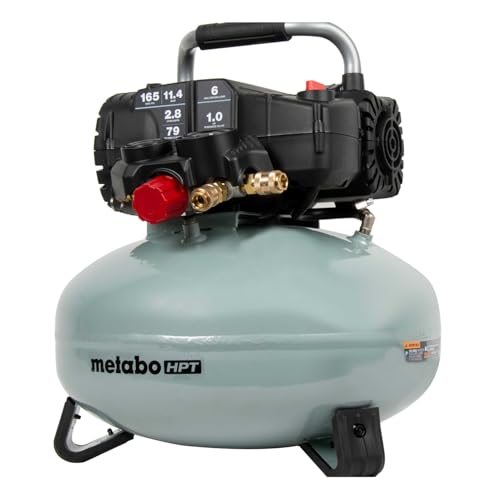
Metabo HPT EC711S Pancake Air Compressor
What We Like
- Quick 46-second tank recovery time
- 73 dB operation is quieter than many compressors
- Lightweight 38.5 lb design with protective cage
- Two quick couplers for fast tool changes
Trade-offs
- 73 dB is louder than dedicated ultra-quiet models like the 60 dB California Air Tools
- 6-gallon tank is smaller than larger stationary models
- 2.8 CFM at 90 PSI limits continuous use with high-demand tools
A 46-second tank recovery time means this compressor gets back to work faster than many in its class, minimizing downtime when you’re running multiple nail guns. That speed, combined with a solid 2.8 CFM at 90 PSI, makes it a great fit for the home garagist tackling trim work, decking, or other projects where you need consistent air without long waits. The 73 dB noise level is a noticeable step down from typical loud compressors, so it won’t drown out the radio, and its manageable 38.5-pound weight makes it easy to move around.
It’s quieter than traditional pancake compressors, but not the quietest option available. For environments where noise is the primary concern, like a shared garage or late-night work, a model like the California Air Tools 2010A operates at a significantly lower 60 dB. However, the Metabo HPT EC711S hits a very practical sweet spot if you need a balanced performer. It recovers fast, delivers reliable air for nailers, and keeps the decibels in check without a premium for ultra-silence.
Product photos
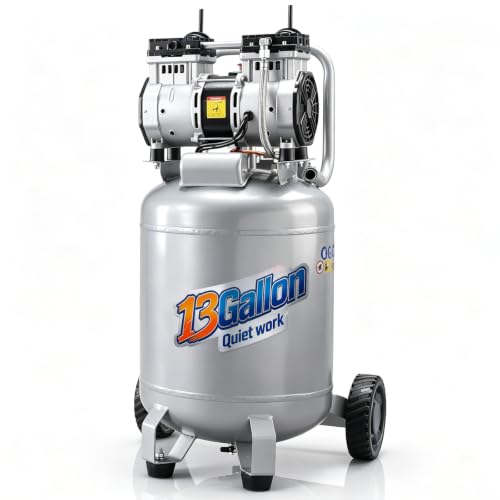
VEVOR 13-Gallon Quiet Air Compressor
What We Like
- Large 13-gallon tank for extended runtime
- Quiet 66 dB oil-free operation
- Rolls easily on two 7-inch rubber wheels
- Comes fully equipped, ready to use
Trade-offs
- At 71 pounds, it's a two-person lift into a vehicle
- Larger footprint than compact pancake models
A 13-gallon tank paired with a 2HP motor means you can run a finish nailer or small sander for a good stretch without the motor cycling constantly. That makes it a serious contender for garage workshops where tasks like spray painting or auto repair demand steady air. The oil-free pump and 66 dB noise level are genuine perks for a home environment, letting you work without disturbing the whole house. For the DIYer who has outgrown a small portable but isn’t ready for a full-sized industrial unit, this compressor hits a practical sweet spot of capacity and relative quiet.
You gain capacity but also size and heft. At 71 pounds on wheels, it’s mobile around the shop but a chore to haul to a jobsite. Compared to a compact like the Metabo HPT EC28M, this VEVOR is a stationary workhorse, not a grab-and-go tool. It’s designed for users who need the air volume more often than they need portability, offering substantial tank reserves at a noise level that won’t force you to wear ear protection for a conversation.
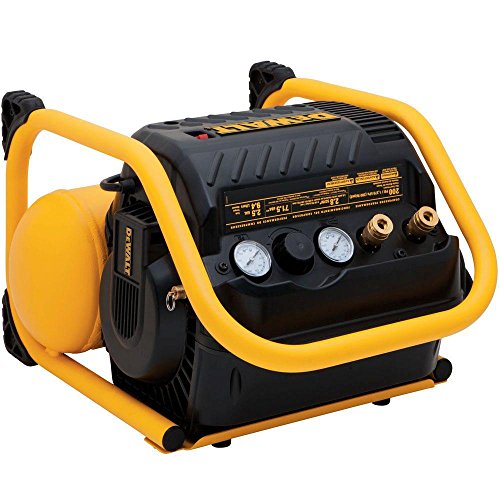
DEWALT DWFP55130 Quiet Air Compressor
What We Like
- Exceptionally quiet 71.5 dBA operation
- Compact vertical or horizontal storage
- Dual quick couplers for two nailers
- Low 12-amp draw reduces breaker trips
Trade-offs
- Small 2.5-gallon tank requires frequent recovery for sustained use
- Lower air volume than larger quiet models like the VEVOR 13-gallon
- At 36 lbs, it's heavier than some compact pancake compressors
At a low 71.5 dBA, this DeWalt compressor allows for quieter operation, which is a significant benefit for working in shared spaces. It delivers 3.0 SCFM at 90 PSI from a 2.5-gallon tank, enabling a large amount of nails to be fired with quick recovery. The unit’s compact, lightweight design and dual quick couplers make it easy to carry, store, and support two nailers in confined areas.
The 2.5-gallon tank provides quick recovery, but for tasks requiring sustained high air volume, a larger tank model would cycle less frequently. For trim work and other applications where nailers are used intermittently, this model balances its air delivery with a thin profile and a weight of 36 pounds. Its roll cage protects key components, and the compressor can be stored or operated either vertically or horizontally to fit your space.
Metabo HPT EC28M Ultra Quiet Air Compressor

What We Like
- Ultra-quiet 59 dB operation for peaceful work
- Lightweight 25.2 lb design with sturdy roll cage
- Oil-free motor for zero maintenance
- Universal quick coupler for fast tool changes
Trade-offs
- Small 1-gallon tank limits prolonged tool use
- Lower air volume than larger tank models
Operating at only 59 dB, this compressor allows a normal conversation while it cycles, making it a practical choice for indoor spaces or quiet neighborhoods. Its 25.2-pound weight and compact shape let it fit under a workbench, and the oil-free design eliminates routine maintenance. You can grab it for quick tasks like finish nailing without creating a major disturbance.
Its quiet, compact design does limit air capacity. That single-gallon tank will cycle frequently under sustained demand, so it’s not the tool for running a die grinder or extensive sanding. For those longer jobs, you’d want to step up to a model like the California Air Tools 2010A with its larger 2-gallon tank, though you’ll trade some portability for that extra air reserve. The Metabo HPT excels at being the quietest, most convenient option for light-duty, stop-and-go work.
Makita MAC320Q Quiet Series Air Compressor

What We Like
- Quiet 60 dB operation for indoor use
- Low 1,750 RPM for longer motor life
- Full roll-cage construction for protection
- Oil-free pump for maintenance-free operation
Trade-offs
- 3-gallon tank refills more often than larger units
- Large roll-cage footprint for its tank size
A 60 dB noise level lets you run this compressor in a shared garage or late at night without annoying the whole household. That low-RPM, 1,750 motor isn’t just quiet; it runs cooler and should last significantly longer than a screaming high-speed unit. This makes the MAC320Q a solid fit for the detail-oriented DIYer who values a peaceful workspace and a tool built for the long haul, not just the weekend project.
Makita built the MAC320Q with a complete roll-cage, which protects the compressor from dents and drops during transport on a busy job site. This durable construction and its 1-1/2 HP motor contribute to a weight of 56.9 pounds, making it heavier than many portable compressors in its class. While the cage is a clear advantage for frequent movement, the overall heft is a factor to consider if you need to carry it up stairs or load it into a truck regularly.
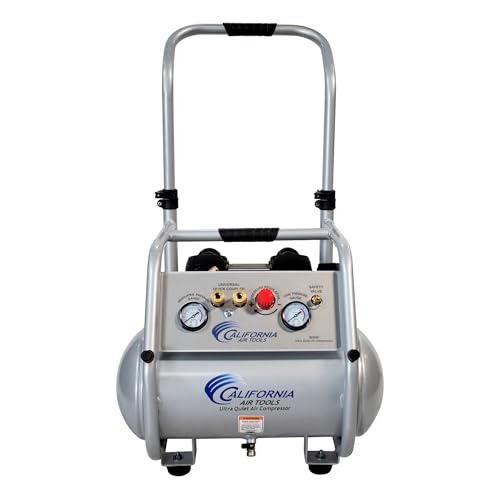
California Air Tools 5020W Ultra Quiet Air Compressor
What We Like
- Ultra-quiet 70 dB operation for garage use
- Oil-free pump needs minimal maintenance
- Easy rolling on large 7.6-inch wheels
Trade-offs
- At 82 lb, it's hefty for lifting into a vehicle.
- 5-gallon tank refills more often than larger stationary units.
- Requires a dedicated 14-amp, 110v circuit.
Operating at just 70 decibels, this compressor lets you run nailers or inflators without needing ear protection or annoying the household. That quiet 2.0 HP motor delivers a solid 6.4 CFM, which is enough to keep up with a framing nailer or a die grinder for short bursts. The five-gallon steel tank and sturdy wheeled build make it the right choice for someone who needs to move substantial air power around a multi-car garage or a driveway job site without the racket of a typical compressor.
The 5-gallon tank capacity is smaller than models like the 13-gallon VEVOR, which holds more air for longer runtimes. This design prioritizes the unit’s 70 dB quiet operation and easy portability over high-volume air storage. For projects involving intermittent tool use within reach of a standard 110v outlet, this model offers a balance of power and low noise.
Product photos
Makita MAC210Q Quiet Series Air Compressor

What We Like
- Quiet 60 dB operation for indoor use
- Maintenance-free oil-free pump
- Durable roll-cage protects the unit
Trade-offs
- 2-gallon tank requires frequent refills for sustained tool use
- 2-gallon tank capacity
A 60 dB noise level means you can run this compressor in a garage without needing ear protection, making it a neighbor-friendly choice for evening projects. This model is built for the DIYer or tradesperson who needs a portable, quiet air source for tasks like inflation, stapling, or light nailing where continuous high-volume air isn’t critical.
Its quiet, compact design does mean you get a 2-gallon air tank. It will cycle on more often during extended sessions with a finish nailer compared to a larger tank like the Makita MAC320Q. That makes it better suited for shorter bursts of work rather than marathon framing sessions. For homeowners tackling weekend projects or contractors moving between tight indoor spaces, however, the compromise on air capacity is well worth the gain in peace and portability.
Product photos
Stealth 20 Gallon Ultra Quiet Air Compressor
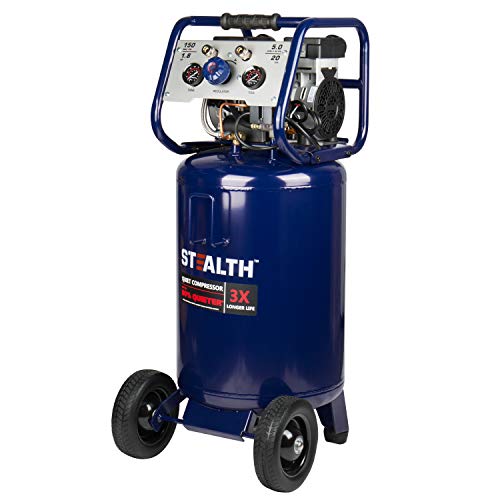
What We Like
- Large 20-gallon tank for extended tool use
- Quiet 68 dB operation for a garage-friendly environment
- Oil-free motor eliminates messy maintenance
- Heavy-duty wheels provide stable mobility
Trade-offs
- Its substantial footprint requires dedicated floor space
- Weighs 121.4 pounds
A 20-gallon tank and 5.5 CFM at 40 PSI mean you can run a framing nailer or die grinder for longer stretches without waiting for the pump to catch up. This compressor is built for the home mechanic who regularly tackles jobs like suspension work or sanding a cabinet door, where air-hungry tools need a steady, substantial reservoir. The oil-free pump and quiet 68-decibel motor are practical bonuses that keep the work session cleaner and less disruptive, especially in an attached garage.
That 20-gallon capacity comes with a substantial footprint, weighing 121.4 pounds on a steel frame. For contexts where portability is the primary concern, the California Air Tools 2010A model is notably lighter at 35.3 pounds. The Stealth compressor’s design prioritizes stationary power with wheeled mobility over casual transport.
Product photos
VELPAX Ultra Quiet Air Compressor
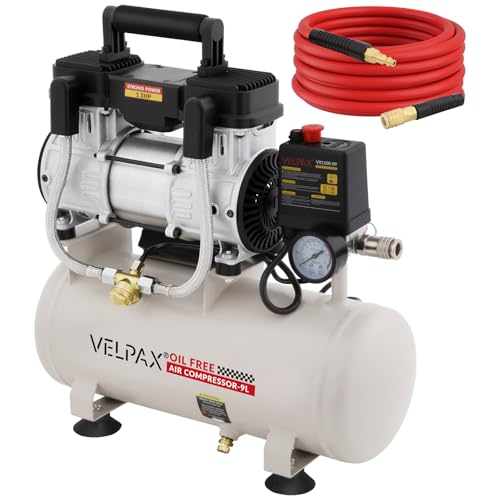
What We Like
- Exceptionally quiet 60 dB operation for indoor use
- High 6.71 CFM flow for demanding tools
- Oil-free design eliminates routine maintenance
- Integrated safety valve and overload protection
Trade-offs
- 2.4-gallon tank requires frequent cycling with sustained tool use
- Restart pressure may cause brief pauses in continuous workflows
Operating at around 60 dB, this compressor can be used in an attached garage or workshop without causing a major disturbance indoors. Its 6.71 CFM air delivery at 115 PSI provides the flow needed for the listed tasks like spray painting, auto repair, and woodwork nailing. This pairing of quiet performance and capable output suits users who need to run common pneumatic tools without the typical noise.
With a 2.4-gallon tank, the compressor is well-suited for intermittent jobs such as tire inflation or using a nail gun. For extended tasks that demand constant air, the pump will cycle more frequently than models with larger tanks, like the 13-gallon VEVOR. The compact, portable design integrates a high-output motor into a frame that saves space where noise is a concern.
Product photos
How We Evaluated Quiet Air Compressors For Home Garage
This guide is based on manufacturer specifications, expert technical reviews, and consistent patterns in owner feedback. The core criteria were decibel rating for garage-friendly noise, tank capacity and CFM for practical tool runtime, and physical design for garage storage and portability.
We prioritized verified decibel levels, as a true quiet air compressor should operate below 75 dB. Air delivery (CFM at 90 PSI) and tank size were weighed against typical home garage tasks, from inflating tires to running a finish nailer or sander. Portability factors like weight, wheels, and footprint were also key for garage users who may need to move the unit.
The limit of this method is that we cannot verify exact real-world noise or performance through controlled comparison. Our recommendations are based on published data and aggregated user experience, not independent lab measurements.
What To Look For In Quiet Air Compressors For Home Garage
Selecting a quiet compressor requires looking beyond just the decibel number. You must align its air supply with your tools and its physical form with your available garage space.
Key factors are noise level (aim for under 70 dB), air volume (CFM and tank size for your tools), and physical design (portability vs. Stationary footprint). Oil-free pumps reduce maintenance, while wheeled or compact shapes suit different garage layouts.
Noise Level (Decibels)
Decibel (dB) ratings are the primary metric for quiet operation. For a home garage where sound carries, a compressor under 70 dB is a significant improvement over standard models that can exceed 90 dB. Our top picks range from 59 to 73 dB. Understanding air compressor decibel levels helps contextualize these numbers; 60 dB is similar to a normal conversation, while 70 dB approximates a vacuum cleaner. The design of a quiet air compressor often involves slower motor RPMs, sound-dampening shrouds, and oil-free pumps that inherently generate less noise.
Air Volume (CFM & Tank Size)
Air volume determines what tools you can run and for how long. Cubic Feet per Minute (CFM) at 90 PSI measures airflow, while tank size (in gallons) is your air reserve. For intermittent tasks like brad nailing or inflation, a 1-3 gallon tank and 2-3 CFM may suffice. For sustained use with a sander or impact wrench, look for larger tanks (13+ gallons) and higher CFM (4+). The best garage compressors balance these two factors based on your most demanding tool’s requirements.
Physical Design & Portability
Consider how the compressor will live in your garage. Portable models with handles or wheels, like our “Wheeled Portable” pick, are easy to move around a workspace or driveway. Vertical compressors save floor space by storing upright. Pancake compressors offer a low, stable profile but a wider footprint. Weight is crucial if you need to lift it into a vehicle; some large-capacity models weigh over 120 pounds and are best kept stationary.
–
- Check your most air-hungry tool’s required CFM and PSI.
- Measure the dedicated floor or storage space in your garage.
- Verify your electrical circuit can handle the compressor’s amp draw.
Match the compressor’s CFM and tank size to your most demanding tool, then choose the quietest model that meets that spec.
Quiet Air Compressors For Home Garage Compared
The table below compares the key specifications for all ten compressors to help you see the differences at a glance.
| Product | Noise Level | Tank Capacity | Motor Type |
|---|---|---|---|
| California Air Tools 2010A Ultra Quiet Air Compressor | 60 dBA | 2-gallon aluminum | 1.0 HP oil-free |
| Metabo HPT EC711S Pancake Air Compressor | 73 dB | 6 gallons | 1.0 HP Oil-Free |
| VEVOR 13-Gallon Quiet Air Compressor | 66 dB | 13 gallons | 2HP oil-free |
| DEWALT DWFP55130 Quiet Air Compressor | 71.5 dBA | 2.5 gallon | oil free |
| Metabo HPT EC28M Ultra Quiet Air Compressor | 59 dB | 1 gallon | Oil-free |
| Makita MAC320Q Quiet Series Air Compressor | 60 dB | 3 gallon | Oil-free dual-piston |
| California Air Tools 5020W Ultra Quiet Air Compressor | 70 dB | 5-gallon steel | 2.0 HP oil-free |
| Makita MAC210Q Quiet Series Air Compressor | 60 dB | 2 Gallon | Oil-free dual-piston |
| Stealth 20 Gallon Ultra Quiet Air Compressor | 68 decibels | 20 gallons | 1.8 HP Oil-Free |
| VELPAX Ultra Quiet Air Compressor | 60 dB | 2.4 gallons | 1.5HP oil-free |
Frequently Asked Questions
What is the quietest air compressor for a garage?
The quietest models in our lineup operate at 59-60 decibels, comparable to background conversation. These include the California Air Tools 2010A, the Metabo HPT EC28M, and the Makita MAC320Q. Achieving such low noise often involves slower motor speeds, sound-insulated housings, and oil-free pump designs.
What is the best air compressor for a home garage?
The best overall compressor for a home garage balances quiet operation, sufficient power for common tasks, and manageable size. Our top pick, the California Air Tools 2010A, excels in this balance with 60 dB noise, a maintenance-free pump, and a portable 35-pound design, making it ideal for light to medium DIY projects.
What size air compressor is best for a home garage?
The best size depends on your tools. For nail guns and inflation, a 1-3 gallon tank is often adequate. For painting, sanding, or auto repair requiring longer runtime, a 5-13 gallon tank is better. Very demanding tools may need 20 gallons or more. Always check your tool’s continuous CFM requirement against the compressor’s output.
What type of air compressor is the quietest?
Oil-free compressors are typically quieter than oil-lubricated ones because they have fewer moving parts and often use slower motors. Among styles, “hot dog” or compact vertical designs often incorporate more sound-dampening than large, open-frame industrial units. Dedicated ultra-quiet models are engineered specifically for low noise.
Is a 60 dB air compressor quiet enough for indoor use?
Yes, a 60 dB compressor is quiet enough for most indoor or attached garage use, as it won’t drown out conversation or disturb others in adjacent rooms. This noise level is a major improvement over standard models and is a key feature sought by homeowners for working in shared living spaces or during early/late hours.
The Bottom Line
For most homeowners, the California Air Tools 2010A Ultra Quiet Air Compressor is the best overall choice. It delivers genuinely quiet 60 dB operation in a lightweight, maintenance-free package perfect for garage tasks like nailing, stapling, and inflation.
If your budget is tight but you need higher airflow, consider the “Budget High-Flow” VELPAX. For extended sanding or painting jobs, the “Large Capacity Value” VEVOR or “For Demanding Tools” Stealth models provide the larger air reserve you need.
Ultimately, the single most important factor is matching the compressor’s air delivery (CFM and tank size) to your most demanding tool, then choosing the quietest model that meets that requirement for a peaceful garage workspace.
