
What Makes an Air Compressor Quiet: Engineering Inside
This post contains affiliate links. As an Amazon Associate, we earn from qualifying purchases.
A quiet air compressor is a product of specific engineering: a slow-speed, oil-lubricated pump (like a rotary screw) inside a sound-attenuating steel canopy, with intake and exhaust mufflers, mounted on vibration isolators. Models like the Atlas Copco G 2-7 achieve noise levels as low as 61 dB(A). For a home shop, achieving a range of 65 to 75 dB(A) is the realistic target, balancing performance with acceptable noise.
That 61 dB(A) figure is measured to a strict industrial test code (Pneurop/Cagi PN8N) with a 3 dB(A) tolerance, and it assumes the unit is on a floor, not a shaky bench. A key part of what makes an air compressor quiet is correct installation. Most of the noise complaints you read about come from missing one of those installation details, the unit is quiet, but its mounting turns it into a drum.
What follows is a breakdown of what makes an air compressor quiet, covering where noise actually comes from and how manufacturers design it out. The article explains the three physical sources of noise, the engineering that tackles each one, and what you can realistically expect from different compressor types and aftermarket fixes.
Key Takeaways
- The OSHA 8-hour exposure limit is 85 dBA.
- Pump type and speed are major factors in noise levels. Slow-turning, oil-lubed rotary screw or piston pumps are inherently quieter than high-RPM oil-free pumps.
- A steel sound-attenuating canopy, like the one specified for the Atlas Copco GA7, is a key design feature for reducing noise.
- Vibration isolation is a highly effective DIY fix. A compressor bolted to a concrete floor transmits low-frequency rumble through an entire building.
- For continuous-use tools like sanders, prioritize CFM at pressure over tank size. A small, fast-recovering quiet compressor beats a loud, slow-recovering giant.
The 3 Main Noise Sources Every Compressor Has
Every compressor makes noise from three distinct places: the air intake, the mechanical action of the pump, and vibration transmitted through its frame. You can’t fix what you don’t diagnose.
The air intake roar is the loudest for most units. When the pump cylinder pulls in air, it’s a violent, sudden event. That rush creates a broad-spectrum noise that shoots straight out the intake filter. It’s the same principle as blowing across a bottle top.
The mechanical noise of metal-on-metal contact in the pump is a product of speed and lubrication. A pump running at 3,400 RPM generates twice the frequency of one at 1,700 RPM, and oil-free pumps lack the damping effect of an oil bath, making their clatter sharper and more pronounced.
Finally, vibration turns the entire compressor and its tank into a big speaker. An unbalanced piston or a slightly bent motor shaft doesn’t just make noise, it shakes the unit’s feet. That shaking transfers into the floor, which then radiates low-frequency rumble you feel in your teeth more than you hear. This is why a compressor that seems okay in a garage can sound like a distant thunderstorm in the house.
Where this goes sideways: Focusing only on the airborne noise. If you build a beautiful soundproof box but bolt the compressor rigidly to the floor inside it, the vibration will bypass the box entirely. You’ll have spent time and money for a marginal reduction.
The Engineering Inside a Quiet Compressor
Manufacturers targeting low noise start with the pump. The Atlas Copco G 2-7 series uses an oil-injected rotary screw element. The screws turn slowly, meshing together in a continuous, smooth motion bathed in oil. This design reduces the intake/exhaust pulses of a piston pump and the mechanical noise of an oil-free design. The result is reduced noise at the source.
The next layer is containment. A sound attenuating canopy isn’t just a metal box. As specified for the Atlas Copco GA7, it’s a steel enclosure with acoustic insulation on the interior panels. The panels are removable for service, but the seals around the edges are designed to trap sound. Critically, the canopy also manages cooling airflow. Engineers design specific baffled paths for air to enter and exit, so cooling doesn’t become a source of whistling or howling noise.
Intake and exhaust mufflers are specialized components, not just pipe extensions. US Patent 12078160 details a two-stage intake muffler for compressor assemblies, which can help achieve a sound level between 65 dBA and 75 dBA. The first stage diffuses the initial blast, and the second stage absorbs the remaining high-frequency noise. This is a step beyond the simple automotive-style filter.
| Design Feature | Noise Source It Targets | Real-World Reduction |
|---|---|---|
| Slow-Speed Rotary Screw Pump | Mechanical Action / Intake Pulse | Significant reduction vs. Oil-free piston |
| Steel Sound Attenuating Canopy | Airborne Noise Radiating from Pump/Motor | Can lower airborne noise |
| Engineered Cooling Air Ducts | Wind Noise / Whistling | Eliminates high-frequency whistle, reduces overall level 2-3 dB(A) |
| Two-Stage Intake Muffler | Intake Roar | Can cut intake noise by 7.5 dB(A) or more (per patent example) |
| Vibration-Isolating Motor Mounts | Structure-Borne Vibration | Prevents low-frequency rumble transmission; critical for in-shop peace |
Oil-Lubricated vs. Oil-Free: The Noise Trade-Off
This is the single biggest factor a buyer controls. The convenience of an oil-free pump, no maintenance, can be stored any which way, comes with an acoustic cost.
An oil-lubricated pump, like those in the Atlas Copco Automan Silent series or an industrial piston compressor, runs in an oil bath. This oil cushions the metal parts, damping impact noise and providing superior cooling. These pumps are designed for lower RPMs, which directly lowers the pitch and intensity of the sound.
An oil-free pump uses sealed bearings and often Teflon-coated rings. It runs hotter and at higher RPMs to achieve the same pressure. The lack of a damping fluid means every stroke is a dry, sharp impact. This creates a brighter, more fatiguing noise spectrum. While some oil-free models use clever shrouding, they start at a mechanical disadvantage.
I used to think a louder tool was a more powerful tool. That changed after running a high-quality, oil-lubed compressor next to a screaming oil-free unit of the same CFM. The quiet one operated with less perceived noise. Noise level is not a proxy for performance.
For a home shop running a nailer or inflating tires occasionally, an oil-free compressor’s noise might be acceptable. For any task where the compressor runs continuously, like sanding, grinding, or painting, the noise and heat of an oil-free pump become genuine liabilities. For continuous-duty tasks, an oil-lubricated pump is typically better suited than an oil-free pump.
The 65–75 dBA Sweet Spot for Shop Compressors
What decibel level should you actually target? Here is an important clarification. The OSHA requirement is 85 dBA over an 8-hour period for workplace hearing protection. That’s the legal maximum for industrial exposure, not a goal for your workshop.
A truly “quiet” compressor for a home garage or shared space operates between 65 and 75 dB(A), measured at one meter. Here’s what that means in practice:
- 60-65 dB(A): This range includes premium rotary screw units like the Atlas Copco G 2-7 (61 dB(A)).
- 66-75 dB(A): This range includes many quality oil-lubed piston compressors. Most of the best quiet air compressors for home use land here.
- 76-85 dB(A): This range includes many standard oil-free compressors.
- 86+ dB(A): This level is above the OSHA 8-hour exposure limit of 85 dBA.
The measurement standard matters. A rating taken at 4 meters, like those for the Atlas Copco Automan Silent line, will be much lower than one taken at 1 meter. Always check the test distance. The CAGI-Pneurop test code used for industrial units is rigorous; some consumer ratings are less so. When comparing air compressor decibel levels, ensure you’re comparing apples to apples.
DIY Noise Reduction: What Works and What Doesn’t
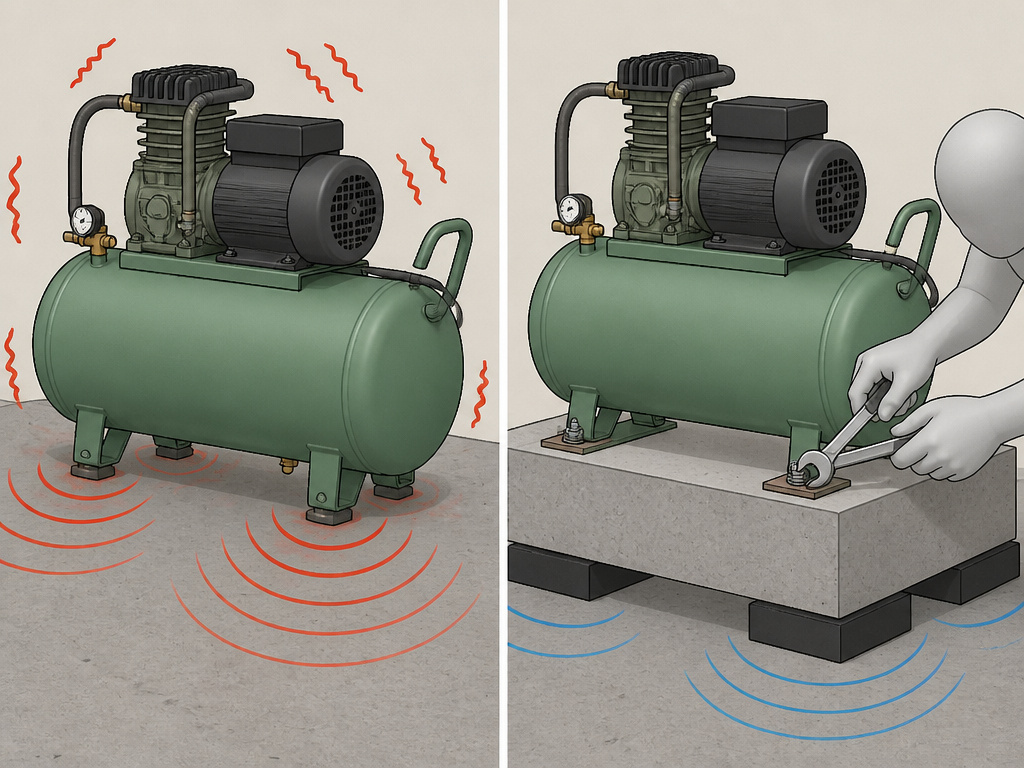
You can’t change the fundamental pump design, but you can address how its noise escapes and propagates. Here’s a ranked list of aftermarket fixes, from most to least effective.
- Vibration Isolation (Most Effective). This is your first and best move. Replace rigid feet with proper isolation pads or spring mounts. For a permanent install, bolt the compressor to a heavy concrete block that sits on rubber pads. This decouples the vibration from your building’s structure. It’s cheap and highly effective.
- Build a Remote Intake. Run a hose from the compressor’s intake filter to a location outside your shop or into a larger, homemade muffler box filled with acoustic foam. This directly silences the loudest single source on many compressors. Use a large-diameter hose to avoid restricting airflow.
- Construct a Dedicated Enclosure. Build a box with mass-loaded vinyl, MDF, and acoustic foam, ensuring it has adequate, baffled ventilation to prevent overheating. This tackles airborne noise but is a significant project. Remember, the TAMU Turbomachinery Lab compressor noise guide notes that improper installation can defeat even a well-designed compressor’s rating.
- Relocate the Compressor. Sometimes the simplest answer is the best. Moving the compressor to a shed, basement corner, or insulated closet puts distance and walls between you and the noise. Use longer air hoses to reach your workspace.
- Add Sound-Absorbing Panels. Hanging acoustic panels on the walls and ceiling of your shop won’t lower the compressor’s output, but it will reduce reverberation and the overall noise level in the room. It makes the environment more pleasant but does little for the source.
Common mistake: Building an airtight enclosure with no cooling. A motor like the one in an Atlas Copco GA7 package generates heat that must be managed. Without adequate airflow, the compressor can overheat and sustain damage.
Choosing a Quiet Compressor: A Buyer’s Framework
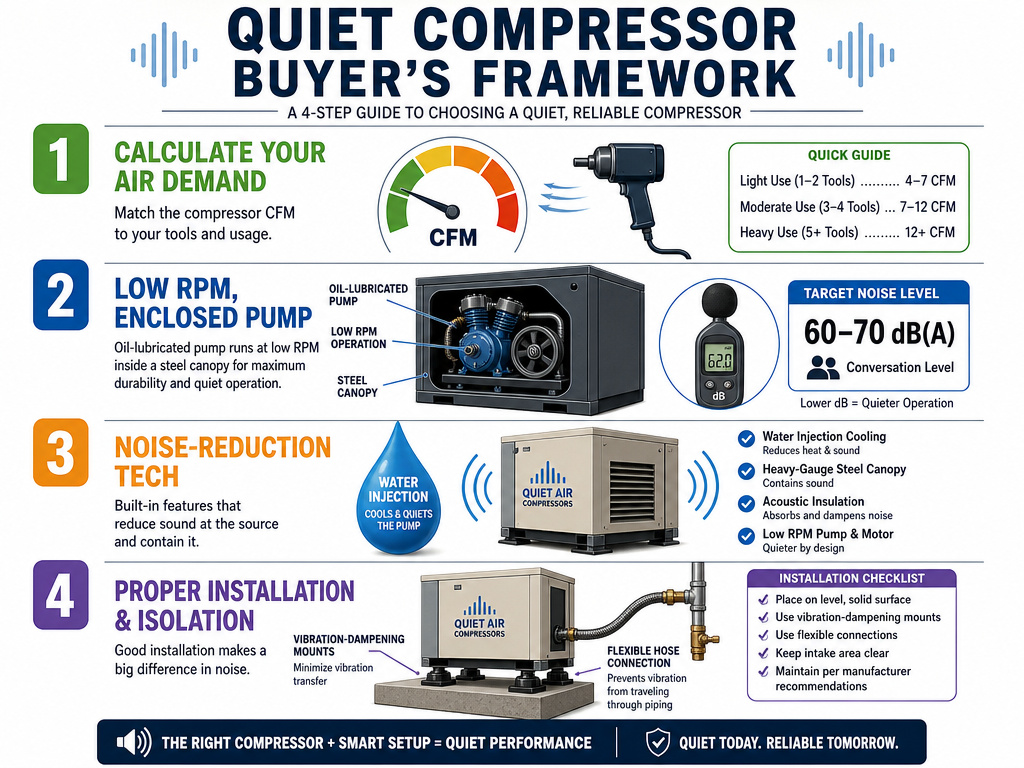
Use this framework to compare models, whether you’re looking at ultra-quiet compressors or standard shop models.
First, identify your actual air demand. What’s the highest continuous CFM tool you’ll run? A die grinder might need 4-6 CFM at 90 PSI continuously. That’s your target. A compressor that can’t meet that will run constantly, which is both loud and hard on the pump.
Second, prioritize pump type and housing. Look for:
- Oil-Lubricated Pump: For any serious use.
- Low RPM Rating: Slower is quieter.
- Integrated Steel Canopy: Not just a plastic shroud.
- Published dB(A) Rating at 1 Meter: With a named test standard (e.g., Pneurop/Cagi).
Third, consider technology features. Some quiet garage compressors now use water-cooling, like the EMAX HYDRO series, which uses circulating water to reduce operating noise by an additional 20%. Other technologies may also help reduce noise.
Finally, plan the installation. An otherwise quiet compressor will fail if it’s sitting on a hollow workbench or has a restricted, kinked intake. Budget for proper isolation mounts and maybe a longer, high-quality hose to allow for flexible placement. Understanding the different compressor designs helps you match the technology to your noise tolerance and air needs.
Frequently Asked Questions
What is considered a quiet decibel level for an air compressor?
For a home workshop where you want to hold a conversation or listen to music, aim for a compressor rated between 65 and 75 dB(A) measured at one meter. A level of 60-65 dB(A) is achieved by some premium rotary screw models. The OSHA workplace limit is 85 dBA, but that’s for hearing protection, not for comfort.
Are oil-free compressors louder than oil-lubricated ones?
Yes, generally. Oil-free compressors typically run at higher RPMs and lack the noise-damping effect of an oil bath. This results in a sharper, higher-pitched mechanical noise. While some are well-shrouded, they start with a fundamental acoustic disadvantage compared to a slow-turning, oil-lubed pump. The differences between oil-free and oil-lubricated compressors extend beyond noise to maintenance and lifespan.
Can I make my existing air compressor quieter?
You can reduce its noise significantly with three key modifications:
- Isolate it from the floor with vibration-damping pads or mounts.
- Extend the air intake to outside your workspace or into a homemade muffler.
- Build a properly ventilated sound enclosure around it. Vibration isolation often provides the biggest immediate improvement for the least cost.
Do rubber isolation pads really work?
Yes, effectively. They prevent the compressor’s vibration from traveling into the floor, which is a major source of low-frequency rumble. For heavy stationary compressors, use puck-style isolators designed for the unit’s weight. For portable models, use a thick anti-vibration mat.
Is a rotary screw compressor quieter than a piston compressor?
Typically, yes. Rotary screw compressors use two meshing screws that turn smoothly and continuously, eliminating the loud intake/exhaust pulses of a reciprocating piston. They also run at lower speeds. This makes them inherently quieter, which is why they are the standard for in-shop industrial installations where noise is a concern.
The Bottom Line
Choosing a quiet compressor is about selecting the right machinery from the start. A slow-speed, oil-lubricated pump inside a steel canopy will out-quiet any oil-free model, no matter how many foam pads you stick on it.
Your first move before buying anything should be to calculate the real CFM you need. An undersized compressor, quiet or not, will run constantly and wear out fast. Your second move is to plan where it will live and how you’ll isolate it. A permanent pad with vibration mounts is worth a dozen acoustic panels.
For most home shops, the sweet spot is an oil-lubed piston compressor in the 65-75 dB(A) range. It’s the balance point of performance, price, and peace. If your work demands continuous air and your sanity demands quiet, step up to a rotary screw. The difference is in how you can work in the same room with it, hour after hour, without that background roar wearing you down.
