
10 Best Coil Siding Nailers in 2026
This post contains affiliate links. As an Amazon Associate, we earn from qualifying purchases.
For a reliable, lightweight pneumatic nailer that handles most siding jobs, the Bostitch N66C Coil Siding Nailer is our best overall pick. Those who prioritize tool-free depth control should look at the Makita AN613, and budget-focused users will appreciate the value of the Freeman PCN65.
Choosing the right coil siding nailer makes installing vinyl, wood, or fiber cement siding faster and more professional. The right balance of weight, capacity, and adjustment features can reduce fatigue and improve results. Our guide is based on research into specifications, manufacturer data, and patterns in expert and owner feedback, helping you find the ideal tool for your project.
Top 10 Coil Siding Nailers in the Market
Certain content that appears on this site comes from Amazon. This content is provided "as is" and is subject to change or removal at any time.
The Best Coil Siding Nailers, Reviewed
Bostitch N66C Coil Siding Nailer

What We Like
- Lightweight aluminum design for durable handling
- Adjustable depth guide for precise nail setting
- Tool-free exhaust directs air away from user
- Soft rubber foot protects softer siding materials
Trade-offs
- Limited to pneumatic operation, requires an air compressor
- Maximum nail length of 2-1/2 inches may limit some applications
- Accepts only wire weld and plastic collated nails
At 4.1 pounds, the Bostitch N66C is lighter than many comparable pneumatic nailers, making it easy to maneuver overhead or during long siding runs. Its compact 11-inch length and 12-inch height contribute to a well-balanced feel that, according to expert assessments, provides a clear line of sight for accurately lining up nails with vinyl siding tabs. The tool-free adjustable exhaust directs air away from the user, which helps keep the immediate work area cleaner. Research notes the nailer performed flawlessly, firing nails into denser cedar and cement siding consistently with no jamming even with longer 2½-inch nails.
As a pneumatic tool, it requires a compressor and hose, which can limit mobility compared to battery-powered options. The nailer drives wire weld and plastic inserted coil nails from 1-1/4 to 2-1/2 inches in length, covering the standard range for most siding applications. Its lightweight aluminum design and soft rubber foot are built to provide durability while helping prevent damage to softer wood surfaces during use.
Makita AN613 Pneumatic Siding Coil Nailer

What We Like
- Tool-less depth adjustment with nine precise settings
- Smooth nose tip prevents material scratching
- Multi-directional exhaust port directs air away
- Reversible hook for convenient hanging
Trade-offs
- At 7.5 lb, it's heavier than the 4.1 lb Bostitch N66C
- Dimensions are bulkier than several other models in the guide
The Makita AN613’s standout feature is its tool-less depth adjustment with nine distinct detents. This lets you dial in the perfect countersink for different siding materials without fumbling for a hex key, a major time-saver on a long job. It’s a solid choice for installers who value precision and hate interrupting their workflow. The smooth nose tip is a thoughtful touch that protects your finish work from accidental marks.
Weighing 7.5 pounds, the Makita AN613 is heavier than some competitors, which could contribute to user fatigue during extended use. For comparison, the Bostitch N66C weighs 4.1 pounds. Its tool-less depth adjustment offers nine distinct settings for precise flush or countersink nailing on siding projects.
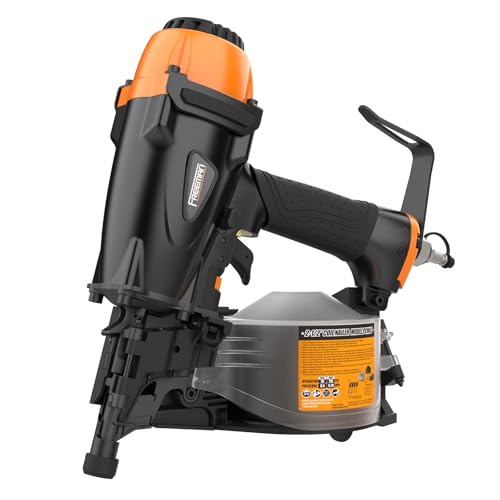
Freeman PCN65 Coil Siding Nailer
What We Like
- Durable one-piece steel drive blade
- Transparent bucket for fastener visibility
- Magnetic nail holder helps prevent jams
- Fire lock for safe transport
Trade-offs
- At 6.0 lb, heavier than the 4.1 lb Bostitch N66C
- Large 13.2-inch length can be cumbersome in tight spaces
A 2-1/2 inch nail capacity lets you handle everything from thin cedar shingles to thick roof sheathing with one tool. This versatility makes it a good fit for pros who need a do-it-all nailer for a full day’s work. The tool-free depth adjustment and dual firing modes mean you can quickly switch from precision trim work to fast-paced sheathing without fumbling for a hex key. This combination of capability and user-focused design delivers professional-grade performance without the premium brand price tag.
Designed for siding, cedar shingles, roof and wall sheathing, and wood fencing, this nailer is built for general construction applications. Its one-piece hardened steel drive blade and anodized aluminum cylinder create a durable pneumatic tool resistant to damage, which means it’s constructed for long-term use on the jobsite. The tool does carry some extra bulk, measuring longer and heavier than streamlined competitors like the Bostitch N66C, so it can feel less nimble when working on ladder transitions or overhead.
Metabo HPT NV65AH2 Coil Siding Nailer

What We Like
- Exceptionally lightweight at 4.8 pounds
- Accepts both wire and plastic collated nails
- Tool-less depth of drive adjustment
- Switchable actuation for safety or speed
Trade-offs
- Maximum nail length is 2-1/2 inches
At just 4.8 pounds, this nailer significantly reduces arm fatigue during long siding runs or overhead work. That low weight, combined with its selective actuation switch and adjustable air deflector, makes it a highly maneuverable and user-focused tool. It’s an ideal match for installers who prioritize comfort and control throughout a full day on the ladder, especially when paired with its ability to handle both plastic and wire collated fasteners.
The trade-off for that lightweight design is a focused scope. It drives nails up to 2-1/2 inches, which is perfect for siding but falls short if you also need a tool for heavier framing tasks. For those jobs, you’d look to a heavier-duty model like the Metabo HPT NV75A5. For dedicated siding installation, however, the NV65AH2’s blend of heft and flexibility is hard to beat.
DeWalt DW66C-1 Coil Siding Nailer
What We Like
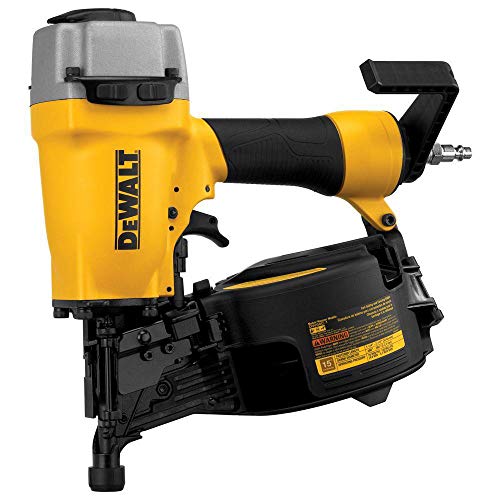
- Tool-free adjustable exhaust for easy redirection
- Light weight reduces arm fatigue during long sessions
- Includes both sequential and bump firing modes
- Simple depth adjustment for precise nail setting
Trade-offs
- Switching firing modes requires a trigger swap
An empty weight of just under 5 pounds makes this one of the lightest coil siding nailers available, a real benefit when you’re facing a full day of siding work overhead. That lightness, combined with its tool-free exhaust port you can spin with your fingers to direct air away from your face, makes it a comfortable and practical choice for consistent, high-volume work. It suits the pro or serious DIYer who values ergonomics and wants to avoid the fatigue that comes from heavier tools.
Weighing just under five pounds, the DeWalt DW66C-1 is one of the lightest coil siding nailers available, which makes it easy on the arm during long siding or fencing projects. It features a tool-free adjustable exhaust and a depth adjuster that reviewers report is easy to access and effective for dialing in the perfect nail set. The nailer offers both sequential and bump firing modes, though switching between them requires swapping out the trigger mechanism.
Max USA SuperSider CN565S3 Coil Nailer
What We Like
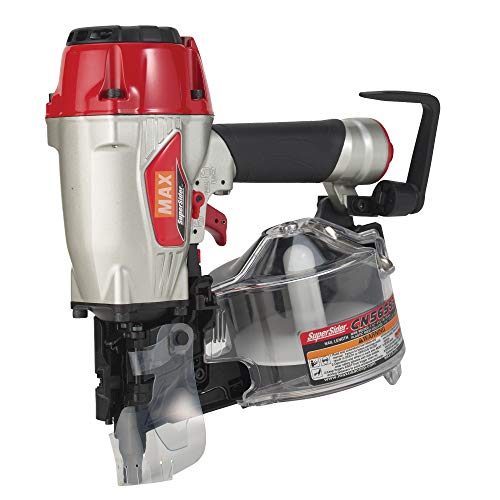
- Tool-less 360-degree exhaust deflector for clean air direction.
- Easy-nail-load magazine simplifies coil changes.
- Maintenance-free end cap filter reduces internal upkeep.
- Anti-double fire mechanism prevents accidental fastening.
Trade-offs
- At 5.2 lb, it is over a pound heavier than the 4.1 lb Bostitch N66C.
The standout feature here is the easy-nail-load magazine, which makes reloading coils a quick, frustration-free task on a busy job site. Combined with a maintenance-free filter and a tool-less exhaust that you can spin to any angle, this nailer is built for the installer who values minimizing downtime and keeping debris out of their face. It’s a straightforward, pragmatic choice for siding pros who prioritize a smooth workflow over chasing the absolute lightest tool in the rack.
Weighing 5.2 pounds, the Max USA SuperSider is heavier than some key competitors, which could influence handling over extended use. Its design prioritizes features like an easy-nail-load magazine and a maintenance-free filter for operational simplicity. For high-volume siding jobs where those features are critical, the trade-off may be acceptable, but the weight is a factual point of comparison.
Product photos
Senco 15-Degree Siding Nailer
What We Like
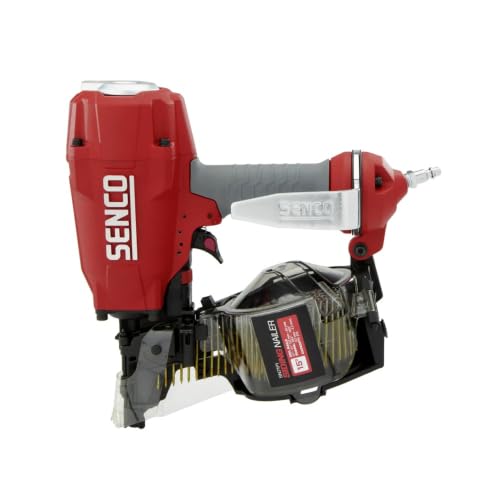
- Massive 375-nail coil capacity.
- Accepts nails down to 1.25 inches.
Trade-offs
- At 11.5 lb, it's the heaviest in the guide.
- Bulky 13.7-inch width demands a solid grip.
A 375-nail coil capacity means you can work longer stretches of siding without stopping to reload, which is a serious advantage on large projects where time is money. This makes the Senco 15-Degree Siding Nailer a logical choice for professional crews focused on pure productivity. The tool is built for output, favoring the user who values maximum uptime over a lightweight tool.
The trade-off for that huge magazine is significant heft and bulk. At over eleven pounds, it demands more arm strength than pneumatic options like the 4.1-pound Bostitch N66C. You must also supply your own power source, as the listing is for the tool only. For a professional with compatible equipment, this adds a capable tool. For someone tackling a single home project, the added weight and system cost might outweigh the capacity benefit.
Product photos
VEVOR CN65 Coil Siding Nailer

What We Like
- Tool-free depth adjustment wheel
- Large 250-nail side-loading magazine
- Accepts both wire and plastic collated nails
- Bump firing mode for rapid work
Trade-offs
- At 6.7 lb, it's heavier than several pro models
- Requires a 15+ gallon air compressor
- Noise and hose management of a pneumatic tool
A 250-nail magazine means you can cover a lot of siding or decking before stopping to reload, a serious efficiency boost for big jobs. This VEVOR nailer hits the core specs you need for siding, fencing, and sheathing, offering tool-less depth adjustment and compatibility with both common nail types. It makes sense for the cost-conscious DIYer or a contractor who wants a capable secondary gun without paying for a brand-name badge.
Weighing 6.7 pounds, the VEVOR CN65 is heavier than some models like the 4.1-pound Bostitch N66C, so users may feel the difference during extended use. Its design includes a full-capacity magazine and a metal body, which contributes to this weight. For users prioritizing a lower upfront cost and high magazine capacity, the tool’s heft is part of the package.
Product photos
Metabo HPT NV75A5 Coil Siding Nailer

What We Like
- Lightweight for easy maneuverability
- Accepts long 3-inch nails for framing
- Tool-less depth adjustment for flush driving
- No-mar nose cap protects work surface
Trade-offs
- Heavier than the 4.1 lb Bostitch N66C
- Longer body at 15.4 inches can be cumbersome in tight spaces
Accepting coil nails up to 3 inches long lets this tool handle both siding attachment and light framing duties without a swap. That versatility, combined with a selective actuation switch for toggling between precision and speed, makes it a logical choice for contractors who tackle mixed projects. The adjustable air deflector and no-mar nose are thoughtful touches that protect both the user and the material during long installs.
You do pay for that capacity with a bit more heft and length than some dedicated siding nailers. At 5.7 pounds and over 15 inches long, it’s not the most compact option for intricate soffit work or all-day overhead use. If your work is strictly siding, the lighter Bostitch N66C might be easier on the arms. But if your jobs regularly blur the line between siding and structural sheathing, this Metabo HPT consolidates two tools into one reliable package.
Product photos
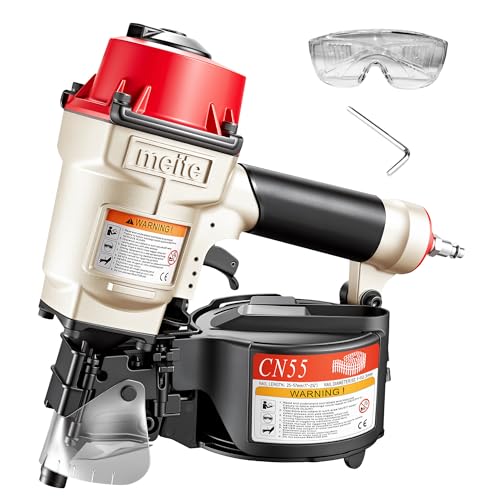
meite CN55 Coil Siding Nailer
What We Like
- High-capacity 300-nail coil reduces reloading
- Lightweight 4.8-pound design minimizes arm fatigue
- Tool-free depth adjustment with thumb wheel
- No-mar tip protects pre-finished siding
Trade-offs
- Maximum nail length is 2-1/4", shorter than some rivals' 2-1/2" capacity
- Pneumatic operation requires a compressor and hose
A magazine holding 300 nails means you can work longer on the wall before climbing down to reload, a serious efficiency boost for contractors facing a full-house siding job. This high capacity, paired with a light 4.8-pound magnesium body, makes the meite CN55 a logical choice for pros who prioritize minimizing downtime and fatigue over a long day. The tool-free depth adjustment and 360-degree exhaust give you the control and clean operation needed for quality results on materials from fiber cement to cedar.
This nailer drives nails up to 2-1/4 inches long, which handles common siding and sheathing materials like fiber cement and OSB. While it can’t drive the full 2-1/2-inch fasteners offered by some competitors, its 300-nail coil capacity means fewer reloads during large projects. That balance of sufficient nail length and high magazine capacity keeps the focus on installation rather than resupply.
Product photos
How We Evaluated Coil Siding Nailers
This guide is based on an analysis of manufacturer specifications and product documentation to compare features such as nail capacity, weight, and collation types. It also considers professional tool reviews and user feedback to understand typical performance and trade-offs.
Our key criteria included tool weight and ergonomics for all-day use, adjustment mechanisms for precise nail depth, magazine design for ease of loading and maintenance, and overall durability for professional-grade work. This research-led approach gives a comprehensive overview, but it cannot replicate the feel of a tool in your hand or its performance over thousands of nails.
What To Look For In Coil Siding Nailers
Selecting a coil siding nailer involves more than just power. You need a tool that fits your specific siding material, project scale, and physical comfort during long workdays. A well-chosen nailer drives nails consistently flush without damaging the material, minimizes reloading stops, and feels balanced in your grip.
Prioritize a lightweight design if you’ll be working overhead, ensure it accepts the nail collation your project requires, and look for tool-free adjustments for depth and exhaust direction.
Weight and Ergonomics
A nailer’s weight directly impacts user fatigue, especially on large projects or when working above shoulder height. Our research shows weights ranging from under 5 pounds to over 11 pounds. Lighter models, like the 4.1-pound Bostitch N66C, are easier to maneuver and reduce arm strain. Heftier tools often offer greater durability or higher capacity but can become cumbersome. Balance is also crucial; a well-balanced tool feels lighter and offers better control for precise nail placement.
Nail Capacity and Collation
Magazine capacity determines how often you must stop to reload. Coils typically hold between 250 and 375 nails. High-volume contractors might favor a massive 375-nail capacity, while DIYers on smaller jobs may not need the extra weight that comes with it. Also, check which collation types the nailer accepts: wire-weld or plastic. Wire collated nails are generally more affordable, while plastic collated nails can leave a cleaner finish and are often required for certain vinyl siding applications. Some nailers accept both, offering more flexibility.
Adjustability and Features
Precise depth adjustment is non-negotiable for a clean siding install. It allows you to drive the nail head flush without crushing softer materials like vinyl. Tool-less adjustment wheels, like on the Makita AN613, provide quick fine-tuning on the job. Also consider the exhaust port; a tool-free, multi-directional exhaust lets you redirect air away from your face or work area. Finally, assess the firing modes. Sequential firing is safer and more precise, while bump firing mode increases speed for large, open areas.
- Check the maximum nail length the tool accepts to ensure it meets your project requirements.
- Look for features that aid maintenance, like a transparent magazine to see remaining nails or an easy-access nose for clearing jams.
- Consider if you need a reversible hook for hanging the tool or a no-mar tip to protect pre-finished siding.
Your primary siding material should guide your choice. Softer vinyl demands a gentler foot and precise depth control, while fiber cement or wood can be used with a heavier-duty tool.
Coil Siding Nailers Compared
The following table lets you quickly compare the key specifications and features of our top picks side-by-side.
| Product | Weight | Nail Length Range | Collation Type |
|---|---|---|---|
| Bostitch N66C Coil Siding Nailer | 4.1 Pounds | 1-1/4-inch to 2-1/2-inch | wire weld and plastic inserted |
| Makita AN613 Pneumatic Siding Coil Nailer | 7.5 Pounds | 2-1/2" | Wire and plastic collated |
| Freeman PCN65 Coil Siding Nailer | 6.0 pounds | 1-1/4" to 2-1/2" | 15-degree plastic or wire collated |
| Metabo HPT NV65AH2 Coil Siding Nailer | 4.8 pounds | 1-1/2" to 2-1/2" | 16° wire, 15° plastic |
| DeWalt DW66C-1 Coil Siding Nailer | Just under 5 pounds | N/A | N/A |
| Max USA SuperSider CN565S3 Coil Nailer | 5.2 Pounds | Up to 2-1/2" | N/A |
| Senco 15-Degree Siding Nailer | 11.5 Pounds | 1.25 inches minimum | Wire Coil |
| VEVOR CN65 Coil Siding Nailer | 6.7 pounds | 1-1/4" to 2-1/2" | Wire & plastic collated |
| Metabo HPT NV75A5 Coil Siding Nailer | 5.7 lbs | 1-3/4" to 3" | 16° wire, 15° plastic |
| meite CN55 Coil Siding Nailer | 4.8 lbs | 1" to 2-1/4" | N/A |
Frequently Asked Questions
Which coil siding nailer is the best?
Our research points to the Bostitch N66C Coil Siding Nailer as the best overall choice for most users. It combines a very lightweight aluminum design with reliable performance, adjustable depth, and a tool-free exhaust. It’s a versatile pneumatic tool well-suited for contractors and serious DIYers installing various siding types, from vinyl to cement board.
What is the best coil nail gun?
For siding-specific work, a 15-degree coil siding nailer is the best type of coil nail gun. It’s designed to fire ring-shank nails ideal for holding siding securely. The “best” model depends on your needs: the Bostitch N66C for overall balance, the Senco for maximum capacity, or the VEVOR CN65 for budget-friendly projects. Our comprehensive siding nailer guide explores these options in detail.
What type of nail gun is best for siding?
A dedicated 15-degree coil siding nailer is the best tool for the job. It’s engineered for the ring-shank nails that provide superior holding power for siding materials. While a framing nailer can sometimes be used, it’s generally not recommended as it’s overpowered for siding and uses different nails. Understanding the differences between nailers is key to selecting the right tool.
What coil nails to use for vinyl siding?
For vinyl siding, you typically need a corrosion-resistant, ring-shank nail with a small, flat head. Plastic-collated nails are often preferred because they leave less debris. The nail length is critical; it must be long enough to penetrate the sheathing but not so long that it over-drives. Always consult your siding manufacturer’s instructions for the exact nail specification.
Can I use a siding nailer for framing?
It is not recommended. Siding nailers are designed for nails up to 2-1/2 inches long, which is insufficient for framing structural members like 2x4s. Framing requires longer nails, typically 3 inches or more, and a more powerful tool like a dedicated framing nailer. Using a siding nailer for framing could result in weak, unsafe connections.
The Bottom Line
For a dependable, lightweight pneumatic nailer that excels at installing vinyl, wood, and cement board siding, the Bostitch N66C is the best overall choice. If your budget is the primary concern, the VEVOR CN65 offers capable performance at a lower cost, while professionals focused on high-volume work should consider the high-capacity Senco model. No matter which model you choose, ensuring it has precise, tool-free depth adjustment is the single most important factor for achieving a clean, professional-looking siding installation.
