
10 Best Framing Nailers in 2026
This post contains affiliate links. As an Amazon Associate, we earn from qualifying purchases.
For professionals and serious DIYers needing reliable, compressor-free power, the Makita XNB03M1 18V LXT Cordless Framing Nailer Kit is our best overall. The Ryobi ONE+ HP 18V Brushless Cordless Framing Nailer is the best compressor-free option for Ryobi platform users, while the Metabo HPT NR90AES1 stands out as the best budget pneumatic tool.
Choosing the right framing nailer means balancing power, weight, and your existing workshop setup to drive nails efficiently all day. We researched specifications, expert round-ups, and patterns in owner feedback to compare these ten models. This guide explains the key differences to help you select the perfect tool for your framing jobs.
Top 10 Framing Nailers in the Market
Certain content that appears on this site comes from Amazon. This content is provided "as is" and is subject to change or removal at any time.
The Best Framing Nailers, Reviewed
Makita XNB03M1 18V LXT Cordless Framing Nailer Kit

What We Like
- Drives full-round head nails into dense engineered lumber
- Tool-less depth adjustment for precise flush nailing
- Anti-dry fire mechanism helps prevent driving blanks
- Anti-slip nose aids in controlled angled nailing
Trade-offs
- 11.9 lb weight is significant for overhead work
- Not included in recent professional head-to-head tests
This cordless nailer can drive up to 1,000 framing nails on a single charge under ideal conditions, offering extended runtime for larger tasks. It delivers the power to sink full-round head nails into dense engineered lumber, a key feature for modern construction materials. A two-mode selector provides control for sequential nailing or bump fire speed, while the tool-less depth adjustment allows for precise flush and countersink results.
The trade-off is heft. At nearly twelve pounds, you’ll feel it after a long day of overhead sheathing compared to a lighter pneumatic like the Metabo HPT NR90AES1. For pure driving power and runtime in a cordless platform, this nailer sets a high bar. If your work is strictly ground-level decking or you already own a different battery ecosystem, a dedicated tool-only option like the Ryobi might offer better value for less frequent use.
Ryobi ONE+ HP 18V Brushless Cordless Framing Nailer

What We Like
- Drives up to 3-1/2 inch nails without a compressor
- Selectable drive modes for precision or speed
- Tool-free depth adjustment for flush results
- Integrated rafter hook for jobsite convenience
Trade-offs
- Tool-only: requires a separate Ryobi ONE+ HP battery and charger
- Uses 30° clipped-head nails, limiting nail head style options
Its AirStrike technology delivers the power to sink 3-1/2 inch nails without a single hose or gas cartridge. That means you can frame a shed or build a deck without ever dragging out a compressor. For anyone in the Ryobi battery ecosystem who tackles occasional heavy-duty projects, this nailer turns a major setup hassle into pure cordless convenience. The selectable drive modes let you switch from careful trim work to sheathing a roof with just a flip of a switch.
Weighing 11.5 pounds, this nailer trades the lightness of a pneumatic tool for cordless convenience. You skip the compressor and hoses entirely, handling all the driving power within the tool itself. That heft becomes noticeable over a full day, but for a DIYer or contractor prioritizing simplicity, the Ryobi provides framing capability without air lines.
Product photos
Metabo HPT NR90AES1 Pneumatic Framing Nailer

What We Like
- Well-balanced, lightweight design reduces user fatigue
- Tool-less depth adjustment for flush or countersunk nails
- High-capacity magazine holds more nails than standard models
- Five-year professional warranty for long-term reliability
Trade-offs
- Requires a separate air compressor and hose to operate
- Plastic collated nails may not be accepted on all job sites
Weighing 7.5 pounds, this pneumatic nailer is built for all-day framing without wearing you out. It uses a cylinder-valve drive system for improved durability and faster nailing. It was rated the Pro Preferred Nailer for seven consecutive years. For contractors or serious DIYers with an air compressor, this tool delivers pro-grade performance without the premium price of cordless models. Its selective actuation switch also lets you flip between precision and speed as the job demands.
The trade-off for that lighter weight and lower cost is being tethered to a compressor. You gain reliability and a faster driving cycle but lose the cord-free mobility of a model like the Metabo HPT NR1890DRA. Its 3.5-inch nail capacity handles the vast majority of framing and sheathing tasks, though you’ll need a different tool for larger timber work. Owner feedback confirms it’s a durable choice that stands up to job-site abuse, making it a smart foundational tool for your kit.
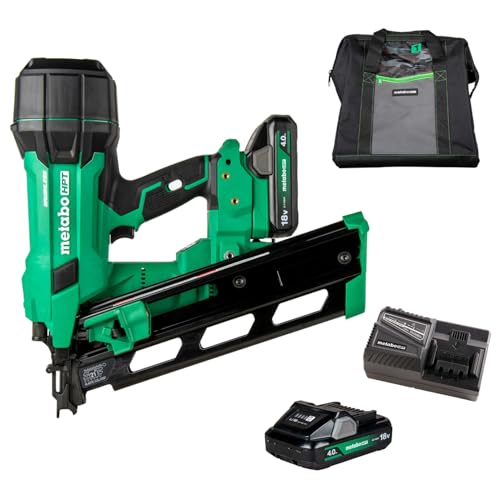
Metabo HPT NR1890DRA MultiVolt Cordless Framing Nailer
What We Like
- Tool-less depth adjustment for quick precision
- Zero ramp-up time like a pneumatic tool
- Compact, 8.4 lb design for tight spaces
- Brushless motor for longer runtime and durability
Trade-offs
- 21-degree collation may not meet all local building codes
- At 8.4 pounds, some may find it heavy for overhead work
Delivering 120 joules of power lets this cordless framer sink three-and-a-half-inch nails into engineered lumber without hesitation, matching pneumatic performance. That power, combined with its air spring drive and zero ramp-up time, makes it a serious job-site workhorse. It’s the ideal choice for a professional or dedicated builder who wants to cut the hose but won’t compromise on driving force. The tool-less depth adjustment and easy mode switching mean you move from precise finish work to rapid sheathing without missing a beat.
Its 21-degree nail collation uses a bulkier magazine than a 30-degree model like the Ryobi ONE+ HP. That can be a hindrance in the tightest corners. For sheer cordless power and ergonomics, however, it stands out in its class. Expert testing noted it effectively drove nails in hard materials where others struggled, and its balance makes it less fatiguing over a long day than many competitors. If your primary concern is reliable power in a cordless package, this Metabo HPT is a compelling pick.
Makita AN924 Pneumatic Framing Nailer

What We Like
- Large air chamber for driving 3-1/2" nails
- Durable aluminum magazine for longer life
- Faster nail driving speed from design
Trade-offs
- Pneumatic design requires a compressor and hose
- No cordless convenience for remote job sites
That lightweight build, paired with a large-capacity air chamber, gives you the consistent power to sink three-and-a-half-inch nails without the tool feeling like an anchor. It’s a straightforward, reliable pneumatic nailer for the pro or serious DIYer who already has a quality air compressor and values a tool that won’t weigh them down. The solid aluminum top-loading magazine is built to handle jobsite abuse, so it’s a tool you can count on for years.
You are tied to an air hose. You gain lightness and simplicity, but you lose the cordless freedom that models like the Metabo HPT MultiVolt offer. If your work is mostly in a single location like a shop or a tightly contained build, the hose is a minor nuisance. For sprawling sites or frequent moves, that tether can become a genuine hassle. This nailer excels where a compressor is already on-site and where saving every ounce on your tool belt directly translates to less fatigue by quitting time.
DEWALT DWF83C Coil Framing Nailer

What We Like
- Cordless 15-degree coil magazine design
- Backed by DEWALT's professional-grade platform
Trade-offs
- Battery and charger sold separately
- Competes against established pneumatic favorites
This DEWALT cordless framer represents the newer generation of battery-powered nailers designed to challenge the long-standing dominance of gas and pneumatic models. It’s built for the pro or serious DIYer who is already invested in a cordless ecosystem and wants to cut the hose for framing and sheathing work. The 15-degree coil magazine holds a significant number of nails, which means fewer reloads when you’re up on a ladder or sheathing a roof. If you’re done with hauling a compressor, this is a solid contender to consider.
Included in a recent head-to-head test of new cordless framing nailers, the DEWALT DWF83C stands as a serious contender among major brands. This research-based comparison places it against other cordless options from Flex, Milwaukee, and Ryobi, signaling its relevance in the current market. The choice for a user often hinges on whether to adopt a modern cordless system or stick with a traditional pneumatic setup, which may have different cost and logistics considerations.
Freeman PFR2190NQ Pneumatic Framing Nailer

What We Like
- Anti-dry-fire mechanism prevents misfires
- Ergonomic comfort grip for reduced fatigue
- Durable one-piece hardened steel drive blade
Trade-offs
- Uses plastic components in its construction
- Requires a separate air compressor to operate
- 21° nail collation may not be as compact as 30° designs
The Freeman nailer is sold with compatible nails, so you can begin working immediately without a separate purchase. Its dual-mode trigger provides a choice between precise sequential firing for careful work and faster bump firing for high-volume tasks like sheathing. Anti-dry-fire protection reduces internal wear and prevents misfires when the magazine is nearly empty, which helps the tool last longer. A tool-free depth adjustment lets you set nail flushness for different materials, while the textured grip enhances control during long sessions.
Research notes several internal parts are plastic, which might give some pause about long-term durability under constant professional abuse. As a pneumatic tool, it also ties you to a hose and compressor, so it’s less mobile than a cordless option like the Metabo HPT NR1890DRA. For framing decks, building walls, or assembling outdoor structures where an air hose is already part of the scene, this Freeman delivers dependable performance with thoughtful user features that smooth out the workday.
Product photos
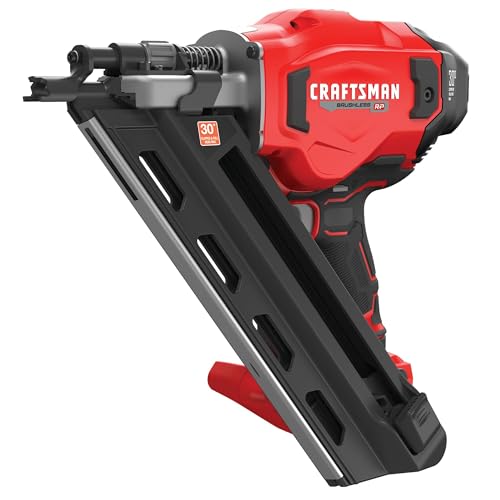
CRAFTSMAN V20 Brushless Cordless Framing Nailer
What We Like
- Tool-free depth adjustment for quick setup
- Rubber overmolded handle minimizes user fatigue
- LED jam indicator alerts to motor stalls
- Rafter hook provides convenient hanging
Trade-offs
- Tool only: requires separate V20 battery and charger
- VERSATRACK storage system is sold separately
The CRAFTSMAN V20 framing nailer uses a brushless motor for better performance and more runtime, making it a fast and efficient cordless option. Its rapid sequential firing mode helps complete jobs quickly, while the tool-free depth change enables quick adjustments for proper nail depth. An LED jam indicator alerts users to possible motor stalls, and the rubber overmolded handle is designed to minimize fatigue during extended use.
You pay for the cordless convenience with some heft; at 9.8 pounds, it demands more arm strength than a lighter pneumatic like the Metabo HPT NR90AES1. Since it’s a bare tool, the real investment includes a battery and charger, making it a commitment to the V20 platform. For a pro already on that system, it’s a logical add-on that brings reliable, hose-free power to the jobsite.
Product photos
BOSTITCH BRT130 Heavy-Duty Timber Framing Nailer

What We Like
- Drives 5-1/8-inch nails for heavy timber
- Adjustable exhaust directs air away
- Smooth trip design for fast cycling
Trade-offs
- 21.5-inch length makes it less maneuverable in tight spaces
The ability to drive 5-1/8-inch nails is what sets this tool apart. That capacity tackles the thick stock and deep penetration required for timber framing, crating, and other heavy structural work. This is a specialist’s tool built for a specific, demanding job. If your project involves large beams or constructing heavy-duty frames, this nailer delivers the necessary power and nail length that standard 3-1/2-inch framers simply cannot match.
That specialization comes with clear trade-offs. Its size and weight make it overbuilt for standard wall framing or decking. The BOSTITCH BRT130 is not your everyday framer; it’s a dedicated solution for when you need to anchor substantial pieces of wood together with serious fasteners.
FLEX 24V Brushless Framing Nailer Kit

What We Like
- Zero ramp-up time for instant firing
- Power adjustment dial for depth control
- Dual LED worklights for dark spaces
- Dry fire lockout prevents blank firing
Trade-offs
- Heavy at 22.1 pounds for overhead work
Driving up to 1,100 nails on a single 5.0Ah charge means you can frame a significant section of a wall or deck without stopping to swap batteries. This extended runtime, powered by a 24V system with thermal management, is the core advantage for pros or serious DIYers tackling large, uninterrupted projects. The tool fires three nails a second with no lag, keeping pace with demanding workflows where cordless convenience can’t come at the expense of productivity.
With a weight of 22.1 pounds, the FLEX nailer is a substantial tool to maneuver all day, particularly on rafters or sheathing roofs. This heft is the trade-off for its extended runtime and 24V power. For a lighter alternative, the Ryobi ONE+ HP cordless framing nailer weighs 11.5 pounds and uses a 30-degree nail angle.
Product photos
How We Evaluated Framing Nailers
This guide is based on a review of manufacturer specifications, professional tool comparisons, and patterns in user feedback from various retailers and forums. The assessment focuses on three core criteria: driving power and consistency, ergonomics and jobsite utility, and platform compatibility or operational requirements.
Power and consistency were paramount, as a framing nailer must sink long nails flush into dense engineered lumber without jamming. We looked for features like anti-dry-fire mechanisms and tool-less depth adjustment that contribute to reliable performance. Ergonomics, including weight, balance, and features like rafter hooks or jam alerts, were assessed for their impact on user fatigue during long projects.
Finally, we considered the tool’s ecosystem. For cordless models, this meant battery platform compatibility; for pneumatics, it involved hose and compressor requirements. A key limit of this research-based approach is that we cannot verify real-world runtime or long-term durability claims, which can vary based on usage intensity and maintenance.
What To Look For In Framing Nailers
Framing nailers are powerful tools designed for structural work, but they come in different forms with specific trade-offs. Your choice hinges on your power source preference, the scale of your projects, and your local building codes.
Focus on power source (cordless vs. Pneumatic), nail collation angle (21° vs. 30°), and ergonomic features like weight and balance to match your typical jobsite conditions.
Power Source: Cordless vs. Pneumatic
Cordless framing nailers offer unmatched jobsite mobility, eliminating the need for a compressor and hose. This saves setup time and reduces tripping hazards, a significant advantage for roof work or remote locations. Modern battery-powered framing nailers use advanced brushless motors and high-capacity batteries to deliver power rivaling pneumatic tools, though they add weight and cost.
Pneumatic nailers, powered by an air compressor, are typically lighter, less expensive for the tool itself, and offer virtually unlimited runtime. However, they tether you to a compressor, which adds noise, setup time, and can limit mobility. For high-volume production framing with a stationary compressor setup, pneumatic framing nailers remain a top choice for many professionals.
Nail Collation and Angle
The collation angle, 21-degree or 30-degree, refers to how nails are bundled in the magazine and is critical for compatibility. The 21-degree angle typically uses plastic-collated nails with full round heads, which are often required by building codes in many regions. The 30-degree angle often uses paper-collated nails with clipped heads, which allow for a more compact magazine but may not be code-compliant everywhere.
Your local supplier availability and code requirements should guide this choice. Some nailers for 21-degree nails are specifically designed for areas where that standard is mandated. Understanding the framing nailer vs finish nailer distinction is also crucial, as finish nailers use much smaller gauge nails for trim and cannot handle framing tasks.
Ergonomics and Jobsite Features
A framing nailer is a heavy tool used repetitively, so comfort and utility features directly impact productivity and fatigue. Look for a well-balanced design; a top-heavy tool becomes exhausting during overhead work. Tool-less depth adjustment is essential for quickly setting nail flushness in different materials. Integrated rafter hooks, rubberized grips, and LED worklights are valuable additions for real-world use. For professionals seeking tools built for demanding daily use, researching durable framing nailers that emphasize longevity and these utility features is a wise step.
- Check the tool’s weight, especially if you’ll be doing frequent overhead nailing.
- Ensure the depth adjustment wheel is easy to access and turn with a gloved hand.
- Look for a secure, adjustable rafter hook if you frequently work on roofs or ladders.
Always verify your local building code’s accepted nail head type and collation before purchasing.
Framing Nailers Compared
The comparison table below highlights the key specifications and differences between these ten framing nailers at a glance.
| Product | Weight | Nail Length Range | Nail Collation |
|---|---|---|---|
| Makita XNB03M1 18V LXT Cordless Framing Nailer Kit | 11.9 lbs | 2" to 3-1/2" | 21° plastic |
| Ryobi ONE+ HP 18V Brushless Cordless Framing Nailer | 11.5 pounds | Up to 3-1/2 inches | 30° |
| Metabo HPT NR90AES1 Pneumatic Framing Nailer | 7.5 pounds | 2 to 3.5 inches | 21° plastic collated |
| Metabo HPT NR1890DRA MultiVolt Cordless Framing Nailer | 8.4 pounds | 3-1/2 inches | 21 degree |
| Makita AN924 Pneumatic Framing Nailer | 11.8 pounds | 2" to 3 1/2" | 21° plastic collated |
| DEWALT DWF83C Coil Framing Nailer | N/A | N/A | 15° Coil |
| Freeman PFR2190NQ Pneumatic Framing Nailer | N/A | 2", 3-1/2" | 21° plastic, full round head |
| CRAFTSMAN V20 Brushless Cordless Framing Nailer | 9.8 Pounds | N/A | 30° |
| BOSTITCH BRT130 Heavy-Duty Timber Framing Nailer | 1.0 pounds | 5-1/8-inch | 21-degree plastic |
| FLEX 24V Brushless Framing Nailer Kit | 22.1 pounds | N/A | 21° framing nails |
Frequently Asked Questions
What is the best brand of a framing nailer?
There isn’t a single “best” brand, as top manufacturers excel in different areas. Makita, Metabo HPT, and DeWalt are highly regarded for their professional-grade cordless and pneumatic models, offering strong power and reliability. For budget-conscious DIYers or those invested in a specific battery ecosystem, brands like Ryobi and CRAFTSMAN provide capable options. The best brand for you depends on your need for cordless power, weight, budget, and any existing battery tools you own.
Which is better, a 21 or 30 degree framing nailer?
Neither is universally better; the choice depends on local building codes and nail availability. A 21-degree nailer typically drives plastic-collated nails with full round heads, which are required in many building codes. A 30-degree nailer often uses paper-collated nails with clipped heads, allowing for a more compact magazine. Always check your local code requirements and consult with your lumberyard on the most readily available nail type in your area before deciding.
Which framing nailer is better, Milwaukee or Metabo?
This depends on your priority. Metabo HPT (formerly Hitachi) nailers are consistently praised in expert reviews for their balance, ergonomics, and power, particularly in their cordless MultiVolt series. Milwaukee makes excellent tools, and their framing nailer is noted in reviews for features like a slim head for tight spaces and an LED light. The better tool is the one that best fits your existing battery platform, feels most comfortable in hand, and meets your specific power and code requirements.
What type of nail gun is best for framing projects?
A dedicated framing nailer is the only appropriate tool for structural framing projects. These are designed to drive large nails, typically 2 to 3-1/2 inches long, into dimensional lumber. They are far more powerful than finish or brad nailers, which are for trim and detail work. For framing, you’ll choose between a cordless model for ultimate mobility or a pneumatic model for lightweight, cost-effective power, provided you have an air compressor.
What should I look for in a cordless framing nailer?
Prioritize driving power, battery platform compatibility, and weight. Ensure the tool can consistently sink the longest nails you’ll use, like three-and-a-half inch nails, into dense lumber. It should be part of a battery system you already own or are willing to invest in, as these batteries are expensive. Finally, consider weight and balance, as cordless models add battery heft; a heavier tool can be cumbersome for all-day overhead work.
The Bottom Line
For the professional or advanced DIYer building a comprehensive cordless toolkit, the Makita XNB03M1 18V LXT Cordless Framing Nailer Kit is the best overall choice. It delivers compressor-free power for full-scale framing. If you’re on a tighter budget and already use a compressor, the Metabo HPT NR90AES1 Pneumatic Framing Nailer offers outstanding lightweight reliability. Ryobi ONE+ HP owners should grab the Ryobi ONE+ HP 18V Brushless Cordless Framing Nailer for serious cordless framing.
Ultimately, your decision should start with your power source: cordless for ultimate jobsite freedom, or pneumatic for proven, lightweight performance. Matching the tool’s nail collation angle to your local building code is the most critical step to ensure your work passes inspection.
