
Can You Use Impact Sockets on a Cordless Ratchet?
This post contains affiliate links. As an Amazon Associate, we earn from qualifying purchases.
Yes, you can and should use impact sockets on a cordless ratchet. Every major manufacturer’s manual for these tools explicitly states to use only impact-rated sockets and accessories. The cordless ratchet delivers high torque, and using standard chrome sockets risks them cracking and causing injury.
That “high torque” clause is where people get tripped up. A cordless ratchet isn’t a hand tool; it’s a power tool that can output hundreds of foot-pounds of force. The internal mechanism is built to handle that strain, but the socket you attach is the final, critical link. Using the wrong one turns a safe tool into a hazard. A common question is, can you use impact sockets on a cordless ratchet?
What follows is a breakdown of why the rule exists, the real difference between socket types, and what happens when you ignore the manual. We’ll also look at the one scenario where the consensus might shift, and why it’s still not worth the risk.
Key Takeaways
- Manufacturer manuals from Snap-on, Milwaukee, and others mandate impact sockets for cordless ratchets and impact wrenches to prevent socket failure.
- Impact sockets are softer (HRC 35-45) and thicker to absorb shock; chrome sockets are harder (HRC 48-52) and more brittle, making them prone to shattering under impact loads.
- The primary risk isn’t the ratchet’s action, but its torque. Even a non-impacting ratchet can deliver enough twisting force to exceed a chrome socket’s brittle strength.
- Using a worn or incorrect size socket reduces effective torque, leading to improperly fastened joints or rounded fasteners.
- For a single, do-it-all socket set, buy impact-rated. They work perfectly on hand tools and are the only safe choice for any power tool you own now or in the future.
The Official Manuals Say: Impact Sockets Only
We should clarify this immediately. This isn’t a suggestion or a best practice debated in online forums. It’s a printed safety directive.
The Snap-on cordless impact wrench manual states: “Use only impact sockets and accessories with these impact wrenches. Use of hand or power sockets will cause premature failure of the socket and possible injury to the user.”
A similar warning appears in manuals for cordless ratchet wrenches. Milwaukee’s operator’s manual is equally blunt: “Use only sockets and other accessories specifically designed for use on impact wrenches and drivers. Other sockets and accessories might shatter or break causing injury.”
The language is consistent because the physics are consistent. A power tool’s output is measured in foot-pounds for a reason. A tool like the Snap-on CT9075 cordless impact wrench has a bolt breakaway torque rating of 1,200 ft-lbs. Your cordless ratchet won’t hit that number, but its torque output is still sufficient to test the limits of a socket not designed for it.
The manual’s warning covers their liability, sure. But it’s based on predictable failure modes they’ve tested. They know that at a certain stress point, a chrome socket will fail before an impact socket does. Your job is to never reach that point.
Impact vs. Chrome: It’s About Physics, Not Color
The difference between an impact socket and a regular chrome socket isn’t just a black oxide finish. It’s a fundamental difference in material science and design intent.
Chrome sockets, often called “hand sockets,” are made from a harder, more brittle steel alloy. They’re thin-walled, chromed for corrosion resistance, and designed for the steady, controlled application of force from a human arm. Their hardness gives them great wear resistance against rounding fasteners.
Impact sockets are softer and more ductile. This lower hardness makes them more ductile, they can bend and flex slightly under load instead of cracking. They’re also significantly thicker, especially in the wall and corner areas, to absorb the hammering blows from an impact wrench. The trade-off is that they wear faster and can round fasteners if used excessively on stuck bolts with a hand tool.
| Characteristic | Impact Socket | Chrome (Regular) Socket |
|---|---|---|
| Material Hardness | Softer (HRC 35-45) | Harder (HRC 48-52) |
| Wall Thickness | Thicker, especially at corners | Thinner |
| Primary Design Goal | Absorb sudden impact energy | Resist wear and corrosion |
| Finish | Black oxide, phosphate, or bare | Polished chrome plating |
| Safe for Impact Tools? | Yes | No |
| Safe for Hand Tools? | Yes | Yes |
This table shows why compatibility is a one-way street. The impact socket’s design parameters (soft, thick, shock-absorbing) are a superset of the chrome socket’s (hard, thin, wear-resistant). An impact socket on a hand ratchet works fine, if a bit clunky. The reverse is a gamble with metal fatigue.
Why the Cordless Ratchet Is a Different Beast
A common misconception is that because a cordless ratchet doesn’t go “brrrrr-tat-tat-tat” like an impact wrench, it’s gentler. This focuses on the wrong thing. The risk isn’t the impacting mechanism; it’s the torque.
Your cordless ratchet is a geared motor. When you pull the trigger, it applies a continuous, high-torque rotational force to the fastener. There’s no hammering action, but there is immense twisting force. A chrome socket, in its brittle state, is terrible at handling pure torsion, especially if there’s any sideload or if the fastener is slightly stuck.
I learned this the hard way early on. I was using a mid-torque cordless ratchet to remove a crankshaft pulley bolt, trusting a chrome socket because “it was just spinning, not impacting.” The socket didn’t shatter dramatically. It developed a hairline crack near the drive square that was invisible until I went to remove it. The next time I used it on a simple lug nut, it split open with a sharp ping, sending a shard into my workbench. The tool was fine. The socket was trash. The lesson was cheap, but it could have been worse.
That continuous torque is also why you must pay attention to socket condition. A worn impact socket (with a rounded hex or a deformed square drive) will slip, reducing torque transfer. A worn socket causes a reduction in fastening torque. You’ll think you’ve tightened a bolt to spec, but you’re 20% under because the socket is flexing in the places it shouldn’t.
The Safety Calculus: What “Might Shatter” Really Means
When the Milwaukee manual says other sockets “might shatter or break,” it’s not scare talk. It’s the predictable outcome of exceeding a material’s yield strength. Here’s what that failure looks like in practical terms.
First, eye injury is the primary risk. A fragment of hardened chrome steel flying at face velocity is no joke. Safety glasses are essential, but preventing the fragmentation is better than relying on protection.
Second, a breaking socket can release the tool violently. If a socket cracks while under load, the stored rotational energy in the ratchet’s motor and gears has to go somewhere. The tool can kick back or spin uncontrollably, leading to hand or wrist injuries.
Where this goes sideways: Using a chrome socket on a high-torque application like a suspension bolt. The socket holds for the first few seconds, then fails just as the bolt breaks loose. The sudden release of energy turns the socket into shrapnel.
Third, there’s damage to the fastener and the ratchet itself. A brittle failure can shear the corners off a bolt head, creating a much bigger problem. It can also score or damage the ratchet’s square drive anvil. The Snap-on CT9075 uses a steel friction ring for retention; a shattered socket can jam or damage this ring, leading to poor socket retention on all your good sockets later.
When Pros Might Bend the Rule (And Why You Shouldn’t)
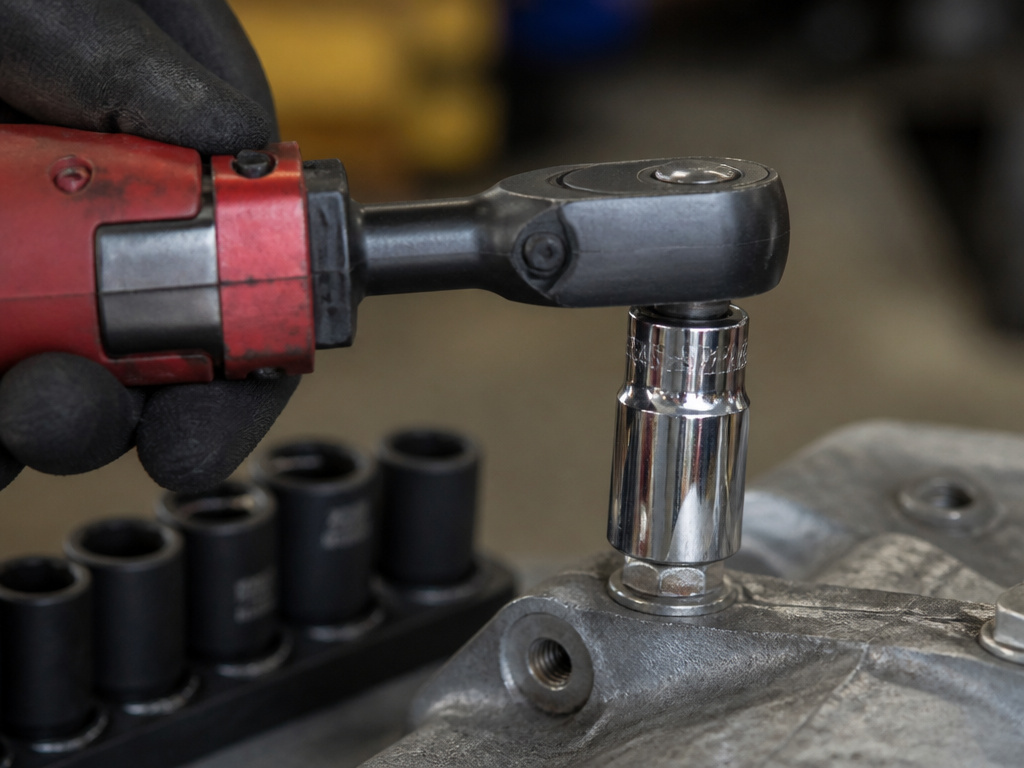
In professional shops, you’ll sometimes see a mechanic use a chrome socket on a cordless ratchet for a specific, low-torque job in a tight space where an impact socket won’t fit. They are making a calculated risk based on intimate familiarity with their tools and the specific force required.
They are also likely using a high-quality chrome socket. And they are applying maybe 50 ft-lbs to a clean fastener, not 150 ft-lbs to a rusted one.
Even then, it’s a risk. The Snap-on manual explicitly forbids “hand or power sockets.” They make no distinction for “low-torque use.” The rule is absolute because they cannot account for every variable in the field, corrosion, previous damage to the socket, slight misalignment.
For the home user or DIYer, the calculation is simple: don’t do it. The consequence of being wrong, a hospital visit, a ruined tool, a stripped bolt, vastly outweighs the minor inconvenience of swapping to the correct socket. Your cordless ratchet is a powerful ally. Don’t handicap it with the wrong ammunition.
Building Your Socket Set: The Smarter Path Forward
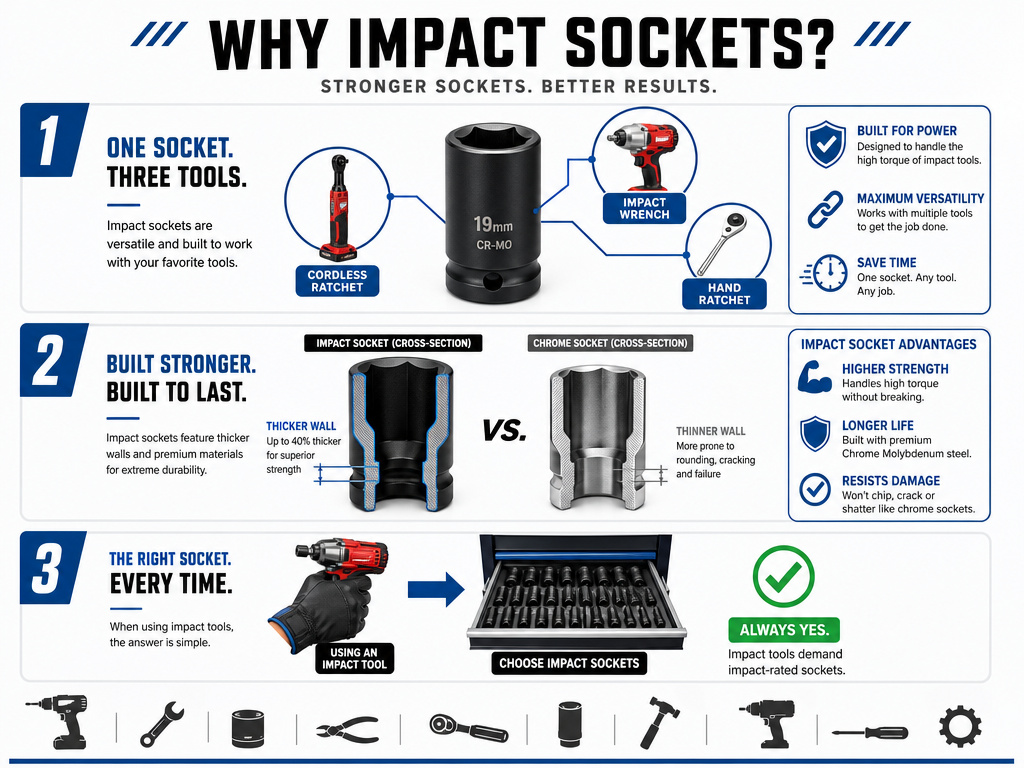
If you’re building a tool collection, the can you use impact sockets on a cordless ratchet question dictates a logical path. The most versatile, safest approach is to buy impact sockets as your primary set.
Here’s why that works:
- Full Compatibility: A single set of impact sockets works safely on every tool in your box: your cordless ratchet, your impact wrench, your breaker bar, and your hand ratchets.
- Durability Where It Counts: They are built to survive the abuse of power tools, meaning they’ll last a lifetime under hand-tool use.
- No Mental Gymnastics: You never have to stop and think, “Is this the right socket for this tool?” The answer is always yes.
Start with a 1/2-inch drive set for larger fasteners (lug nuts, suspension work) and a 3/8-inch drive set for general engine and chassis work. This covers the vast majority of automotive and DIY tasks. The debate over 1/4 vs 3/8 cordless ratchet drive sizes often comes down to your typical fastener size; choose your ratchet first, then the sockets that fit it.
If you already own chrome sockets, relegate them to dedicated hand-tool use only. Label the drawer. The minor weight and size penalty of using an impact socket on a hand ratchet is irrelevant compared to the safety guarantee.
Frequently Asked Questions
Do cordless ratchets need impact sockets?
Yes. Per the manufacturer’s safety instructions, cordless ratchets require impact-rated sockets. They are power tools capable of delivering torque high enough to fracture harder, more brittle chrome sockets.
Is it okay to use impact sockets with a hand ratchet?
Absolutely. Impact sockets are completely safe to use with hand ratchets, breaker bars, and torque wrenches. They are slightly heavier and thicker, but they work perfectly. This is why buying impact sockets as your do-it-all set is the most practical choice.
Can I use Chrome sockets on an electric ratchet?
You should not. The terms “cordless ratchet” and “electric ratchet” refer to the same power tool. The operating manuals from major manufacturers like Snap-on and Milwaukee warn against using chrome (“hand”) sockets due to the risk of breakage.
What are “power sockets” mentioned in some manuals?
Some older manuals refer to “power sockets,” which were a precursor to modern impact sockets. They were thicker than chrome sockets but not always to the same standard. Today, “impact socket” is the correct term. If a manual says “power sockets,” treat that as an instruction to use impact-rated sockets, not chrome ones.
Can you use impact sockets as regular sockets?
Yes, you can use impact sockets as regular sockets on any hand tool. They are softer and may wear faster than chrome sockets if used exclusively for hand-tool work on rusty, stuck fasteners, but they will not fail dangerously.
The Bottom Line
The rule for the can you use impact sockets on a cordless ratchet question is simple because the physics are simple. Your cordless ratchet is a torque-producing power tool. Attach a socket designed for torque and impact. Attach a socket designed only for the steady pull of a human hand, and you’re introducing a known point of failure.
Invest in a set of impact sockets. It’s not an extra expense; it’s the correct expense. It makes your cordless ratchet vs impact wrench decision easier, as the same sockets work on both. It future-proofs your kit for any power tool you add later.
Look at it this way: you bought a cordless ratchet for the power and convenience. Don’t undermine its entire purpose, and your safety, at the last inch by using the wrong socket. The right tool for the job includes the thing you put on the end of it.
