
1/4 vs 3/8 Cordless Ratchet: Key Differences Explained
This post contains affiliate links. As an Amazon Associate, we earn from qualifying purchases.
The difference between a 1/4-inch and a 3/8-inch cordless ratchet is head size and torque capacity. A 1/4-inch drive is smaller, lighter, and fits sockets for smaller fasteners; it’s for tight spaces and lighter duty. A 3/8-inch drive is larger, delivers more torque (typically 35-75 ft-lbs), and handles sockets for larger bolts; it’s for general automotive and mechanical work.
That physical distinction is the whole game when considering a 1/4 vs 3/8 cordless ratchet. It dictates which socket set you’ll use, which bolts you can tackle, and whether the tool will fit where you need it. The rest. RPM, battery voltage, brushless motors, matters, but it’s built on top of that fundamental size choice.
What follows is a breakdown of the three specs that actually decide your choice in the 1/4 vs 3/8 cordless ratchet debate: head profile and torque, RPM for speed, and the real-world access each size gives you. We’ll walk through specific models from Ryobi, DeWalt, and Milwaukee to show how the theory plays out in the tools you can actually buy.
Key Takeaways
- Pick a 1/4-inch drive for dashboards, interior trim, and small engine bays where a 3/4-inch head profile is the only thing that fits.
- A 3/8-inch drive is the default for under-hood work and suspension components; its higher 35-75 ft-lbs torque range handles most automotive fasteners without an impact wrench.
- Speed (RPM) is not power. A 460 RPM Ryobi high-speed ratchet spins fast for long bolts; a 250 RPM Milwaukee delivers more rotational force for breaking things loose.
- Never exceed a ratchet’s max torque manually, the Ingersoll Rand manual warns this can damage the tool and void the warranty.
The Core Physical Difference: Head Size and Torque
The drive size stamped on the ratchet’s anvil is a promise about space and force. A 1/4-inch square drive accepts 1/4-inch sockets, which are smaller and meant for smaller fasteners. A 3/8-inch drive takes larger sockets for larger bolts. This isn’t just about the square peg; it’s about the entire head assembly that houses it.
That fraction of an inch is the difference between fitting behind an alternator and not.
The head size directly limits torque. The gears and motor inside a 1/4-inch ratchet are physically smaller. According to spec sheets, a brushed 1/4-inch model like the Ryobi PRC01 makes 30 ft-lbs. A brushless 1/4-inch like the DeWalt DCF504B or the Ryobi PBLRC01 hits 40 ft-lbs.
Step up to 3/8-inch drives, and the torque ceiling jumps. The Milwaukee M12 FUEL 3053-20 claims 70 ft-lbs. The DeWalt 20V XR DCF510B reaches 75 ft-lbs. These tools aren’t just bigger; they’re built to handle the higher stresses of larger fasteners.
| Drive Size | Typical Max Torque Range | Best For Fastener Sizes | Example Model & Spec |
|---|---|---|---|
| 1/4-inch | 30 – 40 ft-lbs | Up to 13mm (1/2″) | DeWalt DCF504B: 40 ft-lbs |
| 3/8-inch | 35 – 75 ft-lbs | Up to 19mm (3/4″) | Milwaukee M12 FUEL 3053-20: 70 ft-lbs |
| 1/2-inch | 75+ ft-lbs | 19mm and larger | DeWalt DCF510B: 75 ft-lbs |
The takeaway from the 1/4 vs 3/8 cordless ratchet comparison is mechanical, not marketing. If your most common bolts are smaller, a 1/4-inch drive has enough torque and a slimmer profile. This is why most professional ratchets for automotive work are 3/8-inch, it’s the right balance of size and strength.
The RPM and Speed Question: 250 vs 450
Speed gets the flashy headlines, but it serves a specific job. RPM determines how quickly the socket spins, not how much twisting force it applies.
Look at the Ryobi lineup. Their standard brushed 1/4-inch (PRC01) runs at 250 RPM. Their high-speed brushless model (PSBRC02) spins at 460 RPM. The ProToolReviews article notes the high-speed version is your best bet for quickly dealing with longer fasteners.
Where this goes sideways: Assuming a 460 RPM ratchet is “more powerful” than a 250 RPM one. The Milwaukee M12 FUEL 3/8″ ratchet delivers 70 ft-lbs at 400 RPM, it has the torque to back up the speed. A cheap high-speed model might spin fast but stall on a mildly tight bolt.
Here’s how speed and torque pair across brands:
| Brand & Model | Drive | Max Torque | Speed (RPM) | Primary Use Case |
|---|---|---|---|---|
| Ryobi PSBRC02 (High Speed) | 1/4-inch | 40 ft-lbs | 460 | Long-thread fasteners |
| DeWalt DCF500B (Sealed Head) | 3/8-inch | 50 ft-lbs | 0-450 | General automotive, tight spaces |
| Milwaukee M12 (2457-20) | 3/8-inch | 35 ft-lbs | 250 | Low-profile access, lighter duty |
| RIDGID R866011 | 3/8-inch | 55 ft-lbs | 250 | General construction/repair |
Notice the trade-off. The 250 RPM Milwaukee and RIDGID models focus on torque for their class. The 450 RPM DeWalt and Ryobi models add speed for versatility. Your choice depends on whether you need to zip bolts in and out quickly or wrestle them free more often. For a deeper look at top performers, see our roundup of the best cordless ratchets.
Real-World Access: What Actually Fits Where?
Spec sheets list length and head profile. The real test is a crowded engine bay. A 1/4-inch ratchet shines where a 3/8-inch simply won’t angle in.
The Milwaukee M12 1/4-inch ratchet (2456-20) has a low-profile 3/4-inch head. That’s a specific measurement. It’s why the product description says it allows work in the tightest of spaces or engine bays. The Bauer 3/8-inch ratchet also mentions a recessed head profile for tight engine bays, but it’s a larger tool overall at 15-1/4 inches long.
TL;DR: For dashboards, intake plenums, and tight transverse engines, the 1/4-inch’s slim head wins. For open undercarriage and truck bays, the 3/8-inch’s power wins.
Voltage and Battery Platform: 12V vs 18V/20V
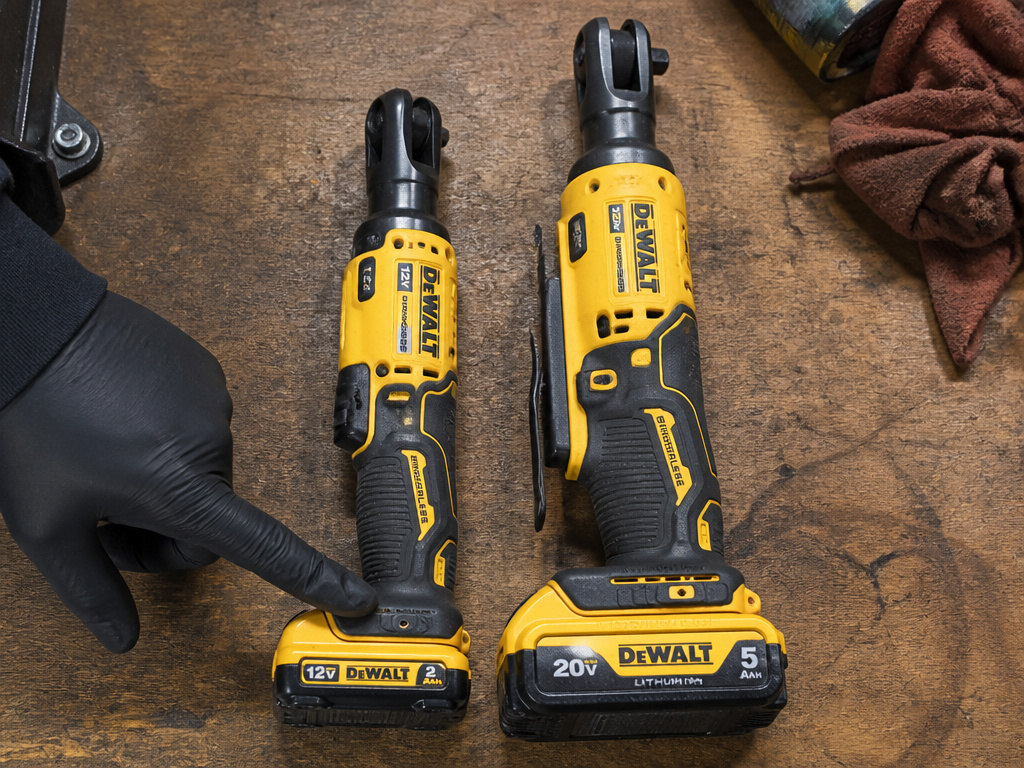
Voltage gets tangled in a branding debate. Harbor Freight’s website says their 20V Bauer ratchet is for DIY and their 12V Hercules is for professionals needing compact tools. However, other manufacturers like DeWalt and Milwaukee offer professional-grade tools in both 12V and 20V/18V platforms. DeWalt and Milwaukee sell professional-grade tools in both 12V and 20V platforms.
The explanation is simpler. Voltage influences the size of the motor and battery pack. A 12V MAX system, like DeWalt’s or Milwaukee’s M12, allows for a more compact tool. The DeWalt DCF504B 1/4-inch ratchet is a 12V tool. So is the high-torque Milwaukee M12 FUEL. They’re plenty powerful for their respective drive sizes.
An 18V/20V platform, like Ryobi’s ONE+ or DeWalt’s 20V XR, often yields a physically larger tool. The DeWalt DCF510B 3/8-inch ratchet is a 20V tool. It’s also heavier (2.6 lbs bare). The extra voltage can support higher torque or longer runtimes, but it comes at the cost of bulk.
Your decision should start with your existing battery ecosystem. If you’re already invested in Milwaukee M12 batteries, buying an M12 ratchet, whether 1/4-inch or 3/8-inch, is a no-brainer. Jumping to a 20V platform just for a ratchet means buying into a new set of chargers and batteries.
Durability, Maintenance, and the Manual Warning
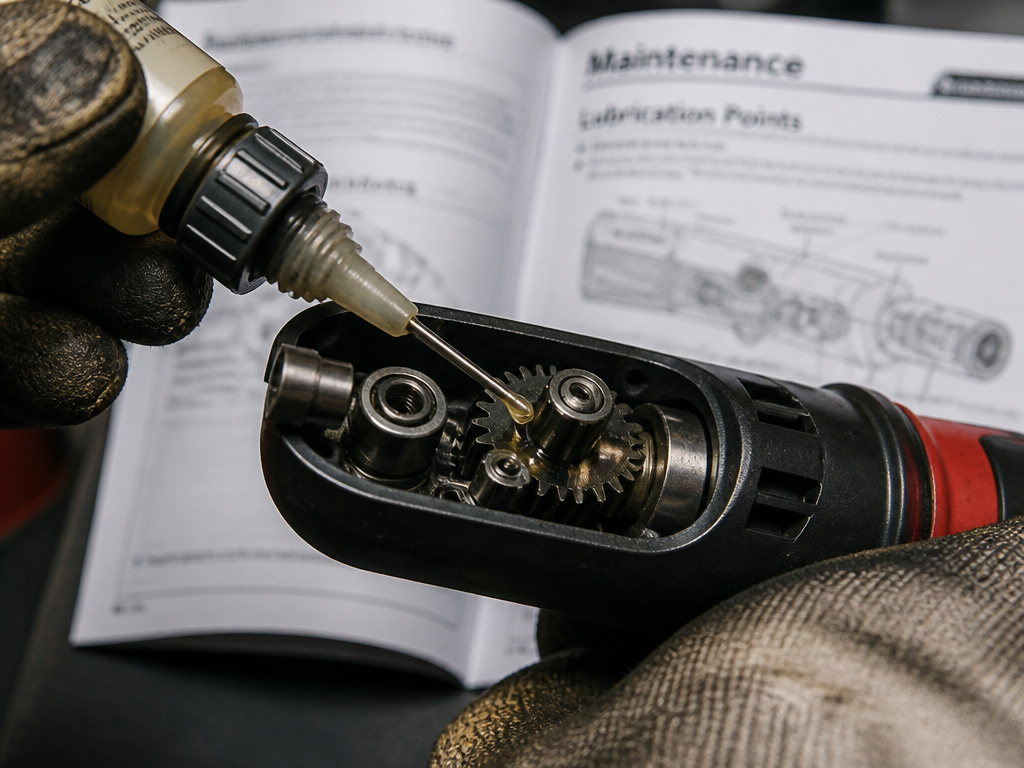
Cordless ratchets have moving parts that fail if abused. The manuals tell you exactly how.
The Ingersoll Rand cordless ratchet manual has a clear, bold warning: using the tool as a manual ratchet and exceeding its max torque may cause damage and will void the warranty. This isn’t scare talk. It’s the manufacturer stating that the internal pawl and gear mechanism is rated for the motor’s output, not for a three-foot cheater bar.
Maintenance is the other half. The same Ingersoll Rand manual prescribes a lubrication schedule: the drive bushing every 30 days of use, the ratchet head components every 3 months, the gearing every 6 months. The Bauer manual recommends periodic cleaning if the mechanism feels gritty. The Milwaukee M12 FUEL has an integrated grease port for self-lubrication.
These aren’t suggestions. A ratchet that isn’t lubricated will start to sound rough, a grinding noise instead of a smooth whir, and eventually the pawl will skip or the gears will strip. If you’re using it professionally, this maintenance is part of the job.
Common mistake: Cranking on a ratchet manually after the motor stalls.
The Adapter Question: Can You Cheat the System?
A 1/4-inch to 3/8-inch socket adapter seems like a magic bullet. Use your compact 1/4-inch ratchet with your existing 3/8-inch sockets. It works, but it changes the tool’s physics.
However, it also adds length and a potential point of failure. A cheap adapter can snap under load. More critically, it makes the tool head even larger, defeating the main advantage of the 1/4-inch drive.
For occasional, light-duty use on a 3/8-inch fastener, an adapter is fine. For regular work, you’re better off with the correct tool. The same logic applies in reverse for a 3/8-inch to 1/2-inch adapter. If you constantly need more torque, you should probably be using an impact wrench, not a ratchet with an adapter.
Head-to-Head: Which Should You Buy?
This is where we commit. The answer isn’t “it depends.” It’s “pick based on your most common fastener size.”
Choose a 1/4-inch cordless ratchet if:
- You work on interiors, dashboards, small appliances, or electronics.
- Your most common bolts are 10mm or smaller.
- You need the absolute slimmest head profile (3/4-inch).
- You want the lightest possible tool (under 2 lbs).
My pick in this category: The DeWalt DCF504B. It hits the 40 ft-lbs ceiling for the size, has a glass-filled nylon housing, and the option for manual operation. It’s a no-nonsense, capable tool. See its current reviews on Amazon.
Choose a 3/8-inch cordless ratchet if:
- You work on automotive engines, suspensions, or general machinery.
- Your most common bolts are 13mm to 19mm.
- You need more torque (55-75 ft-lbs) without stepping up to a bulky 1/2-inch tool.
- You can sacrifice a little headroom for much more power.
My pick in this category: The Milwaukee M12 FUEL 3053-20. Its 70 ft-lbs of torque and 400 RPM strike the best balance of power and speed in the compact class. The integrated grease port is a thoughtful professional touch. Check availability.
For the rare jobs that need more, the DeWalt 20V XR 3/8-inch & 1/2-inch model (DCF510B) is the step up. But for 90% of users, the choice between 1/4-inch and 3/8-inch is decided by bolt size and access, not brand loyalty or voltage. This is the core of any honest cordless ratchet comparison.
Battery Life and Platform Considerations
Cordless ratchets run on battery platforms, typically 12V or 18V/20V, and your choice here affects more than just runtime. A 12V system generally yields a more compact, lighter tool, which is a major advantage when working in tight spaces all day. An 18V or 20V platform often provides more power and longer runtimes, but the tool and battery are physically larger. Your decision should hinge on the tool ecosystem you already own. If you’re invested in a brand’s 12V line for other compact tools, sticking with it for your ratchet makes sense for battery sharing. If your primary platform is 18V, adding a ratchet to that system avoids buying into a new battery family. Consider your typical job length; for quick fastener runs, a small battery is sufficient, but for prolonged use, a larger capacity pack or having spares is key.
Frequently Asked Questions
Should I get a 3/8 or 1/4 cordless ratchet?
Get a 3/8-inch cordless ratchet if you work on cars, trucks, or machinery with medium-sized bolts (13mm-19mm). It’s the most versatile single size. Get a 1/4-inch ratchet if your work is primarily on small engines, interiors, or in extremely tight spaces where the smaller head is the only thing that will fit.
Which is better for me, a 1/2 inch ratchet or a 3/8-inch ratchet?
1/2-inch ratchet is for heavy-duty work like truck lug nuts, large machinery, and construction. It’s overkill for most automotive and DIY tasks. A 3/8-inch ratchet is better for you unless you specifically need the higher torque and larger socket range of a 1/2-inch drive. Most people don’t.
Should I get 1/4 or 3/8 socket set?
Your socket set should match your ratchet. If you buy a 3/8-inch ratchet, invest in a 3/8-inch socket set. Buying both 1/4-inch and 3/8-inch sets doubles your cost. For most people, a full 3/8-inch set with adapters covers 95% of needs. Our best 3/8 ratchets guide covers socket sets.
Can a cordless ratchet break loose bolts?
Yes, but within its rated torque. A cordless ratchet is designed for fastening and loosening bolts that aren’t rust-welded or massively overtightened. For truly “stuck” bolts, you should use a breaker bar or an impact wrench first. Trying to use a ratchet as a breaker bar, as the Ingersoll Rand manual warns, can damage it.
Is a cordless ratchet better than an air ratchet?
For most home users and mobile mechanics, yes. A cordless ratchet eliminates the hose, compressor, and moisture issues of an air tool. Modern brushless cordless models match or exceed the power of mid-range air ratchets. The trade-off is upfront battery cost versus long-term air compressor maintenance. We break down the electric vs air ratchet choice in more detail.
The Bottom Line
The 1/4-inch vs 3/8-inch debate ends with a tape measure and a bolt. Measure the most common fastener you turn. If it’s under 13mm and buried deep, get a 1/4-inch drive. If it’s over 13mm and you have reasonable access, get a 3/8-inch drive.
Everything else, brushless motors, LED lights, variable speed triggers, is a feature built on that foundation. A well-made 3/8-inch ratchet from your preferred battery platform will handle the vast majority of automotive and mechanical work. A 1/4-inch ratchet is a specialist tool for specialist spaces.
One final rule: respect the tool’s limits. These are precision gearboxes, not crude levers. Follow the maintenance schedule, don’t exceed the manual torque rating, and you’ll have a tool that lasts for years. That’s how you get real value from any ratchet tool you buy.
