
10 Best Belt Sanders For Woodworking in 2026
This post contains affiliate links. As an Amazon Associate, we earn from qualifying purchases.
Our top pick for woodworkers is the Makita 9031 Belt Sander, which wins for its variable speed control and ability to sand precisely in confined spaces. For heavy-duty power, the Makita 9404 is a standout, while the Milwaukee M18 Fuel leads for cordless convenience. Choosing the right belt sander depends on your primary tasks, from aggressive stock removal to fine-detail finishing.
A sander that excels at flattening large panels may struggle in tight corners, and vice versa. Our recommendations are based on research into specifications, manufacturer documentation, expert round-ups, and patterns in owner feedback. We’ve sorted ten models to help you find the right tool.
Top 10 Belt Sanders for Woodworking in the Market
Certain content that appears on this site comes from Amazon. This content is provided "as is" and is subject to change or removal at any time.
The Best Belt Sanders for Woodworking, Reviewed
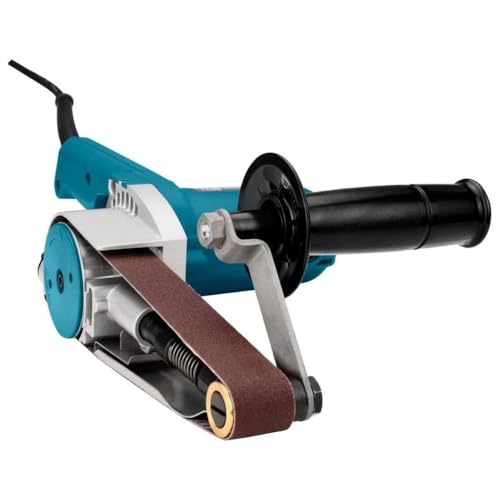
Makita 9031 Belt Sander
What We Like
- Variable speed dial for material matching
- Narrow belt and exposed pulley for tight spots
- Lock-on button reduces hand fatigue
Trade-offs
- Belt width under 2 inches limits large surface work
- Compact size means less stability on big, flat panels
- Corded design requires outlet access
Material removal comes surprisingly fast for a sander this small, nearly matching larger models like the Metabo HPT and Makita 9903 according to research, yet it weighs only 4.6 pounds. That light weight makes it easy to handle all day. A narrow belt and exposed front pulley allow work in tight spaces or on irregular shapes where bigger sanders simply won’t fit. Variable speed control from 656 to 3,280 feet per minute lets users match the tool to different materials like wood, metal, or fiberglass, and a lock-on button aids during long sessions.
Its 1-1/8-inch belt width means this isn’t the tool for sanding large, flat surfaces. For intricate tasks, edge work, or getting into cabinetry gaps, however, the compact size becomes a real benefit. Compared to a stationary benchtop sander, the Makita 9031 is designed for detailed handheld use. It fits in close quarters, making it suited for woodworkers, artists, glaziers, and finish carpenters who need precision in confined spaces.
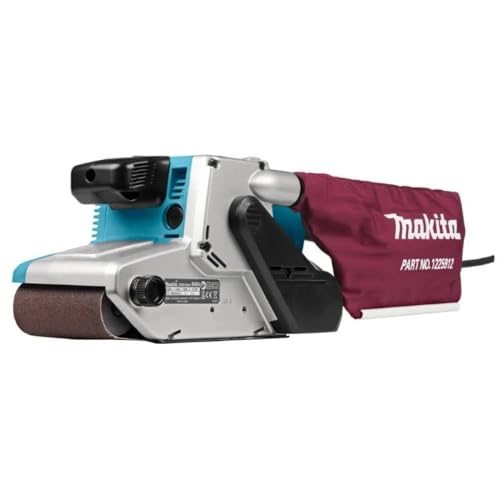
Makita 9404 Belt Sander
What We Like
- Powerful 8.8 AMP motor for fast material removal.
- Low 84dB noise level for operator comfort.
- Auto-tracking belt system requires no manual adjustment.
- Can sand flush to walls with its nose and side.
Trade-offs
- Corded design limits mobility compared to battery-powered options.
An 8.8 AMP motor gives this sander serious grunt for heavy stock removal, making it a go-to for flattening tabletops or leveling glued-up panels. It’s built for demanding workshop tasks where speed and power trump portability. The 84dB noise rating and long power cord are thoughtful touches for all-day comfort, and the auto-tracking belt means you spend less time fiddling and more time sanding. This is a sander for the woodworker who needs to move material quickly and reliably, not just smooth a surface.
Makita’s 9404 delivers material removal speed close to bigger models like the Metabo HPT and Makita 9903, allowing it to handle demanding stock removal jobs. Its 8.8 AMP motor powers through work quickly, while the 84dB noise level reduces operator fatigue. The auto-tracking belt system and flush-sanding design mean you spend less time adjusting and more time working surfaces smooth.
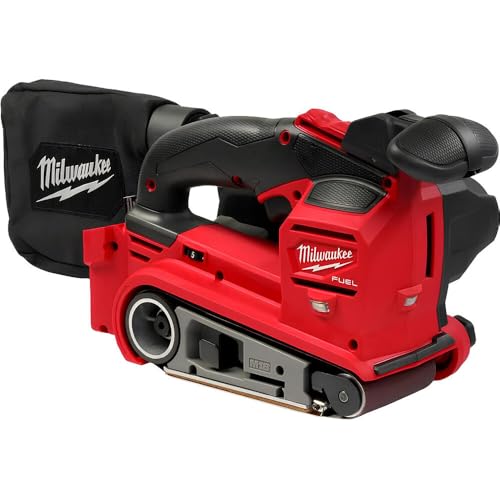
Milwaukee M18 Fuel Belt Sander
What We Like
- Brushless motor matches corded 8A sander power
- Variable speed dial for precise material removal
- Quick, tool-free belt changes minimize downtime
- Intelligent system protects from overload and overheating
Trade-offs
- Limited to 3" x 18" belts, not wider stock
- Bare tool requires separate M18 battery and charger
- At 8.8 lb, it's heavier than some corded competitors
Its brushless motor delivers the power of an 8-amp corded sander, which means you can tackle large surface leveling and stock removal jobs without hunting for an outlet. That cordless freedom, combined with a variable speed range up to 1350 surface feet per minute, makes this a serious option for a woodworker who needs to move around a project or work off-grid. It suits someone invested in the M18 platform who values professional-grade performance over ultimate portability.
The trade-off for that cordless muscle is a specific 3×18-inch belt size. You won’t be sanding the full width of a 4-inch board in one pass like you could with the Makita 9404. And while the tool-free lever makes swaps fast, the 8.8-pound weight, partly due to its sturdy construction, demands more forearm stamina during overhead work than a lighter sander like the Makita 9031. This is a power-first tool, not a finesse-first one.
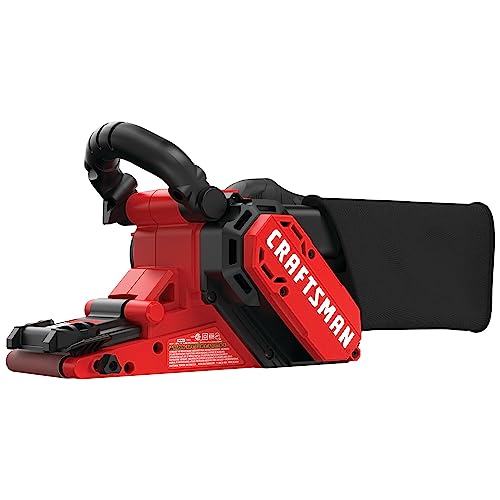
CRAFTSMAN CMEW213 Belt Sander
What We Like
- Tool-free belt release for quick changes
- Angled belt design sands closer to edges
- Three-position over-molded handle improves grip
- Includes a dust collection bag
Trade-offs
- Fixed 800 FPM speed lacks variable control
- Corded design limits mobility compared to cordless options
With a 7-amp motor moving a 3×21-inch belt at 800 feet per minute, this sander provides fast material removal for someone who uses it for just a few projects a year. The Craftsman CMEW213 offers a ton of value without the high-end price. Features include a tool-free belt release for quick changes and an angled belt design to sand closer to adjoining surfaces.
This model focuses on core functionality rather than advanced features. It is a corded, single-speed tool, so operation is tied to an outlet and lacks the variable speed adjustment found on models like the WEN HB632V. For predictable jobs where straightforward sanding power is the priority, the sander represents a solid, no-fuss value.
DEWALT 20V MAX Bandfile Sander

What We Like
- Exceptionally light at 3.7 pounds
- Variable speed dial for control on curves
- Quick, tool-free belt changes
- 104° rotating arm for storage flexibility
Trade-offs
- Bare tool: requires separate battery purchase
- Compact size less suited for large, flat surfaces
The DEWALT 20V MAX Bandfile Sander weighs 3.7 pounds, which helps reduce arm fatigue during extended use. Its brushless motor rotates the belt up to 5,600 feet per minute, and reviewers report this cordless design delivered the smoothest finish of any battery-powered sander they tested. A 104-degree rotating arm provides flexibility and a storage position, while the changeable contact arm allows for multiple applications.
This sander uses a narrow half-inch belt, which reviewers noted removed material faster than expected. Its compact size and 104-degree rotating arm allow it to operate in tight and intricate spaces. For larger surface areas, other models like the Makita 9404 Belt Sander have a bigger footprint and heavier build.
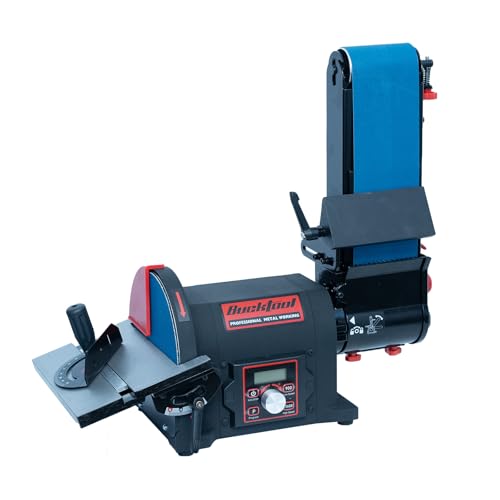
Bucktool 4×36 Belt Disc Sander
What We Like
- Horizontal and vertical belt sanding capability
- Includes miter gauge and sharpening attachment
- Metal dust port doubles as a work stop
Trade-offs
- VFD motor is incompatible with GFCI outlets
- Requires dedicated HACR circuit breaker
- Benchtop design limits portability for on-site work
A 1 HP variable frequency drive motor spins down to 900 RPM, giving you serious control for delicate tasks like sharpening. It still has the grunt for heavy stock removal on metal or hardwood, which makes the Bucktool a true workshop anchor. For a woodworker setting up a dedicated station, it consolidates several grinding and sanding operations into one sturdy, speed-adjustable unit.
A key installation note is that the variable frequency drive motor may cause a GFCI outlet to trip. The manufacturer recommends using a circuit with an HACR breaker instead, which requires planning for its permanent shop location. Unlike handheld belt sanders such as the Makita 9404, this is a benchtop combination tool designed to be set up in one place.
Product photos
CRAFTSMAN V20 Brushless Belt Sander
What We Like
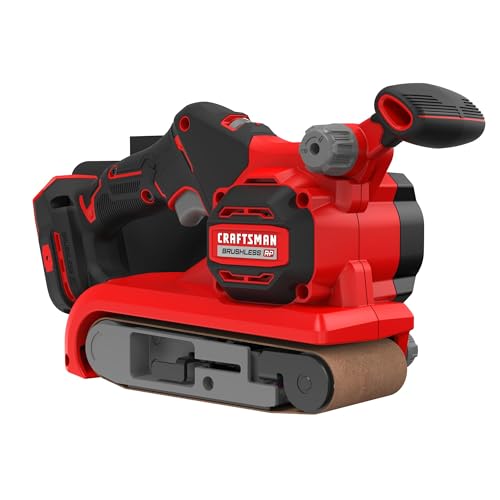
- Brushless motor for fast material removal
- Five variable speed settings for control
- Three-position auxiliary handle improves ergonomics
- Tool-free belt tracking simplifies adjustments
Trade-offs
- Battery and charger sold separately
- At 8.0 lb, it's heavier than some corded models like the Craftsman CMEW213
- Limited to V20 battery platform, not compatible with other brands
The brushless motor hits 950 feet per minute, giving you the grunt to strip material efficiently without bogging down. Where this Craftsman really shines is its five distinct speed settings, letting you dial down for delicate veneers or crank it up for aggressive shaping on rough lumber. That flexibility, combined with a handle you can position for comfort, makes it a solid choice for the occasional user who still demands real control over their work.
This cordless belt sander weighs eight pounds, making it heavier than the corded Craftsman CMEW213 model which is 6.6 pounds. It is a tool-only package, so a V20 battery and charger are required. The brushless motor provides up to 950 FPM for fast material removal and has five variable speed settings for multiple applications.
Product photos
WEN HB632V Belt Sander

What We Like
- Lock-on switch for continuous use
- Quick-release lever for fast belt changes
- Includes dust bag and 80-grit belt
- Two-year warranty for peace of mind
Trade-offs
- 6.3-amp motor is modest for heavy stock removal
- 3-inch belt width is narrower than some 4-inch models
Weighing only 6 pounds, the WEN HB632V limits user fatigue during extended sessions. Its variable speed motor adjusts the belt from 558 to 820 feet per minute for different materials. A lock-on power switch allows for continuous sanding without holding the trigger, and a quick-release lever simplifies belt changes.
While its lightweight design is easy to handle, this sander makes concessions in raw power and belt size. Its 6.3-amp motor and 3-inch wide belt won’t hog off material as aggressively as a heavier-duty model like the 10.3-pound Makita 9404. That makes it less suited for flattening large tabletops or quickly dimensioning rough lumber. For a dedicated shop sander tackling big surfaces, you’ll want more heft and a wider abrasive path. For everything else, this WEN model delivers capable, comfortable sanding without weighing you down.
Product photos
VEVOR 3×21 Belt Sander
What We Like
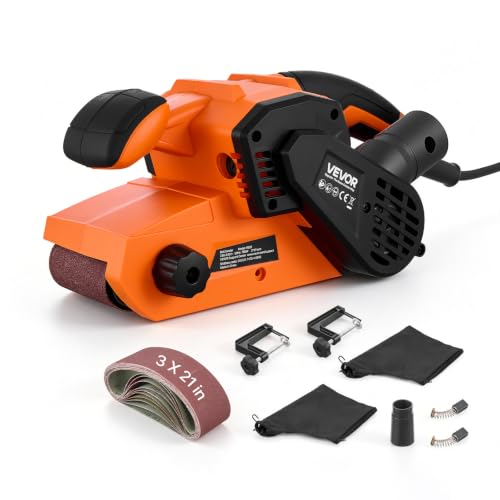
- Converts from handheld to benchtop sander with clamps
- Six-speed control for detailed work to fast stock removal
- Includes a wide range of grits for complete projects
- Dust collection with bags and vacuum adapter
Trade-offs
- At 8.8 lb, it's heavier than some dedicated handheld units like the Makita 9031
- Benchtop mode requires a dedicated, clamped workspace
- Corded design limits mobility compared to cordless rivals
The ability to securely clamp this 3×21 belt sander to a workbench transforms it from a handheld tool into a stationary machine. That dual-purpose design is the core of its appeal, making it a solid fit for a woodworker with a dedicated bench who wants one tool for aggressive shaping and controlled, detailed work. The 7A motor provides stable power for the full range of six speeds, and the included belt assortment covers everything from rough leveling to final smoothing.
All that versatility does come with some heft. At 8.8 pounds, it’s a substantial handful compared to a purpose-built handheld like the lighter Makita 9031. You feel that weight during extended freehand sessions, which is a minor compromise for a shop where the sander spends half its life bolted down. If you’re only ever sanding cabinets in place, a more streamlined cordless option like the Milwaukee might be a better match for pure maneuverability.
Product photos
RIKON Power Tools 50-161VS Belt Sander
What We Like
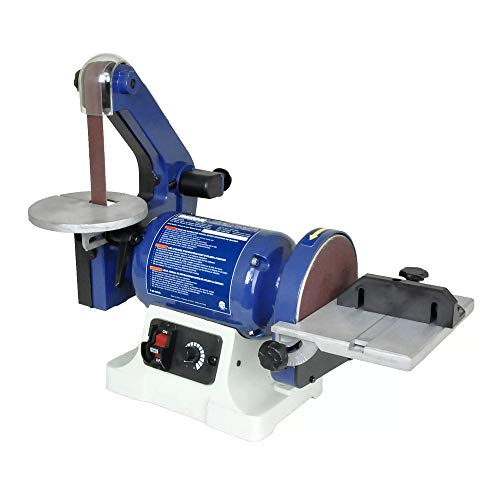
- Variable speed from 2,000 to 3,400 RPM
- Combines belt and disc sanding surfaces
- Adjustable work tables tilt 0 to 45 degrees
- Separate dust ports for belt and disc
Trade-offs
- At 30.2 lb, it's a bench tool, not a handheld
- The 1-inch belt width limits stock size
- Requires shop dust collection for clean operation
A 3/4 HP motor paired with both a 1×30 belt and a 6-inch disc gives you a dedicated station for shaping and finishing small parts. This makes it a natural fit for a workshop corner where you handle detailed woodworking, knife-making, or tool sharpening. The variable speed dial and tilt tables provide the control needed for precise work on different materials and angles.
Its 30-pound weight and footprint demand a permanent bench mount, so it’s not something you’ll move around the shop. For sanding large panels or furniture faces, the narrow belt is a constraint. If your primary need is smoothing broad surfaces, a wider model like the Makita 9404 is a more suitable tool for that specific job.
Product photos
How We Evaluated Belt Sanders
We researched belt sanders by analyzing manufacturer specifications and technical documentation. We also studied expert round-ups from woodworking publications and aggregated patterns from extensive user feedback across multiple platforms. Our core criteria were power and speed for material removal, ergonomics and weight for control during extended use, and belt size and design for accessing different workpieces.
We prioritized features like variable speed dials, effective dust collection ports, and tool-free belt changes based on their practical impact in the shop. This research-based approach identifies reliable tools, but cannot replicate the feel of a sander in your own hands over hundreds of hours of use.
What To Look For In Belt Sanders
The right belt sander balances power, control, and application. A powerful motor removes stock quickly but adds weight, while a compact design improves maneuverability at the expense of stability on large panels.
Focus on belt size and speed for your typical projects, motor power for material removal rate, and ergonomic features like handle placement and weight to reduce fatigue during long sessions.
Belt Size and Speed
Belt dimensions determine your sander’s capability. A common 3-inch by 21-inch belt is versatile for general woodworking, while a 4-inch width covers more surface area for faster panel flattening. Narrower belts under 2 inches, like on the Makita 9031, excel in tight corners and on curves. Speed, measured in surface feet per minute (SFPM), dictates aggressiveness; variable speed control lets you match the belt speed to the material, preventing burn marks on softwoods or providing more control for delicate shaping.
Motor Power and Type
Motor amperage in corded models, like the Makita 9404’s 8.8 AMP, indicates raw power for heavy stock removal. Brushless motors in cordless sanders, such as in the Milwaukee M18 Fuel, deliver efficient, high-torque performance and longer runtime. For stationary benchtop sanders, a variable frequency drive (VFD) motor offers adjustable speed but may have specific electrical requirements, as noted with the Bucktool combo sander. Our research into belt sanders for wood shows that adequate power prevents bogging down under pressure, ensuring consistent material removal.
Ergonomics and Dust Control
A sander’s weight and balance directly affect control and user fatigue. Lightweight models like the DEWALT 20V MAX Bandfile are easy to maneuver for detail work, while heavier sanders can feel more stable on large, flat surfaces. Features like a lock-on switch or a secondary handle, as seen on the CRAFTSMAN CMEW213, improve comfort for prolonged use.
Effective dust collection is critical for visibility and shop cleanliness; look for a well-designed port that accepts a standard vacuum hose or includes a functional bag. Understanding the difference between a belt sander and an orbital sander can also inform your grip and handling approach.
- Check the belt tracking adjustment mechanism for ease of use and stability during operation.
- Verify the dust port design compatibility with your shop vacuum or dust collector.
- Assess the grip texture and handle angles during a dry run at the store, if possible.
A sander should feel like an extension of your arm, not a weight you have to fight.
Belt Sanders for Woodworking Compared
The following table compares key specifications across our picks to highlight their differences at a glance.
| Product | Belt Size | Motor / Power | Belt Speed | Weight |
|---|---|---|---|---|
| Makita 9031 Belt Sander | 1-1/8" x 21" | N/A | 656-3,280 ft./min | 4.6 pounds |
| Makita 9404 Belt Sander | 4" x 24" | 8.8 AMP | N/A | 10.3 Pounds |
| Milwaukee M18 Fuel Belt Sander | 3" x 18" | Brushless | 750-1350 SFM | 8.8 Pounds |
| CRAFTSMAN CMEW213 Belt Sander | 3-in. x 21-in. | 7 Amp | 800 feet per minute | 6.6 pounds |
| DEWALT 20V MAX Bandfile Sander | N/A | 20V MAX battery | Up to 5,600 ft/min | 3.7 pounds |
| Bucktool 4×36 Belt Disc Sander | 4×36 inches | 1 HP VFD | 575-2300 SFPM | N/A |
| CRAFTSMAN V20 Brushless Belt Sander | N/A | Brushless | Up to 950 FPM | 8.0 pounds |
| WEN HB632V Belt Sander | 3-by-18 inch | 6.3-amp variable speed | 558 to 820 feet per minute | 6 pounds |
| VEVOR 3×21 Belt Sander | 3" x 21" | 7 Amp | 630-1200 FPM | 8.8 Pounds |
| RIKON Power Tools 50-161VS Belt Sander | 1 x 30 in. | 3/4 HP, 120V | 1,909 to 3,248 SFPM | 30.2 Pounds |
Frequently Asked Questions
What is the best belt sander for woodworking?
For most woodworkers, the best all-around choice is a variable-speed, mid-sized sander like our top pick, the Makita 9031. It offers the control needed for precise work in tight spaces while still being capable on larger surfaces. Your specific best choice depends on whether your priority is maximum power, cordless freedom, or budget-friendly performance.
Which belt sander is best for removing a lot of material quickly?
For rapid stock removal, you need a powerful motor and a wide belt. Our Best Heavy-Duty Power pick, the Makita 9404, with its 8.8 AMP motor and ability to sand flush to edges, is designed for this task. Benchtop models with longer platens, like the Bucktool 4×36, also provide a stable, powerful platform for aggressive shaping.
What is a high-quality belt sander?
A high-quality belt sander combines durable construction, consistent performance, and thoughtful ergonomics. Key indicators include a motor that maintains speed under load, a belt tracking system that stays aligned without constant adjustment, and features that reduce user fatigue, such as a lock-on button or well-placed handles. Reliable dust collection is another mark of a well-designed tool.
Are Harbor Freight belt sanders any good?
Harbor Freight offers budget-friendly tools that can suffice for very occasional, light-duty use. However, for dedicated woodworking, our research and expert round-ups consistently show that models from established tool brands offer better performance, durability, and safety features. For a reliable budget option, we recommend considering our Best Budget Corded pick, the CRAFTSMAN CMEW213.
When should I use a benchtop belt sander instead of a handheld one?
A benchtop belt sander, like the RIKON 50-161VS, is ideal when you need to bring small, precise workpieces to a stationary, stable sanding surface. It excels at sharpening tools, sanding small parts, and achieving perfectly square edges. A handheld sander is necessary for sanding large furniture panels, fitting cabinets to walls, or any task where the workpiece is too large or fixed to move.
The Bottom Line
The Makita 9031 Belt Sander is our Best Overall pick for its excellent blend of variable speed control, compact design, and proven reliability. This makes it a superb choice for finish carpenters and detail-focused woodworkers. If your shop demands raw power for flattening, choose the Makita 9404. For cordless convenience without sacrificing torque, the Milwaukee M18 Fuel is your tool.
Budget-conscious DIYers should look at the CRAFTSMAN CMEW213. Ultimately, matching the sander’s belt size, power, and ergonomics to your most common tasks is the single most important step to a confident purchase.
