
10 Best Benchtop Belt Sanders in 2026
This post contains affiliate links. As an Amazon Associate, we earn from qualifying purchases.
For a powerful, dual-function sander that can handle heavy material removal and precise bevel work, the DEWALT 4 x 36 Inch Belt and Disc Sander is our best overall. For precise speed control, consider the RIKON 50-161VS, and for exceptional stability, look to the WEN 6502T with its cast iron base.
Choosing the right benchtop belt sander saves you time and frustration on every project. A well-matched machine provides smooth, consistent results, from shaping a table leg to sharpening a tool. We compiled this list by analyzing specifications, manufacturer data, expert insights, and patterns in owner feedback.
You’ll find detailed reviews and a comparison table to pinpoint the right tool for your workbench.
Top 10 Benchtop Belt Sanders in the Market
Certain content that appears on this site comes from Amazon. This content is provided "as is" and is subject to change or removal at any time.
The Best Benchtop Belt Sanders, Reviewed
DEWALT 4 x 36 Inch Belt and Disc Sander

What We Like
- Powerful 7.0 AMP motor for demanding tasks
- Large 8-inch disc for fast material removal
- Independent, tiltable tables for precise bevel work
- Two-in-one design offers belt and disc sanding
Trade-offs
- Disc is larger than many 6-inch competitors
A 7.0 AMP motor paired with an 8-inch disc gives this sander the muscle for serious stock removal and finishing in one compact unit. That power, combined with the flexibility of separate, adjustable tables for the belt, makes it a true workshop workhorse. It’s the right fit for the woodworker or metal fabricator who needs a dependable, dual-purpose machine for everything from rough shaping to final bevels without swapping tools.
The fixed-speed operation means you can’t dial down for delicate materials, a feature found on models like the RIKON 50-161VS. Its strength is in its straightforward, sturdy construction. You get a lot of capability in a relatively compact footprint, but the trade-off is a lack of fine-tuned control. For most general shop tasks, however, its combination of power and precision is hard to beat.
Product photos
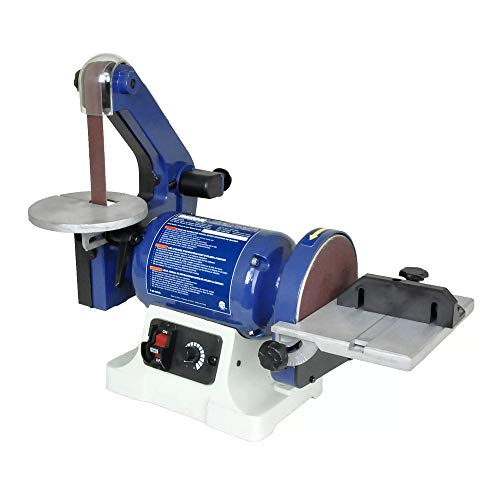
RIKON Power Tools 50-161VS Benchtop Belt Sander
What We Like
- Precise variable speed control from 2,000 to 3,400 RPM
- Combined belt and disc sanding in one unit
- Includes miter gauge for controlled disc sanding
- Dust collection ports for both belt and disc
Trade-offs
- A 1-inch wide belt is narrow for large surface work
- Smaller 6-inch disc offers less surface area than 8 or 9-inch models
The variable speed motor, adjustable from 2,000 to 3,400 RPM, gives you direct control over the aggression of your cut. That makes this sander a natural fit for mixed-material shops and detail work where you might start with metal shaping and finish on wood without changing machines. The dual dust ports and tilting tables support organized, precise setups. It’s built for the craftsperson who needs finesse on smaller projects like knife handles, tool sharpening, or intricate model parts.
The trade-off for that control is the 1×30 inch belt size. You won’t be flattening large tabletops or squaring up long board edges efficiently. For that kind of work, a model like the DEWALT with its 4×36 inch belt provides a much broader sanding surface. The RIKON excels in its niche, offering professional-grade speed adjustment in a compact benchtop package ideal for a crowded workshop where space is at a premium.
Product photos
WEN 6502T Belt and Disc Sander

What We Like
- Cast iron base minimizes vibrations
- Belt tilts fully for edge and contour sanding
- Tension lever simplifies belt changes
- Combines belt and disc sanding functions
Trade-offs
- 6-inch disc is smaller than 8 or 9-inch competitors
- Fixed speed operation lacks versatility for different materials
The cast iron base is the defining feature of the WEN 6502T, providing a level of stability that directly translates to smoother, more controlled sanding passes. This makes it a solid choice for the woodworker who values a vibration-free work surface for consistent results on smaller projects. The 4-by-36 inch belt and 6-inch disc offer a classic two-in-one format, and the ability to tilt the belt through a full 90-degree arc adds useful flexibility for detailed work.
It’s a capable machine for general shop tasks, but for heavy stock removal on metal or dense hardwoods, you might find its limits. Compared to the variable-speed RIKON 50-161VS, the WEN’s fixed 3600 RPM is less adaptable, but its foundational build quality is a clear step up from many lighter-duty benchtop units.
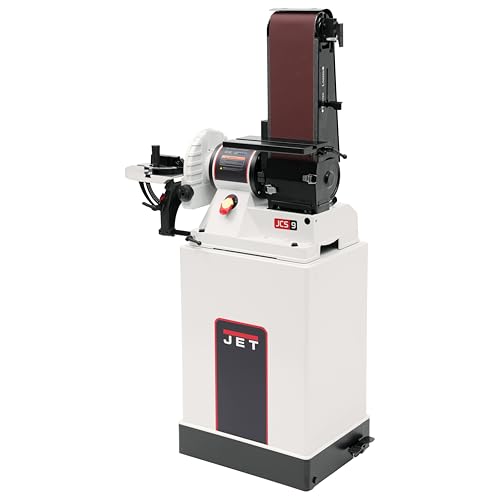
JET JSG-96CS Belt and Disc Sander
What We Like
- Large 6×48 belt and 9-inch disc provide substantial capacity
- Graphite-coated steel platen runs cooler for longer belt life
- Quick-release lever and dual thumbscrew tracking for easy belt changes
- Integrated locking wheels allow for shop mobility
Trade-offs
- At 196 pounds, it requires a dedicated, sturdy benchtop or stand
- Single dust port may require a dedicated collector for optimal use
A 6×48 inch belt and 9-inch disc offer a level of material handling that smaller benchtop units simply can’t match. This is a machine for the serious hobbyist or small professional shop where you’re frequently working with larger panels, wide boards, or long stock. The 3/4 HP motor has the grunt for heavy material removal, and the massive cast iron table with preset stops provides a solid, vibration-free platform for precision work. It’s built for volume and durability, not occasional light duty.
That larger capacity requires significant shop space and a strong work surface, as the machine weighs 196 pounds. A single 4-inch dust port on the back collects debris from both the belt and disc. For projects involving consistently large workpieces, this sander serves as a central shop tool.
BUCKTOOL 4×36 Inch Belt Disc Sander

What We Like
- Maintenance-free direct-drive motor shaft
- Belt tilts to 90 degrees for vertical sanding
- Sturdy cast aluminum base reduces vibration
- Quick sanding belt replacement design
Trade-offs
- At 35.5 lb, it's a substantial bench fixture, not easily portable.
- 6-inch disc is smaller than the 8-inch on some competitors.
A direct-drive motor powers both the belt and disc from the shaft, which eliminates belt tension adjustments and pulley replacements. This is the core appeal for woodworkers who want to spend time sanding, not tinkering. Its 3/4 HP induction motor provides quiet, consistent power for everything from shaping to final passes. You can also swing the belt to a vertical position, which opens up options for edge work and smaller pieces. It’s a set-it-and-forget-it machine built for steady workshop duty.
The trade-off for that simplicity is a lack of fine-tuning, as you get one belt speed. For tasks like polishing or working with softer materials where variable speed is key, a model like the RIKON 50-161VS might be a better fit. Compared to a heavier, more industrial unit like the JET JSG-96CS, this sander finds a sensible middle ground. Its cast aluminum construction offers solid stability for its class without needing a dedicated stand or massive bench space.
WEN HB424V Variable Speed Belt Sander

What We Like
- Converts from handheld to benchtop sander
- Variable speed for different materials
- Quick-release lever for belt changes
- Includes dust bag and mounting hardware
Trade-offs
- No disc sander attachment included
- Only two sanding belts supplied
The WEN HB424V can be used as a handheld tool or attached to a benchtop, offering two modes from one machine. Its 10-amp motor provides variable belt speeds from 660 to 1310 feet per minute, allowing adjustment for different tasks. A lock-on power switch enables continuous operation without holding the trigger, and a quick-release lever simplifies changing sandpaper belts. The package includes a rubber mounting pad and clamps for the stationary setup, along with a detachable dust bag.
This is a dedicated belt sander, unlike combination models such as the WEN 6502T or DEWALT 4 x 36 Inch Belt and Disc Sander that also incorporate a disc. The design focuses on providing a belt sander in both handheld and stationary formats. For a permanent benchtop installation with a larger disc and belt, the JET JSG-96CS represents a different category of tool.
Product photos
RIKON Power Tools 50-112 Benchtop Belt Sander

What We Like
- Cast iron base ensures vibration-free sanding
- Direct-drive disc motor provides reliable torque
- 1900 SFPM belt speed for fast material removal
Trade-offs
- Weighs 38.6 lb, making it less portable for mobile setups
- 6-inch disc is smaller than some 8- or 9-inch models
Heavy cast iron and steel construction provides a vibration-free base, which keeps the sander steady on the bench for controlled work. A belt speed of 1900 SFPM helps finish workpieces fast. This combination of stability and speed supports efficient material removal.
The single belt speed and 6-inch disc are fixed, unlike variable-speed models such as the RIKON 50-161VS. The disc is smaller than those on some other sanders, like the 8-inch disc on the DEWALT model. These are trade-offs for the tool’s straightforward, stable design.
Product photos
KFMK 2×42 Inch Belt Disc Sander

What We Like
- Belt adjusts to vertical or horizontal positions
- Includes tool rest and miter gauge accessories
Trade-offs
- Lacks variable speed control
A 2×42-inch belt paired with a 1/2 HP induction motor gives you the focused power and control needed for grinding bevels and finishing blades without bogging down. This sander is built for the specific demands of shaping and sharpening metal, and its ability to switch the belt between vertical and horizontal positions adds crucial flexibility for different grinding angles. The included tool rest and miter gauge are thoughtful touches that help achieve precise results right out of the box.
It’s a specialized benchtop tool.
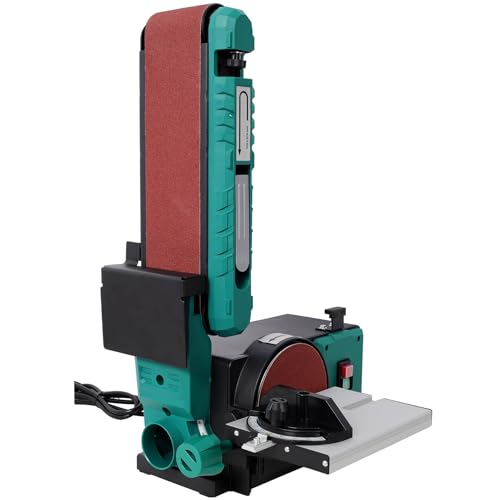
HIROHRTV 4×36 Belt/Disc Sander
What We Like
- Versatile 0-90° adjustable belt tilt
- Quick-change sandpaper lever for belts
- Precise 0-45° beveling table
- Combined belt and disc functions
Trade-offs
- 33.4 lb weight demands a sturdy benchtop.
A smooth 0-90° adjustable belt tilt is the core feature here, transforming this from a basic horizontal sander into a tool that can tackle vertical edges and complex angular work without repositioning the piece. That makes it a natural fit for a workshop that values adaptability over raw power, especially for detailed woodworking where you need to switch between beveling a tabletop and sanding an inside curve. The quick-release lever for changing belt paper supports that workflow, keeping you moving from one grit to the next without fuss.
You pay for that flexibility in a couple of areas. At 33.4 pounds, it’s solid but not a lightweight, so your workbench needs to be stable. The 6-inch sanding disc gets the job done, but if you frequently work on large, flat surfaces, you might find yourself wishing for the larger disc on something like the DEWALT model. It’s a capable, mid-range machine that puts precise angle control front and center.
Product photos
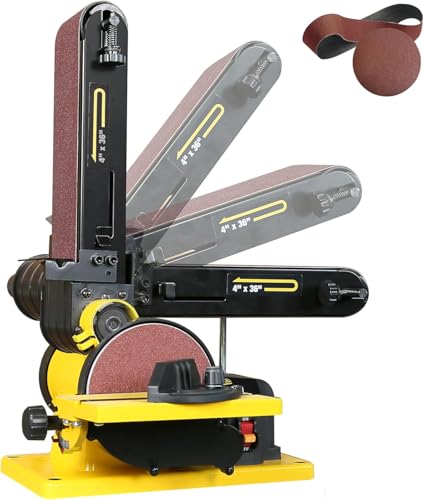
Woodskil 4×36 Belt/Disc Sander
What We Like
- Upgraded 3/4 HP motor provides strong material removal.
- Belt tilts 0-90 degrees for horizontal or vertical sanding.
- Separate dust ports for the belt and disc.
- Includes a two-year warranty for peace of mind.
Trade-offs
- The 6-inch disc is smaller than the 8-inch disc on the DEWALT model.
- Fixed belt speed lacks the variable control of models like the RIKON 50-161VS.
The 3/4 HP motor is the standout here, delivering enough torque to power through hardwoods and metal without bogging down. This makes the Woodskil a serious contender for the hobbyist or small shop owner who needs reliable muscle for frequent stock removal and shaping. Its relatively compact 25-pound footprint and the ability to tilt the belt from horizontal to vertical add to its versatility for different project angles.
You trade some mass and vibration dampening for that lighter weight and powerful motor. It’s a capable workhorse, but for sanding large panels flat, the heavier cast-iron construction of a model like the JET JSG-96CS would be more stable. Where this sander shines is in general workshop tasks where its motor power and adjustable belt position are more critical than absolute heft.
How We Evaluated Benchtop Belt Sanders
Our evaluation began with a deep dive into specifications and manufacturer documentation to understand the core capabilities of dozens of popular models. We then cross-referenced this with insights from professional woodworking and tool review publications to see how these machines perform in real workshop scenarios.
Our final criteria prioritized power and capacity for material removal, build quality for stability and longevity, and versatility in features like tilt angles, speed control, and dust collection. We also considered best practices from a belt sander guide to assess user-friendly designs. This research-led approach gives a comprehensive picture, but it cannot replicate the nuanced feel of a machine after hundreds of hours of using a belt sander on varied projects.
What To Look For In Benchtop Belt Sanders
A benchtop belt sander is a significant shop investment, so matching its features to your most common tasks is key. Consider your primary materials, project sizes, and the space you have available on your workbench.
Focus on motor power (amps or HP), belt size, and build stability. A 4×36-inch belt is a versatile standard, while a cast iron base dramatically reduces vibration. Decide if you need a combination sander with a disc or a dedicated belt machine.
Motor Power and Belt Size
Motor power, measured in amps or horsepower, dictates how aggressively the sander can remove material without bogging down. For general woodworking, a 5-7 amp motor is a solid starting point. The belt’s dimensions, its width and length, determine the size of the surface you can work on efficiently.
A common and versatile size is 4 inches wide by 36 inches long, suitable for everything from tool handles to small furniture components. Larger belts, like a 6×48-inch, offer more sanding area for long boards or wide panels but require a more substantial, often heavier, machine.
Build and Stability
The sander’s construction directly impacts its performance and finish quality. A sturdy, vibration-resistant base is non-negotiable for smooth, controlled sanding. Models with a cast iron or heavy cast aluminum base, like many top-rated bench sanders, absorb motor vibration far better than lightweight stamped steel. This stability allows for more precise work and reduces user fatigue. Also, examine the tables and platens; cast iron tables that lock down securely provide superior workpiece support, especially for bevel and edge sanding.
Versatility and Features
Versatility expands what you can accomplish with a single machine. A combination belt and disc sander offers two distinct tools in one footprint, with the disc ideal for end-grain and detailed shaping. Variable speed control is invaluable for working with different materials, like slowing down for metal or plastics.
Other features to prioritize include an adjustable belt tilt (0-90 degrees) for contour sanding, effective dust collection ports to keep your shop clean, and tool-free belt change mechanisms. For a broader look at these dual-function tools, explore our guide to combination belt and disc sanders.
- Check if the belt can be tilted to a vertical position for sanding inside curves or edges.
- Ensure the dust collection ports are a standard size that fits your shop vacuum or dust collector hose.
- Look for a quick-release tension lever for fast belt changes without tools.
- Verify the table bevels for precise angle work on edges.
- Consider if you need a miter gauge for controlled sanding on the disc.
For most home workshops, a 4×36-inch combination sander with a cast iron base offers the best balance of capability, footprint, and value.
Benchtop Belt Sanders Compared
The table below compares our picks across key specifications to help you see the differences at a glance.
| Product | Motor | Belt Size | Disc Size |
|---|---|---|---|
| DEWALT 4 x 36 Inch Belt and Disc Sander | 7.0 AMP | 4" x 36" | 8" disc |
| RIKON Power Tools 50-161VS Benchtop Belt Sander | 3/4 HP, 120V | 1 x 30 inches | 6 inch PSA disc |
| WEN 6502T Belt and Disc Sander | 4.3 Amp | 4 x 36 inches | 6 inches |
| JET JSG-96CS Belt and Disc Sander | 3/4 HP, 115V | 6" x 48" | 9" |
| BUCKTOOL 4×36 Inch Belt Disc Sander | 3/4 HP fully enclosed induction | 4 x 36 inches | 6 inches |
| WEN HB424V Variable Speed Belt Sander | 10-amp variable-speed | 4-by-24-Inch | N/A |
| RIKON Power Tools 50-112 Benchtop Belt Sander | N/A | 4" x 36" | 6" |
| KFMK 2×42 Inch Belt Disc Sander | 1/2 HP induction | 2×42 in. | 6" |
| HIROHRTV 4×36 Belt/Disc Sander | 120V/60Hz | 4×36 inches | 6 inches |
| Woodskil 4×36 Belt/Disc Sander | 3/4 HP | 4×36 inches | 6 inches |
Frequently Asked Questions
What is the best benchtop belt sander?
The best overall benchtop belt sander for most workshops is the DEWALT 4 x 36 Inch Belt and Disc Sander. It combines a powerful 7.0 AMP motor with a large 8-inch disc and independent, tiltable tables, making it a versatile two-in-one tool for demanding material removal and precise bevel work.
What is the best benchtop belt sander for knife making?
For knife making and metalworking, the KFMK 2×42 Inch Belt Disc Sander is a strong choice. Its key feature is a belt that adjusts to vertical or horizontal positions, which is crucial for grinding blades and handles. It also includes helpful accessories like a tool rest and miter gauge for controlled work.
Who makes the best belt sander belts?
The best sanding belts are typically from specialized abrasive manufacturers, not necessarily the tool brands themselves. For consistent performance and long life, look for high-quality aluminum oxide or ceramic abrasive belts from reputable suppliers, as they are designed to withstand the heat and pressure of bench sanding.
Which belt sander is the best?
The “best” belt sander depends entirely on your specific needs. For a powerful, do-everything combo unit, the DEWALT is our top pick. If precise speed control is your priority, choose the RIKON 50-161VS. For knife making, look at the KFMK. Evaluate your primary projects to decide, and you can compare more belt sanders for different applications.
What’s the difference between a belt sander and an orbital sander?
A benchtop belt sander uses a continuous loop of sandpaper on a platen for fast, aggressive stock removal and shaping, often leaving linear scratches. A random orbital sander is a handheld tool that uses a spinning and orbiting pad for a much finer, swirl-free finish. They are complementary tools for different stages of a project. For a detailed breakdown, see our belt sander vs. Orbital sander comparison.
The Bottom Line
The DEWALT 4 x 36 Inch Belt and Disc Sander earns our best overall recommendation. It combines a powerful motor, a large disc, and professional-grade versatility, making it ideal for the serious DIYer or small shop owner. If you’re on a tighter budget or need exceptional vibration control for finer work, the WEN 6502T is a superb value. For anyone working with mixed materials who needs precise speed adjustment, the RIKON 50-161VS is the clear choice. Ultimately, the most important factor is matching the sander’s capacity and features to the scale and type of projects you tackle most often in your shop.
