
What Is a Dado Blade: The Two Main Types Explained
This post contains affiliate links. As an Amazon Associate, we earn from qualifying purchases.
A dado blade is a specialized circular saw blade assembly used on a table saw to cut wide, flat-bottomed grooves (dados) in a single pass. It comes in two main types: a stacked dado set uses two outer blades and removable inner chippers for precise width adjustment, while a wobble dado blade is a single angled blade on an adjustable hub. Its primary purpose is for joinery, quickly creating clean dados, rabbets, and box joints.
That definition covers the what. The real question is whether it’s the right tool for your shop and your saw. To understand its role, one must ask: what is a dado blade? A dado blade changes how you build cabinets, bookshelves, and drawers, but it also introduces specific risks and compatibility hurdles that a standard blade doesn’t have.
What follows is a breakdown of how each type works, the essential safety steps (including why they’re banned commercially in Europe), and the exact specs you need to check on your table saw before you even think about buying one.
Key Takeaways
- A stacked dado set is the precise, versatile choice for clean joinery, while a wobble blade is a cheaper, less accurate option for occasional wide grooves.
- SawStop saws have specific requirements: they prefer dado sets under 6 pounds, very nearly 8 inches in diameter, and without excessive coatings that could interfere with the braking system.
- Never use a dado stack without its special table insert, the standard insert’s narrow kerf opening is a major kickback hazard.
- In the European Union, commercial shops generally cannot use them: dado sets lack a CE safety mark and are banned for commercial use in countries requiring the mark, as their use requires removing the blade guard and riving knife.
- Always install both outside blades; using chippers without them or with only one outer blade is a direct violation of the manufacturer’s safety instructions.
Stacked vs. Wobble: The Two Main Types
When you compare a what is a dado blade, the difference between a stacked and a wobble dado isn’t just about price. It’s about the quality of the cut you’ll get and how much setup frustration you’re willing to tolerate.
A stacked dado set consists of two circular saw blades fixed on either side of a set of removable chippers. The two outside blades cut the dado walls and the chippers remove the waste material in between and smooth the bottom of the dado.
That’s the textbook definition. In practice, you have a kit. The Harbor Freight set, for example, includes two 8-inch, 24-tooth outside blades, four 1/8-inch, 2-tooth chipper blades, one 1/16-inch, 2-tooth chipper blade, two 0.005-inch shims, and two 0.008-inch shims. You build the width you need like a sandwich: outer blade, shim, chippers, shim, outer blade. The chippers must nest into the gullets of the outer blades, and when you use more than one, they should be staggered 90 degrees relative to each other. This stacking is what gives a clean, flat-bottomed groove.
A wobble blade takes a completely different approach. It’s a single blade mounted on an adjustable hub that allows the blade to tilt, or wobble, on the arbor. As the angle increases, the cut gets wider. It’s simpler and cheaper.
Here’s the trade-off:
| Type | Best For | Biggest Drawback |
|---|---|---|
| Stacked Dado Set | Precision joinery, box joints, repeatable cabinet work. | More parts, longer setup time, higher cost. |
| Wobble Dado Blade | Occasional wide grooves in framing or rough carpentry. | Less accurate, produces a slightly rounded groove bottom, can cause significant vibration. |
The vibration is the real deal-breaker for fine work. On a wider setting, that single off-angle blade doesn’t spin true. You’ll hear and feel it in the saw. For a one-time shelf groove in a utility cabinet, it’s fine. For fitting a tenon into a mortise, it’s a non-starter.
What a Dado Blade Actually Does (And When to Use One)
You don’t buy a dado blade to make rip cuts, which answers part of what is a dado blade. You buy it to solve specific joinery problems quickly and cleanly.
Its core job is cutting dados, those rectangular grooves across the grain of a board. Think of the slots on the inside of a bookshelf that hold the shelves. That’s a through dado. A stopped dado is a groove that doesn’t go all the way across the board, leaving a clean front edge. With a well-tuned stack and a precise fence setup, you can plow a perfect, glue-ready groove in one pass that would take a router three or four setups to match.
Beyond dados, this tool excels at:
- Rabbets: Lower the blade height and run the board on its edge against the fence. You’re cutting an L-shaped notch on the edge or end of a board, perfect for joining cabinet backs or glass panels.
- Tongue-and-Groove: With two complementary setups, you can mill the tongue on one board and the matching groove on another.
- Box (Finger) Joints: This is where a dado stack shines. Using a simple jig on your table saw’s miter gauge, you can cut a series of perfectly spaced, interlocking fingers for incredibly strong corner joints.
Common mistake: Trying to cut a dado wider than your saw’s arbor can handle. The stack gets too wide, the nut won’t engage fully, and the whole assembly can come loose at speed.
The alternative is making multiple passes with a standard combination saw blade, then cleaning out the waste with a chisel. It works, but it’s slow, and the bottom is rarely perfectly flat. For a single shelf, that’s okay. For a bank of kitchen cabinets, the dado blade pays for itself in time saved.
The Parts of a Stacked Dado Set and How to Adjust It
If you go with a stacked set, and for joinery, you should, you need to speak its language. It’s not one blade; it’s a system.
- Outside Blades (2): These look like standard saw blades but are designed to work as a pair. They make the vertical walls of your groove.
- Chipper Blades: These are the smaller, multi-toothed discs that go between the outer blades. They hog out the waste. A typical set includes a few in different thicknesses (like 1/8″ and 1/16″).
- Shims: These are your micro-adjusters. They’re wafer-thin metal discs (like 0.005″ or 0.008″) that let you dial in the exact width. The Harbor Freight manual has a critical rule: a 0.024-inch shim must always be installed between an outside blade and a chipper blade. When using only the two outside blades, both 0.024-inch shims must be installed between them.
Adjusting the width is a trial-and-error process off the saw. You assemble your stack to a target width, test-cut on scrap, measure, then add or subtract shims to hit your mark. Want a perfect 3/4″ groove for plywood? You’ll likely need a combination of chippers and several shims. It’s fiddly, but that’s the price of precision.
Where this goes sideways: Not staggering chipper blades. If you stack them with their teeth aligned, they can act like a single thick blade, causing tear-out and vibration. Offset them 90 degrees so their cutting forces balance out.
The goal is a stack that’s tight on the arbor, with all components flush against each other. Before you tighten the nut, spin the assembly by hand to ensure nothing is binding. That faint swish-swish sound of the blades barely clearing the insert plate is what you’re listening for.
Table Saw Compatibility: The Make-or-Break Check
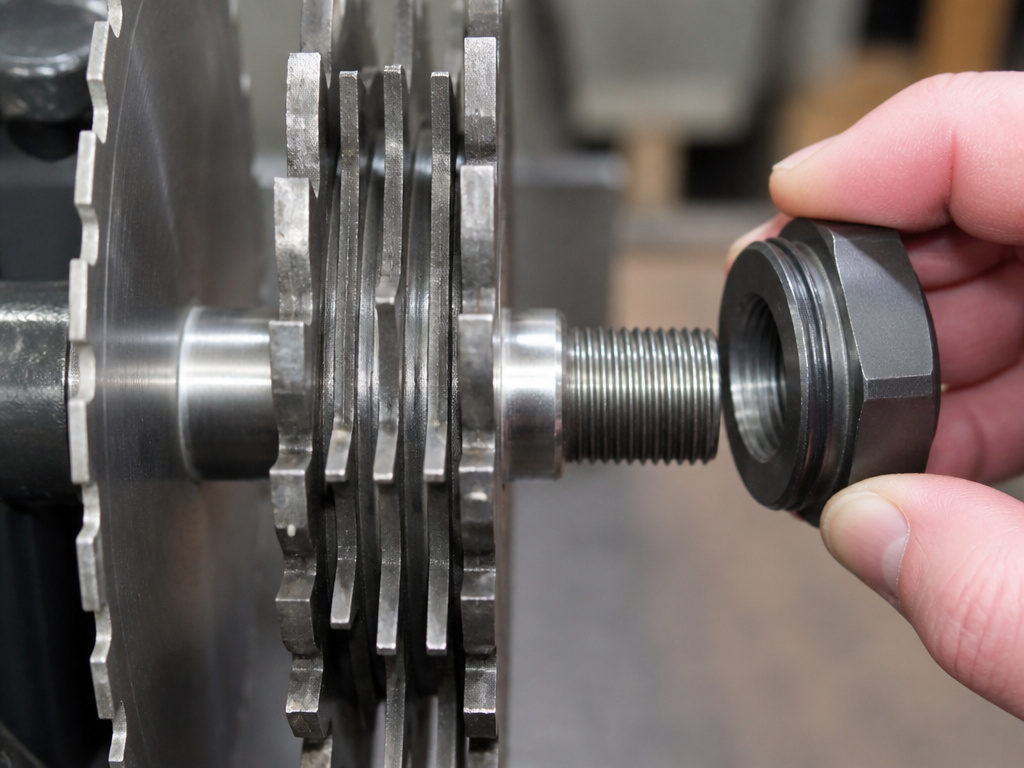
Not every table saw can run a dado blade. This is the step that stops more people than any other, and the manual is your only reliable source.
First, arbor length. This is the threaded shaft that holds the blade. A dado stack is much wider than a single blade. You must have enough thread to fully engage the nut. The Harbor Freight manual states the arbor shaft nut must be fully engaged, with a minimum of 1/2 inch of arbor threads visible after tightening. If your nut is only on by a few threads, the stack can loosen under load. That’s not a maybe; it’s a guarantee.
Second, motor and arbor ratings. The manual for your saw will explicitly say if it’s rated for dado use. Some contractor saws have spindles not designed for the extra weight and side load.
Third, special inserts and washers. You cannot use the standard throat plate. The saw blade kerf is too narrow. You need a dado insert that matches the wide opening.
| Saw Type | Key Limitation | What to Check |
|---|---|---|
| Bosch GTS1031 | Max 1/2″ width, 8″ diameter, 0° bevel only. | Manual for TS1013 insert requirement. |
| SawStop | Prefers ~6 lb weight, ~8″ diameter, minimal coatings. | SawStop compatibility list or owner’s manual. |
| European (CE) | Commercially banned; no CE mark issued. | Local regulations for hobby vs. Commercial use. |
| Contractor Saw | Arbor length & motor HP often limiting. | Manual for “dado rated” designation and min. Thread spec. |
The SawStop situation is unique. Their automatic braking system is sensitive. Representatives have noted that dado blades over about 6 pounds, or with features like anti-kickback shoulders, may not work reliably. The blade also needs to be very nearly 8 inches in diameter for the brake to contact it correctly. It’s not worth guessing, check their published list.
The Critical Safety Rules (Beyond the Basics)
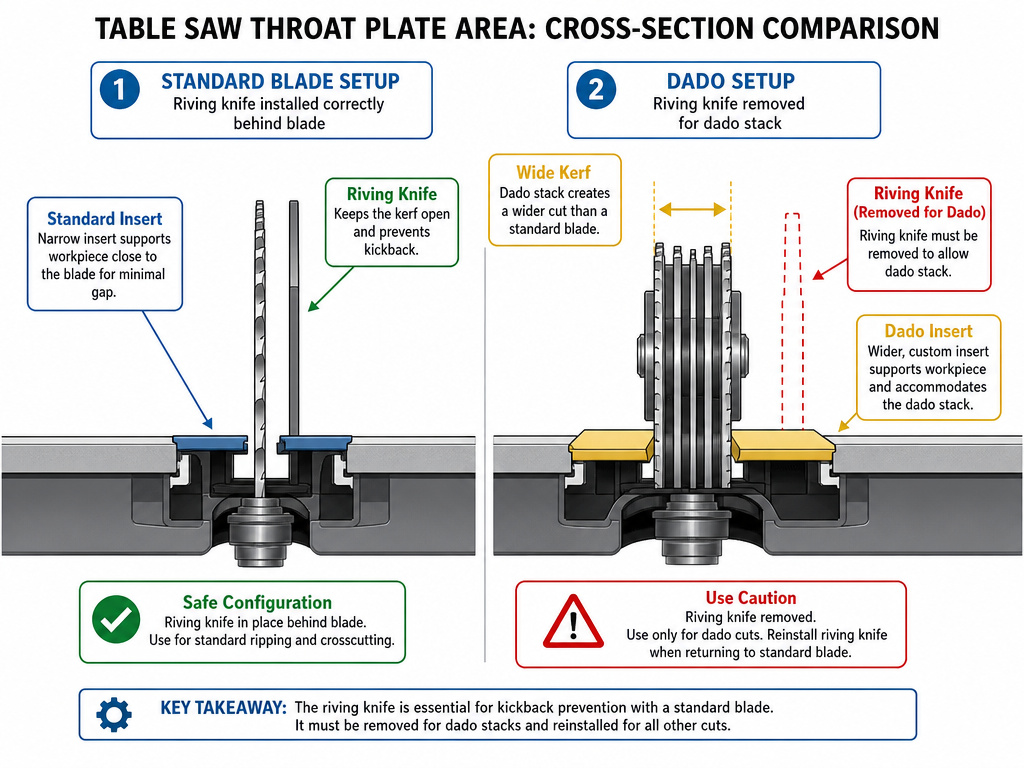
Using a dado blade multiplies the normal risks of a table saw. You’re removing more material, creating more force for kickback, and you’ve almost certainly removed two key safety devices.
1. The Riving Knife Must Come Off.
This is mandatory and the primary reason for the European ban. A dado stack’s wide kerf cannot be used with a riving knife or splitter. That means there’s nothing to prevent the kerf from closing on the back of the blade and launching the workpiece. Your anti-kickback strategy shifts entirely to proper feed technique and workpiece support.
2. The Special Insert is Not Optional.
That wider cut needs a wider opening in the table. Using the standard insert is like trying to force a square peg through a round hole, the workpiece will catch, bind, and kick back violently. The Bosch manual puts it in a warning box: “Always use the Bosch dado blade Table Insert No. TS1013.”
3. Kickback is Your #1 Concern.
With no riving knife and a wide, aggressive cutter, the forces at play are greater.
- Use a sacrificial fence: When cutting a rabbet, your workpiece can fall into the gap between the blade and the fence. A piece of scrap tacked to your fence closes this gap.
- Featherboards are mandatory: They keep the workpiece firmly against the fence and down on the table, countering the blade’s tendency to lift and pull.
- Never crosscut with the fence: This is a cardinal table saw rule, but it’s doubly true with a dado. Use a miter gauge or crosscut sled. If the workpiece binds between the blade and fence, it becomes a missile.
4. Personal Protection is Specific.
The volume of fine dust a dado stack generates is immense.
Why Dado Blades Are Banned in Europe (And What It Means for You)
If you’ve shopped for tools in the UK or EU, you might have noticed dado blades are hard to find. There’s a regulatory reason.
For a power tool to be sold for commercial use in the European Union, it generally must carry a CE mark, indicating it meets EU health, safety, and environmental standards. Dado blade sets are not awarded a CE mark. The consensus among European safety authorities is that their inherent use, requiring the removal of the blade guard and riving knife, makes them unsafe for commercial operations.
This isn’t a suggestion; it’s an effective ban. Countries that require the CE mark for commercial work, like the UK, France, and Germany, do not allow dado-equipped table saws on professional job sites.
What most people get wrong: Thinking the ban applies to home hobbyists. In many cases, the regulations govern commercial operations. A home woodworker in Europe might still purchase and use one, but they are accepting the full, unmitigated risk. The tool is sold with clear warnings that it bypasses the saw’s built-in safety systems.
For a DIYer elsewhere, this isn’t just a curiosity. It’s a stark reminder that you are disabling primary safety systems when you install a dado stack. The guard is gone. The splitter is gone. Your safety now depends entirely on your setup, your jigs, and your disciplined adherence to the remaining rules.
Troubleshooting Common Dado Blade Problems
Even with a perfect setup, things can go wrong. Here’s how to diagnose the usual suspects.
-
Burn Marks on the Sides of the Cut This usually means your outer blades are dull, or your feed rate is too slow. The blades are rubbing, not cutting. Check that your stack is perfectly aligned and not pinching the workpiece. A sharper set of quality table saw blades for the outer cutters often solves this.
-
Tear-Out or a Rough Bottom If the bottom of your groove looks chewed up, your chippers are likely not seated flat or are dull. Ensure they are properly nested in the outer blade gullets. Also, a scoring blade (a dedicated thin blade that scores the wood fibers before the main cutters hit them) can eliminate tear-out on plywood.
-
Vibration or a Loud Hum First, re-check that everything is tight and that chippers are staggered 90 degrees. If it persists, your stack might be out of balance. Try reassembling it in a different order. A wobble blade will always have some vibration; it’s in the design.
-
Width is Inconsistent Your stack is shifting. The most common cause is an arbor nut that isn’t fully tightened. Remember the 1/2 inch of visible threads rule. If the nut is bottoming out before it clamps the stack, you need a different washer or a thinner nut. Don’t force it.
-
The Cut is Not Square This points to an issue with your saw or fence, not the blade. Ensure your blade is at a perfect 90° to the table (dado cutters on saws like the Bosch GTS1031 cannot be used at a bevel angle). Then, check that your fence is parallel to the blade. A misaligned fence will cause the workpiece to steer, creating a tapered groove.
Frequently Asked Questions
Do all table saws accept dado blades?
No. You must check your saw’s owner’s manual. Key limiting factors are arbor length (must have enough thread for the wide stack), motor horsepower, and whether the arbor spindle is rated for the extra weight and side load. Many jobsite and older contractor saws are not designed for them.
Can I cut dados without a dado blade?
You can make multiple passes with a standard blade and clean out the waste with a chisel, or use a router with a straight bit and an edge guide. The router method is cleaner and quieter but often slower for a single groove.
What’s the difference between a dado and a rabbet?
Dado is a groove cut across the grain, usually in the middle of a board’s face. A rabbet is an L-shaped notch cut on the edge or end of a board. You can cut both with a dado stack by adjusting the blade height and using the fence differently.
Can you use a dado blade on a radial arm saw or a circular saw?
Some radial arm saws can accommodate them, but it’s less common and requires specific models rated for it. You cannot safely use a standard dado stack on a handheld circular saw. The width, weight, and unbalanced forces make it extremely dangerous.
Are dado blades worth the money for a hobbyist?
It depends on your projects. If you build bookshelves, cabinets, or drawers with any frequency, a stacked dado set will save you hours of labor and produce stronger, better-looking joints. For someone who mostly does crosscuts and rips, it’s an expensive specialty tool that will gather dust.
Before You Go
A dado blade isn’t just another type of circular saw blade. It’s a system that provides a higher level of woodworking efficiency and quality, but it demands a higher level of respect and preparation. The single most important step happens before you buy: confirming your table saw is truly compatible. If your manual is vague or says no, listen to it.
If you proceed, treat the safety steps as law, not guidelines. The missing riving knife changes everything about how you handle the workpiece. Start with simple through-dados in scrap to learn the feel and sound of a well-executed cut. The speed and cleanliness of a well-executed groove are what make this tool a cornerstone of serious shop work. Just make sure your shop, and your habits, are ready for it.
