
Single Bevel vs Dual Bevel Miter Saw: How to Choose
This post contains affiliate links. As an Amazon Associate, we earn from qualifying purchases.
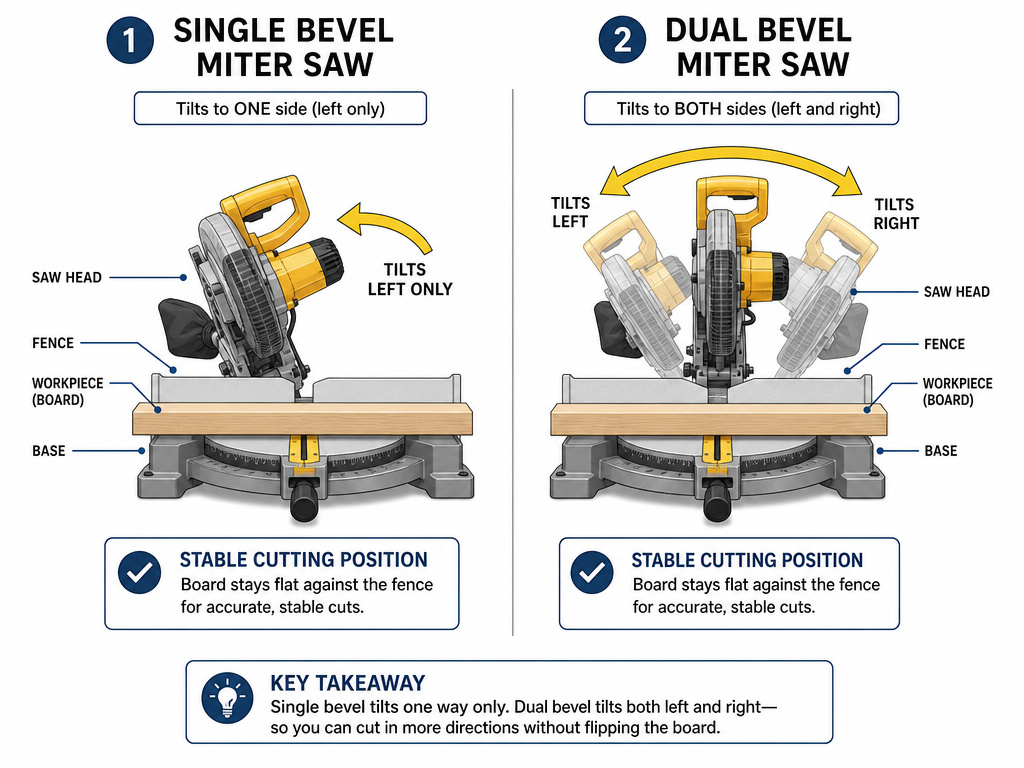
A single bevel miter saw tilts the blade in one direction (usually left) for angled edge cuts, while a dual bevel miter saw tilts both left and right. The dual bevel’s ability to cut mirrored angles without flipping the workpiece makes it the better buy for frequent crown molding, trim work, or any project requiring opposing bevels.
That left-or-right tilt is the entire decision. It changes how you work, what you can do efficiently, and what kind of mistakes you’re prone to make, which is the core of the single bevel vs dual bevel miter saw debate.
What follows is a breakdown of that core mechanism, the projects it decides, and the specific tools that get the job done without overcomplicating your shop. By the end, you’ll know exactly which type of saw you should walk out of the store with.
Key Takeaways
- The single bevel saw tilts one way; you must flip the workpiece for a mirrored cut, which introduces alignment error.
- The dual bevel saw tilts both ways, allowing quick, mirrored cuts without moving the material, crucial for crown molding on adjacent walls.
- For most DIYers doing occasional trim, a single bevel is sufficient; for anyone installing crown molding or doing frequent trim work, the dual bevel pays for itself in saved time and frustration.
- Always verify bevel angles with a speed square; the saw’s built-in gauge can drift, and a miscalibrated saw is the main cause of gappy joints.
- Don’t confuse a basic chop saw with a bevel-capable miter saw; only tools labeled “single bevel” or “dual bevel” can make these tilted blade cuts.
The Core Difference: Single vs Dual Bevel Explained
A bevel cut is when the saw blade tilts away from vertical to slice an angled edge onto your workpiece. Think of the slanted edge on a picture frame or the complex angle where crown molding meets the ceiling. That’s a bevel.
A single bevel miter saw tilts in one direction (usually left). A dual bevel miter saw tilts both left and right. This functional difference dictates whether you must physically flip your board to cut a matching angle on its opposite side.
The single bevel saw has one pivot. To get the same angle facing the other way on the mating piece, you have to pick up the board, turn it around, re-register it against the fence, and cut again. It’s not just an extra step; it’s an invitation for error. Your fence alignment, your hand pressure, even a slight bow in the wood can throw the two mirrored pieces off just enough to leave a visible gap.
A dual bevel saw adds a second pivot. You make your first cut, then simply swing the blade to the same angle on the opposite side. The board never moves. The cut is perfectly mirrored because the saw’s geometry does the work, not your ability to reposition a six-foot length of trim identically twice.
Where this goes sideways: Assuming your single bevel saw’s fence is perfectly square every time you flip a board. It rarely is. That tiny shift is why DIY crown molding jobs often have one tight corner and one with a hairline gap you can’t quite caulk away.
Common Projects and Which Saw Wins
The choice isn’t abstract. It’s decided by what’s on your cut list.
Crown Molding and Trim Work
This is the dual bevel’s home turf. Installing crown molding means coping inside corners and fitting outside corners. Those outside corners require two pieces cut at identical but opposite bevels, a left and a right, to meet with a clean joint.
With a single bevel saw, you cut the first piece, then mark, flip, and recut the second. It’s slow. It’s fussy. One sloppy flip and the joint is off. A dual bevel saw allows you to cut both pieces in sequence, left-then-right, with the stock held firmly in the same position against the fence. The speed and accuracy gain isn’t a luxury; it’s the difference between a professional-looking install and a weekend of frustration.
For baseboards, window casings, and door trim where you’re mostly making square or simple miter cuts, a single bevel saw is perfectly capable in the single bevel vs dual bevel miter saw comparison. But the moment your trim project involves any opposing bevels, the dual bevel’s advantage becomes obvious.
Picture Frames and Furniture
Making a simple picture frame requires only 45° miter cuts, no bevel. But step into furniture making, a tapered leg for a table, a slanted edge on a shelf, and bevels come into play. If your design calls for symmetrical, angled edges on opposite sides of a piece, the dual bevel saw removes a major variable.
Here’s a sensory reality: cutting a bevel on a wide board with a single bevel saw often means the workpiece extends far to the right of the blade (if your saw tilts left). It can feel unbalanced. A dual bevel allows you to choose the tilt direction to keep the work more centered over the saw’s base, which simply feels more stable and controlled.
| Project Type | Single Bevel Suitable? | Dual Bevel Advantage |
|---|---|---|
| Crown Molding (outside corners) | Possible, but error-prone | High – Enables perfect mirrored cuts without flipping |
| Baseboard/Simple Trim | Yes – Most cuts are square or simple miters | Low – Unnecessary for basic 90° cuts |
| Picture Frames | Yes – Typically requires only miter cuts | None – Bevel function not used |
| Furniture (tapered legs, angled edges) | Possible | Moderate – Efficiency gain on symmetrical designs |
| Decking / Fencing | Yes – Bevels are rarely needed | Low |
The Practical Realities: Cost, Weight, and Calibration
A dual bevel saw isn’t just a single bevel with an extra lever. The added mechanism means more parts, more weight, and a higher price. You need to know what you’re buying into.
Cost and Value
You pay more for the dual bevel mechanism. The question is whether you’ll use it enough to justify the cost. If you’re a homeowner who might install trim once and then use the saw for years of straight crosscuts, the single bevel is the smarter financial choice. You can invest the difference in a better blade or a sturdy stand.
But if “trim work” appears on your project list more than once a year, or if you have a house full of crown molding in your future, the dual bevel’s time savings and improved results justify the step up. It’s a tool that pays for itself not in resale value, but in reduced project time and fewer wasted boards.
Weight and Portability
The dual bevel mechanism adds bulk. A 12-inch sliding dual bevel saw is a substantial tool. If you need to move your saw from a truck bed to a second-story job site frequently, that weight matters. Many pros on the go still choose a robust single bevel model for this reason, sacrificing the dual-bevel convenience for lower weight and simpler setup.
For a stationary workshop saw, the weight is a benefit, it adds stability and reduces vibration.
Calibration and Maintenance
Common mistake: Trusting the bevel scale on a new saw straight out of the box. The scales on both single and dual bevel saws can be inaccurate. Always verify with a digital angle gauge or a speed square before starting precision work.
This is critical. A dual bevel saw has two sets of adjustments to potentially drift. The good ones have positive stops and micro-adjustments at common angles. The process is the same for both types: loosen the bevel lock, tilt the blade to your desired angle using the scale as a guide, lock it down, and then check the actual angle with a trusted reference tool.
The difference is frequency. If you’re using the dual bevel function constantly, switching from left to right bevels, it’s wise to check the calibration on both sides periodically. A single bevel saw used mostly for 90° crosscuts might hold its calibration longer with less checking.
The part nobody mentions: Sawdust and grit love to settle in the bevel pivot tracks. Blowing out the mechanism with compressed air every few months keeps the movement smooth and the angles accurate. It’s a five-minute habit that prevents a half-day of troubleshooting mysterious gaps.
How to Choose: A Decision Framework
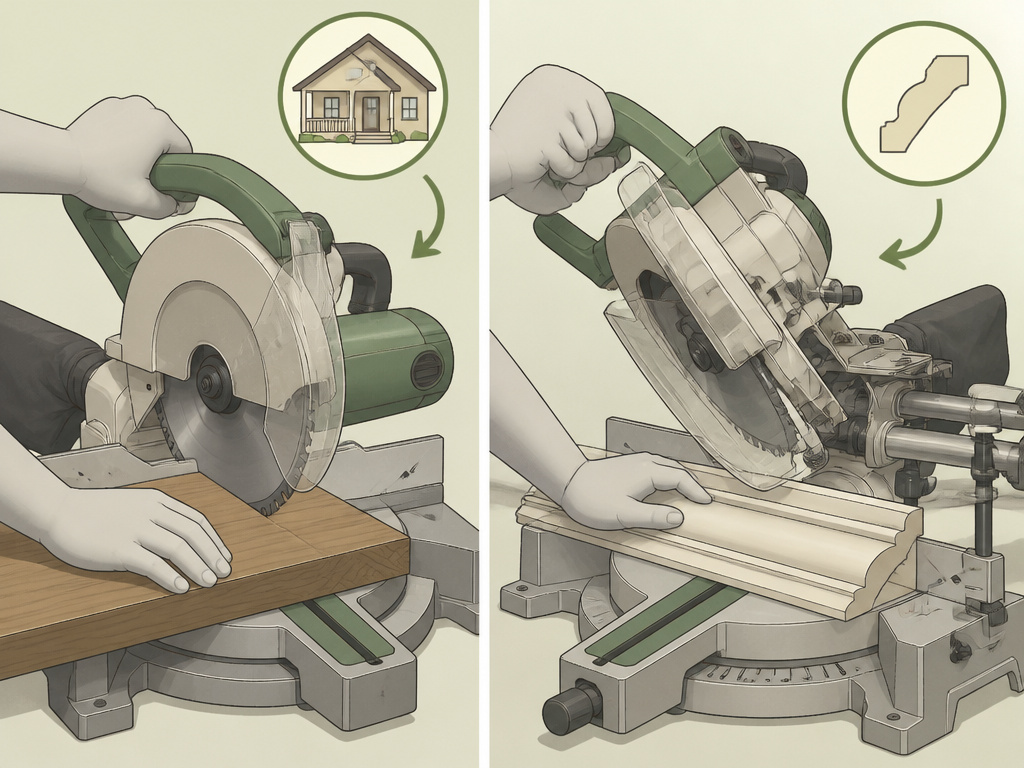
Stop thinking about features and start thinking about your next three projects. Your choice should be driven by your actual workflow, not a hypothetical future.
For the Occasional DIYer / Homeowner: Choose a single bevel miter saw. Your projects are likely to be decks, fences, shelving, and maybe one bathroom trim update. You’ll use the miter function constantly and the bevel function rarely. The money you save can be put toward a high-quality blade, a 60-tooth finishing blade makes even a modest saw cut like a dream. Many brands offer competent single-bevel models that are perfect for this tier.
For the Serious DIYer / Remodeler: Choose a dual bevel miter saw. If you’re planning to tackle crown molding, wainscoting, or building furniture with angled joins, the dual bevel is an essential efficiency tool. It eliminates the single biggest source of error in those projects. Many brands offer robust dual-bevel models that are known for holding their settings through heavy use.
For the Professional Carpenter / Installer: This is a pure workflow decision. If your job is 80% quick, accurate crown or trim installs, the dual bevel is your daily driver. If you’re a framer or general contractor where the saw is used mostly for square crosscuts and the occasional bevel, a heavy-duty single bevel saw might be lighter and faster to deploy. Many pros in this camp use a premium single bevel saw.
Miter Saw vs Table Saw for Bevel and Miter Cuts
While a table saw can tilt its blade for bevel cuts, a compound miter saw is purpose-built for making precise, combined miter and bevel cuts in one motion. This is crucial for projects like crown molding or picture framing. A single or dual bevel miter saw allows you to set the workpiece flat against the fence and simply lower the blade, a safer and more stable operation for cutting the ends of boards. On a table saw, you must maneuver the entire board past a tilted blade, which can be cumbersome and less accurate for complex compound angles.
Sliding or Non-Sliding Miter Saw with a Bevel
Whether you choose a sliding or a standard miter saw, the single or dual bevel function works the same. The sliding feature simply increases the width of board you can cut. When selecting your saw, consider that a dual bevel is especially useful for trim carpentry and custom millwork. If you frequently handle wide crown molding or trim pieces, a sliding dual bevel saw combines the capacity to cut wider boards with the efficiency of tilting the blade in both directions without flipping the workpiece.
Corded or Cordless Miter Saw for Bevel Cuts
The choice between a corded or cordless miter saw doesn’t change the fundamental operation of the bevel mechanism. Both types can be single or dual bevel. Your decision hinges on job site logistics. A cordless model offers clear portability for work without easy power access. However, for stationary shop use or long production runs involving frequent bevel cuts for trim work, a consistent corded power source eliminates battery management. Always verify your saw’s calibration with a square, regardless of its power source, to ensure bevel accuracy.
Frequently Asked Questions
Should I get a single or dual-bevel miter saw?
Get a dual-bevel miter saw if you plan to do any crown molding, complex trim, or furniture projects that require mirrored angled cuts. The time and accuracy savings are significant. If you only need a saw for basic crosscuts and straight-forward DIY projects, a single-bevel saw is more cost-effective and simpler to maintain.
Is double bevel better than single bevel?
It is better for specific tasks. A double (dual) bevel miter saw is objectively better for making efficient, accurate opposing bevel cuts, as used in crown molding. For general cutting where you rarely need a bevel, a single bevel saw is not “worse”, it’s just a more specialized, and often lighter, tool.
What should you never cut with a miter saw?
Never cut metal with a wood-cutting blade, never cut freehand without securing the workpiece, and never cut pieces that are too small to hold safely against the fence. Also, avoid using warped or twisted stock, as it can kick back when the pinched blade releases.
Who makes the best dual-bevel miter saw?
The “best” depends on your budget and needs. The best model depends on your budget and needs, with many brands offering reliable, innovative, or premium options. Your choice should be guided by trying the handle and testing the bevel action, the best saw is the one that feels right in your hands.
How can I tell if a used miter saw is single or dual bevel?
Look at the saw arm’s pivot point. A single bevel saw will have a bevel scale and a locking lever on only one side (typically the left). A dual bevel saw will have a second scale and a second locking lever or control on the opposite side of the arm. Also, check the user manual if it’s included; the model number will tell you definitively.
The Bottom Line
Your miter saw is a relationship. You’ll lift it, tune it, and trust it to make cuts that fit perfectly. The single bevel vs dual bevel miter saw question comes down to how often you’ll need that trust to deliver a mirrored angle without a second thought.
If your answer is “more than once a year,” the dual bevel is the right tool for the job. The initial cost is higher, but the payback in saved time, saved material, and professional-grade results is immediate. For everyone else, a well-chosen single bevel saw is a powerful and capable cornerstone of the workshop.
One final, grounded rule: No matter which saw you buy, budget for a digital angle gauge. The confidence of knowing your blade is at exactly 33.9°, not “roughly 34 degrees,” is what separates a precise cut from a great one. That’s true for both sides of the bevel debate.
