
Table Saw vs Track Saw: Which Should You Buy?
This post contains affiliate links. As an Amazon Associate, we earn from qualifying purchases.
In the table saw vs track saw choice, a table saw is a stationary workhorse for ripping lumber and joinery, while a track saw is a portable system for breaking down sheet goods. Most woodworkers need a table saw first for its versatility, but if you work mainly with plywood in a small space, a track saw is the better initial buy.
The gap in cut depth is the first physical limit you’ll hit. A track saw like the Makita SP6000 maxes out at 2-3/16 inches, though some sources note most track saws max out around 2.1 inches. A job-site table saw like the DeWalt DWE7491RS cuts 3-1/8 inches, and table saws generally handle 3 inches or more. That extra capacity decides which tool you can even use for thick hardwoods.
What follows is a breakdown of the five specs that matter: kerf width, cut depth, safety, space, and the real cost of accessories. By the end, you’ll know which tool to buy first and how to use the other one when you eventually own both.
Key Takeaways
- Choose a table saw first if your shop has the space and you need one tool for ripping, joinery, and repetitive cuts.
- Choose a track saw first if you primarily cut plywood, work in a small garage, or need job-site portability.
- A track saw’s thin-kerf blade (typically 2.0–2.4 mm) wastes less material than a standard full-kerf table saw blade (typically 2.8–3.2 mm) on sheet-good projects.
- Track saws are inherently safer with no kickback risk; table saws require rigorous safety practices.
- Neither tool replaces the other completely. A hybrid setup, track saw for breakdown, table saw for joinery, is ideal.
The 2.2 mm vs 3.2 mm Kerf Difference That Saves a Sheet
Kerf is the width of material turned to dust by the blade. It seems trivial until you run the numbers on a cabinet project. A typical thin-kerf track saw blade removes 2.0 to 2.4 mm. A standard full-kerf table saw blade takes 2.8 to 3.2 mm.
That’s real money. For a one-off shelf, it doesn’t matter. For a kitchen’s worth of cabinets, it’s the difference between an accurate quote and an embarrassing change order. You measure kerf by pushing two offcuts back together and measuring the gap with calipers, don’t trust the number on the blade box.
A track saw’s rubber splinter guard and a table saw’s zero-clearance insert don’t change the kerf, but they prevent chip-out. That means you don’t need to add a trim allowance to your finished edges, which acts like free material savings. A thin-kerf blade on a table saw needs a stabilizer to avoid deflection on long rips through 18 mm stock.
Cut Depth and Power: Where Each Tool Hits a Wall
The maximum depth of cut is a hard limit. Sources disagree on the exact figure, but the hierarchy is clear.
| Tool & Model | Cut Depth at 90° | Cut Depth at 45° | Motor / Speed |
|---|---|---|---|
| Track Saw (Makita SP6000) | 2-3/16″ (56 mm) | 1-9/16″ (40 mm) | 2200–6400 RPM (variable) |
| Table Saw (DeWalt DWE7491RS) | 3-1/8″ (79 mm) | 2-1/4″ (57 mm) | 15 Amp, 4800 RPM (constant) |
The Makita SP6000’s 56 mm cut depth is enough for material up to that thickness. The DeWalt’s 79 mm cut depth handles thick stock in one pass. If you regularly work with thick hardwoods or need to cut deep dados, the table saw is your only option. The track saw’s variable speed is useful for starting cuts in delicate materials, but it doesn’t make up for a lack of raw cutting capacity.
The table saw’s constant 4800 RPM and 15-amp motor deliver consistent power for hardwoods. The track saw’s lighter magnesium construction keeps it portable but can feel tippy on bevel cuts, the center of gravity shifts past the edge of the track. You need to guide it carefully.
The Real-World Workflow: Sheet Goods vs. Joinery
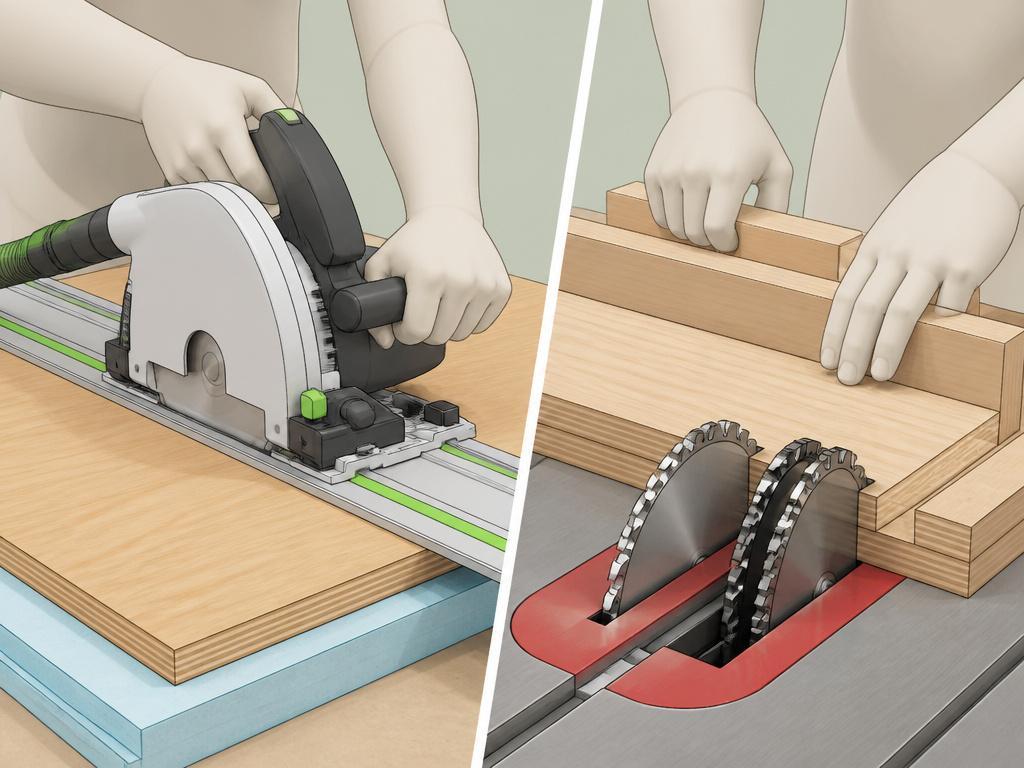
Your project list dictates the winner in the table saw vs track saw debate. To be clear, for cutting a 4×8 sheet of plywood by yourself in a garage, the track saw is the better choice. You lay the sheet on foam boards, clamp the track, and glide the saw across it. For example, the Makita SP6000 weighs 9.7 lbs. It’s controlled, clean, and safe. Trying to maneuver that same sheet over a table saw is a two-person job that often ends with tear-out on the underside.
For everything else, ripping twenty identical shelf sides, cutting dados for cabinet backs, or milling tenons, the table saw is faster and more accurate. The fence locks in place. You can build a crosscut sled for perfect 90-degree cuts. A track saw can’t run a dado stack.
Where this goes sideways: Using a track saw for repetitive rip cuts. Clamping and aligning the rail for each identical cut turns a five-minute table saw job into a 30-minute chore with more room for measurement error.
This is why many woodworkers, as noted in a Sawmill Creek woodworking community discussion, end up with both tools after considering the table saw vs track saw choice. They use the track saw for the initial breakdown of sheet goods and the table saw for final dimensioning and joinery. It’s a powerful hybrid workflow.
Safety: The Unbeatable Track Saw Advantage
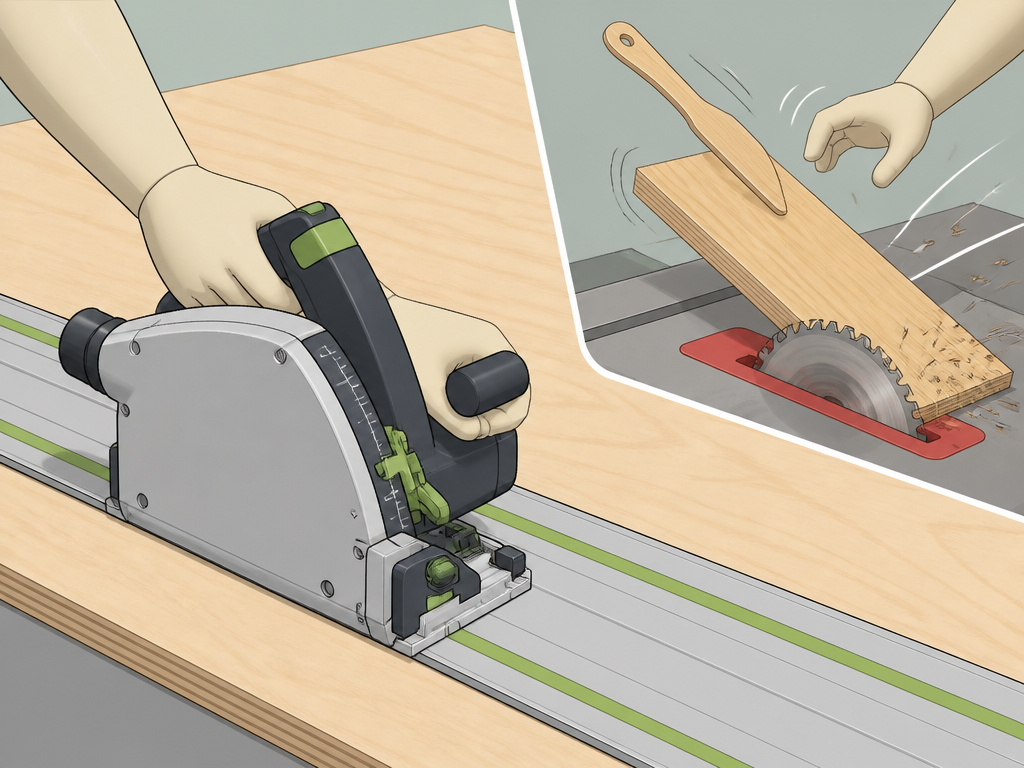
This isn’t a close call. Table saws cause more workshop injuries than any other power tool, with kickback being the primary danger. A track saw eliminates that risk. The blade is fully enclosed, it plunges into the material, and the rail guides the cut. The workpiece stays still. You cannot accidentally touch the blade during operation.
The safety is baked into the design, not added on. The manual for the Makita track saw still recommends using two hands, but the risk of the workpiece being thrown is zero. For a home shop shared with family or for anyone anxious about power tools, this is a massive point in the track saw’s favor.
Table saw safety relies on you: using a riving knife, a blade guard, push sticks, and maintaining a well-tuned machine. Technologies like SawStop add a significant cost premium. If safety is your top concern, the track saw’s inherent design is the clear choice. Learning proper table saw techniques is essential if you go that route.
Space, Portability, and the Hidden Cost of Accessories
A table saw demands a permanent footprint. A contractor saw with outfeed needs a significant permanent footprint. A track saw and its rail fit in a closet or the back seat of a car. For a one-car garage shop or a contractor moving between sites, this is the deciding factor.
But the “portable” track saw system gets expensive fast. The saw itself is just the start.
| Accessory | For Track Saw | For Table Saw |
|---|---|---|
| Essential Guide | Track (common lengths include 55″ or 118″) | Quality Fence (aftermarket upgrade) |
| Work Surface | MFT Table or Foam Boards | Outfeed Support / Stand |
| Accuracy Jig | Track Squares & Clamps | Crosscut Sled |
| Dust Control | 1.5″ Hose | 2-1/2″ Port |
An MFT (Multi-Function Table) with dog holes turns a track saw into a capable cross-cutting station, closing some of the gap with a table saw. But that’s another several hundred dollars and more floor space. A table saw’s rolling stand adds portability, but it’s still a beast to move. Your shop size and whether you need to take the tool to the work should guide your choice. For cutting large panels on site, a track saw paired with a good circular saw vs table saw guide is a versatile kit.
Can a Track Saw Replace a Table Saw?
For a subset of woodworkers, yes. If you build cabinets, built-ins, or plywood furniture and pair the track saw with a miter saw, you can cover 80% of your cuts. The clean, glue-ready edges from a track saw are a real benefit.
But the 20% it can’t do is critical:
- Joinery: Dados, rabbets, and tenons are impossible.
- Thin Rip Cuts: The rail needs stock wide enough to provide a stable clamping surface.
- Repeat Cuts: As mentioned, resetting the rail kills efficiency.
- Thick Stock: Anything over the saw’s maximum cut depth is a no-go.
The table saw is still the central tool in a general-purpose workshop. A track saw is a brilliant specialist. Sources like HomeBuildLab suggest most people should start with the versatile table saw and add the specialist track saw later, though others argue a track saw can be a primary tool for those with space constraints. Check our best table saws guide if that’s your direction. If your heart is set on a track saw, our track saw buying guide covers the top models.
Frequently Asked Questions
Can a track saw do everything a table saw can do?
No. A track saw excels at breaking down sheet goods and making precise straight cuts, but it cannot perform joinery cuts like dados or rabbets, and it is inefficient for making many identical rip cuts. It also has a more limited cutting depth.
Which is better for a beginner, a table saw or track saw?
For a beginner with space, a table saw is better. It’s more versatile for learning fundamental woodworking skills like ripping, crosscutting, and basic joinery. However, if a beginner is solely focused on building with plywood (e.g., cabinets) and has a small shop, a track saw is safer and easier to manage for that specific task.
Is a track saw safer than a table saw?
Yes, significantly. Track saws eliminate the risk of kickback, have fully enclosed blades, and keep the workpiece stationary. Table saws require strict safety protocols and are responsible for more workshop injuries.
Can you rip a 2×4 with a track saw?
You can, but it’s not ideal. The rail needs a wide enough surface to clamp to, which can be awkward on a narrow 2×4. A table saw or even a circular saw setup is faster and more stable for ripping dimensional lumber.
Why would you use a track saw if you have a table saw?
You’d use a track saw to safely and cleanly break down full sheets of plywood without needing help, to make precise long cuts on large panels (like countertops), and to take your cutting station to a job site. It complements a table saw; it doesn’t replace it.
The Bottom Line
Start with the tool that matches your most common material. If that’s plywood and sheet goods in a tight space, get the track saw. If it’s a mix of lumber and sheet goods with room for a stationary tool, get the table saw.
The one rule most guides skip: if you buy a track saw, budget for at least a 55-inch track and a way to square it up immediately. The raw saw without a guide rail is hamstrung. If you buy a table saw, your first upgrade should be a better blade, followed by building a simple crosscut sled. The stock fence and miter gauge are almost always the weak points.
Both tools have become more affordable. You can get a capable track saw or circular saw for well under Festool money, and a solid job-site table saw is under $500. Whichever you choose, spend the time to learn it properly. The right technique matters more than the brand name on the housing.
