
Can You Use a Staple Gun on Drywall?
This post contains affiliate links. As an Amazon Associate, we earn from qualifying purchases.
You can use a staple gun on drywall, but only in a few specific, code-defined applications, like attaching a base layer in a multi-wall assembly or securing metal corner bead. The staples must be 16-gauge with a 7/16-inch crown and penetrate at least 5/8 inch into wood framing. For hanging a sheet of drywall to studs in a standard stick-built home, screws or nails are the code-compliant, professional choice.
The official specs from the Gypsum Association and major manufacturers have clear, numbered rules for staples. They aren’t banned. But the rulebook and the jobsite often tell two different stories. A common question is, can you use a staple gun on drywall? Building codes for residential construction typically call for nails or screws, and a pro’s hammer tacker or screwgun is what you’ll see on 99% of job sites.
What follows is a breakdown of when the manuals say you can staple, the exact staple you must use, and the practical reasons most contractors reach for a screwgun instead of exploring can you use a staple gun on drywall. This includes attaching corner bead, hanging lightweight items, and the one mistake that turns a simple repair into a crumbled mess.
Key Takeaways
- The Gypsum Association and USG specs permit 16-gauge staples with a 7/16-inch crown for attaching gypsum board, but typically only as a base layer in double-wall assemblies or for sheathing.
- For hanging objects, a staple in drywall alone (not into a stud) has very little holding power; anything heavier needs an anchor or a screw into framing.
- Never use staples on the final, finish layer of a multi-layer drywall system or in high-moisture areas, the finish layer requires screws, and moisture will rust staples quickly.
- When securing metal corner or angle bead, a manual staple gun is the preferred tool for speed and control, firing staples through the bead’s flange every 6-8 inches.
- Plaster is not drywall. Firing a staple into a plaster wall often results in a cracked, cratered mess because the brittle lath behind it can’t absorb the impact.
The Official Staple Spec for Drywall (According to the Books)
The rulebooks aren’t silent on this. Primary sources like the Gypsum Association’s fastener guide and the USG/CGC Construction Handbook detail exactly when and how staples can be used. The answer isn’t a simple yes or no, it’s a list of conditions.
According to the Gypsum Association, staples used to attach gypsum panels shall be 16 gauge, with not less than a 7/16 inch (11 mm) wide crown. They should be driven with crowns parallel to framing members and must not fracture the gypsum core or cut the face paper.
That’s the technical snippet. The most common approved application is in multi-layer wall assemblies. The USG/CGC handbook states staples are recommended only for attaching the base layer of boards to wood framing in double-layer systems. The finish layer always gets screws or nails. This method uses the staple’s speed for the hidden layer where holding power is less critical, and the screw’s superior grip for the visible, finished surface.
The specs also cover edge distance and penetration. Fasteners must be at least 3/8 inch from the edge or end of the board. For penetration, the USG/CGC handbook calls for leg lengths that provide a minimum of 16 mm (5/8 inch) into the wood framing, while other sources like Walls & Ceilings Magazine also cite a 5/8 inch minimum for staples in multi-layer applications. Another source, National Shelter Products, specifies a minimum 3/4 inch penetration for gypsum wallboard attached to their sheathing system. This variance shows why you must check the specific manufacturer’s installation sheet.
Where the Manuals Disagree: Crown Orientation
Even the primary sources don’t fully agree on technique. It’s a small detail, but it matters for proper installation.
| Source | Staple Crown Orientation Rule | Reasoning / Context |
|---|---|---|
| Gypsum Association | Crowns parallel to framing members. | Aligns the staple’s strength with the grain of the wood stud. |
| USG/CGC Construction Handbook | Crown perpendicular to gypsum board edges (except where edges fall on supports). | Prevents the board edge from cracking or lifting between staples. |
So, which is right? If you’re following a specific manufacturer’s system, use their rule. In the absence of that, note that sources disagree: the Gypsum Association recommends crowns parallel to framing members, while the USG/CGC Construction Handbook recommends crowns perpendicular to gypsum board edges except where edges fall on supports. The goal is the same: a tight hold without damaging the board.
Why Screws (or Nails) Are the Default for Hanging Drywall Sheets
Building codes for residential construction, such as the International Residential Code (IRC), typically call for nails or screws for attaching gypsum wallboard, which directly informs the can you use a staple gun on drywall question, as staples are not commonly listed as an approved fastener for this primary application in stick-built homes. As one industry article notes, using staples for hanging drywall sheets in stick-built homes might even require petitioning for a code change, a hurdle no builder or inspector wants. However, other sources specify staples for certain code-compliant applications like base layers in double-wall assemblies.
The physical reason is holding power. A screw’s threads bite into the wood along their entire length, creating immense resistance to pull-out. A staple is essentially two smooth nails joined by a crown. It relies on friction and its bend resistance. Some sources argue that under constant stress, a staple has a higher chance of working loose compared to a screw, leading to pops or sagging over time, while other sources imply staples are suitable for specific applications when specifications are followed.
Common mistake: Using a staple gun to hang ceiling drywall. The sustained downward force (gravity) requires fasteners with high holding power.
These depths ensure the fastener is anchored in solid wood, not just the drywall. Meeting penetration specs for primary attachment with a staple requires a long leg.
The Two Jobs Where a Staple Gun on Drywall Shines
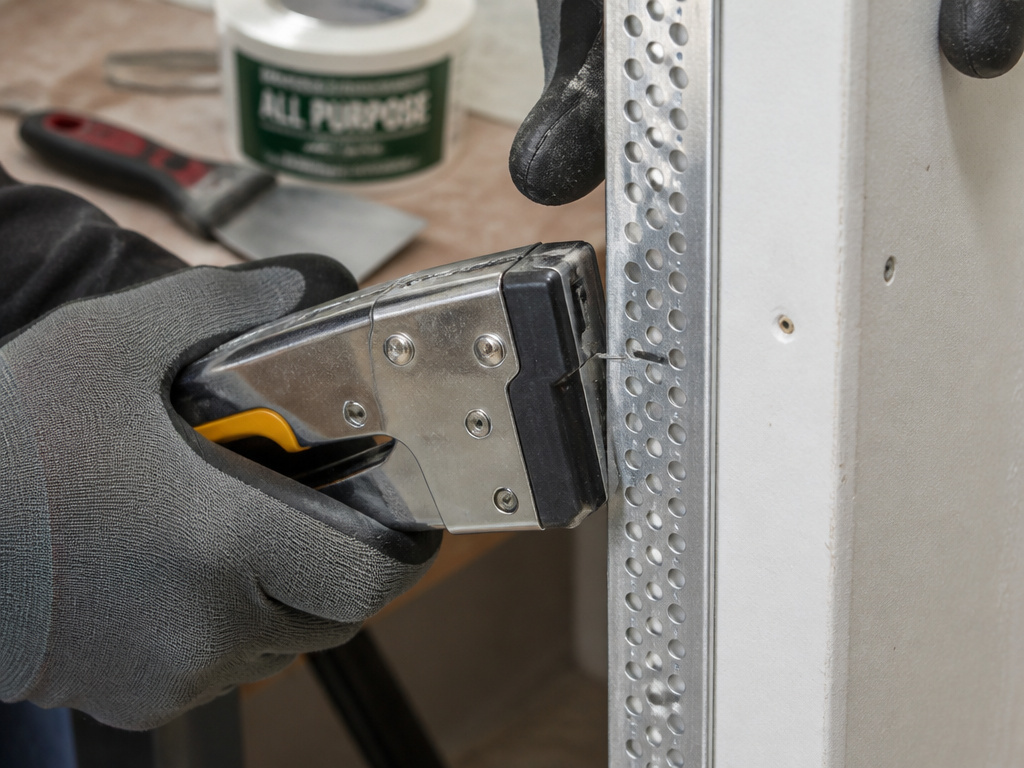
Forget hanging full sheets. In the drywall trade, the staple gun has two legitimate, frequent uses where it’s often the best tool for the job.
1. Securing Metal Corner Bead and Trim
This is the staple gun’s real home in drywall finishing. Metal corner bead (for outside corners) and angle bead (for inside corners) have flanges designed to be fastened flush to the wall before the joint compound is applied. A manual staple gun is perfect for this.
The process is straightforward:
- Hold the bead firmly in the corner.
- Place the staple gun’s nose against the bead’s flange.
- Fire a staple through the metal and into the drywall and stud behind it. The staple’s wide crown holds the thin metal flange flat. You can space staples at appropriate intervals along the bead. The joint compound will completely bury them, leaving a smooth, reinforced corner.
I keep a heavy-duty manual gun loaded with appropriate staples just for this. The control is better than a hammer tacker, and you don’t have to drag an air hose around for a pneumatic model.
2. Temporarily Holding or Pinning
Before the glue dries or before the permanent screws go in, a few well-placed staples can be a huge help. Some pros use them to “tack” a sheet into position on the wall before driving screws, especially when working alone. A couple of staples in the field of the board (away from edges) will hold it flush to the studs while you grab your screwgun.
They’re also useful for securing insulation batts between studs before the drywall goes up, or for attaching vapor barriers. For these non-structural jobs, the staple’s speed is a real advantage. Just remember, it’s a temporary hold, the drywall screws provide the permanent strength.
Hanging Things on Drywall? The Weight Limit Nobody Mentions
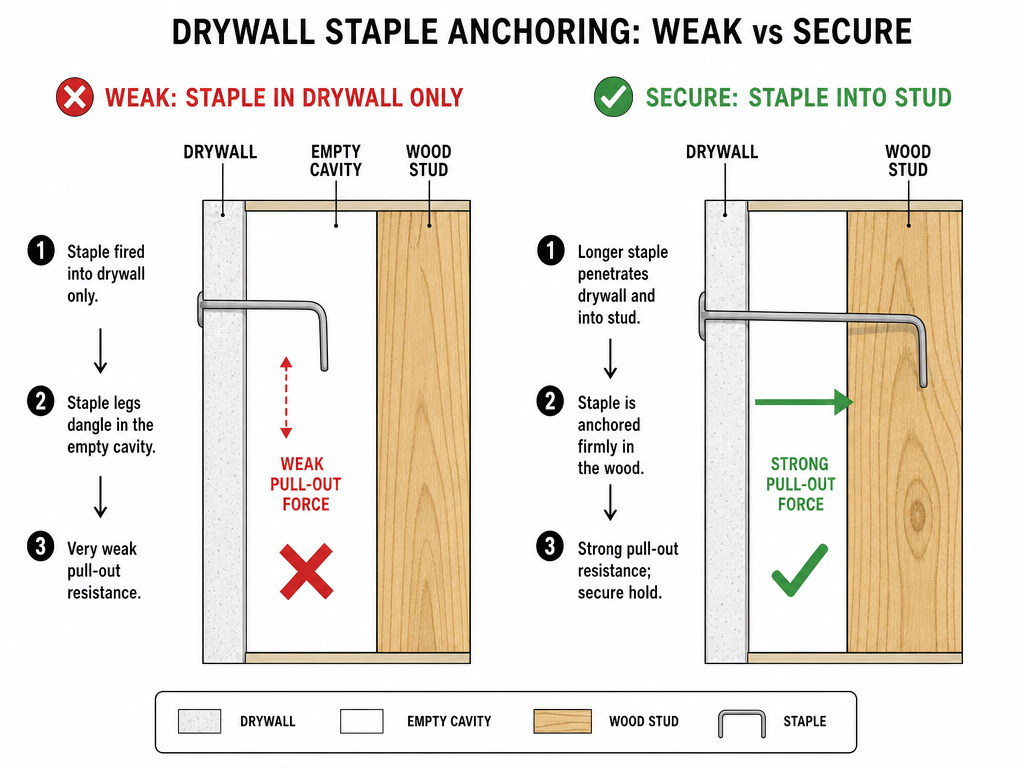
You have a poster, a fabric wall hanging, or a lightweight shelf. Can you just staple it up? Technically, yes. Should you? It depends entirely on what’s behind the wall.
A staple fired only into the drywall itself, with its point dangling in the empty cavity, has very little holding power. You’re relying on the friction of the staple’s legs against the brittle gypsum core. A light tug will pull it straight out, often taking a chunk of the paper face with it.
Where this goes sideways: Stapling a lightweight picture frame directly into drywall. The first time you bump it or the seasonal humidity changes, the staple loosens and the frame slides down the wall, leaving two ugly gashes.
For any object with real weight, think more than a single sheet of paper, you need to hit a stud. A staple long enough to penetrate the drywall and sink at least 5/8 inch into the wood stud can provide some holding power. However, if you’re going to the trouble of finding a stud, a screw may provide greater holding power.
For true hang-on-the-drywall solutions, use a wall anchor designed to spread the load across the back of the drywall. A staple is not. It’s a fastener for through materials, not for hanging from them.
Manual vs. Pneumatic: Which Staple Gun for Drywall Tasks?
If you’re doing corner bead or a small pinning job, you have two main choices: a hand-powered manual gun or a pneumatic gun hooked to an air compressor.
| Gun Type | Best For | Power & Speed | Portability & Setup |
|---|---|---|---|
| Manual Staple Gun | Corner bead, small DIY jobs, insulation. | Moderate power; requires hand strength. Slow but precise. | Excellent. No cords or hoses. Grab and go. |
| Pneumatic Staple Gun | High-volume work (e.g., sheathing, securing underlayment). | High power and speed (over 100 staples/min). Consistent depth. | Poor. Requires a large air compressor and hose, limiting mobility. |
For many drywall-related tasks a DIYer will encounter, such as securing corner bead, a manual staple gun can be a suitable tool. It offers enough power to drive a staple through corner bead and into the stud, and the control to place staples accurately. You won’t be wrestling with a hose or listening to a compressor cycle.
Safety and Damage: What Can Go Wrong
Using any tool carries risk, and a staple gun on drywall has specific pitfalls. The biggest one isn’t the tool itself; it’s what’s hidden behind the wall.
Plaster Walls Are Not Drywall. This distinction is critical. Plaster is a hard, brittle layer over wood or metal lath. A staple gun can easily crack the plaster face, and if it hits the lath, it may not penetrate properly, leaving a wobbly, insecure hold surrounded by a network of cracks. Repairing a staple hole in plaster is a much bigger job than spackling a hole in drywall.
Crushing the Drywall Core. Applying too much pressure or using excessive power can fracture the gypsum core around the staple. This weakens the board’s integrity and makes the fastener less secure. The staple should be driven so the crown bears tightly against the board without fracturing the core or cutting the face paper.
What staple gun should I use for drywall?
Manufacturer specifications don’t recommend specific brand names or models. Instead, they provide the critical technical criteria your tool must meet. The staple gun must be capable of driving 16-gauge staples with a 7/16-inch wide crown. The tool’s power and depth adjustment are crucial, as you must drive the staple so the crown sits tight against the board without cutting the face paper or fracturing the gypsum core. For attaching gypsum panels, you need a tool that can consistently achieve the required penetration into the wood framing, which varies by application. Choose a staple gun robust enough to handle these specific, heavy-duty fasteners.
Is stapling drywall okay for a rental?
Using staples on drywall in a rental property is generally not advisable for minimizing damage. Building codes and manufacturer guidelines typically specify screws or nails for permanent attachment in finished living spaces. Staples are recommended only for specific structural applications, like attaching a base layer in a double-wall system, and are prohibited for the final finish layer. For a rental, the priority is a secure, durable installation that withstands tenant use and allows for standard repair. Staples may not provide equivalent holding power and can complicate future repairs or patching, potentially violating lease agreements that require returning the property to its original condition.
Frequently Asked Questions
Will a staple gun go through drywall?
Yes, a standard manual or pneumatic staple gun will easily penetrate 1/2-inch drywall. The challenge is driving the staple to the correct depth, flush so the crown is tight against the surface without crushing the paper, and ensuring the legs are long enough to hit solid framing if required.
What type of nail gun do you use for drywall?
Can I use a staple gun instead of a nail gun for drywall?
Not for primary attachment. The holding power and code acceptance are not equivalent. A staple gun is suitable for specific tasks like securing corner bead or insulation, but a screwgun or nails are required for actually hanging the drywall panels to the studs in a code-compliant manner.
Is it safe to hammer a nail into drywall?
Yes, it can be done if you know what’s behind the wall and use the correct technique. The safety risk is hitting hidden electrical wires or pipes.
Before You Go
The official specs give you a clear path: 16-gauge, 7/16-inch crown, 5/8-inch penetration. That’s the rule if you’re stapling a base layer or following a manufacturer’s sheathing guide. For the other 99% of drywall work, the screwgun reigns supreme because of code, strength, and universal professional acceptance.
If you take away one thing, let it be this: staples and screws are for different jobs. Use a staple gun for speed on non-structural tasks like corner bead. Use screws for any application where holding power, code compliance, or preventing call-backs matters. And never, ever use a staple to hang something on drywall unless you’ve hit a stud, and even then, a screw is still the better choice.
