
Oil Free vs Oil Lubricated Air Compressor: Key Differences
This post contains affiliate links. As an Amazon Associate, we earn from qualifying purchases.
An oil-free air compressor uses coatings like Teflon or water for lubrication and delivers certified clean air (ISO 8573-1 Class 0), while an oil-lubricated compressor uses oil to cool, seal, and lubricate, offering greater efficiency and durability for general use. For most workshops, an oil-lubricated model with proper filtration is the better value; choose oil-free only if your work in food, pharma, or electronics cannot tolerate any oil contamination risk.
That distinction directly connects the machine under your workbench to the air coming out of your tools, beyond just a spec sheet. The choice between an oil free vs oil lubricated air compressor is critical. Get it wrong, and you’re either wasting money on overkill or risking a ruined paint job.
What follows is a breakdown of the three specs that decide it, air purity, duty cycle, and total cost, plus the one field observation that changes how you hear your shop.
Key Takeaways
- Oil-free compressors carry a 50 to 100% higher initial cost but are mandatory for food, pharmaceutical, and electronics work where air purity is essential.
- For general shop use, an oil-lubricated compressor with a coalescing filter delivers the best balance of power, longevity, and value.
- Energy consumption accounts for up to 90% of a compressor’s total lifetime cost; oil-lubricated models generally run more efficiently, offsetting their maintenance.
- Never assume “oil-free” means maintenance-free; these units require scheduled checks of bearings, seals, and cooling systems.
- The noise difference is physical: oil-lubricated pumps run quieter than comparable oil-free models.
Oil-Free vs. Oil-Lubricated: The Core Differences
Here is a clarification. “Oil-free” doesn’t mean the machine has no lubricant. It means no oil is injected into the compression chamber where your air is squeezed. In a dry-running oil-free screw compressor, the rotors are synchronized by timing gears, and lubrication is handled by permanent coatings or isolated systems. The goal is to eliminate any chance of compressor oil entering your air line.
An oil-lubricated compressor, by contrast, floods the compression chamber with oil. This oil does three jobs at once: it lubricates the moving parts, seals the tiny gaps between rotors or pistons, and, critically, carries heat away.
Properly designed oil-free compressors deliver ISO 8573-1 Class 0 air, certified oil-free. Oil-lubricated compressors with appropriate downstream filtration generally deliver ISO 8573-1 Class 3 air quality (≤ 1 mg/m³ oil).
That ISO standard is your benchmark. Class 0 is true zero oil. Classes 1 through 5 have defined, very low limits. Most industrial shops don’t need Class 0; they need Class 3 or better, which a maintained oil-lubricated compressor with appropriate downstream filtration can hit reliably.
How Air Quality Standards Dictate Your Choice
The ISO 8573-1 standard is the rulebook for compressed air purity, covering particles, water, and oil. For our purposes, the oil classes are what matter.
| ISO 8573-1 Oil Purity Class | Maximum Oil Content | Typical Source |
|---|---|---|
| Class 0 | As specified by user (effectively zero) | Certified oil-free compressors |
| Class 1 | ≤ 0.01 mg/m³ | Oil-lubricated compressor + high-efficiency coalescing filtration |
| Class 2 | ≤ 0.1 mg/m³ | Oil-lubricated compressor + standard filtration |
| Class 3 | ≤ 1 mg/m³ | Standard outlet of a filtered oil-lubricated compressor |
You match the class to your work. If you’re running an impact wrench in an auto shop, Class 3 air from a lubricated compressor is fine. If that same air will touch a semiconductor or a bag of potato chips, it is inadequate and a product recall waiting to happen.
The part nobody mentions: A Class 1 rating (≤ 0.01 mg/m³) is achievable with a well-filtered oil-lubricated system. You only need the premium for a true oil-free (Class 0) compressor if your industry regulations explicitly demand it or the consequence of even trace contamination is catastrophic.
This is where the “oil-free for everything” marketing bumps into reality. For painting, a dedicated filter and dryer on a lubricated compressor line often yields cleaner, drier air than a cheap, hot-running oil-free unit that pumps moisture-laden air into your spray gun.
The Real Cost: Purchase Price vs. Total Ownership
The sticker shock is real. An oil-free compressor carries a price premium of 50 to 100% over an oil-lubricated unit of equivalent capacity. You’re paying for the precision engineering of contact-free compression chambers and the certifications that come with them.
But the purchase price is just the entry fee. Delta Industries Inc. Notes that energy consumption can account for up to 90% of an air compressor’s total life cycle cost. Here’s where the efficiency argument gets nuanced.
Robert Horneman of ELGi states that oil-lubricated compressors run more efficiently because the oil closes the distance between the rotor and the housing, leading to more airflow for less input power. Robert Horneman of ELGi states oil-free compressors run hotter and less efficiently, while Delta Industries Inc. Notes they can minimize downstream filtration and pressure drops, translating to energy savings. However, an oil-free system minimizes downstream filtration and pressure drops, which can also translate to energy savings.
The math only works if you actually need those filtration savings. In a small shop without extensive piping, the inherent efficiency of the oil-lubricated pump usually wins.
Maintenance is the other half of the equation. The story here isn’t as clean as “oil-free means no maintenance.”
- Oil-Lubricated: Requires regular oil changes, plus oil separator and air filter replacements. Sources disagree on the interval: Brabazon cites 4,000 to 8,000 hours, while the Willand Service Centre gives a guideline of every 2000 hours.
- Oil-Free: Eliminates oil changes but introduces other needs. Wright Air specifies they require scheduled inspection and servicing of air filters, cooling systems, gearboxes, bearings, seals, and dryers.
I learned this the hard way overlooking bearing checks on a small oil-free unit. It ran fine until the day it didn’t, the tell was a high-pitched whine that appeared over a week, not a gradual loss of power. The rebuild cost nearly matched the price of the compressor.
Noise, Heat, and Lifespan: The Physical Trade-Offs
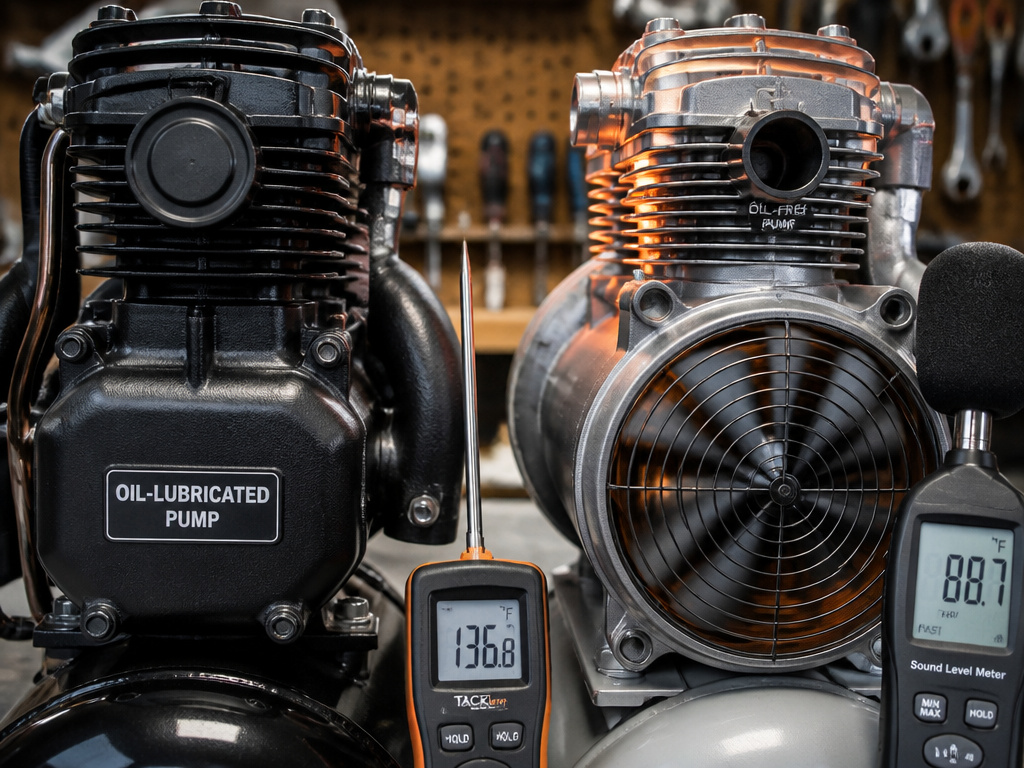
These differences aren’t theoretical; you feel them in your shop. Oil acts as a coolant and a dampener. An oil-lubricated compressor generally produces less noise and heat because the oil lubricates and draws heat away from the compression chamber.
An oil-free compressor has to shed that heat through air cooling alone. You’ll notice it, the cabinet feels warmer to the touch after a long session, and the fan runs more aggressively. This higher operating temperature is a key reason sources like Mark Compressors state oil-free compressors have a shorter lifespan and are not suitable for heavy-duty, continuous applications.
The noise difference is stark. Oil-lubricated compressors generally run quieter, while oil-free models tend to be louder. For a home garage, the significant noise difference can mean the difference between working while your family is home and waiting until they’re out.
| Characteristic | Oil-Lubricated Compressor | Oil-Free Compressor |
|---|---|---|
| Typical Noise Level | Lower | Higher |
| Operating Temperature | Cooler (oil-cooled) | Hotter (air-cooled) |
| Expected Lifespan | Longer (up to 50,000 hrs) | Shorter |
| Duty Cycle Suitability | Excellent for continuous, heavy-duty | Better for intermittent, light-duty |
Which Industries Actually Need Oil-Free Air?
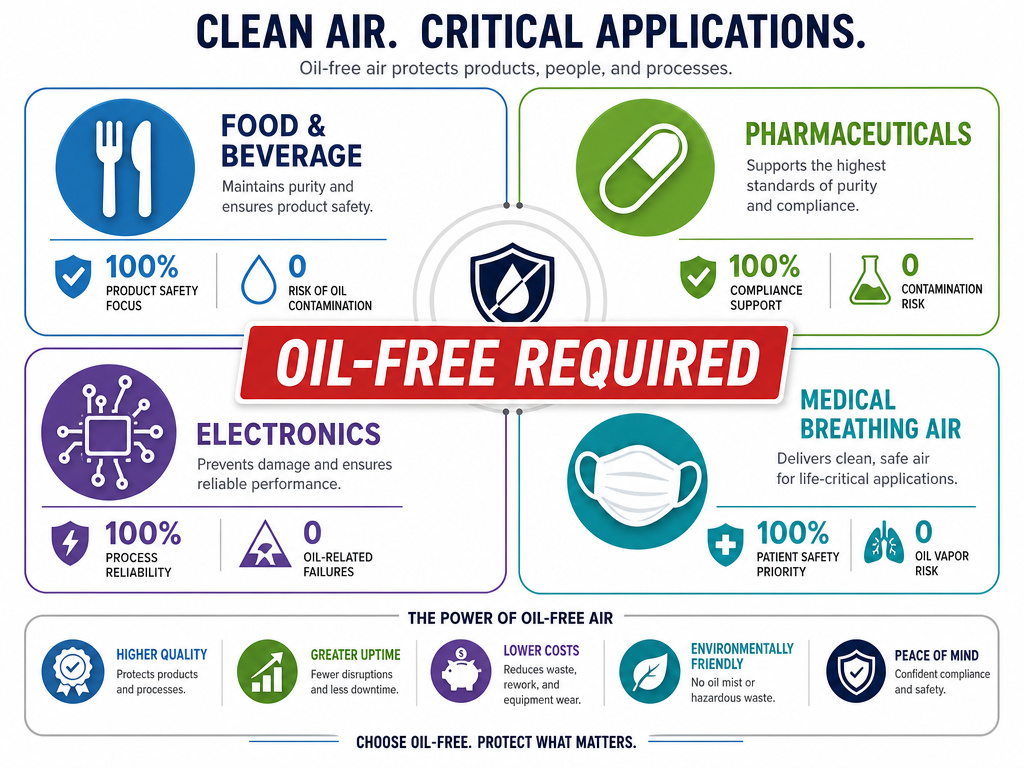
This is the zero-tolerance list. If your work falls here, the debate is over, you need a certified oil-free system.
- Food & Beverage Production: Any compressed air that directly contacts products or packaging.
- Pharmaceutical Manufacturing: GMP regulations require documented, certified oil-free air.
- Electronics & Semiconductor Fabrication: Oil mist can destroy circuit boards and contaminate cleanrooms.
- Medical & Dental Breathing Air: Air used for patient respiration must be contaminant-free.
For everyone else, general manufacturing, automotive shops, woodworking, metal fabrication, an oil-lubricated compressor is not just appropriate; it’s the robust, cost-effective choice. The compressed air simply needs appropriate downstream treatment for the specific tool or process.
Which One Should You Choose for Your Workshop?
Forget the labels for a minute. Your oil free vs oil lubricated air compressor choice boils down to three questions.
- What’s the highest-stakes thing your air will touch? If it’s a brake line, a woodworking project, or a pneumatic nailer, an oil-lubricated compressor is your workhorse. If it’s food, medicine, or a microchip, stop here and get an oil-free unit.
- How many hours will it run each week? For continuous, multi-hour use (like sanding or running an assembly line), the durability and cooling of an oil-lubricated pump are unmatched. For topping off tires or occasional brad nailing, a portable oil-free model’s convenience might win.
- Where will it live? If your compressor sits in a detached garage, noise matters less. If it’s in a shared space or you value a quieter shop, the oil-lubricated advantage is significant.
Common mistake: Sizing a compressor by tank gallons alone. The critical spec is CFM (cubic feet per minute) at the PSI your hungriest tool requires. A small tank with a high-CFM pump is better than a large tank with a weak pump.
My stance for a home shop is clear. I prefer a well-maintained, oil-lubricated compressor for its balance of power and tolerable noise. I install a coalescing filter and automatic drain at the regulator, that’s the underrated step that protects your tools more than the compressor type itself.
For the once-a-month user, a small, portable oil-free compressor is a valid choice. Just know you’re trading longevity and quiet operation for that convenience.
How are oil-free compressors lubricated
Oil-free compressors use alternative methods to lubricate moving parts without letting oil contact the compressed air. Some models use permanent coatings, such as Teflon (PTFE), on components like cylinders or rotors. Other designs use water as the lubricant instead of oil. In screw compressors, timing gears synchronize the rotors, and the compression chamber itself remains dry. The lubrication is handled by these isolated systems or pre-lubricated components, ensuring the air stream stays completely free of oil.
Are oil-free or oil-lubricated compressors more energy efficient
Oil-lubricated compressors generally run more efficiently. The oil seals the gaps between moving parts, like rotors and housings, which leads to more airflow for less input power. The oil also cools the air during compression. Oil-free compressors run hotter and less efficiently because they lack this sealing and cooling oil. However, oil-free models minimize downstream filtration needs and pressure drops, which can save some energy. Since energy costs make up most of a compressor’s lifetime expense, the overall efficiency depends on your specific system setup and air quality requirements.
Environmental impact of oil-free vs oil-lubricated compressors
Oil-free compressors eliminate the risk of oil mist in the exhaust air and prevent potential oil leaks or spills in your facility. This removes a source of soil and water contamination. Oil-lubricated compressors carry a risk of oil getting downstream if filters are not changed regularly, posing contamination issues. However, oil-lubricated units typically have a longer lifespan, which can reduce waste from more frequent replacements. The choice involves weighing the direct pollution risk of oil against the resource use and waste from manufacturing and disposing of the equipment itself.
Frequently Asked Questions
What are the downsides of oil-free air compressors?
They are typically louder, run hotter, have a shorter overall lifespan, and come with a significantly higher purchase price. They also aren’t maintenance-free; they require regular checks of bearings, seals, and cooling systems.
How long do oilless air compressors last?
Lifespan is shorter than oil-lubricated models due to higher operating temperatures and the eventual wear of permanent lubricants like Teflon coatings. They are not designed for the heavy-duty, continuous use that can wear an oil-lubricated compressor to 50,000 hours.
Can you run an oil-free air compressor on its side?
This is one of their practical advantages. Since there’s no oil sump to worry about, oil-free compressors can be operated at angles or on their side without risk of lubricant starvation or leakage, making them more portable for job sites.
Is an oil-free air compressor any good?
They are excellent at their specific job: delivering absolutely oil-free air. For purity-critical applications, they are the only correct choice. For general workshop use, however, an oil-lubricated compressor usually offers better value, efficiency, and durability.
Which type is better for painting?
You need dry, clean air. A high-quality oil-lubricated compressor paired with a dedicated desiccant dryer and particulate filter will outperform a basic oil-free compressor that pumps out hot, moisture-laden air. The key is the air treatment, not necessarily the compressor type.
The Bottom Line
The right oil free vs oil lubricated air compressor choice depends on which one is right for the job on your bench, not on a superior technology.
If your work involves anything on the zero-tolerance contamination list, buy an oil-free compressor and don’t look back. The cost is justified. For many workshops, garages, and job sites, an oil-lubricated compressor is the smarter investment. Its lower noise, better efficiency, and proven longevity translate to a tool that works with you, not against you, for years.
Don’t overthink it. Start with your air quality requirement, be honest about your usage patterns, and budget for the necessary filtration. And whatever you choose, install a moisture trap. That’s the single step that pays off faster than any debate over pump type.
