
10 Best Air Compressor Oil in 2026
This post contains affiliate links. As an Amazon Associate, we earn from qualifying purchases.
Our pick for the best air compressor oil is the Ingersoll Rand All Season Select Synthetic, a genuine OEM fluid offering superior year-round protection for reciprocating compressors. We also recommend Triax Kompressor ISO 100 for high-performance synthetic applications and TriboDyn Tri-Guard 3046 for those seeking the longest possible drain interval.
Choosing the wrong oil can accelerate pump wear and lead to costly repairs. Our research is based on manufacturer specifications, industry guides, and patterns in owner feedback. This guide will help you match the right lubricant to your compressor type and operating conditions.
Top 10 Air Compressor Oils in the Market



Certain content that appears on this site comes from Amazon. This content is provided "as is" and is subject to change or removal at any time.
The Best Air Compressor Oils, Reviewed
Ingersoll Rand All Season Select Synthetic Air Compressor Lubricant
What We Like
- Maintains viscosity in summer heat and winter cold
- Provides four times the life of petroleum oil
- Prevents carbon build-up on valves and rings
- Genuine OEM fluid for Ingersoll Rand compressors
Trade-offs
- One-litre bottle is small for large industrial compressors
- Premium OEM pricing compared to generic synthetic oils
This synthetic lubricant maintains its viscosity across seasons, so you can leave the same oil in your compressor year-round without worrying about winter starts or summer heat. Its service life is four times that of petroleum oil, which means fewer changes, less downtime, and less waste oil to handle over your machine’s lifetime. As the genuine Ingersoll Rand OEM factory fill, it’s formulated for the loads a reciprocating compressor sees, protecting bearings and cylinder walls under continuous duty.
The trade-off is that you’re paying for the Ingersoll Rand name and OEM engineering. This can feel like a premium compared to a universal synthetic. The oil is purpose-built for protecting your reciprocating compressor from carbon deposits and wear. If you have a rotary screw unit, you’d need to step up to Ingersoll Rand’s dedicated rotary screw oil. For the vast majority of piston compressors, this is the comprehensive lubricant that justifies its top-tier status.
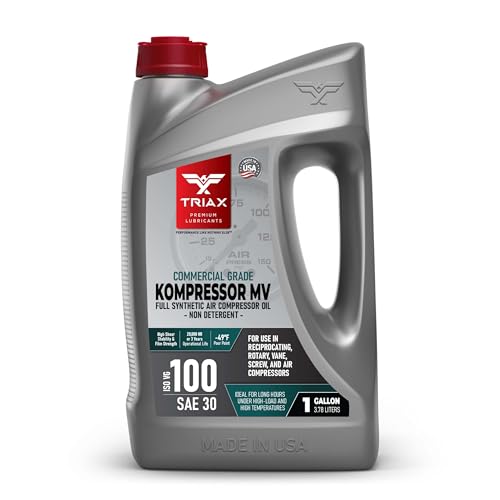
Triax Kompressor ISO 100 Full Synthetic Air Compressor Oil
What We Like
- 1000% higher load capacity than conventional oils
- True multi-viscosity for all-season use
- Reduces operating temperatures by 30%
- Wide compatibility with major compressor brands
Trade-offs
- Not for use in oxygen air or LNG compressors
- Industrial grade may be overkill for light-duty home compressors
An oil that promises over 20,000 hours of service life is built for compressors that run hard and often. This full-synthetic formula is for the shop owner or serious fabricator whose equipment faces extreme temperatures and heavy loads daily. Its multi-viscosity performance means you can set it and forget it, regardless of the season, while the 30% reduction in operating temperature directly translates to less thermal stress and longer component life. This oil is engineered to protect high-value commercial and industrial machinery from premature wear.
This is a full synthetic, industrial-grade fluid designed for severe-duty applications, which means it delivers the high load-bearing capacity and temperature resistance needed for demanding commercial use. Its formulation is explicitly not for use in oxygen air or Liquid Natural Gas compressors, limiting its scope to standard compressed air systems. For operators of rotary, vane, screw, or reciprocating compressors from brands like Ingersoll Rand or Quincy, the oil’s advanced film strength and up to 30% reduction in operating temperatures are key benefits.
Product photos
TriboDyn Tri-Guard 3046 Synthetic Air Compressor Oil
What We Like
- 8,000-hour drain interval cuts maintenance frequency
- Proprietary Tri-Guard technology prevents sludge and varnish
- Rapidly separates from moisture to prevent internal corrosion
- Energy-efficient formulation reduces operating temperatures
Trade-offs
- At 7.5 pounds per gallon, it is heavier than many 1-liter synthetic options
- ISO 46 grade is not suitable for compressors requiring a heavier oil like ISO 100
- The 1-gallon container is bulkier than smaller bottles for infrequent top-ups
An 8,000-hour drain interval means you can run your rotary screw compressor for a full year of continuous operation before even thinking about an oil change. This synthetic is built for shops that hate downtime, actively fighting sludge and rapidly shedding water to protect the air-end. It’s the clear pick for anyone whose compressor is a critical, hard-working asset and who measures value in reduced maintenance hours, not just the sticker on the bottle.
A key advantage is the 8,000-hour extended drain interval, which can cut maintenance frequency in half compared to standard oils that last 4,000 to 6,000 hours. This formulation is engineered specifically for the ISO VG 46 viscosity grade demanded by most industrial rotary screw compressors. The one-gallon jug is substantial, so it requires more storage space and is heavier than smaller bottles like the one-liter Ingersoll Rand All Season Select.
Product photos
Mag 1 Air Compressor Oil

What We Like
- Highly refined petroleum base for classic lubrication.
- Anti-foam agents promote smooth operation.
- One-gallon volume suits frequent compressor users.
Trade-offs
- At 7.2 pounds, a gallon is heavy to pour.
- Petroleum base lacks extreme temperature range of synthetics.
- Basic formula lacks the multi-viscosity of synthetics like Triax.
A gallon of this petroleum-based oil provides enough lubricant for several compressor oil changes, which suits a workshop with regular maintenance needs. Its blend of highly refined base stocks and anti-foam agents aims to create a long-lasting lubricant for smooth operation and extended compressor life. This formulation is designed for consistent lubrication in typical operating conditions.
Its limitation lies in its simplicity. As a conventional petroleum oil, it won’t handle the extreme cold starts or high-temperature demands that a full synthetic can. You’re buying a proven, single-viscosity fluid, not a multi-faceted performance lubricant. For a homeowner’s compressor used in a temperate garage or a shop with consistent conditions, that’s more than enough. Just be ready to maneuver that substantial one-gallon jug when it’s time for a change.
Product photos
Milton High Performance Conventional Air Compressor Oil
What We Like
- High-performance conventional formulation for reciprocating compressors.
- ISO-100 SAE 30W viscosity suits standard operating conditions.
- Non-detergent formula prevents harmful carbon deposit buildup.
Trade-offs
- Conventional oil lacks the extreme temperature tolerance of synthetics.
This one-gallon jug of conventional, non-detergent ISO-100 SAE 30W oil is specified for reciprocating air compressors, making it a direct match for pumps requiring that grade. The Milton formula provides the lubrication called for by many compressor manuals. A gallon container supplies enough oil for several maintenance cycles in a typical workshop or garage compressor.
This oil is a conventional lubricant, not a synthetic. Full synthetics are often formulated for different compressor types, including rotary and screw models. This Milton product is designated specifically for reciprocating air compressors.
Coilhose Pneumatics Air Tool Lubricant

What We Like
- Flip-top cap enables precise direct application
- Formulated specifically to prolong air tool life
- Non-corrosive and stable, won't decompose
- Can be applied via standard air line lubricator
Trade-offs
- 16-ounce capacity is small for large compressor reservoirs
- Tool-focused design lacks viscosity grade for compressor selection
This lubricant is specially formulated for air tools and pneumatic accessories, which means it’s built to protect the valves, vanes, and motors inside your impact wrenches and nailers from wear. The convenient flip-top cap lets you put a few drops directly into the tool’s inlet, a straightforward solution for workshop maintenance. It’s a sensible pick for anyone who wants to keep their air tools running smoothly and rust-free with a no-fuss product.
Coilhose Pneumatics Air Tool Lubricant is specially formulated for air tools, cylinders, and pneumatic accessories, which means its primary job is maintaining equipment downstream from the compressor. It comes in a 16-ounce bottle and can be applied directly into a tool’s in-port or through a line lubricator. The product is non-detergent and inhibits rust, helping to prolong the life of the components it’s designed for.
Product photos
Ingersoll Rand Ultra Coolant Rotary Screw Compressor Oil
What We Like
- Extends oil change intervals up to eight times over conventional oils
- High flash point enhances operational safety
- Non-foaming formula reduces oil carryover to air lines
- Higher thermal conductivity lowers operating temperatures
Trade-offs
- At 11 pounds, it's a heavy single container for small top-ups
- OEM formulation is not a universal substitute for all compressors
- Premium product compared to general-purpose synthetic oils
A synthetic oil engineered for 8,000 hours of run time drastically cuts maintenance frequency for heavy-use shops. That’s the core promise of this Ingersoll Rand coolant. It’s backed by a non-foaming formula that keeps oil out of your air lines. Its thermal conductivity also pulls heat away faster than comparable synthetics. This makes it the logical choice for anyone running an Ingersoll Rand rotary screw compressor hard, as it’s the genuine OEM fluid designed to protect that specific investment over the long haul.
This oil is engineered specifically for Ingersoll Rand rotary screw compressors, which means it’s not a universal fluid for a typical garage reciprocating unit. The formula is a genuine OEM part designed around those systems, so it protects the airend and preserves efficiency over the compressor’s life. While a product like the Triax Kompressor is listed for rotary, vane, screw, and reciprocal types, this one targets a narrower application with features like varnish-free operation.
Campbell Hausfeld Air Compressor Oil

What We Like
- Reduces valve carbon build-up for longer life.
- Single viscosity 30 weight simplifies selection.
- Non-detergent formula is correct for many compressors.
- Compact 16 oz bottle is convenient for small top-ups.
Trade-offs
- 16 oz capacity is insufficient for large initial fills.
- Single viscosity lacks multi-grade temperature versatility.
The 16-ounce bottle makes this a straightforward choice for topping off a standard pancake or hot-dog compressor. It’s a simple, single-viscosity 30-weight oil, so you don’t need to fuss over multi-grade ratings, and its non-detergent formulation is precisely what most homeowner-grade reciprocating compressors require. This is the oil you grab when you just need to keep a trusted, simple machine running smoothly without overcomplicating things.
This 16-ounce bottle is designed for routine top-offs, not for filling a large compressor from empty. Its single-viscosity 30-weight formula is a non-detergent oil, which helps reduce carbon buildup on valves to prolong compressor life. Compared to multi-viscosity synthetics, it is not formulated for the same range of operating temperatures.
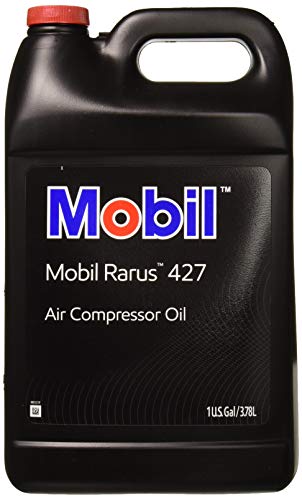
Mobil Rarus 427 Compressor Oil
What We Like
- Manufactured in the United States.
- One-gallon container suits high-volume users.
Trade-offs
- Weight is 7.7 pounds, heavier than some one-gallon competitors.
- Product listing lacks viscosity and synthetic/conventional specification.
This one-gallon jug of Mobil Rarus 427 is a heavyweight, both in its 7.7-pound physical form and its brand heritage. It’s a straightforward, American-made lubricant designed for the compressors powering motorcycles, ATVs, and other powersports equipment where the manufacturer calls for a dedicated compressor oil. You’re getting a purpose-built fluid from a major lubricant company, packaged in a size meant for serious workshop use rather than occasional top-offs.
The limitation is in the details, or the lack of them. If you need a fully synthetic, multi-viscosity oil with explicitly stated high-temperature performance, you’d look at a product designed for that purpose.
Milton Premium Full Synthetic Air Compressor Oil

What We Like
- Full synthetic formula prevents sludge and varnish deposits
- Extreme all-season performance down to -38°C
- Advanced anti-foaming and moisture-displacing formula
- Provides maximum wear, oxidation, and corrosion protection
Trade-offs
- Only for reciprocating compressors, not rotary screw types
Its ability to perform down to -36°F makes this oil a reliable choice for anyone running a compressor in an unheated garage or shed through the winter. The full synthetic base provides maximum protection against wear and oxidation, which translates directly to longer pump life and fewer maintenance headaches. This is the pick for the owner who needs a single oil that works year-round, from a sweltering summer project to a mid-winter tire fill-up, without worrying about viscosity breakdown or cold-weather gelling.
This oil is specifically for oil-lubricated reciprocating compressors, so it’s not suitable for rotary screw units like the Ingersoll Rand Ultra Coolant. The 32-ounce bottle is a practical volume, but its rectangular shape, measuring 12 by 11 by 10 inches, takes up considerable shelf space. The Milton brand also offers a high-performance conventional oil, which is listed among other products.
Product photos
How We Evaluated Air Compressor Oils
We evaluated these products by reviewing manufacturer data sheets, consulting industry maintenance guides, and analyzing common feedback from professional and workshop users. Our primary criteria were the oil’s formulation (synthetic versus conventional), its viscosity and ISO grade, and its specific application suitability for compressor type. A detailed air compressor oil guide can further help demystify these essential choices.
We prioritized oils that offered clear protection against common failures like carbon deposits, varnish, and moisture-related corrosion. For reciprocating compressors, we looked for non-detergent formulas and proper SAE ratings. For rotary screw models, we focused on oils with high thermal stability and extended drain intervals. A thorough air compressor oil change process is just as important as selecting the right lubricant.
A research-based evaluation cannot replicate thousands of hours of real-world runtime. We rely on published specifications and consistent user reports to identify oils that deliver on their promises for pump protection and maintenance intervals.
What To Look For In Air Compressor Oils
Selecting the right oil requires matching the product to your machine’s design and your work environment. The wrong choice can shorten your compressor’s life.
Focus on the oil’s base (synthetic or conventional), its viscosity grade (like ISO 100 or SAE 30), and its compatibility with your compressor type (reciprocating or rotary screw). Always check your owner’s manual first.
Oil Type: Synthetic vs. Conventional
Synthetic oils are chemically engineered for superior performance. They offer extended drain intervals, better resistance to sludge and varnish, and maintain their viscosity across a wider temperature range. This makes them ideal for high-duty-cycle industrial compressors or any machine operating in extreme heat or cold. Conventional petroleum-based oils are a budget-friendly choice for standard reciprocating compressors used in moderate conditions, but they require more frequent changes and lack the advanced protective qualities of synthetics.
Viscosity & ISO Grade
Viscosity refers to an oil’s resistance to flow. An oil that is too thin won’t protect under load, while one that is too thick can cause excessive drag and overheating. Most air compressors specify an ISO viscosity grade, such as ISO 100 (similar to SAE 30) or ISO 46. Using the incorrect viscosity grade can void warranties and damage internal components. Always match the oil grade to your compressor manufacturer’s specification.
Compressor Compatibility
The most critical factor is ensuring the oil is designed for your compressor’s mechanism. Reciprocating (piston) compressors typically require a non-detergent oil to prevent harmful carbon deposits. Many models call for a conventional or synthetic oil with an SAE 30W or ISO 100 rating. Rotary screw compressors run continuously under higher pressure and heat; they demand high-performance synthetic oils with excellent thermal stability and anti-foaming properties. Oil-free compressors, of course, require no lubricant.
- Check your owner’s manual for the manufacturer’s specific oil recommendation.
- For top-ups, use the same oil type and grade already in the system. For a new fill, consider a guide to the best oil-lubricated air compressors if you’re selecting equipment.
When in doubt, the safest choice is the oil brand and type specified by your compressor’s manufacturer.
Air Compressor Oils Compared
The following table compares our top picks side-by-side to help you quickly see the key differences.
| Product | Oil Type | Viscosity Grade | Container Size |
|---|---|---|---|
| Ingersoll Rand All Season Select Synthetic Air Compressor Lubricant | Full synthetic | ISO 100 SAE 30 | 1 litre |
| Triax Kompressor ISO 100 Full Synthetic Air Compressor Oil | Full synthetic | ISO 100 SAE 30 | 1 Gallon |
| TriboDyn Tri-Guard 3046 Synthetic Air Compressor Oil | Synthetic | ISO 46 | 1 Gallon |
| Mag 1 Air Compressor Oil | Petroleum | N/A | 1 Gallon |
| Milton High Performance Conventional Air Compressor Oil | Conventional non-detergent | ISO-100 SAE 30W | 1 Gallon |
| Coilhose Pneumatics Air Tool Lubricant | N/A | N/A | 16-Ounce Bottle |
| Ingersoll Rand Ultra Coolant Rotary Screw Compressor Oil | N/A | 10W-20 | 5 litres |
| Campbell Hausfeld Air Compressor Oil | N/A | 30 weight | 16 oz |
| Mobil Rarus 427 Compressor Oil | N/A | N/A | 1 Gallon |
| Milton Premium Full Synthetic Air Compressor Oil | Full synthetic | ISO-100 | 32 ounces |
Frequently Asked Questions
What is the best oil for air compressors?
The best oil depends entirely on your compressor type and usage. For most workshop owners with a common reciprocating compressor, a non-detergent oil like the Milton High Performance Conventional Air Compressor Oil (ISO-100 SAE 30W) is a reliable, manufacturer-recommended choice. For professional or severe-duty applications, a high-performance synthetic like Triax Kompressor ISO 100 offers superior protection.
Which oil is recommended for an air compressor?
Always follow the recommendation in your compressor’s owner manual. It will specify the required oil type (conventional or synthetic), viscosity (e.g., ISO 100, SAE 30), and whether a non-detergent formula is necessary. Using the wrong oil can lead to increased wear, carbon buildup, and potential warranty issues.
Is synthetic air compressor oil better?
Synthetic oil is generally superior in performance. It provides longer drain intervals, resists breakdown under high heat, and offers better protection across a wide temperature range. For industrial or heavy-use compressors, the long-term savings on maintenance and downtime often justify the higher initial cost compared to conventional oil.
Can I use 10W30 motor oil in my air compressor?
You should not use automotive motor oil in an air compressor. Motor oils contain detergents and additives that can cause foaming and leave harmful deposits on compressor valves and rings. Air compressor oil is specifically formulated without these additives to ensure clean, reliable operation.
What’s the difference between compressor oil and air tool oil?
Compressor oil is designed to lubricate the pump’s internal components (pistons, screws, bearings). Air tool oil is a lighter lubricant formulated for pneumatic tools like nailers and impacts. Do not use air tool oil in your compressor reservoir, as it lacks the necessary viscosity and protective qualities for the pump.
The Bottom Line
For most workshop professionals, the Ingersoll Rand All Season Select Synthetic Air Compressor Lubricant is the best overall choice. It provides genuine OEM protection, works in all seasons, and prevents the carbon buildup that plagues many compressors. If you’re on a tight budget and have a standard-duty compressor, consider the Mag 1 Air Compressor Oil as a reliable conventional option.
For operators of industrial rotary screw compressors seeking maximum uptime, the TriboDyn Tri-Guard 3046 with its 8,000-hour drain interval is the standout pick. Always start your search by checking your compressor’s manual, using the correct oil type and grade is the single most important factor for ensuring a long and reliable service life.
