
1/4 vs 3/8 Air Hose: Which Should You Buy?
This post contains affiliate links. As an Amazon Associate, we earn from qualifying purchases.
The choice between a 1/4-inch and a 3/8-inch air hose comes down to airflow capacity and pressure loss. A 1/4-inch hose is suitable for low-demand tools like nailers and inflators, while a 3/8-inch hose provides more airflow for high-demand tools such as impact wrenches and sanders. The larger diameter minimizes pressure drop over distance, which is critical for maintaining tool power.
That difference in inner diameter at the heart of the 1/4 vs 3/8 air hose choice isn’t just a number on a spec sheet. It dictates whether your impact wrench stalls on a rusty bolt or powers through it. The wrong hose turns your compressor into a bottleneck.
What follows is a breakdown of the specs, a head-to-head comparison of where each size wins, and a straightforward guide to matching the hose to your actual tools and shop layout.
Key Takeaways
- Match the hose inner diameter (ID) to your tool’s air consumption, 1/4-inch for low-flow, 3/8-inch for high-flow.
- Pressure drop is the real enemy; a 50-foot 1/4-inch hose can cause a significant loss of your tool’s power, while a 3/8-inch hose loses far less.
- A 3/8-inch hose is suitable for high-demand tools.
- Hose length multiplies pressure drop; always use the shortest hose that reaches your work.
- Never pair a high-flow tool (e.g., die grinder) with a small-diameter hose; it will starve the tool and overwork the compressor.
The Core Difference: Airflow Capacity & Pressure Drop
Think of your air hose as a highway. A 1/4-inch ID is a single lane. A 3/8-inch ID adds an extra lane. Both can handle traffic, but when a big rig, like an impact wrench needing 20+ CFM, comes through, the single lane causes a jam. That jam is pressure drop.
The inner diameter (ID) of a hose controls the volume of air that can pass through, directly affecting flow rate and pressure. A larger ID provides less resistance, resulting in higher airflow and lower pressure loss over a given length. (Source: Tameson.com)
The math is simple: the cross-sectional area of a 3/8-inch hose is larger than a 1/4-inch hose. This means it can deliver more air, faster, to your tool. When a tool is “air hungry,” a small hose can’t keep up. The pressure at the tool inlet plummets, and torque output falls off a cliff. You hear the tool labor, slowing under load.
I learned this the hard way trying to run a 1/2-inch impact wrench off a 50-foot 1/4-inch poly coil hose. The gun would spin up fine for about two seconds on a rusted lug nut, then just hum impotently. The hose couldn’t deliver the sustained CFM. Swapping to a 3/8-inch hose was the difference between a frustrating hour and a five-minute job.
How Much Power Are You Losing?
We can quantify the problem. While exact figures depend on your compressor output, tool demand, and hose length, the trend is stark. A smaller diameter hose can cause a significant loss of working torque compared to a larger one. Over longer runs, 50 or 100 feet, that loss compounds.
The takeaway from the 1/4 vs 3/8 air hose comparison? For any hose over 25 feet or any tool that grunts under load, step up to 3/8-inch.
Matching Hose Size to Your Tools
This isn’t about brand loyalty; it’s about matching a spec to a job. Your tool’s air consumption rating (in CFM) is its dietary requirement. Feed it poorly, and it performs poorly.
1/4-inch Air Hose: The Specialist
- Best for: Low-CFM tools.
- Tools: Brad nailers, finish nailers, staplers, tire inflators, air brushes, small blowguns.
- Why it works: These tools use short, quick bursts of air. They don’t need a high sustained flow, so the smaller hose’s restriction isn’t a bottleneck. Its lighter weight and greater flexibility are advantages here.
3/8-inch Air Hose: The Workhorse
- Best for: Moderate to High-CFM tools.
- Tools: Impact wrenches, die grinders, sanders (orbital & disc), ratchets, larger drills.
- Why it works: These tools run continuously under load. The 3/8-inch ID delivers the volume they need to maintain power. As Tameson notes, the 3/8 air hose is suitable for high-demand tools due to its ability to provide more airflow.
Common mistake: Using a 1/4-inch hose on a die grinder because it’s handy. The tool will feel weak, overheat from working too hard, and you’ll burn through discs faster. It’s a sure way to shorten the tool’s life.
So, which one should you buy? If your shop sees a mix of tasks, a good 3/8-inch polyurethane hose like a Flexzilla is the single most versatile choice. It’ll run your finish nailer without issue and have the guts for your impact wrench. Buying a 1/4-inch hose as your primary line is a limiting decision.
The 4 Other Factors You Must Weigh
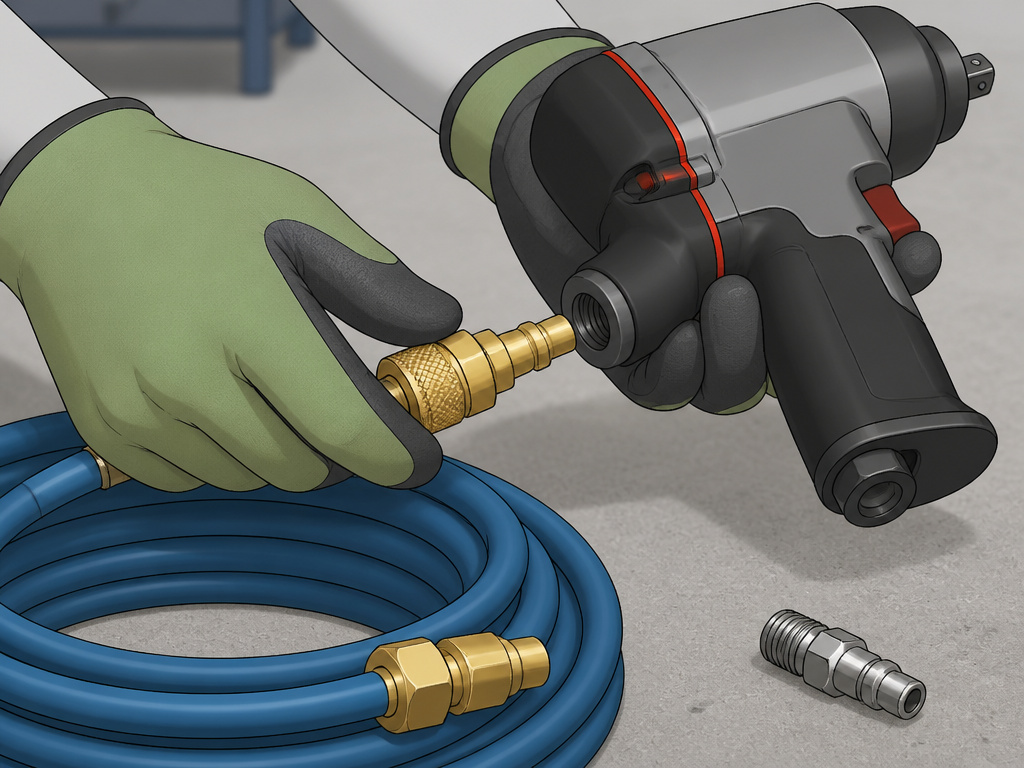
Diameter is the headline, but it’s not the whole story. Ignoring these four aspects can turn even the correctly sized hose into a problem.
1. Hose Length: The Shortest Path Wins
Every foot of hose adds resistance. The guidance from pneumatic suppliers is universal: use the shortest hose that reaches your work. A 50-foot hose coiled at your feet when you’re working 10 feet away is creating 40 feet of unnecessary pressure drop. For fixed workstations, consider installing a dedicated reel or hard-plumbed line with a short whip hose.
2. Material & Construction: More Than Just a Tube
Hoses aren’t all the same rubber. The material dictates handling, durability, and where you can use it.
| Material | Best For | Feel & Handling |
|---|---|---|
| PVC / Vinyl | Light-duty, indoor use; cheapest option. | Stiff, especially in cold; can kink. |
| Rubber | Traditional shop use; good abrasion resistance. | Heavy, durable, less flexible when cold. |
| Polyurethane | Modern shop standard; excellent flexibility. | Light, very flexible, kink-resistant, easy to coil. |
| Hybrid (e.g., Flexzilla) | Best all-around; polymer with nylon braid. | Remains flexible in freezing temps; lies flat. |
The inner layer must resist oils and condensate, while the outer layer needs to withstand sunlight, chemicals, and abrasion. A hose with a nylon braid between layers offers higher pressure ratings and better burst resistance. For most users, a hybrid polymer hose hits the sweet spot of durability, flexibility, and price.
3. Fittings & Couplers: Don’t Create a Bottleneck
You can have a perfect 3/8-inch hose hobbled by tiny, restrictive fittings. This is a rampant shop error. Fittings are specified by their thread size (e.g., 1/4″ NPT) and their orifice size (the hole inside).
Where this goes sideways: Putting a 1/4-inch NPT fitting with a small orifice on a 3/8-inch hose. The air hits a choke point right at the tool, negating the benefit of the larger hose.
Always use high-flow fittings like the Milton V-series. They’re designed with a larger internal passage to match the capacity of your hose. And when connecting different sizes, perhaps a 3/8-inch hose to a tool with a 1/4-inch port, use a full-flow adapter that doesn’t restrict the interior diameter. A guide on air hose fittings has more detail on this critical step.
4. Operating Pressure & Environment
Check your hose’s maximum working pressure (PSI). It must exceed your compressor’s output pressure. Hoses have different pressure ratings, so know the maximum operating pressure of your system. Also, consider your environment. Will the hose live outdoors? Choose a UV-resistant material. Dragging across concrete? Look for good abrasion resistance. Working in a freezer? You need a material like polyurethane that stays flexible in the cold.
1/4 vs 3/8: Head-to-Head Decision Guide
Here is a practical guide. Walk through this checklist when you’re at the store or ordering online.
When to CHOOSE a 1/4-inch Air Hose:
- You work exclusively with small, low-CFM pneumatic tools (nailers, inflators).
- Your hose runs are very short (under 25 feet).
- Maximum portability and minimal weight are your top priorities.
- You’re on a tight budget and your tools align with its limits.
When to CHOOSE a 3/8-inch Air Hose:
- Your tool mix includes any high-demand tool (impact wrench, sander, grinder).
- Your hose runs are 25 feet or longer.
- You want one versatile hose that can handle any tool you own now or later.
- You value maintaining full tool power over slight savings in weight and cost.
The 3/8 air hose is suitable for high-demand tools. It future-proofs your setup. The slight extra cost and marginal increase in stiffness are trivial compared to the frustration of an underpowered tool.
Storage, Durability, and Real-World Longevity
A hose’s life is determined by how you treat it. A 3/8-inch rubber hose is heavy and can be a chore to coil neatly. It tends to develop memory, leaving kinks and loops that trip you. A lightweight polyurethane 3/8-inch hose, on the other hand, coils effortlessly and lies flat.
Never yank a hose by its fitting to move it, that’s the fastest way to rip the fitting from the hose collar. Avoid running over it with vehicles, and keep it away from sharp welding spatter or hot engine parts. Store it out of direct sunlight to prevent the outer layer from cracking and degrading.
When connecting an air hose, use a drop of thread sealant made for air lines (not regular pipe dope) and hand-tighten, then give it a modest quarter-turn with a wrench. A guide on how to connect an air hose to a compressor covers this process. Overtightening brass fittings into aluminum tool ports strips the threads, creating a permanent, annoying leak. I’ve donated enough fittings to the floor gods to learn this.
Filling Tires with a 1/4 vs 3/8 Air Hose
Filling car or truck tires is a low-demand task. For this specific job, a 1/4-inch air hose is generally suitable. Its smaller inner diameter controls the volume of air passing through, which is sufficient for the moderate flow needed to fill a tire. The primary consideration is avoiding unnecessary bulk; a 1/4-inch hose is less cumbersome to handle and store for this routine chore. However, always ensure the hose’s inner material is resistant to any oils or condensate that may be in your air system. For rapid filling of large volumes, like truck or tractor tires, the larger 3/8-inch hose can move more air faster, but for most passenger vehicles, the smaller hose gets the job done efficiently.
Compressor Size and Tank Capacity for Hose Selection
Your air compressor’s output and tank capacity directly influence which hose diameter is practical. A 1/4-inch hose is suitable for low-demand tools and pairs well with smaller, portable compressors that have limited airflow. The inner diameter should be large enough to handle the compressor’s flow rate without causing an excessive pressure drop, which robs your tools of power. For a larger stationary compressor that can run high-demand tools, the 3/8-inch hose is necessary to deliver that greater volume of air. The key is matching the hose’s capacity to your compressor’s capability; a small compressor cannot benefit from a large hose, but a powerful compressor will be strangled by a hose that’s too small.
Frequently Asked Questions
Is a 3/8 air hose better than 1/4?
For most applications, yes. A 3/8-inch hose delivers more airflow with less pressure drop, ensuring your tools receive the air they need to perform. A 1/4-inch hose is only “better” when your priority is absolute minimum weight and flexibility for very low-demand tools.
Can I use 1/4 fittings on a 3/8 hose?
You can, but you shouldn’t unless they are high-flow fittings. Standard 1/4-inch NPT fittings often have a small internal orifice that will choke the airflow, defeating the purpose of the larger hose. If you must adapt, use a full-flow adapter that maintains the largest possible internal diameter throughout.
What size air hose is best for a home garage?
For a general-purpose garage, a 3/8-inch hose is suitable for high-demand tools. It provides the flexibility to run anything from a nail gun to an impact wrench effectively. It’s the right balance of capability and manageability.
How many CFM can flow through a 3/8 air hose?
There’s no single answer, as it depends on pressure and hose length. A 3/8-inch hose provides more airflow for high-demand tools compared to a 1/4-inch hose. For continuous-use industrial tools with higher CFM needs, a 1/2-inch hose may be required.
Is this the same as a pressure washer hose?
No. Absolutely not. Air hoses are designed for compressed air (typically 100-150 PSI). Pressure washer hoses are built for very high-pressure water (1000+ PSI) and are not rated for compressed air. Using an air hose on a pressure washer could result in a catastrophic rupture, and using a pressure washer hose for air is dangerous and likely to fail.
The Bottom Line
Stop overthinking it. Unless you’re a hobbyist who only ever uses a brad nailer, buy a 3/8-inch hose.
The small price and weight premium buy you a crucial margin of performance that you’ll notice the first time you zip off a stubborn bolt or run a sander without it bogging down. Pair it with high-flow fittings, keep it as short as your workspace allows, and coil it properly after use. That’s it.
Your compressor is the heart of your air system, but the hose is its arteries. Don’t clamp them down. Give your tools the air they deserve.
