
Types of Air Hose Fittings Explained: A Selection Guide
This post contains affiliate links. As an Amazon Associate, we earn from qualifying purchases.
Air hose fittings are not universal. In the US, five mechanically incompatible quick-connect families coexist: Industrial (M-style), Automotive (A-style), ARO, Lincoln (T-style), and Tru-Flate (P-style). Matching the style, thread (NPT vs. BSP), and body size to your tool’s CFM demand is the only way to prevent leaks, pressure drop, and tool starvation. A single worn O-ring can drop tool output by 15–20 PSI.
The distinction between thread size and body size is where most people get lost. You can have a 3/8″ NPT thread on a fitting with a 1/4″ body, the thread connects to the port, but the body’s internal bore restricts airflow. That restriction is silent. Your impact wrench just feels weak, so you crank the regulator, overwork the compressor, and blame the tool. For clarity, see our guide on types of air hose fittings explained.
What follows is a map. We’ll break down the five quick-connect families with a visual identification guide, match materials to your shop’s real pressure and cycle life, and walk through a step-by-step process to standardize your air system and kill leaks for good.
Key Takeaways
- The five US quick-connect styles (Industrial, Automotive, ARO, Lincoln, and Tru-Flate) are mechanically incompatible. An A-style plug will not lock into an M-style coupler.
- Match the fitting body size (1/4″ or 3/8″) to your tool’s CFM, not just its thread size. A 1/4″ body flows ~10-14 SCFM; a 3/8″ body flows 25-35+ SCFM.
- Quality brass couplers last for approximately 50,000+ cycles, while zinc die-cast bodies show micro-cracking after approximately 5,000–8,000 cycles.
- Always use PTFE tape on NPT threads clockwise and torque 1/4″ brass fittings to 15–20 ft-lb.
- A single 1/16″ leak at 100 PSI wastes approximately 25 CFM, which can cost hundreds annually in extra compressor runtime.
The Five Families of US Quick-Connect Fittings
This is the single most important section in the guide. Walk into any hardware store and you’ll see a wall of fittings that all look vaguely similar. They are not, a central theme in the types of air hose fittings explained. In the United States, five distinct quick-connect style families exist, and they are largely not interchangeable. This fragmentation is historical, stemming from different manufacturers and industry sectors establishing their own standards decades ago.
The core problem is mechanical incompatibility. The profile of the male plug (the shape of its nose and the placement of its locking groove) must match the internal latch mechanism of the female coupler. Forcing a plug into a mismatched coupler might seem to work for a second, but it won’t seal. You’ll get a massive leak, or worse, the connection will blow apart under pressure.
Where this goes sideways: Assuming all 1/4″ fittings are the same. A 1/4″ NPT thread tells you how it screws into a tool, not which quick-connect family it belongs to. Mixing an ARO plug with an Industrial coupler damages the internal O-ring and sleeve on the first forced connection.
Here is the definitive breakdown. This table is your first stop before buying anything.
| Fitting Style | Also Known As | Max PSI (Typical) | Compatible With | Incompatible With |
|---|---|---|---|---|
| Industrial / M-style | Milton M-style, I/M style | 300 PSI | Industrial (M-style) only | A-style, ARO, T-style, Tru-Flate |
| Automotive / A-style | Milton A-style, Auto style | 300 PSI | Automotive (A-style) only | M-style, ARO, T-style, Tru-Flate |
| ARO style | Ingersoll-Rand ARO | 250 PSI | ARO only | All other US styles |
| Lincoln / T-style | T-style, Lincoln style | 200 PSI | T-style only | All other US styles |
| Tru-Flate / P-style | Tru-Flate, Pacific style | 300 PSI | P-style only | M-style, A-style, ARO, T-style |
Note: “Compatible” means a plug and coupler of the same style will lock and seal. Cross-style adapters exist, but each one is an additional potential leak point. Standardizing your entire shop on one style is the professional move.
How to Identify What You Already Have
Start with the male plug. It’s much easier to identify than the female coupler. Look for a stamp on the side; it may show “M”, “A”, or “ARO”. If not, you need a visual guide.
The most reliable field method is to examine the plug’s tip length and shoulder profile. An Industrial (M-style) plug has a rounded nose with a distinct flat shoulder. An Automotive (A-style) plug has a longer, more tapered nose. Tru-Flate (P-style) plugs look similar to A-style but have a slightly larger collar diameter.
If you’re holding a mystery plug, the best move is to take it to the store and physically test it against known couplers. Don’t guess. A wrong guess means you’re buying two fittings instead of one.
Thread Types: NPT, BSP, and the Costly Mistake
Quick-connect style is only half the battle in the types of air hose fittings explained. The other half is the threaded end that screws into your tool or compressor port. Here, a nearly identical look can be disastrous.
NPT (National Pipe Taper) is the American standard. The threads are tapered, so they create a seal by wedging together, usually with the help of PTFE tape. Common sizes range from 1/8″ NPT for small nailers to 1/2″ NPT for high-volume industrial lines.
BSP (British Standard Pipe) is the European and Asian standard. It comes in two flavors: parallel (BSPP) and tapered (BSPT). They look nearly identical to NPT threads.
Common mistake: Forcing a BSP fitting onto an NPT port. The thread pitches are close, so it might seem to start threading. But the thread angles differ (60° for NPT vs. 55° for BSP). Forcing it damages the sealing taper on both parts permanently. The connection will always leak, and you’ve ruined two fittings.
How do you tell them apart? Use a thread pitch gauge. If you don’t have one, check the tool’s manual or country of origin. Most tools sold in the US use NPT. If you’re buying an imported pneumatic device, assume BSP until proven otherwise. This is a primary reason to check the manual before you wrench anything on.
Fitting Body Size vs. Thread Size: The Silent Tool Killer
This is the concept that separates a functioning air system from a high-performing one. They are independent variables.
- Thread Size (e.g., 1/4″ NPT): This is the diameter and type of the threads that screw into your tool’s port. It’s about mechanical connection.
- Body Size (e.g., 1/4″ or 3/8″): This refers to the internal bore of the quick-connect fitting itself. It’s about airflow capacity, measured in Standard Cubic Feet per Minute (SCFM).
You can have a fitting with a 3/8″ NPT thread on a 1/4″ body. The large thread will fit your tool’s big port, but the small bore will choke the airflow. Your tool will never reach its rated power.
Here’s the airflow reality, sourced from industry testing:
- A 1/4″ quick-connect body flows roughly 10–14 SCFM at 90 PSI.
- A 3/8″ industrial body flows 25–35 SCFM.
The rule: Check your tool’s CFM requirement (it’s on the spec sheet or tool housing). Then select a fitting whose body size meets or exceeds that number. Don’t just match the thread.
Materials Comparison: Brass vs. Steel vs. Zinc
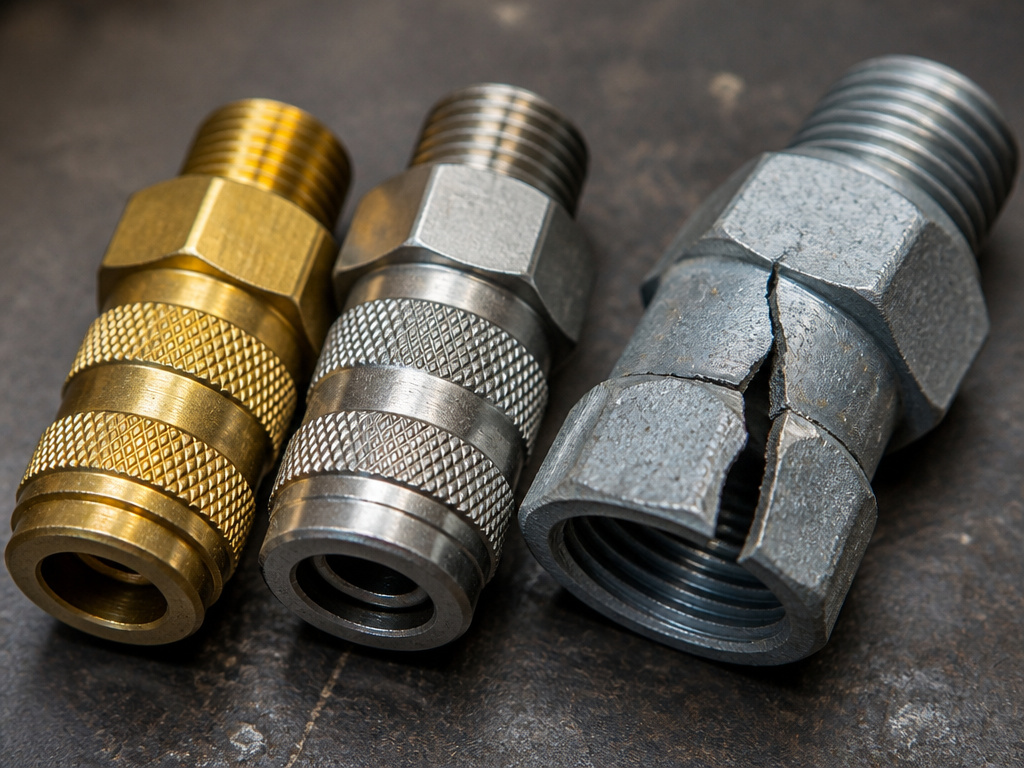
The material determines pressure rating, corrosion resistance, service life, and cost. Choosing based solely on price is how you end up with fittings that fail mid-project.
| Material | Max Working PSI | Cycle Life (Approx.) | Corrosion Resistance | Best For |
|---|---|---|---|---|
| Brass | 200–300 PSI | 50,000+ cycles | Excellent | Auto shops, general industry, humid environments |
| Steel (Plated) | 300–500 PSI | 75,000+ cycles | Moderate | Heavy industrial, high-pressure circuits |
| Stainless Steel | 300–500 PSI | 100,000+ cycles | Outstanding | Food processing, pharmaceuticals, outdoor/humid |
| Zinc Die-Cast | 150–200 PSI | 5,000–8,000 cycles | Poor | Light DIY, occasional use, rental equipment |
To be practical. For 95% of home workshops and professional auto shops, brass is the default. It machines precisely, resists the moisture common in compressed air lines, and offers a great balance of durability and cost. The price is 2-3x that of zinc, but the 10x cycle life makes it cheaper in the long run.
Zinc die-cast fittings are the budget option packed in big-box store kits. They work for inflating tires or running a brad nailer a few times a year. Under the stress of daily professional use, their life is short. Testing shows zinc bodies develop micro-cracking after approximately 5,000–8,000 connect/disconnect cycles. After that, they can fail catastrophically.
A worn O-ring inside a brass quick-connect is a simple, cheap fix. A zinc coupler body that cracks under pressure is a sudden, dangerous failure. Know which one is on your lines.
Other Common Fitting Types and Their Jobs
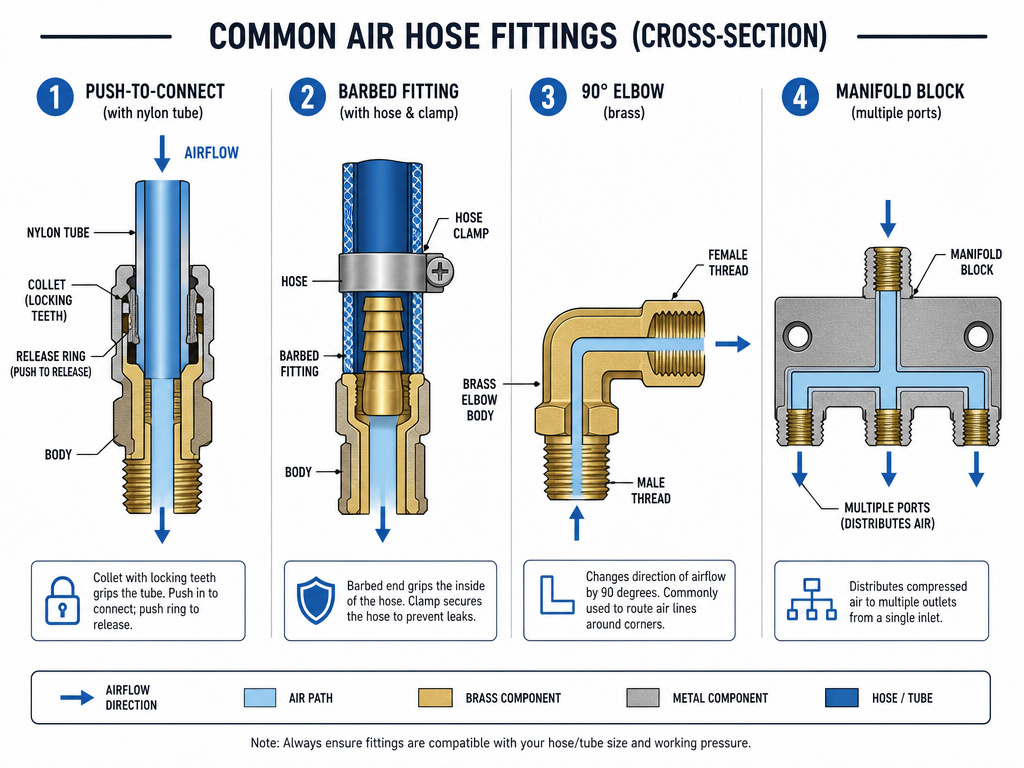
Quick-connects get the spotlight, but your air system needs other players. Here’s what they do.
- Push-to-Connect Fittings: Insert rigid tubing (copper, nylon, polyurethane) and it locks. No tools. Quality brass push-to-connect fittings are typically rated for 150–200 PSI. Don’t use them with standard rubber hose, the hose’s outer diameter tolerance is too loose for a reliable grip.
- Barb Fittings: Ridged shanks that go inside a hose, secured with a clamp. Cheap and simple, but pressure-rated for below 150 PSI. Not for high-cycle tools.
- Elbow & Tee Fittings: Route your air lines. A 90-degree brass elbow at the compressor outlet prevents hose strain and fatigue cracking, a detail most install guides skip.
- Manifold Blocks: For shops running multiple tools. They prevent the pressure drop caused by daisy-chaining quick-connects together.
Choosing the right type is about matching the job. For a permanent shop air line made of copper, push-to-connect or compression fittings are ideal. For a flexible hose to a moving tool, use a barbed end with a clamp rated for pressures below 150 PSI or a properly attached quick-connect coupler. Learn how to connect an air hose to a compressor.
Step-by-Step: Choosing the Right Fitting for Your Tool
Follow this sequence. It turns the wall of options into a simple decision tree.
- Identify the Thread. What size and type is on your tool’s inlet port? For US tools, it’s likely 1/4″ NPT. Measure: 1/4″ NPT male threads are about 0.540″ in outer diameter.
- Check Tool CFM. Find the standard cubic feet per minute requirement at 90 PSI. This data is essential. It’s in the manual or on the tool.
- Select Body Size. If CFM is under 15 SCFM, a 1/4″ body is fine. For 15–35+ SCFM, you need a 3/8″ body.
- Determine Your Shop’s Quick-Connect Style. Look at your existing air hose ends. Use the identification guide above. Standardize on one style, Industrial (M-style) is the broadest professional standard in the US.
- Choose the Material. For general use, pick brass. It’s the workshop standard for a reason.
- Verify Pressure Rating. Your fitting’s max PSI must exceed your compressor’s regulated output by a safe margin (20% is good practice).
This process ensures every link in your air chain is rated for the job. It stops you from creating a bottleneck at the fitting, which is the last place you’d think to look when a tool underperforms.
Leak Troubleshooting and Proper Installation
Air leaks are the silent tax on your compressor’s lifespan and your electricity bill. A single 1/16″ leak at 100 PSI wastes approximately 25 CFM. Your compressor cycles constantly to make up for it.
Here’s a systematic fix.
Find the Leak:
Pressurize your system and close all tools. Listen for hissing. For smaller leaks, spray a soapy water solution on every connection, couplers, NPT threads, hose barbs. Bubbles pinpoint the problem.
Fix NPT Thread Leaks:
- Depressurize and disconnect.
- Clean all old tape or sealant from the male threads.
- Wrap PTFE (Teflon) tape clockwise (viewed from the end) for 2-3 taut wraps. More is not better, it can bunch and cause leaks.
- Screw the fitting in hand-tight, then wrench to the proper torque: 15–20 ft-lb for 1/4″ NPT brass, 20–30 ft-lb for 3/8″ NPT. For a deeper dive on this specific skill, our guide on using thread tape on air fittings walks you through the common pitfalls.
Fix Quick-Connect Leaks:
The culprit is almost always the internal O-ring. Disassemble the coupler (usually by prying out a retaining ring). Inspect the O-ring. If it’s flat, cracked, or has a cut, replace it. Standard O-ring sizes for 1/4″ industrial couplers are #010 or #111 Buna-N. Keep a kit on hand. If the O-ring looks good, the coupler body itself might be worn out, replace the whole unit. For persistent issues, our article on fixing a leaking air hose fitting has more detailed diagnostics.
Safety and Compliance Notes
This is the code.
OSHA Standard 29 CFR 1910.169 has two rules that directly affect fitting choice:
- Air lines used for cleaning (e.g., with a blowgun) must not exceed 30 PSI at the nozzle.
- All air hose connections used above 30 PSI must have positive-locking devices (which proper quick-connects are) to prevent accidental disconnection.
ISO 4414 “safety” couplings use a two-stage release that vents air before disconnection, preventing dangerous hose whip. While not yet universal in the US, they represent the direction of the industry for a reason.
The takeaway: Use fittings rated for your pressure, inspect them (check O-rings every six months in professional use), and never bypass safety features. Your air compressor hoses and fittings are a pressurized system. For more on hoses, see our guide to the best air compressor hoses. Treat them with the same respect you give to the compressor itself.
How to Identify and Measure Fitting Thread Size
NPT (American) and BSP (British) threads look nearly identical but are not compatible. Forcing them together damages the sealing taper on both parts. To identify them, you need to measure the thread’s outside diameter. For example, a 1/4″ NPT male thread measures approximately 0.540″ OD, while a 3/8″ NPT measures about 0.675″ OD. Use a caliper for accuracy. Remember that the nominal size (like 1/4″) refers to the pipe’s approximate inner diameter, not the threads you measure. European fittings may use DN (nominal diameter) for size notation. Always verify the thread standard before making a connection to avoid leaks and damage.
Frequently Asked Questions
Are all air compressor hose fittings universal?
No. This is the most persistent and costly misconception. The five major US quick-connect styles (Industrial, Automotive, ARO, Lincoln, Tru-Flate) are mechanically incompatible. A plug from one style will not lock or seal in a coupler from another. NPT thread sizes are standardized, but the quick-connect geometry is not.
What size air fitting do I need for a 1/2″ impact wrench?
You need a minimum 3/8″ body quick-connect fitting with a corresponding 3/8″ inner diameter air hose. Most 1/2″ impacts have a CFM demand that often requires a 3/8″ body, which a 1/4″ body will restrict. Match the body size to the CFM, not the tool’s physical size or thread.
How do I stop my air fittings from leaking?
For NPT threads: clean, reapply 2-3 wraps of PTFE tape clockwise, and torque properly. For quick-connects: replace the internal O-ring (size #010 or #111 for 1/4″ industrial). For barbed fittings: ensure the hose is fully seated and the clamp is tight. Never exceed the fitting’s pressure rating.
What is the difference between NPT and BSP fittings?
NPT (National Pipe Taper) is the US standard with a 60° thread angle. BSP (British Standard Pipe) is the European/Asian standard with a 55° angle. They look similar but are not compatible. Forcing them together damages the threads and ruins the seal.
Can I use push-to-connect fittings with rubber air hose?
No. Quality brass push-to-connect fittings are rated for use with rigid copper tube, nylon tubing, and polyurethane air line. The outer diameter tolerance of standard rubber hose is too loose for the collet to grip reliably, leading to leaks and blow-offs.
The Bottom Line
Fittings are the punctuation in your air system’s sentence, get them wrong, and the whole meaning falls apart. The rule isn’t complicated: identify your quick-connect style, match the body size to your tool’s CFM hunger, and buy brass. That trio handles 90% of shop setups.
The one spec to never ignore is the fitting’s body size. It’s the difference between a tool that works and a tool that works well. A 3/8″ body on a high-demand tool is not an upgrade; it’s the minimum. If you’re building a new system, standardize on Industrial (M-style) couplers and don’t look back. It’s the closest thing to a universal professional standard in the US.
Finally, listen to your system. A faint hiss isn’t background noise; it’s money leaving the tank. A 15 PSI drop at the tool isn’t a weak compressor; it’s probably a worn O-ring you can replace for cents. Your fittings are control points. Treat them that way.
